.webp)





.webp)
GEO
Calculating...
Aug 2026
Structured Data and Schema for AI Answers
Does schema markup help you get cited by AI? What the evidence shows, where structured data still matters, and the schema worth adding for B2B SaaS.

Structured data helps AI understand who you are, but it does not directly make AI cite you. The evidence is clear: adding schema markup produces no measurable lift in AI citations. It's still worth using for rich results and entity clarity, so treat it as cheap infrastructure rather than the thing that gets you recommended.
Does schema markup help you get cited by AI?
Not directly, and the best evidence we have says the lift is roughly zero. Schema markup is worth having for other reasons, but if you're adding it purely to get cited by ChatGPT or AI Overviews, the data doesn't back that bet.
The correlation everyone quotes
You've seen the stat on a LinkedIn carousel: pages cited by AI are far more likely to have schema. Ahrefs found AI-cited pages were almost three times more likely to carry JSON-LD, and 53% of cited pages run schema. It looks like proof, and it isn't.
The reason it's seductive is that the number is real, it just doesn't mean what it seems to. Schema tends to live on sites that also publish stronger content, earn more links and maintain their pages, and those are the things that get a page cited. The markup is a passenger, not the driver.
The causation test
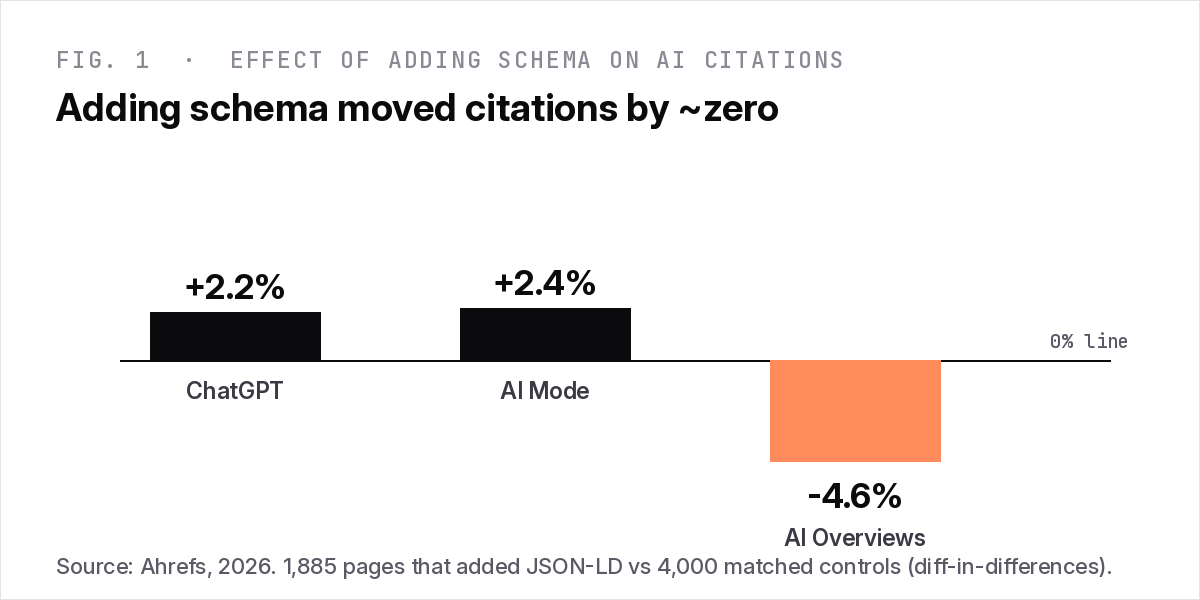
Correlation is not cause, so Ahrefs ran the study that actually answers the question. They tracked 1,885 pages that added JSON-LD, matched them against 4,000 control pages, and measured citation changes across the major platforms. The result was a shrug.
Four separate tests pointed the same way. The honest summary from the people who ran it is worth pinning up.
What AI actually reads
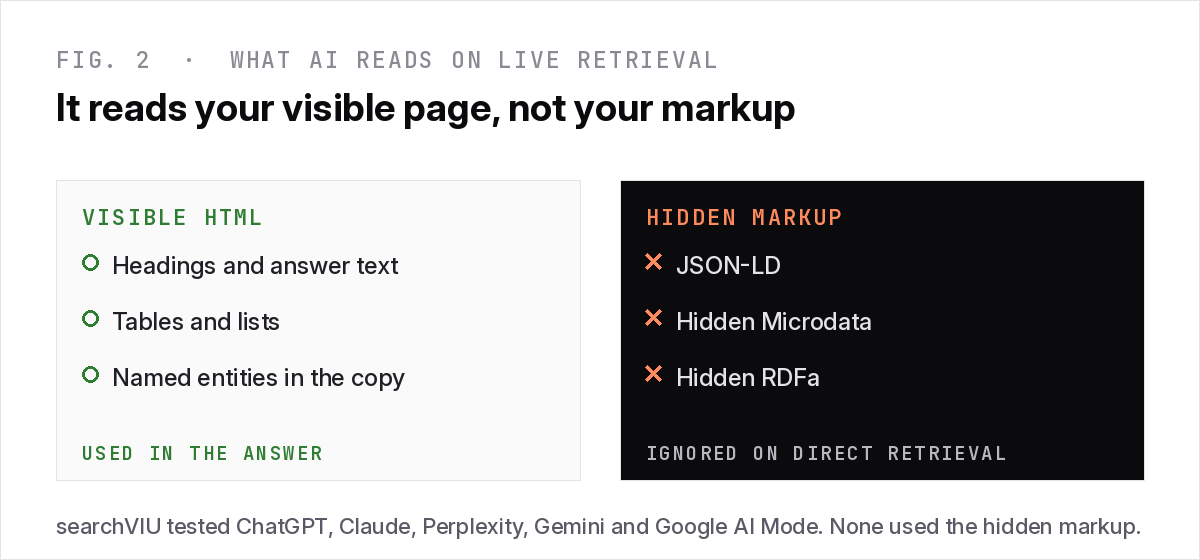
Here's the part that surprises people. When these systems fetch a page live, they read what's visible, not what's buried in your markup.
So is schema pointless for AI?
No, and this is where the hot takes get it wrong in the other direction. Schema doesn't buy citations, but it does real work as infrastructure, and there's one scenario where it may genuinely help visibility.
Where it still earns its keep
Structured data still powers rich results in traditional search, feeds knowledge graphs and voice assistants, and helps machines resolve who you are. That entity clarity matters more as answers get personalised, even if it isn't a direct citation lever. Ahrefs is explicit that there are many good reasons to use JSON-LD, just not this one.
Search Engine Land's balanced take on schema in AI search without the hype lands in the same place: it's foundational plumbing that reduces ambiguity, not a switch you flip for visibility. That's a less exciting story than the carousels, and it's the accurate one.
The one place it might move AI
The Ahrefs study looked at pages already being cited heavily. For pages that AI systems can't see at all, schema might still help them get crawled, parsed and understood in the first place. If you're already in the consideration set, schema won't push you higher. If you're invisible, cleaner markup is one of several things worth ruling out.
Our verdict: infrastructure, not a growth hack
Add schema, keep it accurate, and move on. It's cheap insurance that helps entity resolution and traditional results, and it does no harm. What it won't do is get a page recommended that wasn't going to be recommended anyway, so don't let a schema project crowd out the work that actually moves the needle.
What actually gets you cited instead
If schema isn't the lever, what is? The same three things we come back to across this hub: extractable content, entity clarity, and third-party validation. That's where the marginal hour should go.
Visible, extractable content
Since AI reads the visible page, the structure of that visible content is what counts. Answer-first sections a model can lift beat any amount of hidden markup, which is exactly what we cover in structuring content for answer engines. Our guide to semantic SEO covers this.
Entity clarity and consistency
Name your product, category and competitors in the visible copy, and keep the facts consistent everywhere a model might read them. Schema can reinforce an entity, but it can't invent clarity your page doesn't already have in plain text.
Third-party validation
The strongest citation signal for SaaS lives off your own site: reviews, listicles and comparison content models trust. That's the core of the answer engine optimization playbook, and it does far more than markup ever will. The mechanics of earning those are in our guide to brand mentions.
Line the three up and the priority is obvious. Visible structure and third-party validation are what move citations; schema sits underneath as support. A team that inverts that order, polishing markup while the content stays hard to extract, tends to wonder why the needle won't budge.
The schema worth adding for B2B SaaS
Add the schema that pays off in traditional search and entity resolution, and skip the rest. Here's the short list that's worth the effort, with honest reasons that aren't "AI will cite you."
Organization and Person
Organization and Person markup anchor your brand and your authors as entities, which supports knowledge panels and helps disambiguate you from similarly named companies. This is the highest-value schema for a SaaS brand, and it's set-and-forget.
Product, FAQ and Article
Product or SoftwareApplication, FAQ and Article schema can earn rich results in traditional search and keep your key facts structured. Just don't expect them to change your AI citation rate. For the full implementation walk-through, our guide to schema SEO for SaaS covers the how-to.
Keep it consistent with what's visible
Whatever you mark up must match your visible content exactly. Schema that claims a price or a rating the page doesn't show is a risk, not a shortcut, and it's the fastest way to get structured data ignored or flagged.
How to test schema on your own site
Don't take our word or Ahrefs' word, run the experiment on your own pages. It takes ten pages and a month, and it tells you the truth for your site specifically.
Run the mini-experiment
Pick five to ten pages already getting some AI citations, add JSON-LD to them, and leave another matched five to ten pages untouched as controls. Record baseline citations for both groups, then compare after 30 days. If the treated pages don't outpace the controls, the platform moved, not your schema.
What a fair test looks like
The trap is a simple before-and-after, which just measures whatever the platform was doing that month. You need the control group, and you need to change nothing else on the test pages during the window. Track it in a tool that reports citations, and confirm the result the way you'd confirm any AI visibility change.
Where to go next
Get the schema in once, correctly, then put it out of your mind and work the levers that move citations. Our AEO audit checklist puts schema in its proper place in the sequence, and if you'd rather a team handle the whole program, that's what our B2B SaaS AI search team is for.
Frequently asked questions
Does schema markup help you get cited by AI?
Not directly. A controlled Ahrefs study of 1,885 pages that added JSON-LD found no meaningful change in citations on ChatGPT, Google AI Mode or AI Overviews. Schema helps with rich results and entity clarity, but it is not a lever that gets you cited by AI on its own.
Do LLMs read JSON-LD schema?
Mostly not during live retrieval. A searchVIU experiment found ChatGPT, Claude, Perplexity, Gemini and Google AI Mode all extracted only visible HTML when fetching a page, ignoring hidden JSON-LD, Microdata and RDFa. That's why the structure of your visible content matters more than your markup.
Is schema markup still worth it in 2026?
Yes, just for the right reasons. Structured data powers rich results, feeds knowledge graphs and voice assistants, and anchors your brand as an entity. Treat it as cheap infrastructure that supports traditional search and entity resolution, not as a way to buy AI citations.
What schema should a B2B SaaS company use?
Prioritise Organization and Person markup to anchor your brand and authors, then add Product or SoftwareApplication, FAQ and Article where relevant for rich results. Keep every marked-up value consistent with what's visible on the page, since mismatches get structured data ignored.
Does schema help with Google AI Overviews?
The evidence says no measurable help, and possibly a tiny decline. In the Ahrefs test, pages that added schema saw AI Overview citations move by about −4.6% versus controls, which the authors could not clearly attribute to schema. Focus on content quality and third-party validation instead.
.png)
Latest articles
What we've published in the past 30 days — across SEO, GEO, content, and digital PR.