.webp)





.webp)
GEO
Calculating...
Oct 2026
Agentic SEO: How to Get Your SaaS Found and Recommended by AI Agents
Agentic SEO is how B2B SaaS gets found and recommended by AI agents. See the two meanings, what agents need, and a practical checklist to start.

Agentic SEO is optimising your brand so AI agents can find it, understand it and recommend it when they research on a buyer's behalf. It is the practical craft behind getting picked in agent-led search, and it covers the content, data and evidence an agent reads before it shortlists you. The aim is simple: be the option an agent acts on.
The two meanings of agentic SEO
Search for agentic SEO and you will find two different ideas wearing the same name. It helps to separate them before you spend a budget on either.

Meaning one: agents that do SEO
The first meaning is about automation: using AI agents to run audits, find decaying pages and draft fixes. Ahrefs frames it clearly, and it is a real productivity gain for a busy team.
Meaning two: being chosen by agents
The second meaning is the one that changes your pipeline. It is optimising so that when a buyer's agent researches your category, it finds you, understands you and recommends you. One makes your team faster. The other makes your brand visible to the agents doing the buying.
Our verdict: do the second, borrow from the first
Both are worth doing, but they are not equal in impact. Automating your own SEO saves hours, while being the brand an agent recommends wins deals. We focus this guide on the visibility sense, and use agents to do the work faster where it helps.
For the strategic frame around all of this, see our guide to agentic marketing, which sets the visibility goal that agentic SEO delivers on.
Why the confusion matters
The two meanings pull budgets in different directions. Buy an automation tool expecting more pipeline and you will be disappointed, because faster audits do not make an agent recommend you. Name the outcome you want first, then pick the work. This guide assumes the outcome is visibility, because that is where the revenue is.
What agents need to recommend you
An agent recommends what it can read, compare and trust. Four things decide whether you clear that bar, and none of them is keyword density.

Use-case fit over brand recognition
Precision wins. Semrush found only 7% of buyers notice a vendor in an AI response because they recognise the name, while 53% notice the one that closely matches their use case. Pages that name a specific job beat pages that describe a broad category, because an agent can match the specific one to a brief.
Machine-readable facts
If an agent cannot extract your pricing, specs and claims, it cannot place you in a comparison, so you fall out by default. Clear text and structured data are the fix, which is why our schema and structured data guide is a core part of this work.
Third-party evidence
Agents corroborate before they commit. Reviews, comparison pages and independent mentions are the proof an agent checks against your own claims, and the backbone of MADX's approach in review sites and AI recommendations.
A consistent entity
Say the same thing about yourself everywhere. When your site, your docs and your third-party profiles agree on what you do and who you are for, an agent gets a clean signal. When they conflict, it discounts you or picks the wrong version.
Make it easy, not clever
The instinct to be clever hurts you here. An agent does not reward a witty headline or a dense feature matrix it cannot parse. It rewards a plain sentence that states the fact. When in doubt, write the boring, specific version, because the boring version is the one an agent can quote back to a buyer.
A quick self-test
Here is a test you can run in five minutes. Open your main product page, copy the text an agent would see, and paste it into a chatbot with the prompt "who is this for, what does it cost, and what does it integrate with". If the answer is vague or wrong, an agent researching your category will be vague or wrong about you too. Fix what the test exposes before you spend on anything fancier.
What stopped working
It is worth naming the tactics that no longer move the needle. Keyword-stuffed pages, thin content spun at scale and self-declared superlatives with no proof do little for an agent, because it weighs evidence rather than repetition. If a claim has no source an agent can check, treat it as invisible. The old lever of volume has been replaced by the new lever of verifiability.
A practical agentic SEO checklist
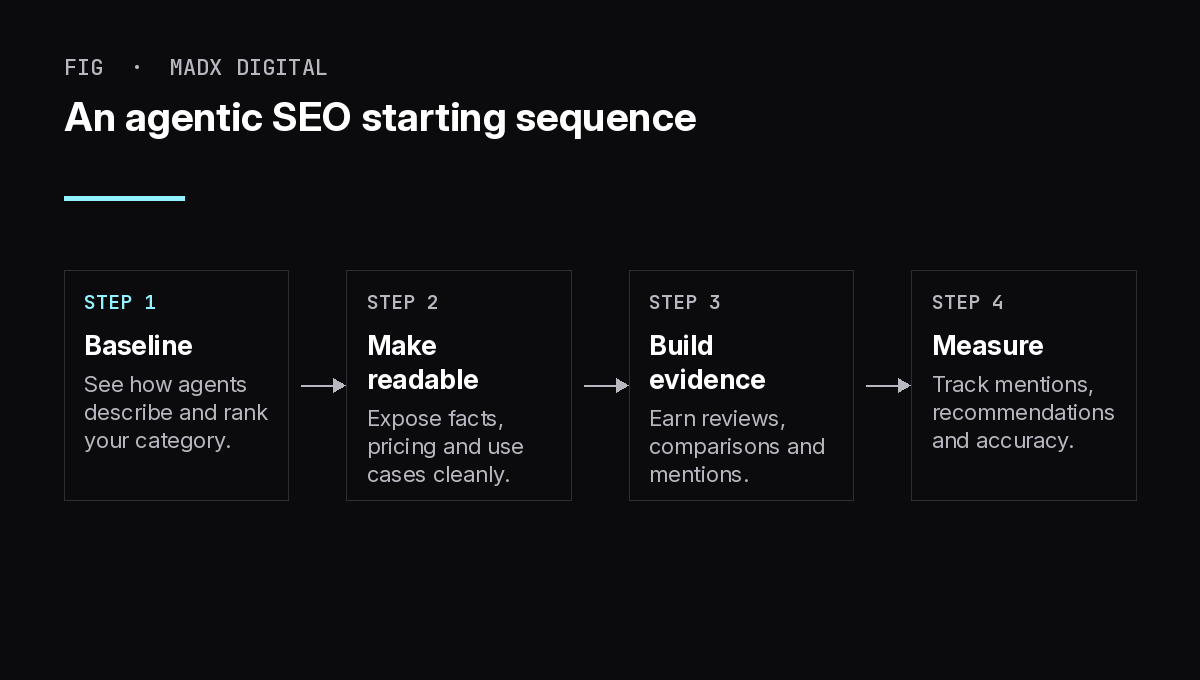
You do not need a new team for this. You need to work three layers in order: see what agents say, fix what they read, then build what they trust.
On-site: make yourself readable
Start with your own pages. Put pricing, plans, integrations and core specs in clean text an agent can lift, write a use-case page for each real job you solve, and add structured data so the facts are unambiguous. This is the layer you fully control, so it moves fastest.
Picture the smallest useful version: a single page titled for one job, stating who it is for, what it replaces, the integrations it supports and a transparent price band. That page gives an agent everything it needs to match you to a brief, which a glossy overview never does.
Off-site: build the evidence
Then earn the proof agents corroborate against: reviews on the platforms your buyers trust, placement in comparison and alternatives content, and independent mentions. This is the slowest layer to grow and the hardest to fake, which is exactly why it carries so much weight. It is also the core of our AI search agency work.
Measurement: track the recommendation
Finally, measure the thing that matters. Not clicks, but whether agents mention and recommend you, and whether they describe you accurately. Our guide to measuring AI search visibility covers the how, and a free AI search audit gives you a fast baseline.
In practice, track four things: how often you appear on your core category prompts, whether you make the recommended shortlist, whether the facts the agent repeats are correct, and how that presence trends against a named competitor. Those four tell you more than any ranking report.
Common mistakes
Three errors show up again and again. Teams gate the facts an agent needs behind a form, they write one broad page instead of several specific ones, and they chase mentions without fixing the on-site facts those mentions point back to. Fix the readable layer first, or the evidence you build has nowhere solid to land.
Who owns this
Agentic SEO sits across teams, which is why it stalls without an owner. Product and marketing hold the readable layer, since pricing and use cases live with them. The content and digital PR team own the evidence layer.
Someone needs to own the measurement, or no one will notice when your recommendation rate moves. Name those owners up front and the work actually ships.
Where agentic SEO fits with GEO and AEO
Agentic SEO does not replace your other acronyms. It extends them. Each layer earns you a different kind of visibility, and they stack.
GEO and AEO are the foundation
Generative engine optimisation gets you into AI answers, and answer engine optimisation structures your content to be lifted. Agentic SEO builds on both, aiming at the recommendation an agent acts on. Start with our guide to ranking in AI search if those foundations are not solid yet.
The mechanisms it depends on
Agentic SEO only makes sense once you understand how agents actually search and buy. Two companion pieces go deeper: how agentic search works and how AI agents build B2B shortlists. And if the generative-versus-agentic distinction is still fuzzy, start with agentic AI vs generative AI.
The order that works
If you want a sequence, run it over a quarter. Weeks one to four, baseline how agents handle your category. Weeks five to eight, fix the readable layer on your own pages.
Weeks nine onward, build the evidence and start tracking your recommendation rate. The order matters because each layer makes the next one pay off faster, and skipping ahead wastes the spend. A review campaign pointing at pages an agent cannot parse is money spent twice.
The honest caveat
Agentic SEO is new, and anyone promising a fixed playbook is guessing. Agents change, platforms shift and the tactics will move with them. What will not change is the principle underneath: be genuinely easy to read, compare and verify, and be worth recommending. Build on that and you are resilient to whatever the agents do next.
Frequently asked questions
What is agentic SEO?
Agentic SEO has two senses. One is using AI agents to automate SEO work. The other, which this guide focuses on, is optimising your content, data and evidence so AI agents discover, understand and recommend your brand when they research for a buyer.
Is agentic SEO the same as GEO or AEO?
No, but they stack. Generative engine optimisation gets you into AI answers and answer engine optimisation structures content to be lifted. Agentic SEO builds on both and targets the recommendation an agent acts on.
How do I optimise for AI agents?
Make your pricing, specs and use cases machine-readable, earn third-party evidence like reviews and comparisons, and keep your facts consistent across the web. Then measure whether agents mention and recommend you, not just whether people click.
Does keyword optimisation still matter for agentic SEO?
Less than it used to. Agents weigh use-case fit and evidence far more than keyword density. Semrush found only 7% of buyers notice a vendor by brand name, while 53% notice the one that matches their use case, so precision and proof beat repetition.
Where should a B2B SaaS team start with agentic SEO?
Work three layers in order: baseline how agents describe your category, make your own pages readable and structured, then build the third-party evidence agents corroborate against. Start the evidence layer early, since it takes longest.
.png)
Latest articles
What we've published in the past 30 days — across SEO, GEO, content, and digital PR.