.webp)




.webp)
SEO
Calculating...
Aug 2026
Semantic SEO: Optimising for Meaning, Not Keywords
Semantic SEO optimises for meaning: entities, intents and passages instead of keyword matching. A practical workflow for search and AI visibility.

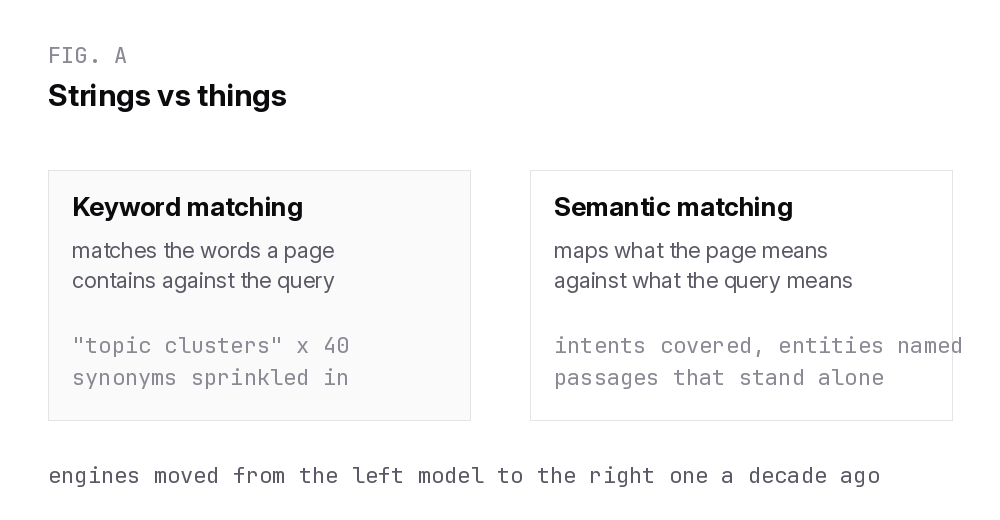
Semantic SEO is the practice of optimising content around meaning rather than keyword strings: covering a topic's full set of intents, naming entities explicitly, and structuring passages so machines can map them to the concepts people search for. It matters because engines stopped matching words years ago and started matching meaning.
Most teams still write for the old system. They pick one keyword, repeat it in headings, sprinkle synonyms and call it optimised. Modern retrieval barely notices any of that, and it shows in the pages that rank instead.
Semantic SEO is the meaning layer of topical authority, and it's the most misunderstood piece of the puzzle. This guide translates the machinery, embeddings, passages and intent coverage, into changes you can actually make to a brief, a draft and a site.
What semantic SEO is
Semantic SEO means writing so that machines understand what your content is about, not just which words it contains. In practice that's three habits: cover the related questions a topic implies, make key terms and entities explicit, and structure content so each passage carries one clear idea.
What it replaces
It replaces keyword-density thinking, the habit of targeting one string and its synonyms. It doesn't replace keyword research. You still need to know what people search and how demand clusters, which is exactly how we planned this hub's topic cluster. The change is what you do with the research: you write to resolve the intent behind the terms, not to repeat the terms.
A useful gut check: if a knowledgeable friend asked you the target query over coffee, would your page's opening paragraph be a good answer out loud? Keyword-optimised pages usually fail that test because they open with throat-clearing built around a phrase. Semantically optimised pages pass it, and machines grade the same way your friend would.
How search became semantic
Search's semantic turn happened in public, in stages: Knowledge Graph in 2012 made entities first-class, Hummingbird in 2013 rewrote matching around meaning, and BERT and MUM brought deep language models into ranking. Each stage moved evaluation further from strings and closer to concepts.
The direction of travel matters more than the acronyms. Hummingbird let Google answer "how tall is the Eiffel Tower" and "height of the tower in Paris" with the same result, because both mean the same thing. BERT let it read function words properly, so "flights to London from Copenhagen" stopped matching pages about the reverse trip. Every update since has widened the gap between meaning what the query means and merely containing its words.
Why synonym stuffing stopped working
Once matching runs on meaning, synonyms are free. The engine already knows that "user onboarding" and "customer onboarding" live in the same neighbourhood, so listing both buys nothing. What isn't free is coverage: a page that explains onboarding benchmarks, tooling and failure modes occupies more semantic territory than one that repeats the term 40 times. Territory is what ranks.
From strings to entities
An entity-aware engine knows that your brand, your category and your competitors are things with attributes and relationships. Content that names those things explicitly gives the engine clean edges to connect, while content built on vague pronouns and marketing abstractions gives it fog. The identity half of this story is covered in our entity SEO guide.
Embeddings and passages, in plain English
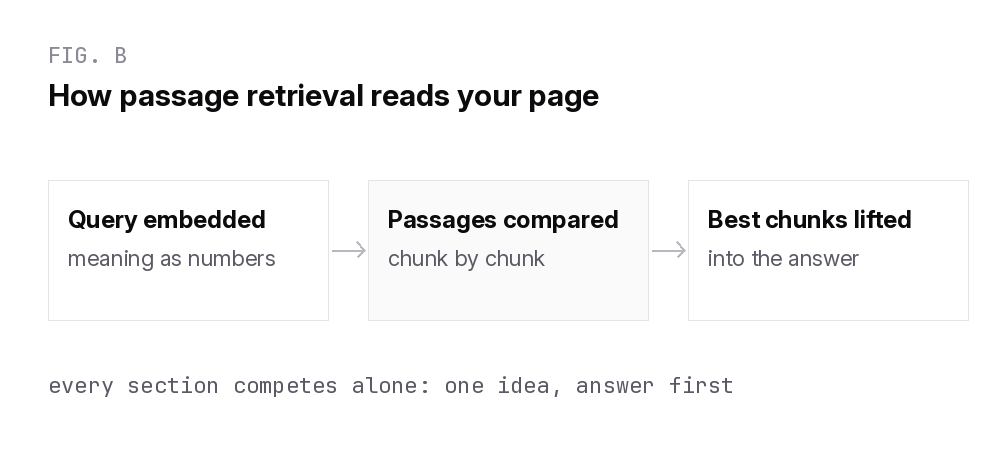
An embedding is a list of numbers representing what a piece of text means, positioned so that similar meanings sit close together. Engines embed queries and content, then measure the distance. The practical part: this now happens at the passage level, not just the page level, so every section of your article is its own candidate for retrieval, judged on its own meaning.
Mike King's team at iPullRank uses the same machinery diagnostically, measuring how far each page sits from the site's overall meaning.
Read that twice, because it cuts both ways. Focused content raises the whole site's relevance for its subject. Off-topic content drags it, which makes pruning a legitimate semantic optimisation, not just housekeeping.
Semantic SEO in practice
The practice fits into the work you already do. It changes what goes in a brief, how a draft is structured, and what you check before publishing. No new deliverables, different standards.
Cover intents, not synonyms
For any target query, list the questions a searcher implicitly carries: what is it, how does it work, how do I do it, what does it cost, what are the alternatives. Cover the ones that belong on the page and link to the ones that deserve their own. That's how one article ranks for hundreds of long-tail variants without targeting any of them individually.
When a topic has a repeatable pattern behind those variants, you can cover it at scale instead of one article at a time, which is the domain of programmatic SEO for B2B SaaS.
Where do the questions come from? People-also-ask boxes, the queries your Search Console already shows for the page's topic, sales call transcripts, and the sub-queries fan-out tools reveal. Fifteen minutes of collection produces a better brief than an hour of keyword-volume sorting, because the questions are the intent, stated in the searcher's own words.
Make meaning explicit
Define key terms in full sentences, name the entities (products, companies, features, standards), and put comparisons in tables where the relationships are unambiguous. This is precisely what Aleyda Solis's AI search checklist prescribes: explicit definitions, criteria, steps and comparisons with entities named. Explicitness feels less clever to write. It reads clearer and retrieves better.
Structure passages to stand alone
One idea per section, an answer in the first sentence, headings phrased as the questions people ask. Since engines extract as little as 13% of a long page under a roughly 2,000-word grounding budget, per Dan Petrovic's research, the passage a machine happens to grab must make sense without the rest of the page. Our pillar page guide applies this at page scale.
Semantic SEO for AI search
Here's the convenient truth: the semantic work that improves rankings is the same work that earns AI citations. There's one discipline, applied to two surfaces.
Chunk-level relevance decides citations
When ChatGPT or AI Overviews, now on roughly 16% to 25% of US queries, assemble an answer, they retrieve passages that match each sub-query's meaning. A semantically clean passage, one idea, explicit terms, self-contained, is simply easier to lift. The formatting side of this is covered in our guide to structuring content for answer engines, and the query mechanics in our piece on query fan-out for B2B SaaS.
The failure mode is a page whose value is spread thin across it. Each individual chunk scores mediocre, no passage wins retrieval, and a worse but tighter competitor gets the citation. We see this constantly with long narrative posts: strong page, weak passages, invisible in AI answers until the sections get restructured.
Both sides of the GEO debate, then a verdict
One camp says AI search demands a brand-new discipline with new rules. The other says it's SEO in a new interface. The evidence leans to the second, and Lily Ray put it plainly after a year of testing.
Our verdict: the fundamentals transfer, and the packaging tightens. Semantic SEO done properly was always extraction-friendly; AI search just raised the price of doing it badly. Google still holds 90.6% of global search share per BrightEdge, and Similarweb data shows 95.3% of ChatGPT users still visit Google, so one meaning-first strategy serving both surfaces isn't a compromise. It's the only sane allocation.
Where semantics meets brand mentions
One nuance for commercial queries: on bottom-of-funnel prompts, the prize is your brand being named in the recommendation, and that's earned largely off your site, in the buyer guides and comparisons models retrieve. Semantic SEO still sets the table, because the language those sources use to describe you comes partly from how clearly you describe yourself. Fuzzy positioning on your own pages becomes fuzzy positioning in everyone else's, and then in the model's answer.
A workflow that holds up
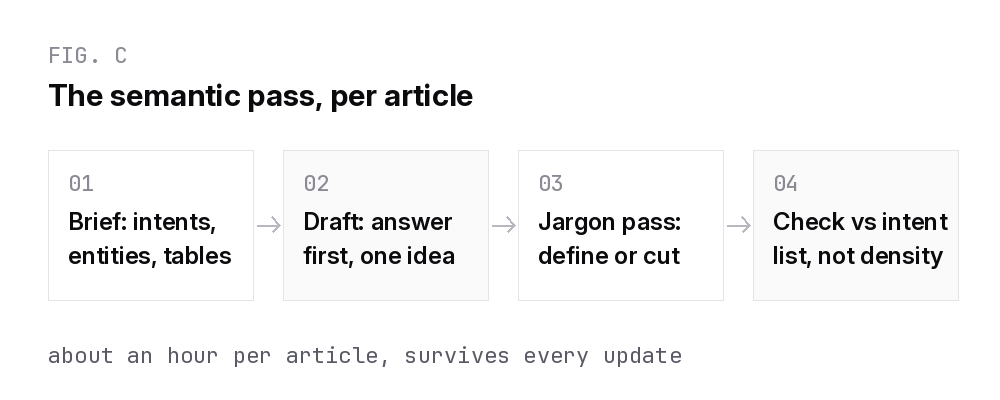
This is the semantic pass we run on every piece we ship, our own included. It adds about an hour per article and survives every algorithm update, because it optimises for the thing updates keep rewarding.
In the brief
List the primary intent and the 5 to 10 related questions the page must resolve. Name the entities that must appear. Specify the table the page needs and the terms it must define. A brief written this way makes semantic quality the default instead of a revision.
In the draft
Answer first, in the opening 40 to 60 words. One idea per section, headings as questions, definitions in prose, comparisons in tables. Then the jargon pass: every term a newcomer wouldn't know gets defined or cut.
Before publishing
Check the page against the intent list, not a density score: every listed question needs a passage that answers it alone. Confirm internal links use anchors that name the destination's topic. Then scan for anything off-topic for the site's core subject, and move it or cut it, remembering the site focus lesson above.
Run the same pass on old content twice a year. Semantic drift is real: categories rename themselves, entities appear and vanish, and a page that meant the right thing in 2024 can miss the 2026 phrasing of the same intent. Refreshing definitions and entities in an existing page is usually cheaper than writing a new one, and it protects the rankings you already earned.
Tools help at the margins: fan-out emulators to see how machines decompose your queries, embedding-based content scores to find thin sections, and the classic SERP read to check intent. But the workflow is the point. If you want it run across a whole library, semantic auditing is part of what our SaaS SEO agency does, and our free AI SEO audit will show you where meaning leaks out of your current pages.
Frequently Asked Questions
What is semantic SEO in simple terms?
Semantic SEO is writing so search engines understand what your content means, not just which words it repeats. That means covering the related questions a topic implies, defining key terms explicitly, naming entities, and structuring each section so it answers one thing clearly.
Is semantic SEO different from keyword SEO?
Yes, in target rather than tooling. Keyword SEO optimises a page for one string and its synonyms. Semantic SEO optimises for the intent behind the string: the full set of questions and concepts the searcher carries. You still do keyword research; you just write to resolve intents instead of repeating terms.
What are semantic keywords?
Semantic keywords are terms conceptually related to your main topic: subtopics, attributes, entities and question phrasings that machines expect a genuinely expert page to mention. They're covered naturally by resolving a topic properly, which is why chasing lists of LSI keywords is the wrong mental model.
Does semantic SEO help with AI search visibility?
Directly. AI assistants retrieve passages whose meaning matches their sub-queries, so semantically clean passages with explicit definitions, named entities and tables get lifted into answers more often. The same structure that improves rankings improves citation odds in ChatGPT and AI Overviews.
How do you write semantically optimised content?
Start the page with a direct answer, give each section one idea with the answer in its first sentence, phrase headings as real questions, define every term a newcomer wouldn't know, and put comparisons in tables. Then check the draft against the intent list from your brief rather than a keyword density score.
What tools help with semantic SEO?
Useful categories: fan-out emulators that show how AI systems decompose queries, embedding-based content scoring that flags thin or off-topic sections, and standard SERP analysis to confirm intent. Tools accelerate the workflow, but the discipline of intent coverage and explicit structure is what actually moves results.
.png)
Latest articles
What we've published in the past 30 days — across SEO, GEO, content, and digital PR.