.webp)




.webp)
GEO
Calculating...
Sep 2026
AI Visibility for B2B SaaS
AI visibility is the leading pipeline metric for B2B SaaS. What to track across ChatGPT, Perplexity and Google AI, and the tools that measure it.

.mx-kt{border:1px solid #E4E4E8;background:#FAFAFB;border-radius:8px;overflow:hidden;margin:0 0 30px;font-family:Inter,sans-serif} .mx-kt .mx-bar{height:5px;background:linear-gradient(90deg,#BCC0C5,#FF929F,#FFAC92,#FFD392,#92FFB0,#92F2FF,#92CAFF,#A192FF,#DC92FF)} .mx-kt .mx-in{padding:22px 26px} .mx-kt .mx-h{margin:0 0 12px;font-size:12px;letter-spacing:.08em;text-transform:uppercase;color:#5A5A66;font-weight:700} .mx-kt ul{margin:0;padding-left:20px;color:#1F1F26;font-size:16px;line-height:1.65} .mx-kt li{margin:8px 0} .mx-toc{border:1px solid #E4E4E8;background:#fff;border-radius:8px;padding:20px 26px;margin:0 0 32px;font-family:Inter,sans-serif} .mx-toc .mx-h{margin:0 0 12px;font-size:12px;letter-spacing:.08em;text-transform:uppercase;color:#5A5A66;font-weight:700} .mx-toc ol{margin:0;padding-left:20px;color:#1F1F26;font-size:16px;line-height:1.9} .mx-toc a{color:#1F1F26;text-decoration:none;border-bottom:1px solid #B8B8C0} .mx-box{border:1px solid #E4E4E8;border-left:3px solid #0B0B0E;background:#FAFAFB;border-radius:6px;padding:20px 24px;margin:26px 0;font-family:Inter,sans-serif;font-size:16px;line-height:1.62;color:#1F1F26} .mx-note{border:1px solid #E4E4E8;border-left:3px solid #5BB8FF;background:#fff;border-radius:6px;padding:20px 24px;margin:26px 0;font-family:Inter,sans-serif;font-size:16px;line-height:1.62;color:#1F1F26} .mx-lab{display:block;font-size:12px;letter-spacing:.08em;text-transform:uppercase;color:#5A5A66;font-weight:700;margin-bottom:8px} .mx-q{border-left:3px solid #0B0B0E;margin:28px 0;padding:4px 0 4px 22px;font-family:Inter,sans-serif} .mx-q p{font-size:20px;line-height:1.5;color:#0B0B0E;font-weight:600;margin:0 0 10px} .mx-q .mx-cite{font-size:14px;color:#5A5A66;font-weight:600} .mx-q .mx-cite a{color:#5A5A66} .mx-tw{width:100%;border-collapse:collapse;margin:24px 0;font-family:Inter,sans-serif;font-size:15px} .mx-tw th{background:#F4F4F6;text-align:left;padding:10px 14px;font-size:11px;letter-spacing:.05em;text-transform:uppercase;color:#5A5A66;border:1px solid #E4E4E8;font-weight:700} .mx-tw td{padding:10px 14px;border:1px solid #E4E4E8;color:#1F1F26;vertical-align:top;line-height:1.5} figure.mx-fig{display:block !important;width:100% !important;max-width:100% !important;margin:30px 0} img.mx-img{display:block !important;width:100% !important;max-width:100% !important;height:auto;border:1px solid #E4E4E8;border-radius:6px} .mx-cap{display:block;font-family:Inter,sans-serif;font-size:13px;color:#5A5A66;margin-top:10px;line-height:1.5}
Key takeaways
- AI visibility is how often, and how favourably, AI answers name your brand on the questions your buyers ask. It's fast becoming the leading indicator of pipeline for B2B SaaS.
- The traffic looks small (AI referrals are around 1% of visits today) but it punches far above its weight, converting several times higher than organic and deciding who makes the shortlist.
- Track presence, recommendation rate, share of voice against competitors, citations and sentiment. A single "are we visible" number hides the picture.
- Watch each surface separately. ChatGPT, Perplexity and Google's AI answers cite different sources, so an average across them tells you very little.
- Tools like Profound, Ahrefs Brand Radar, Peec AI, Semrush and Otterly track this. Start with a fixed buyer-prompt set and watch the trend, not any single answer.
AI visibility is how present and how favourably your brand shows up when AI tools answer your buyers' questions. It covers whether you're mentioned, recommended, cited, and how you're described, across ChatGPT, Perplexity and Google's AI answers. For B2B SaaS it's becoming the metric that predicts pipeline, because the AI answer now decides who gets shortlisted.
What we'll cover
- What is AI visibility and why it's the new KPI
- Is it worth tracking if the traffic is small?
- What to actually track
- Which surfaces to watch
- The tools that track AI visibility
What is AI visibility and why it's the new KPI
AI visibility measures your brand's presence inside AI answers. Where SEO asked "do we rank," AI visibility asks "does the model name us, recommend us, and describe us accurately" on the prompts that matter to buyers.
A quick definition
Think of it as share of voice for the answer era. It rolls up several things: how often you appear, how often you're the recommendation rather than a footnote, which sources the model cites about you, and whether the description is flattering or wrong. That bundle is what we mean by AI visibility.
The traffic looks tiny, the influence is huge
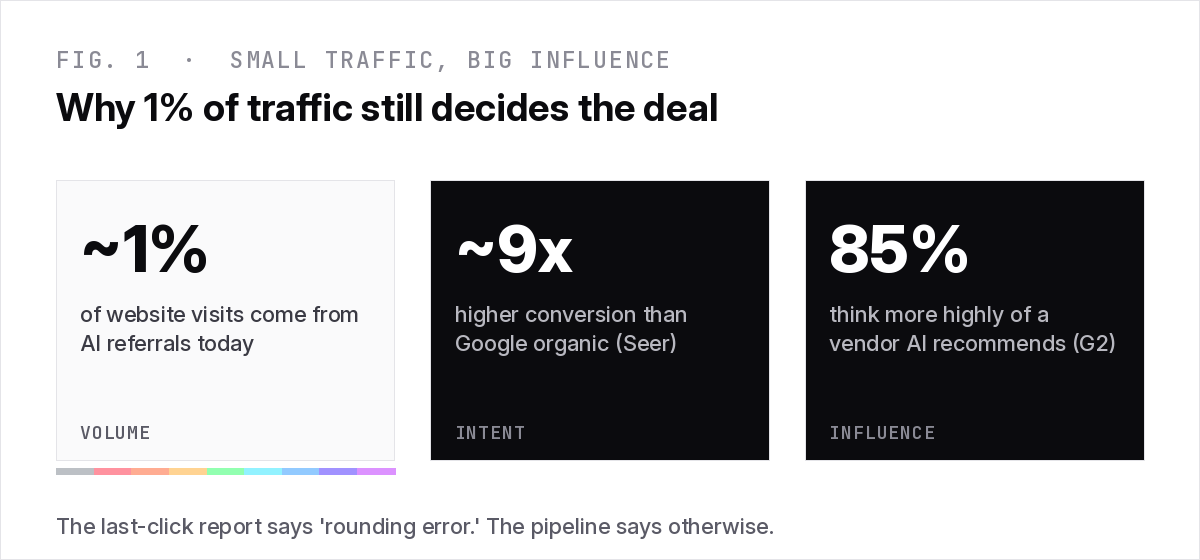
Here's the trap that makes executives dismiss it. AI referrals are still only around 1% of total website visits, so a last-click dashboard makes AI search look like a rounding error. That number badly understates the influence.
The AI answer is where the shortlist gets built. G2 found AI chatbots are now the number one source shaping which vendors get considered, and 85% of buyers think more highly of a vendor an AI recommends. You can be shaping a deal long before anyone clicks through, which is exactly why we treat this as a pillar of answer engine optimization.
"Buyers have moved from reference to inference. Instead of gathering sources and synthesizing the data themselves, they trust AI chatbots to return the shortlist in a single prompt."
Tim Sanders, Chief Innovation Officer at G2, in The Answer Economy (2026)
And the traffic it does send converts
When AI does send a click, it's a good one. Seer Interactive measured ChatGPT referral traffic converting at 15.9%, versus 1.76% for Google organic, roughly a 9x gap, and Semrush data puts AI visitors at about 4.4x the conversion rate of organic across industries. Small volume, high intent. Ignoring it because it's 1% of sessions is like ignoring your best-converting channel because it's new.
Is it worth tracking if the traffic is small?
Yes, but as a leading indicator, not a last-click number. This is where teams split, and both camps have a point, so it's worth being honest about the tension before you build a dashboard.
The skeptic's case
The pushback is fair on its face. AI referral traffic is small, attribution is messy because much of the influence happens with no click, and citations shift run to run. If you demand clean last-click ROI this quarter, AI visibility will disappoint you.
The case for tracking it
The counter is that you're measuring the wrong thing if you only count clicks. AI visibility is a leading indicator: it tells you whether you're in the consideration set before that shows up in pipeline. AirOps' 2026 State of AI Search found only about 30% of brands stay visible across AI answers consistently, so this is still winnable ground.
Our verdict
Track it, and report it as influence, not last-click revenue. Treat share of voice on buyer prompts the way you'd treat pipeline coverage: a forward-looking signal you act on early. The practitioner who framed the shift best is Seer's Nick Haigler.
"Having your brand mentioned in the fan-out query increases your likelihood of being cited in the LLM response and appearing as a citation."
Nick Haigler, R&D Lead at Seer Interactive, in Gemini 3 Query Fan-Outs (2026)
What to actually track
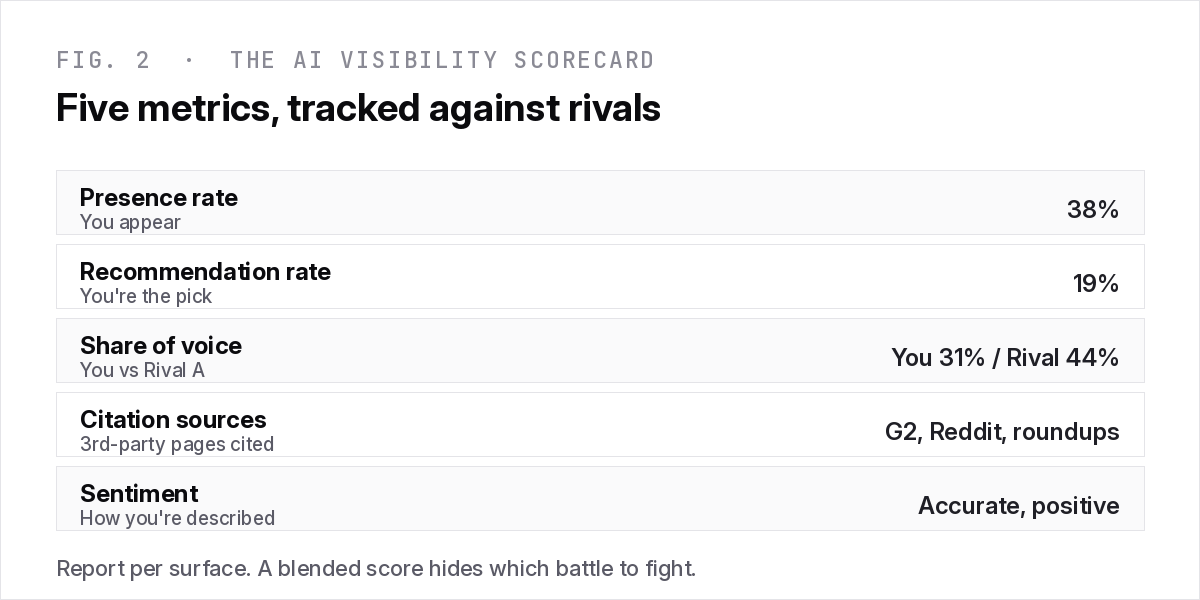
Move past a single "are we visible" score. AI visibility is several distinct metrics, and each one answers a different question about your position in the answer.
MetricWhat it tells youPresence rateShare of your buyer prompts where you appear at allRecommendation rateHow often you're named as a pick, not just a sourceShare of voiceYour presence versus named competitors on the same promptsCitation sourcesWhich third-party pages the model pulls to describe youSentimentWhether the description is accurate and favourable
Presence and recommendation rate
Start with two numbers: what share of your priority prompts mention you at all, and what share actually recommend you. The gap between them is where a lot of SaaS brands lose. Being cited as one of eight sources is not the same as being the tool the buyer is told to try.
Share of voice against competitors
Absolute presence means little without the comparison. If a rival is named on eight of your top ten buyer prompts and you're on three, that gap is the number to move. Share of voice on "best [category]" and "[competitor] alternatives" is the closest thing to a scoreboard AEO has.
Citations and sentiment
Track which sources the model leans on to talk about you, since those third-party pages are your intervention points, and watch how you're described. Earning those mentions is its own discipline, covered in our guide to brand mentions. An AI confidently repeating a stale price or a wrong integration is a visibility problem too, and often a faster fix than earning a new mention. Keeping that description accurate is the job of entity SEO.
A rough benchmarkOn a fixed set of 50 buyer-intent prompts, appearing in more than 20% is a strong position in most B2B SaaS categories in 2026. The median is lower, with many brands showing up in fewer than 10% of the prompts that matter. Set your own baseline first, then chase the trend.
Which surfaces to watch
Watch each answer engine on its own, because they don't agree. The same buyer prompt can name different vendors and cite different sources on ChatGPT, Perplexity and Google, so a blended number hides more than it shows.
ChatGPT and Perplexity
ChatGPT drives the majority of AI referral traffic and leans on a mix of training knowledge and live retrieval. Perplexity is more citation-heavy and search-like. Buyers use both, so both belong in your prompt set, and the sources they cite for you can differ sharply.
Google AI Overviews and AI Mode
Google's AI surfaces pull from the live index and use query fan-out, which we break down in our fan-out guide. They tend to reward pages that already rank well and cover a topic in depth, so your traditional SEO position feeds your visibility here more than on ChatGPT. Structuring how engines connect your brand to its category is the aim of knowledge graph optimization.
Don't average across surfaces
The mistake we see most is one blended "AI visibility" percentage. Report per surface. You might be strong on Perplexity and invisible on ChatGPT, and the fix for each is different, so a single averaged number just hides which battle to fight.
What we see across client workWhen we first pull a client's numbers, the surprise is almost always the spread. A brand can sit at 40% share of voice on Google's AI answers and near zero on ChatGPT, because ChatGPT is leaning on review sites and roundups the brand never appears in. That's not a content problem, it's a placement problem.
The tools that track AI visibility
You can't do this by hand at scale, so use a platform built for it. Several now track brand mentions, recommendations and citations across the major answer engines, differing mostly on coverage and depth.
Profound and Ahrefs Brand Radar
Profound is a dedicated AI-visibility platform with strong prompt and citation analytics. Ahrefs Brand Radar reports AI mentions and the cited pages behind ChatGPT and Perplexity answers, which is useful when your Ahrefs data already lives in one place. Both let you build a prompt set and watch share of voice over time.
Peec AI, Semrush and Otterly
Peec AI and Otterly focus on tracking brand visibility across AI prompts, and Semrush's AI toolkit folds visibility tracking into its wider suite. They differ on which engines and regions they cover, so pick based on where your buyers actually research rather than on the longest feature list.
How to start
Build a fixed set of the buyer prompts that decide deals, capture who gets named and cited today, and re-run it monthly. That baseline plus a trend beats any one-off snapshot. For the step-by-step mechanics, our guide to measuring AI search visibility walks through the setup, and the AEO audit checklist puts measurement in sequence with the work that moves it. If you'd rather have a team run the whole thing, that's what our B2B SaaS AI search team does.
For the step-by-step version of this, see our guide to getting your B2B SaaS recommended by AI.
{"@context":"https://schema.org","@type":"Article","headline":"AI Visibility for B2B SaaS","description":"AI visibility is the leading pipeline metric for B2B SaaS. What to track across ChatGPT, Perplexity and Google AI, why it matters, and the tools that measure it.","image":"https://cdn.prod.website-files.com/61754c216e460330e19c7aa7/6a7c1f2d385c47b97e709b37_ai-visibility-b2b-saas-hero.png","datePublished":"2026-08-12","dateModified":"2026-08-12","author":{"@type":"Person","name":"Perry Steward","url":"https://www.madx.digital/author/perry-steward"},"publisher":{"@type":"Organization","name":"MADX Digital","url":"https://www.madx.digital"},"mainEntityOfPage":{"@type":"WebPage","@id":"https://www.madx.digital/learn/ai-visibility-for-b2b-saas"}}
Frequently asked questions
What is AI visibility?
AI visibility is how often and how favourably AI tools name your brand when answering your buyers' questions. It covers whether you're mentioned, recommended, cited and described accurately across ChatGPT, Perplexity and Google's AI answers. Think of it as share of voice for the answer era.
Why does AI visibility matter if AI traffic is small?
Because the influence is far bigger than the click count. AI referrals are around 1% of visits today, but the AI answer decides who makes the shortlist, and the traffic it sends converts several times higher than organic. Treat AI visibility as a leading indicator of pipeline, not a last-click number.
What should I measure for AI visibility?
Track five things: presence rate (where you appear), recommendation rate (where you're the pick), share of voice against competitors, the sources cited about you, and sentiment. A single "are we visible" percentage hides which of these is actually holding you back.
What is a good AI visibility score?
On a fixed set of 50 buyer-intent prompts, appearing in more than 20% is a strong position for most B2B SaaS categories in 2026. The median is lower, with many brands showing up in under 10% of relevant prompts. Set your own baseline first, then work the trend.
What tools track AI visibility?
Profound, Ahrefs Brand Radar, Peec AI, Semrush and Otterly all track brand mentions, recommendations and citations across the major answer engines. They differ on which engines and regions they cover, so choose based on where your buyers research rather than on feature count.
.png)
Latest articles
What we've published in the past 30 days — across SEO, GEO, content, and digital PR.