.webp)





.webp)
GEO
Calculating...
Aug 2026
The B2B SaaS AEO Audit Checklist
A sequenced answer engine optimization audit for B2B SaaS: baseline your prompts, fix the foundation, make content extractable, then earn off-site mentions.

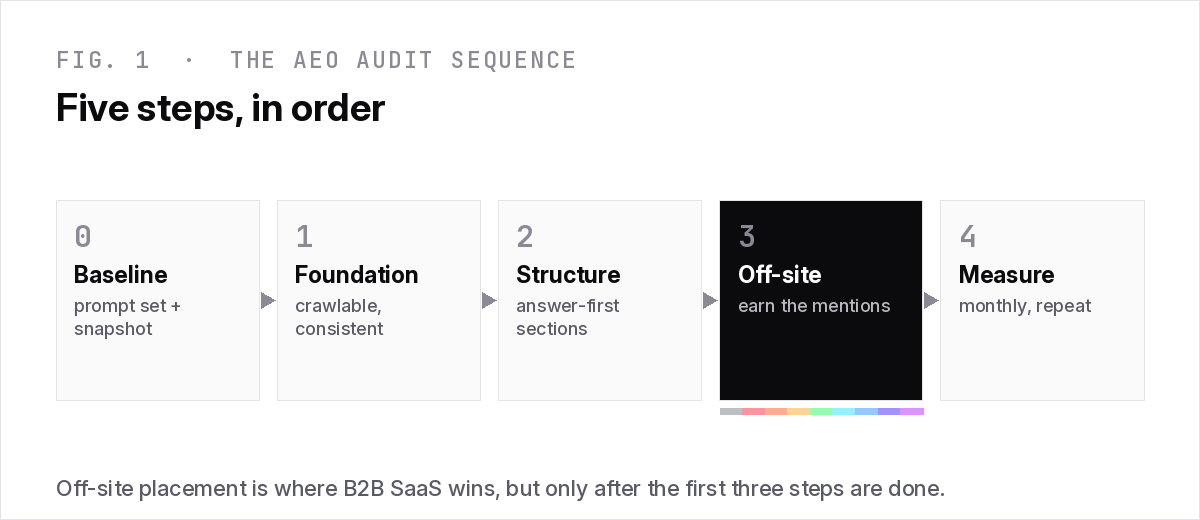
An AEO audit checks whether AI answers can find, understand and recommend your SaaS on the questions your buyers ask, then fixes what's blocking it. Run it in four steps: build a prompt baseline, fix the technical foundation, restructure content to be extractable, and earn the off-site mentions that drive recommendations. Then measure and repeat.
This checklist sequences the whole answer engine optimization playbook into an order you can run in about a week. Each step links to the deeper guide if you want the full detail. If you're still untangling the terms, start with AEO vs GEO vs SEO, then come back here to run the work.
Before you start: prompt set and baseline
Do this first or the rest is guesswork. You need a fixed set of buyer prompts and a snapshot of where you stand before you change anything, so you can prove what worked.
Build the buyer-prompt set
List 20 to 50 prompts your buyers actually ask, weighted to bottom-funnel: "best [category] for [use case]," "[competitor] alternatives," "[you] vs [rival]," pricing and integration questions. These are the prompts where a shortlist gets decided, so they're the ones worth tracking.
Capture today's baseline
Run each prompt through ChatGPT and Google AI Mode and record three things: whether you appear, whether you're recommended, and your share of voice against named competitors. That baseline is the whole point of AI visibility tracking, and it turns the rest of this audit from opinion into measurement.
Step 1: fix the foundation
Make sure a model can actually reach and parse your pages. None of the clever work matters if your content is invisible or contradictory at the technical level, so clear this first.
Check you're crawlable and indexable
Confirm your key buyer pages return clean HTML, aren't blocked in robots.txt, and don't hide their content behind JavaScript that AI crawlers won't run. Since answer engines read visible HTML, a page that only renders client-side may be effectively blank to them, a point Google's own AI guidance reinforces.
Make your facts consistent
Audit your pricing, integrations, positioning and security claims across your own site, and fix contradictions. A model that finds two different prices for your product will trust neither, and it's the kind of error that quietly costs you recommendations.
Do the same for the descriptions of what you do. If your homepage calls you a "work management platform" and your comparison pages say "project management software," pick one primary category and use it consistently. That single choice does more for how a model classifies you than most technical fixes.
Add schema once, correctly
Put Organization, Person and Product schema in place for entity clarity and rich results, then move on. Just don't expect it to buy citations, for the reasons we lay out in schema and structured data for AI answers.
Step 2: make content extractable
Restructure your buyer pages so a model can lift a clean answer from each section. This is the highest-impact on-site work, and it's usually re-ordering, not rewriting.
Rewrite sections answer-first
Under each heading, lead with the direct answer, then the evidence. Phrase headings as the questions buyers ask, and make each section pass the standalone test: it should make sense pasted on its own. The full method is in structuring content for answer engines.
Build or fix the comparison pages
Make sure you have honest, current comparison, alternatives and best-for pages, since those are the ones a model reaches for on buyer prompts. A comparison page that only flatters your product gets skipped, so lay out the real trade-offs.
Name entities, drop pronouns
Repeat your product, category and competitor names through the copy so any lifted passage keeps its subject. It reads slightly heavier to a human, but it's what keeps a chunk usable when it's pulled out on its own.
Step 3: earn the off-site mentions
This is where the real SaaS gains are. The sources AI trusts most for buyer prompts are third-party, so getting named in them is the core of the work, not an afterthought.
Find the sources AI already cites
From your baseline, list the third-party domains the models pull to answer your buyer prompts: review sites, "best of" listicles, roundups and community threads. Those pages are your target list, because they're already in the model's consideration set.
Get placed in them
Work down that list by how often each source appears, and earn a spot: a review profile, an inclusion in a listicle, a mention in a roundup. This is Link Building 2.0, and a single placement in a source cited for ten of your prompts beats a pile of links no model reads. G2 found review-site citations are the number one signal that makes buyers trust an AI recommendation, so a strong presence on G2, Capterra and the category roundups is rarely wasted effort.
Fix how you're described
Where the model repeats something wrong or stale about you, trace it to the source and correct it. Earning accurate brand mentions is often faster than winning brand-new ones, and it directly shapes whether the recommendation is flattering.
Step 4: measure and repeat
Re-run the baseline monthly and act on the trend. AEO is a loop, not a launch, and the compounding comes from running it as a habit rather than a one-time project.
Track the trend, not the snapshot
Each month, re-run your prompt set and watch presence, recommendation rate and share of voice move. A rival closing on your best prompts is an early warning; you gaining on theirs is proof the work landed. The setup lives in measuring AI search visibility.
What "done" looks like
It doesn't. Models change, competitors move, and new buyer prompts appear, so the audit is recurring by nature. The upside is that most of your market treats AEO as a one-off, which leaves the habit as an edge.
When to hand it over
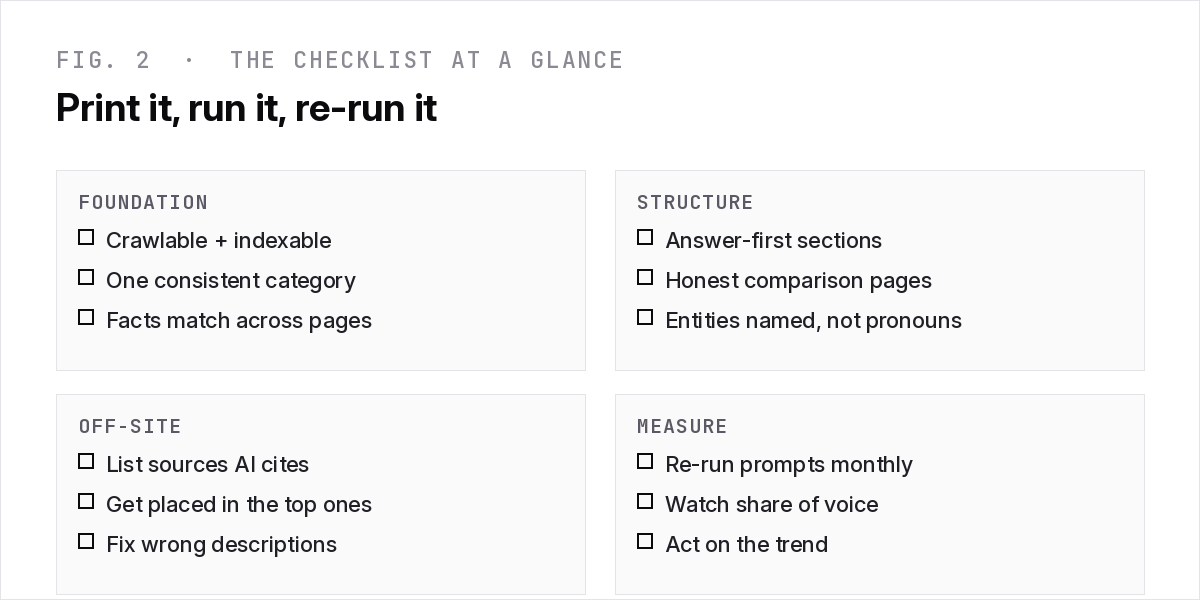
The audit is straightforward; running it across a large site every month, and closing the off-site placements, is the slow part. If you'd rather have a team own the loop, that's exactly what our B2B SaaS AI search team does. Either way, the sequence is the same: baseline, foundation, structure, off-site, measure, repeat.
If you want a running start, here's a fair week-one plan:
- Day 1: build the prompt set and record the baseline.
- Day 2: clear the foundation checks (crawlable, indexable, consistent facts).
- Days 3 to 4: restructure your five highest-intent buyer pages answer-first.
- Day 5: pull the cited-sources list and open your first placement conversations.
That single week usually shifts your presence on the prompts that matter, and it gives you a baseline to prove the next month against.
Frequently asked questions
What is an AEO audit?
An AEO audit checks whether AI answer engines can find, understand and recommend your brand on the questions your buyers ask, and fixes what's blocking it. It runs in four steps: baseline your buyer prompts, fix the technical foundation, restructure content to be extractable, and earn the off-site mentions that drive recommendations.
How do I do an answer engine optimization audit?
Start by building a set of 20 to 50 buyer prompts and recording who gets named today. Then check your pages are crawlable and consistent, restructure sections to be answer-first, earn placements in the sources AI cites for your category, and re-run the baseline monthly to track the trend.
How long does an AEO audit take?
The first pass takes roughly a week: a day to build the prompt set and baseline, a day or two on the technical foundation, a couple of days restructuring your top buyer pages, and ongoing time on off-site placements. After that it's a monthly loop, not a one-off project.
What's the most important part of the checklist for B2B SaaS?
The off-site step. For B2B SaaS, most citations come from third-party sources like review sites and comparison content, so getting named in the pages AI already cites for your category moves the needle more than any on-site tweak. The on-site work makes you extractable; the off-site work makes you recommended.
How often should I run an AEO audit?
Monthly for the measurement loop, with deeper structural work each quarter. Models change, competitors move and new buyer prompts appear, so a stale audit goes out of date quickly. A small, consistent monthly review beats an occasional heroic one.
.png)
Latest articles
What we've published in the past 30 days — across SEO, GEO, content, and digital PR.