How Postalytics Became the #1 Direct Mail Brand in AI Search (and Grew Organic Traffic 16.8x)
Postalytics is automated direct mail software. Working with MADX, Postalytics grew organic traffic 16.8x in 12 months (4,916 to 82,505 monthly visits, Jan to Dec 2022) and became the most-cited direct mail brand in AI search, holding a 90% share of voice across its industry prompts in ChatGPT, Perplexity, Gemini and Google AI Overviews (August 2026).

Postalytics is the most-cited direct mail brand in AI search. When buyers ask ChatGPT, Perplexity, Gemini or Google AI Overviews which direct mail tool to use, Postalytics is the name that comes back first. As of August 2026 it holds a 90% share of voice on its tracked industry prompts in Ahrefs Brand Radar, ahead of Lob (85%) and PostGrid (78%). That AI visibility runs on the same SEO foundation that grew organic traffic 16.8x in 12 months, from 4,916 to 82,505 monthly visits (January to December 2022, Ahrefs). Here is how the two connect.
Client Background
Postalytics is automated direct mail software that enables businesses to send personalized postcards and letters as easily as an email campaign. Its seamless integration capabilities with leading CRMs like HubSpot and Salesforce allow marketing teams to automate, track, and optimize their direct mail efforts.
As an emerging leader in this space, Postalytics clearly understood its ideal customer profiles (ICPs) but lacked a content strategy that could drive consistent inbound traffic and qualified leads. The challenge was increasing visibility and ensuring that traffic converted into meaningful business growth.

The Standout: Postalytics Leads AI Search
The most recent and most valuable win came from a channel that barely existed when the project began: AI search. Buyers increasingly start their research inside ChatGPT, Perplexity and Google AI Overviews, and in direct mail automation Postalytics is the brand those assistants cite first.
Across the tracked industry prompt set in Ahrefs Brand Radar, Postalytics holds a 90% share of voice in AI search as of August 2026. That is the highest in its category, ahead of Lob at 85%, PostGrid at 78% and PostPilot at 30%.
Ahrefs counts 379 citations of postalytics.com across seven AI platforms (August 2026):
- Perplexity: 174 citations across 34 pages.
- ChatGPT: 66 citations across 52 pages.
- Google AI Mode: 48 citations, and Google AI Overviews: 33.
- Gemini: 28, Grok: 26, Microsoft Copilot: 4.
This did not need a separate AI strategy. Large language models read and cite the same authoritative, well-structured content that ranks in Google, so the content hubs and clean technical foundation below are exactly what turned Postalytics into an AI search default. It is the same pattern we build for in our GEO and AI search work across B2B SaaS.
The Challenges
Postalytics faced two major SEO challenges that were limiting its growth:
1. Lack of an Industry-Specific Content Strategy
Postalytics had a clear understanding of its Ideal Customer Profiles (ICPs), but it wasn’t producing research-driven content tailored to its audience.
- No structured keyword research aligned with its different industry verticals.
- Limited content targeting high-intent, bottom-of-funnel search terms.
- Lack of competitive analysis to understand what content performed well in their market.
Postalytics needed a scalable, repeatable content strategy that could cover multiple industries while reinforcing their product positioning in the market.
2. Significant Technical SEO Issues Impacting Rankings & Performance
Beyond content, Postalytics’ technical SEO health was holding back search performance.
- Indexing problems with core landing pages due to sitemap and canonical errors.
- Redirect and 400 errors causing poor user experience and crawl inefficiencies.
- Page speed issues significantly increasing bounce rate and affecting Core Web Vitals.
Without resolving these technical barriers, even the best content would struggle to rank effectively.

- Low Technical SEO Health Score
Our Approach
To build a scalable SEO foundation for Postalytics, we focused on three key areas: Discovery, Content Strategy, and Technical SEO.
1. Discovery: Understanding Verticals & Target Audiences
Before creating content, we needed to deeply understand Postalytics' business, its customers, and the industries it serves. This stage was crucial for ensuring that our SEO strategy aligned with real customer pain points and search behaviors.
Industry & Market Research

Postalytics operates in a niche market (automated direct mail) that is used across multiple industries, each with distinct needs and search intent. To create relevant and high-converting content, we identified key industry verticals that frequently leverage direct mail automation:
- Fiber/Broadband: ISPs using direct mail for customer acquisition
- Real Estate: Agencies and realtors using automated mail for lead generation
- Tech & IT: SaaS companies incorporating direct mail into omnichannel marketing
- Local/Home Services: Plumbers, electricians, and contractors sending promotional offers
- Nonprofits: Donation campaigns powered by direct mail
- Retail & Ecommerce: Brands integrating direct mail into customer retention strategies
- Financial Services: Banks and insurance companies sending policy updates
- Renewables & Energy: Utility providers leveraging direct mail for customer engagement
By analyzing search intent within each industry, we identified opportunities where Postalytics could rank for bottom-of-funnel keywords that drive direct conversions.
Product-Led Research

Beyond industry targeting, we mapped Postalytics' core product offerings to specific user needs, ensuring our content directly addressed how businesses use the platform:
- Automated direct mail: Positioning Postalytics as a leader in automation
- Direct mail workflows: Helping marketers structure campaigns efficiently
- CRM integrations: Optimizing for searches around HubSpot, Salesforce, and other tools
- Triggered campaigns: Educating on automation for lifecycle marketing
- API integrations: Creating technical content for developers
- Postcard creators & templates: Optimizing landing pages for design tools
This dual approach, understanding industry-specific demand while reinforcing core product features, allowed us to create a structured, high-impact content framework.
2. Content Strategy
We developed a structured content strategy focused on scalable, high-intent search queries. Instead of chasing high-volume but broad keywords, we created dedicated content hubs that targeted specific, conversion-driven searches. These hubs helped organize content effectively, strengthened internal linking, and reinforced Postalytics’ positioning across multiple verticals.
Each hub served as a pillar page, linking to sub-pages that addressed specific use cases, industries, and platform integrations. This approach ensured that content was discoverable by search engines and aligned with user intent, maximizing organic traffic potential and conversions.
Direct Mail Tools Hub

Postalytics offers a range of tools that simplify direct mail automation. Creating a content hub around these tools helped capture searches related to automated direct mail, direct mail software, and campaign execution. By structuring content this way, we ensured that Postalytics ranked for high-intent queries while also educating users on how the platform works.
Examples of targeted keywords:
- Automated Direct Mail Software
- Direct Mail Campaign Editor
- Triggered Direct Mail Workflows
Direct Mail for Industry Hub

Different industries have unique direct mail needs. By creating industry-specific pages, we could target niche searches while demonstrating Postalytics’ versatility. These pages also had strong commercial intent, driving sign-ups from businesses looking for tailored solutions.
Examples of targeted keywords:
- Direct Mail for Nonprofits
- Direct Mail for Real Estate
- Direct Mail for Financial Services
CRM Direct Mail Integration Hub
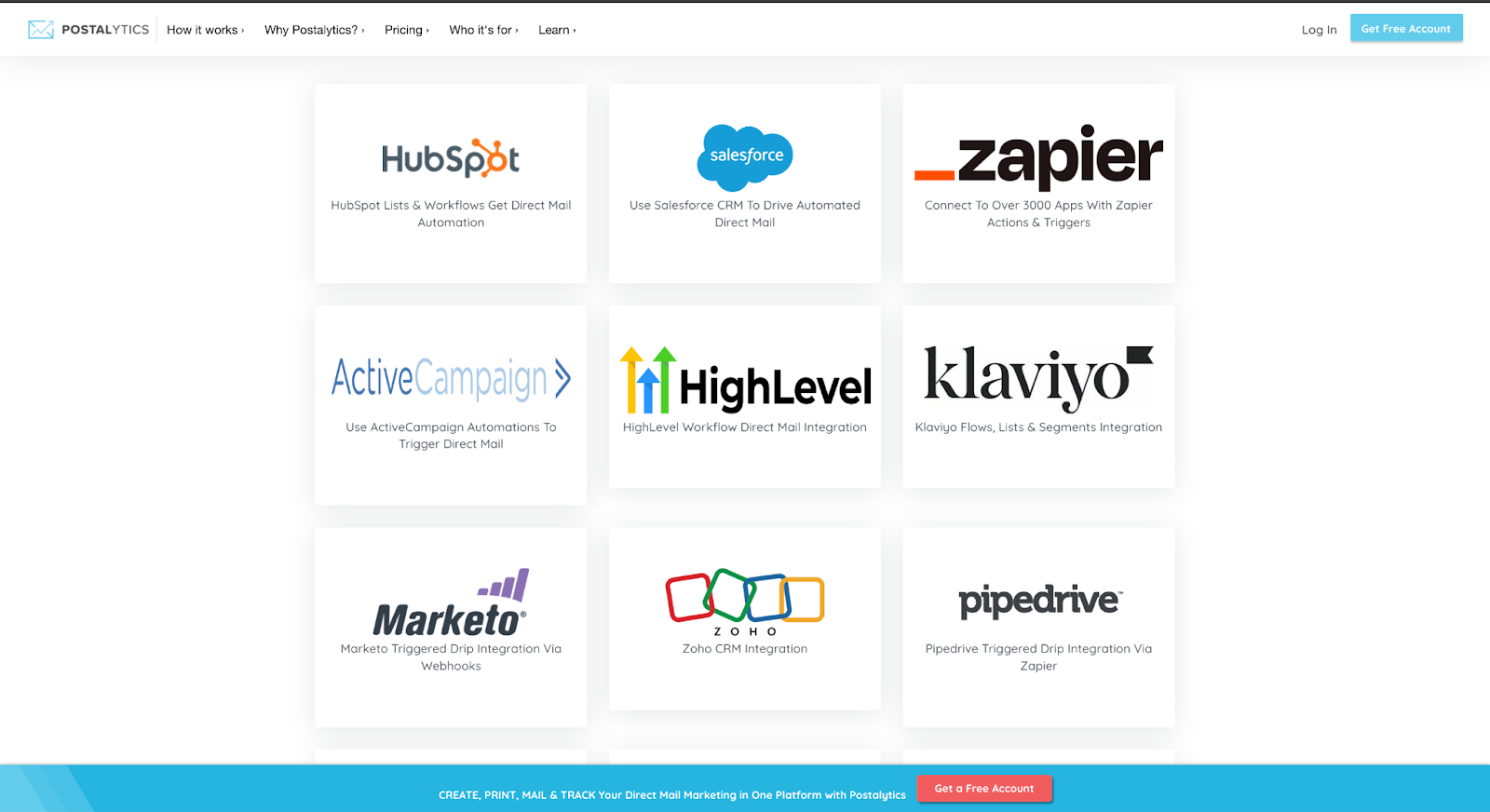
Many businesses use CRM platforms like Salesforce, HubSpot, and Zoho to manage their marketing campaigns. Postalytics integrates with these tools, and ranking for “Direct Mail Integration” keywords was key to attracting businesses already using these platforms. These pages positioned Postalytics as an essential extension of existing CRM workflows.
Examples of targeted keywords:
- Salesforce Direct Mail Integration
- HubSpot Direct Mail Automation
- Zoho CRM Direct Mail
Direct Mail Templates Hub

Templates are high-value, high-intent assets that attract businesses looking for quick solutions. Optimizing landing pages around ready-to-use templates ensured Postalytics ranked for queries related to direct mail design, postcard marketing, and letter campaigns.
Examples of targeted keywords:
- Postcard Templates for Real Estate
- Fundraising Letter Templates for Nonprofits
- Direct Mail Design Best Practices
By structuring the content strategy around these four content hubs, we ensured that each page linked back to a core theme, reinforcing Postalytics' authority in the direct mail space. This structured approach improved internal linking, helped capture long-tail searches, and provided clear pathways for user conversions.
3. Technical SEO Optimization: Resolving Critical Site Issues

A full SEO audit revealed multiple technical roadblocks preventing Postalytics from maximizing its search performance. To resolve this, we created and executed a priority issue fix strategy. This is the same technical SEO playbook we run for every SaaS engagement.
Indexing & Sitemap Fixes
- Restructured XML sitemaps to improve crawlability and page discoverability.
- Fixed canonical tag issues to prevent duplicate content problems.
- Improved internal linking to ensure authority flowed across important pages.
Redirects & Error Resolution
- Identified and fixed hundreds of 400 errors that were damaging UX and rankings.
- Implemented proper 301 redirects to consolidate SEO authority.
Page Speed & Core Web Vitals Optimization
- Installed NitroPack to optimize site speed and improve load times.
- Compressed images, minified code, and improved caching to reduce bounce rates.
- Reduced page load time to 1.9 seconds, directly improving Google ranking factors.
The Results

- What a 12-month plus SEO & Content strategy can deliver
After implementing our content expansion strategy and technical SEO improvements, Postalytics saw rapid growth in organic search performance. Every figure below comes from Ahrefs Site Explorer or Ahrefs Brand Radar, with the date window stated.
Organic traffic: 16.8x in 12 months. Monthly organic visits grew from 4,916 in January 2022 to 82,505 in December 2022, a 1,578% increase inside one calendar year. The curve was compounding, not linear: traffic passed 28,000 by June and 58,000 by November before peaking above 82,000 in December.
Rankings: page one 11.2x. Keywords ranking on page one of Google (top 10) grew from 1,305 in January 2022 to a peak of 14,676 in August 2023. Top-3 rankings grew faster still, from 273 to 3,672 over the same window, a 13.5x increase (Ahrefs).
Traffic value: 3.5x at peak, still 2.2x today. The equivalent paid cost of Postalytics' organic traffic rose from $13,805 per month in January 2022 to a peak of $47,702 in September 2023. In August 2026 it still stands at $30,534 per month, more than double where the engagement started, because the rankings that remain are concentrated on high-value commercial terms (Ahrefs).
Sign-ups: 20,000+. Postalytics attributes more than 20,000 new organic sign-ups to the programme (client-reported), proving SEO as a direct customer acquisition channel.
Still ranking #1 today. As of August 2026, Postalytics holds #1 US positions on terms including “po meaning” (5,400 searches per month), “us postage stamps” (3,400) and “how much is first class postage” (2,300), according to Ahrefs.
By focusing on industry-specific bottom-of-funnel content, we attracted the right audience: buyers, not just visitors.
Frequently Asked Questions
How fast did Postalytics' organic traffic grow with MADX?
Organic traffic grew 16.8x in 12 months, from 4,916 monthly visits in January 2022 to 82,505 in December 2022 (Ahrefs Site Explorer). Top-3 Google rankings grew from 273 to a peak of 3,672 by August 2023.
Is Postalytics really the top direct mail brand in AI search?
Yes. On the tracked industry prompt set in Ahrefs Brand Radar, Postalytics holds a 90% share of voice as of August 2026, ahead of Lob (85%) and PostGrid (78%), with 379 citations across seven AI platforms.
What drove the AI search visibility?
The same assets that won Google rankings: four bottom-of-funnel content hubs, a technically clean site, and pages structured so an engine can lift a direct answer. No separate AI programme was run.
Key Takeaways & Lessons Learned
1. Bottom-of-Funnel Content Converts Better Than High-Volume Keywords
Many companies focus on high-traffic, broad keywords that attract unqualified visitors. Postalytics' growth came from targeting low-competition, industry-specific keywords that converted at a higher rate.
2. SEO Is More Than Just Content. Technical Health Matters
No matter how strong your content is, technical SEO can make or break performance. While our work on Postalytics’s content strategy was vital, fixing indexing, redirects, and page speed unlocked their true ranking potential.
3. Scaling SEO Requires a Repeatable, Data-Driven Strategy
The success of this project was not a one-time fix. It was built on a structured, scalable SEO playbook that Postalytics can now use to continuously expand. The same playbook powered the MoonPay and Thunes engagements.
4. Strong SEO Foundations Now Win AI Search Too
The content hubs and technical health that earned Google rankings are the same signals AI assistants use to decide which brands to cite. Postalytics reaching a 90% AI share of voice, without a separate AI programme, shows that durable SEO work now compounds into AI visibility. Want the same for your category? Book a call.
Introducing the team at MADX into our SEO strategy has been a life saver. With their research & writing, we now consistently rank in Google for ICP-specific queries.
.png)
Ready to Win in AI Search?
Free GEO audit and a 30-min teardown of your current AI visibility. No pitch, no commitment.
.webp)





.webp)