.webp)





.webp)
GEO
Calculating...
Aug 2026
How to Structure Content for Answer Engines
How to structure content for answer engines: write self-contained, answer-first chunks so AI can extract, cite and recommend your B2B SaaS pages.


Structuring content for answer engines means writing each section so it works as a standalone answer. AI systems often retrieve at the passage level, breaking your page into chunks and pulling only the ones that match a query. If a section can't be understood on its own, it won't get extracted, cited or recommended, no matter how good the full page is.
How answer engines read your content
They don't read the whole page, they retrieve pieces of it. Many AI systems break documents into chunks, convert each into a vector, and pull only the segments that semantically match the question before writing an answer.
Retrieval happens at the passage level
Anthropic lays out the standard retrieval-augmented generation pipeline plainly, and it's worth reading how the sausage is made.
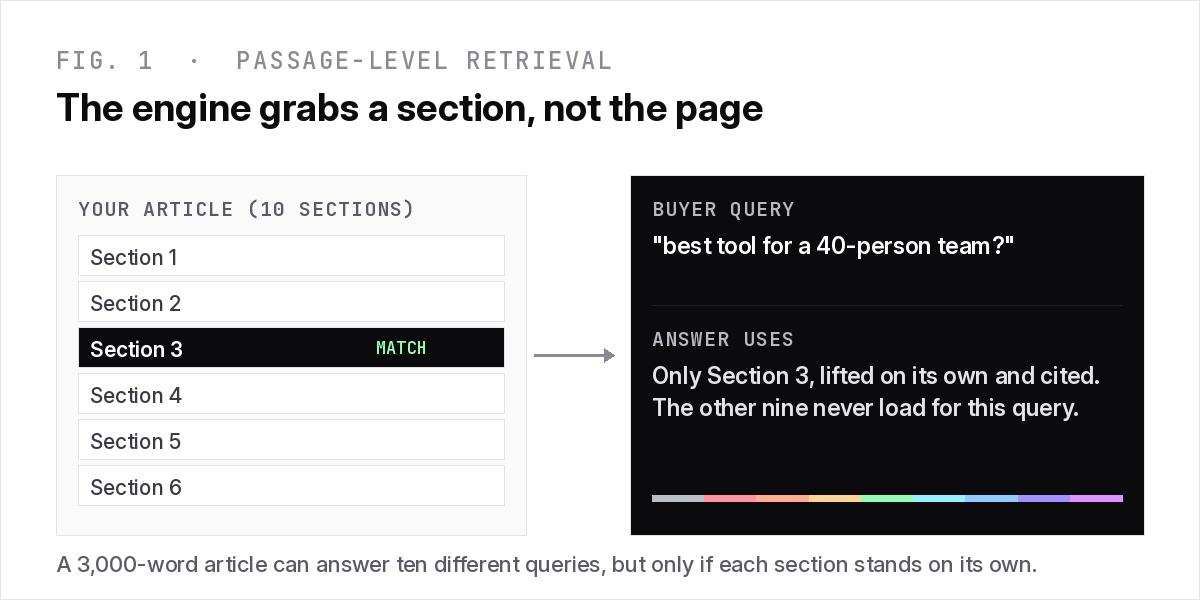
A few hundred tokens is roughly 75 to 300 words. So the unit that competes for a citation isn't your article, it's the individual passage. Retrieval typically surfaces sections of 100 to 300 words that match the query, then hands those to the model as context.
One article, many independently retrieved sections
Here's the mental shift. A single 3,000-word guide can be mined for ten different answers to ten different questions, but only if each of those ten sections stands on its own. This is the on-page half of query fan-out: the model fires many sub-queries, and each one is looking for a clean passage to lift.
Write one long, meandering argument and you've built something a human might read top to bottom, but a machine can't cut into usable pieces. Write ten self-contained sections and you've built ten chances to be the answer.
Do you actually need to chunk content?
Not in the rigid, cut-it-into-fixed-lengths sense, and here the experts genuinely disagree. Google says manual chunking is unnecessary for its systems; plenty of practitioners structure carefully anyway. Both can be right, because they're answering slightly different questions.
The case against manual chunking
Google has been clear in its AI features guidance that you don't need to break content into bite-sized chunks for its AI systems to use it. Its models handle segmentation themselves, so contorting your content into arbitrary fragments buys you nothing with Google specifically.
The case for structuring anyway
The catch is that Google isn't the only engine that matters. ChatGPT, Perplexity, Claude and countless RAG-based tools retrieve at the passage level, and their systems vary in how much surrounding context they preserve. Structuring content into clear, self-contained sections hedges across all of them, and it happens to be good writing for humans too.
Our verdict
Don't chunk mechanically, structure semantically. Break content on meaning, not character count, so each section is a complete thought. Lumar put the principle well.
How to write a self-contained, answer-first section
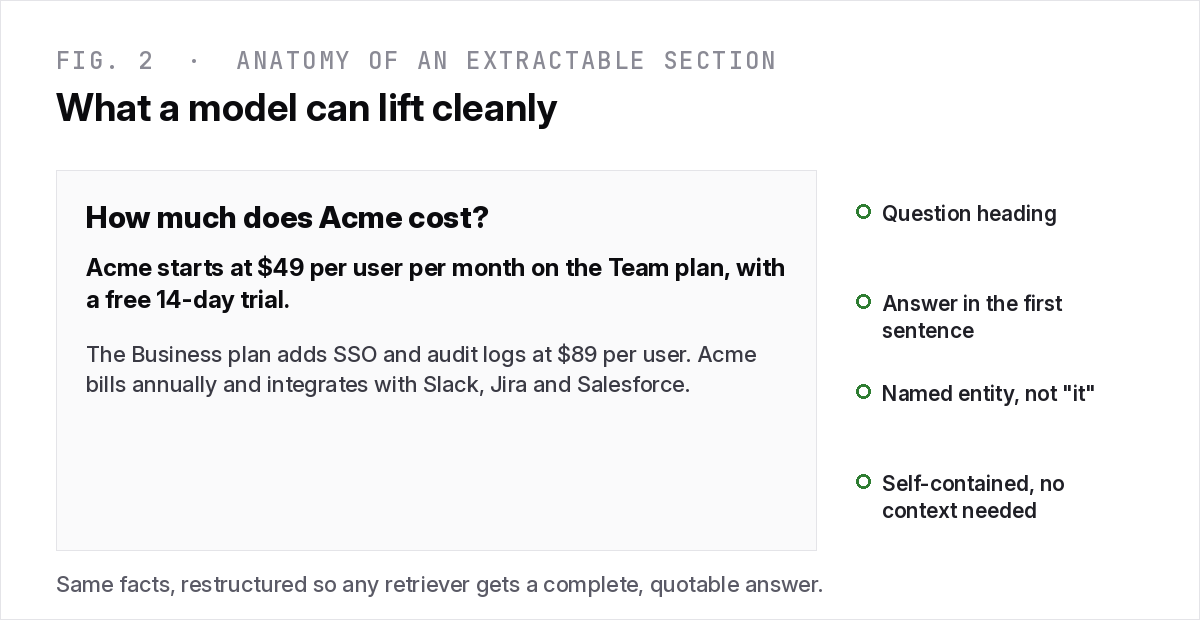
Every section should answer one question, lead with the answer, and make sense with nothing above it. Get those three right and you've done most of the work of AEO structure.
Lead each section with the answer
Put the direct answer in the first sentence or two under the heading, then the evidence and detail. Models lift the cleanest passage that resolves the query, and a section that opens with setup and buries the answer three paragraphs down rarely wins. Aleyda Solis's AI search checklist puts chunk-level retrieval and answer-first structure near the top for the same reason.
Make every section pass the standalone test
This is the rule we drill into every content team we work with. Each section has to be understood without the reader, or the model, having read what came before. If a paragraph leans on the one above it to make sense, a passage-level retriever will grab it and serve a fragment that answers nothing.
Keep entity names visible (the pronoun penalty)
Watch your pronouns. Anthropic's research shows exactly how a lifted chunk loses its meaning when the entity isn't named in it.
Pronouns read smoothly for a human going top to bottom. For a machine grabbing one paragraph, they erase the subject. Repeat the product name, the competitor and the category often enough that any single section still knows what it's about.
Structural rules that make content extractable
Beyond answer-first passages, a few structural habits make a page far easier to mine. None of them are new, they're just doing double duty now for readers and retrievers.
Write headings as the questions buyers ask
Phrase H2s and H3s as the actual questions your buyer would type or say. A heading that mirrors the query gives the retriever a strong signal that the passage beneath it is the answer, and it makes your table of contents read like a set of promises you then keep.
One idea per section, split semantically
Each section should own one distinct sub-topic. Split on meaning, not on an arbitrary word count, so no section tries to cover three things and none of them fully. If a heading needs "and" twice, it's probably two sections.
Use formats AI can lift cleanly
Tables, short definitions, and tight lists are easy for a model to extract and reuse, which is one reason comparison tables punch above their weight in AI answers. We go deeper on which formats win in our guide to the best content formats for AI search, and structured data helps too, covered in schema for AI answers.
How to pressure-test your pages
You don't need a tool to check this, you need a clipboard. The fastest way to know whether your content is extractable is to try to extract it yourself.
The copy-paste test
Take any section of a page, paste it into a blank document on its own, and read it cold. Does it answer one clear question without anything above it, and does it name the product and category rather than leaning on "it" and "this"?
If yes, a model can cite it. If no, you've found your next edit, and it's usually a small one. Run this on your top pages and you'll build a punch list of fixes faster than any audit tool hands you.
Where to apply it first
Start with the pages that touch buyer decisions: comparison, alternatives and category pages. Those are the ones a model reaches for on the prompts that decide deals, so a structural fix there compounds fastest. Our AEO audit checklist sequences the whole sweep, the wider strategy sits in the answer engine optimization pillar, and you'll want to confirm the fixes land by tracking AI visibility.
When to get help
Restructuring a large content library by hand is slow, and the gains are uneven if you can't see which pages the models already pull from. That's the kind of work our B2B SaaS AI search team runs at scale. Whether you do it yourself or hand it over, the target is the same: every section a clean, self-contained answer a machine can quote.
Frequently asked questions
What is content chunking in AI search?
Content chunking is the way AI systems break a page into smaller segments, or chunks, to retrieve and use it. Each chunk gets converted into a vector and stored, so the system can pull only the segments that match a question rather than reading your whole page. It usually works at the passage level, around 100 to 300 words.
Do I need to chunk my content for AI search?
Not manually, and not into rigid fixed lengths. Google says you don't need to chunk content for its AI systems. The useful version is to structure content semantically, so each section is a complete, self-contained thought, which helps across other engines like ChatGPT and Perplexity and helps human readers too.
What is passage-level retrieval?
Passage-level retrieval is when an AI system fetches specific sections of a page rather than the whole document. Because models have limited context windows, they surface only the passages that best match the query and feed those to the answer. It means your individual sections, not just your page, compete to be cited.
How long should a content chunk be?
There's no fixed rule, but retrieval commonly operates on passages of roughly 100 to 300 words. Rather than counting words, aim for one complete idea per section that reads well on its own. Semantic completeness matters more than hitting a specific length.
How do I structure content so ChatGPT can cite it?
Write each section answer-first: put the direct answer under a question-shaped heading, then the evidence. Keep it self-contained so it makes sense with nothing above it, and name entities like your product and category instead of relying on pronouns. Then test it by pasting the section on its own and checking it still answers cleanly.
Does Google use content chunking?
Google has said manual chunking is unnecessary for its own AI systems, which handle segmentation themselves. That doesn't make structure irrelevant, since clear sections still help other AI engines, crawlers and human readers. Structure your content well for everyone, and don't fragment it artificially just for Google.
.png)
Latest articles
What we've published in the past 30 days — across SEO, GEO, content, and digital PR.