.webp)





.webp)
SEO
Calculating...
Aug 2026
Entity SEO: Making Your Brand Unambiguous to Google and LLMs
Entity SEO makes your brand unambiguous to Google and LLMs. Run our B2B SaaS entity audit and fix the inconsistencies that quietly cap AI visibility.
Entity SEO is the practice of making your brand, products and people unambiguous to search engines and AI systems, which understand the web as a graph of entities rather than a pile of keywords. The goal: when a machine encounters your name, it resolves to one thing, described one way, in one category.
This used to be a specialist's afterthought. Then assistants started answering buyer questions by looking up brands, and suddenly the difference between a resolved entity and a fuzzy one is the difference between being recommended and being skipped.
Entity work is the least glamorous stage of building topical authority, and in our audits it's the stage most often broken. This guide explains how engines resolve entities, then walks the audit we run for B2B SaaS brands, including the fixes that move AI visibility fastest.
What entities are and what entity SEO means
An entity is a distinct, identifiable thing: a company, a person, a product, a concept. Machines prefer entities to keywords because entities don't depend on wording. Whether a buyer types your brand name, misspells it, or describes what you do, a well-resolved entity lets the system connect all three to the same record.
Strings vs things
Google announced this shift back in 2012 with the Knowledge Graph, under the slogan "things, not strings". What's new is that LLMs doubled the stakes. A language model answering "best CRM for construction firms" isn't matching keywords; it's connecting entities, categories and attributes drawn from everything it has read about each brand. Our guide to semantic SEO covers the meaning layer; this article covers the identity layer.
A quick test shows the difference. Search your category with your brand name misspelled, or describe your product without naming it, and see whether engines still surface you. Strong entities survive bad inputs because the system knows the thing, not just the string. Weak entities vanish the moment the wording changes, and most weak entities belong to companies that never noticed.
Entities you own beyond the brand
Your company isn't the only entity worth managing. Products, founders and subject-matter experts are entities too, and each one either reinforces the company record or muddies it. A founder with a clear profile and consistent bylines lends expertise signals to the brand, while a strong product entity can carry the company into categories the parent brand doesn't rank for. Map them deliberately rather than letting the graph guess.
How Google and LLMs resolve entities
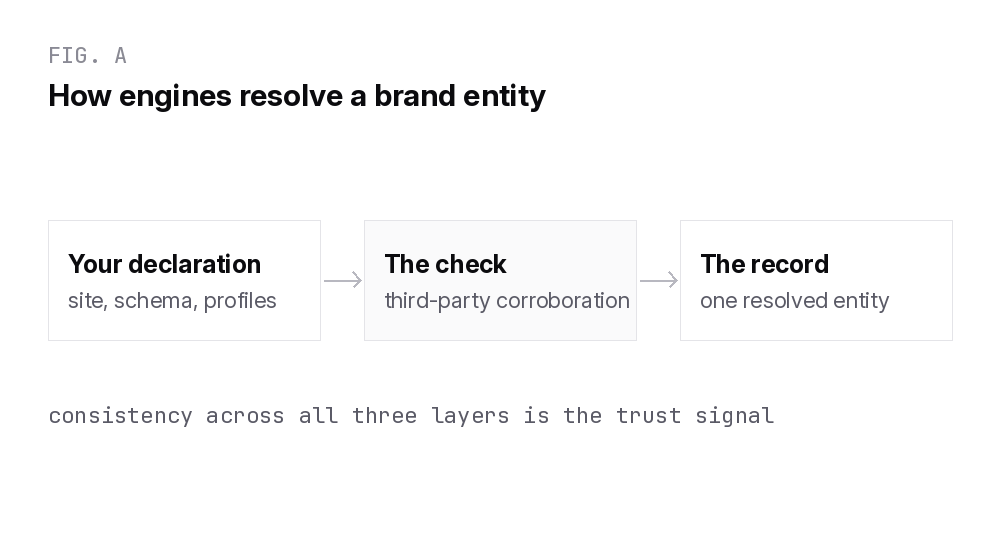
Both systems answer the same three questions about you: what is this thing, what category does it belong to, and can independent sources confirm it? They just consult different evidence, and you need all of it aligned.
The lookup layer
Google checks its Knowledge Graph, the entity database behind knowledge panels, which we cover in depth in our knowledge graph optimization guide. LLMs draw on their training data plus live retrieval. In both cases your website is the primary declaration of identity, your structured data is the machine-readable version of it, and Search Engine Land's entity SEO guide is a good technical companion on how the pieces connect.
The corroboration layer
Declarations get checked. Engines compare what you say about yourself with what G2, LinkedIn, Crunchbase, review sites and the press say about you, and consistency is the trust signal. This is why third-party sources dominate AI answers: 5W Research found Wikipedia and Reddit alone drive over 25% of US ChatGPT citations, with review platforms close behind in commercial categories.
Think of it as a jury, not a judge. No single source decides who you are; the verdict comes from agreement across many. That's also why entity work resists shortcuts: you can't schema-markup your way past twelve profiles that each tell a different story.
Why consistency beats volume
Kevin Indig's analysis of Semrush's 2026 ChatGPT ownership data found domain strength explains category ownership only about half the time; fit and consistency did more of the work. That matches what we see in campaigns. A smaller brand described identically everywhere routinely out-mentions a bigger brand described five different ways.
The entity audit for B2B SaaS
The audit is a structured comparison: collect every place your brand is described, then measure the drift. Most teams have never read their own third-party descriptions side by side, and the first pass is usually uncomfortable.
Budget half a day for a typical SaaS brand. The collection step is mechanical: your about page, schema, every social profile, every review platform listing, Crunchbase, and the top 10 third-party pages that mention you. Paste each description into one document, then read them as a stranger would. The drift finds itself.
Start with the entity home
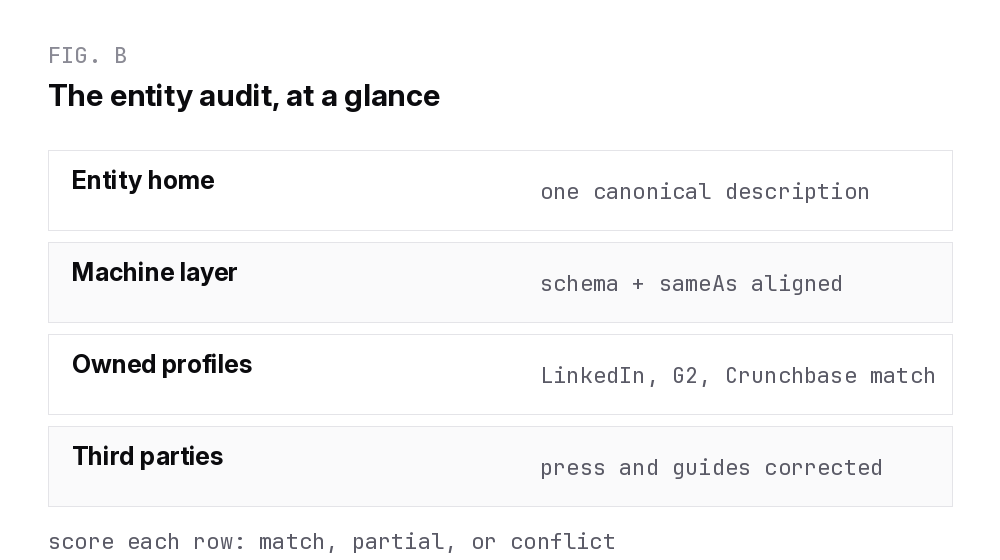
Pick one page as the canonical answer to "what is this company" and write it in plain, extractable language: who you are, what category you're in, who you serve, what the product does. No metaphors, no category-inventing wordplay. Every other signal should agree with this page, which makes it the reference point for the whole audit.
Then align the machine layer
Your Organization schema should restate the entity home and use sameAs to link every official profile, following Google's Organization structured data guidance. We covered implementation in our guide to schema and structured data for AI search. Schema doesn't create trust by itself, but it removes the ambiguity that stops trust accruing to the right record.
Score the drift
For each row of the table, mark match, partial or conflict against the entity home. Conflicts are your work queue, and the priority order is simple: owned properties first because you control them, data sources second because engines quote them, press last because it needs outreach. In most SaaS audits we run, half the conflicts get fixed inside a week.
Building entity strength
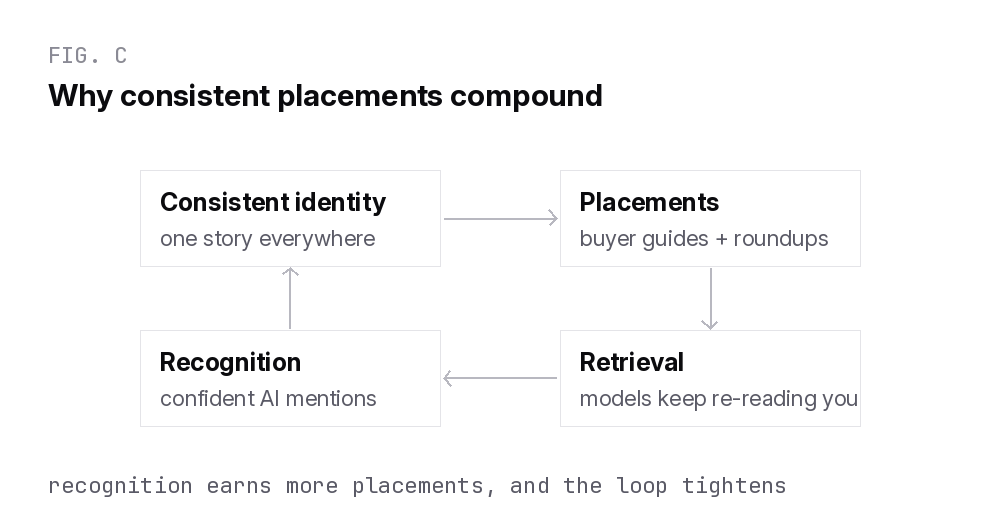
Once the identity is consistent, strength comes from repetition in trusted places. Machines believe what they see confirmed often, recently and independently.
On your own site
Use your brand name and category language the same way everywhere, connect related pages with descriptive anchors, and keep author and company details present on the content that demonstrates expertise. A coherent topic cluster does double duty here: it builds topical authority and it repeatedly co-locates your entity with the category's vocabulary.
Co-location is an underrated lever. Every time your brand name appears in the same passage as the category term, the problems you solve and the audience you serve, you strengthen the associations the graph stores. Write those sentences on purpose, especially on the pages that describe the product.
Scaled page sets reinforce this at volume. Integration and comparison pages built with programmatic SEO for B2B SaaS repeatedly place your brand next to the category vocabulary machines use to resolve it.
Off your site
Placements in buyer guides, comparison posts and category roundups do more for entity strength than most link building, because they describe you in category context on pages engines retrieve constantly. That's the heart of our Link Building 2.0 approach, and it's also what our brand mentions guide measures. Every placement should describe you consistently, which is why the audit comes first.
How to measure entity strength
Three checks, run quarterly. Ask the major assistants who you are and what category you're in, then grade the answers for accuracy and consistency. Track how often AI answers on your category's buyer prompts name you, in what language, and whether a knowledge panel exists and stays accurate. Improvement shows up first as better descriptions, then as more frequent mentions.
Keep a written record of each quarter's answers. Model outputs drift, and the record is how you separate a real trend from a noisy week. It's also the least contestable before-and-after you can show a leadership team.
Common entity problems and fixes
Entity problems cluster into three families: confusion, staleness and fragmentation. Each has a distinct signature in AI answers, so diagnose before fixing.
One diagnostic shortcut: read what assistants cite when they describe you wrong. The cited page is usually the contaminating source, and correcting or outweighing that specific page beats publishing anything new. We've fixed months-old misdescriptions with a single outreach email to the right buyer guide.
Confusion: engines mix you up with someone else
Shared names are the classic case, a SaaS brand sharing its name with a consumer app or a common word. The fix is disambiguation through context: always co-locate your name with your category, strengthen the signals that distinguish you, and make sure your sameAs network points at the right profiles. How AI systems weigh those brand signals is covered in our guide to how LLMs rank brands.
Staleness: engines describe who you used to be
Repositioned brands inherit their old story. If you moved upmarket or changed category, assume every third-party description still carries the previous era until proven otherwise. Update owned properties, then work the placement list, and expect models to lag reality by months. The earlier the corrections start, the shorter the lag.
Fragmentation: five partial identities, no strong one
Different names across profiles, region-specific descriptions that disagree, product brands competing with the company brand. Consolidate ruthlessly: one canonical name, one category claim, one boilerplate paragraph reused everywhere. Fragmented identity splits your corroboration across records, and machines reward the brand whose evidence all points one way.
A rename deserves its own warning. If you're changing the company name, plan the entity migration like a site migration: update every record in the audit table within the same fortnight, keep the old name co-located with the new one during the transition, and expect a dip in recognition before the graph consolidates. Brands that drip-feed a rename across a year confuse machines for a year.
Entity SEO isn't a one-off project; it's hygiene that compounds. If you want the audit run properly, with the placement work to back it, that's part of what our SaaS SEO agency does for B2B SaaS brands. Start with the side-by-side test either way. Ten minutes of reading your own descriptions usually makes the case for the rest.
Frequently Asked Questions
What is an entity in SEO?
An entity is a distinct, identifiable thing: a company, person, product, place or concept that search systems track independently of the words used to describe it. Google's Knowledge Graph and LLM training data both organise information around entities, which is why consistent identity signals matter as much as keywords.
How is entity SEO different from keyword SEO?
Keyword SEO earns visibility for queries by matching the words people search. Entity SEO earns recognition for the brand itself by making its identity, category and attributes unambiguous across the web. You need both: keywords bring the page into a search, entities decide whether the machine trusts and recommends the brand behind it.
Does entity SEO help with ChatGPT visibility?
Yes, directly. LLMs answer buyer questions by connecting entities to categories and attributes drawn from everything they've read about a brand. A consistently described entity gets recommended more confidently, while conflicting descriptions make a model hedge or skip the brand entirely.
What is an entity home?
An entity home is the single page, usually your about page or homepage, that serves as the canonical statement of who your company is, what category it's in, who it serves and what the product does. Every other signal, from schema to social profiles to review listings, should agree with it.
How do you fix a brand entity that AI describes incorrectly?
Work outward from what you control. Update the entity home and Organization schema, then align every owned profile, then correct data sources like Crunchbase and review platform listings, then pitch corrections into the third-party pages assistants cite. Expect models to lag your changes by weeks to months, so start with the sources they retrieve most.
Do you need schema markup for entity SEO?
Schema is the machine-readable half of entity SEO, so yes. Organization markup with accurate sameAs links removes ambiguity about which profiles and records belong to you. It won't create authority on its own, but without it your corroborating signals may never consolidate around one record.
.png)
Latest articles
What we've published in the past 30 days — across SEO, GEO, content, and digital PR.