.webp)





.webp)
GEO
Calculating...
Sep 2026
Answer Engine Optimization for B2B SaaS
Answer engine optimization (AEO) is how B2B SaaS gets named in AI answers. What it is, why it matters, and the playbook to get recommended.

Answer engine optimization (AEO) is the practice of structuring your content, your product data and your off-site presence so AI answer engines name and cite your SaaS when a buyer asks a question. Think ChatGPT, Perplexity, Google AI Mode and Copilot. The goal is not a ranking. It's being the recommendation inside the answer a buyer reads instead of a search results page.
What is answer engine optimization?
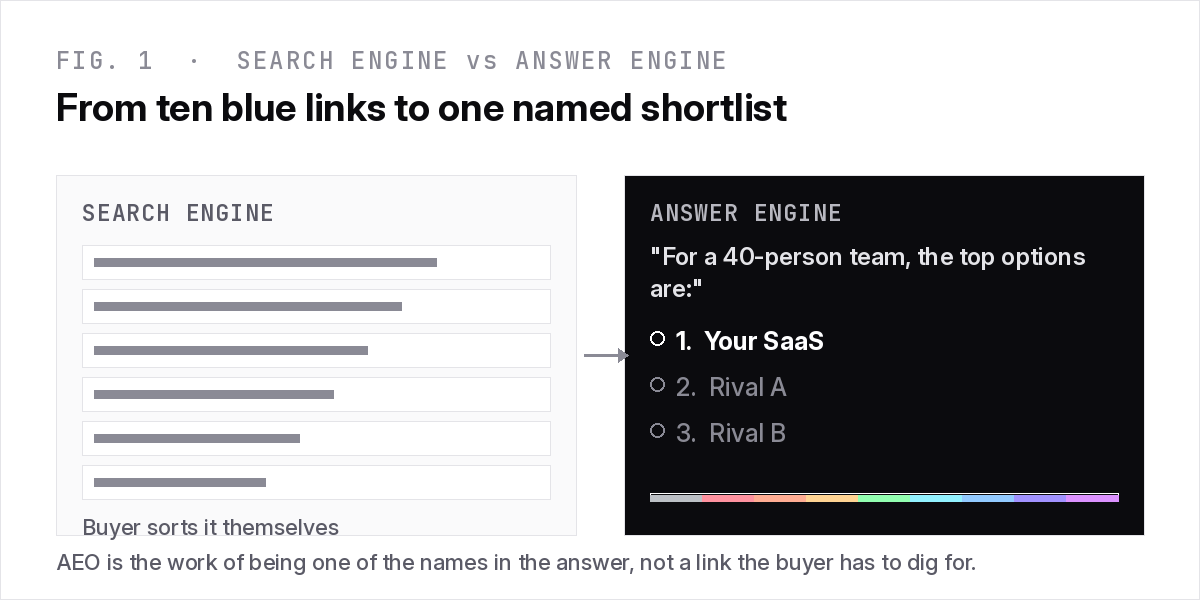
Answer engine optimization is optimising to be the answer, not to rank a page. An answer engine reads a question, pulls passages from many sources, and writes one synthesised reply that names a few brands. AEO is the work of making sure yours is one of them.
AEO in one sentence
If SEO got you onto a page of ten blue links, AEO gets you into the single paragraph that replaces them. That's the whole shift. A buyer used to compare options themselves; now a model does the comparing and hands them a shortlist.
Answer engines vs search engines
Search engines retrieve. Answer engines synthesise. Google AI Mode doesn't run your exact query and stop, it breaks the question into a fan of related searches and blends the results, a mechanic we broke down in our guide to query fan-out for B2B SaaS.
That changes what "winning" means. You're no longer fighting for one position on one query. You're trying to be the source the model reaches for across a whole cluster of buyer questions, then the brand it feels safe recommending by name.
The B2B SaaS version of the job
Most AEO advice is written for recipe blogs and local plumbers. B2B SaaS is a different animal. Your buyer isn't asking "what is a CRM", they're asking "best CRM for a 40-person sales team" and "HubSpot alternatives for startups".
Those are bottom-funnel, high-stakes, comparison-shaped questions. So the AEO that moves revenue for SaaS is not blog trivia. It's making your product the obvious pick on the buyer prompts where a shortlist gets decided. The full three-way distinction sits in our breakdown of AEO vs GEO vs SEO.
Is AEO just SEO or GEO rebranded?
Half true, and the half that's false is the part that costs you. AEO shares plumbing with SEO, but the objective changed from ranking a page to being quoted in an answer, and that changes what you build. The GEO vs AEO argument, on the other hand, is a naming fight with no strategic payoff.
The case that it's the same
The skeptics have a point. The people doing AEO are the same SEO teams, using the same crawlable-content fundamentals. Aleyda Solis has pointed out that the overwhelming majority of AI search work is being led by SEO practitioners, and her AI search optimisation checklist reads like disciplined SEO taken to its logical end: clean structure, entity clarity, strong trust signals.
The case that it's different
Then you look at what actually gets cited, and the "it's just SEO" story falls apart. Kevin Indig's analysis of what content works well in LLMs found the ranking factors for AI answers diverge sharply from classic search signals. Profound's research reported a surprisingly small overlap between who ranks on Google and who gets cited by ChatGPT. Same raw ingredients, different recipe.
Our verdict
Stop arguing about the acronym. AEO and GEO describe the same job, and the best framing we've seen comes from the team at Profound.
Here's where we land. SEO is the foundation, not the finish line. If your pages aren't crawlable and clear, none of this works, but treating AEO as "SEO, but say AI a lot" is why so many SaaS brands are invisible in the answers their buyers read.
The wider shift is covered in our generative engine optimisation guide and the traditional-vs-AI split in GEO vs SEO. Read AEO as the SaaS-specific application of both: get extracted, get trusted, get recommended on buyer questions.
Why AEO matters for B2B SaaS right now
Because the buyer already moved, and most vendors haven't noticed. Your prospects are running their research through a chatbot before they ever hit your site, and the chatbot is quietly deciding who makes the shortlist.
Buyers start in the chatbot now
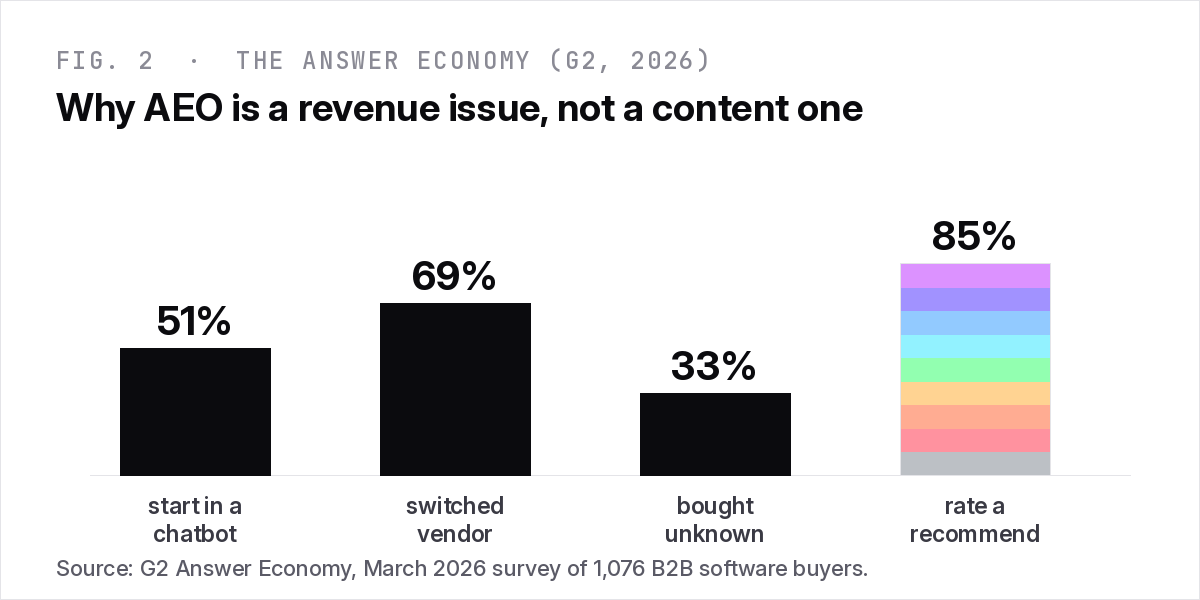
This isn't a projection. G2's March 2026 "Answer Economy" survey of 1,076 buyers found that 51% of B2B software buyers now start research with an AI chatbot more often than with Google, up from 29% in G2's April 2025 report. Seventy-one percent rely on chatbots for software research, up from 60% seven months earlier.
Read those two numbers together. Half your market opens a chatbot first, and the share is still climbing fast. If your brand isn't in that answer, you're losing the deal before the buyer knows you exist.
The AI is reshaping shortlists
The scary part for incumbents, and the opening for challengers, is how much the answer changes the outcome. In the same G2 research, 69% of buyers chose a different vendor than they'd planned based on chatbot guidance, and one in three bought from a vendor they'd never heard of before.
That is a shortlist being rewritten in real time by a model. AI chatbots are now the number one source influencing which vendors get considered. Brand awareness you spent years building can be skipped in one synthesised paragraph.
Mentions beat citations for SaaS
This is the point most AEO guides miss, so read it twice. A citation is a link to you as a source. A mention is the AI naming or recommending you in the answer itself. They are not the same outcome, and for B2B SaaS the mention is worth far more.
The data is blunt about it. G2 found 85% of buyers think more highly of a vendor when an AI chatbot mentions it in a recommendation. A recommendation on "best tool for X" does the selling with no click required, while a citation buried under the answer might never get read.
So weight your effort toward getting recommended, and treat the link as a bonus. We go deeper on the mechanics in our guide to brand mentions.
How to actually do AEO: the B2B SaaS playbook
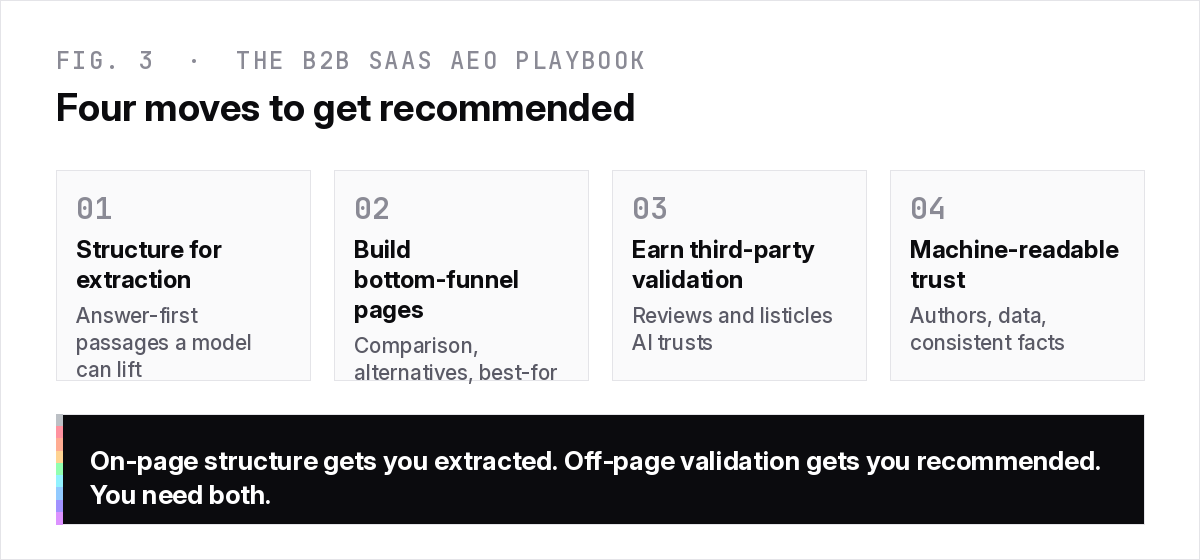
AEO comes down to four moves: make your content easy to extract, build the pages AI pulls from on buyer questions, earn the third-party validation it trusts, and make your credibility machine-readable. Skip any one and the model has a reason to recommend someone else.
Move 1: structure content for extraction
Answer engines don't read pages, they lift passages. They chunk your content into segments and pull the cleanest one that answers the sub-question. So every section has to work as a standalone snippet: a direct answer first, evidence after.
Front-load the answer under each heading, keep passages self-contained, and write headings as the questions buyers actually ask. The full method, including passage and chunk optimisation, is in our guide to structuring content for answer engines.
A quick test we run on client pages: take any section, paste it on its own, and ask whether it answers one question without the rest of the page. If it needs the paragraph above it to make sense, a model can't cleanly lift it, and it won't.
Move 2: build the pages AI pulls from
For SaaS, the pages that earn recommendations are bottom-funnel: comparison pages, "alternatives to [competitor]" pages, "best [category] for [use case]" pages, plus pricing and security. Build them like evidence, not brochures.
A comparison page that honestly lays out where you win and lose gives the model a clean passage to quote. One that only flatters your own product gets skipped, because it doesn't answer the question the model was sent to resolve. Buyers ask comparison questions, so comparison content is where the mentions live.
There's data behind the instinct, too. A Surfer study found pages that rank across several of those fanned-out sub-queries are 161% more likely to be cited in AI Overviews than pages that only rank for the head term. Breadth across a buyer's real questions beats one strong page.
Move 3: earn third-party validation
Here's the uncomfortable truth. The sources AI trusts most for buyer queries are ones you don't own: review sites, "best of" listicles, industry roundups and community threads. G2 found that citations from software review sites are the number one signal that makes buyers trust an AI recommendation.
So getting named in those places is not a nice-to-have, it's the core of SaaS AEO. This is what we call Link Building 2.0: earning placements in the comparison and buyer-guide content that answer engines already cite for your category. If you'd rather we map and close those placements for you, that's the day job of our B2B SaaS AI search team.
Move 4: make trust signals machine-readable
The model can only recommend what it can verify. Named authors, real credentials, published methodologies, case studies and clean structured data all give it something concrete to trust. Aleyda Solis's checklist puts citation-worthiness and entity clarity at the centre for exactly this reason.
Schema won't magically get you cited, and anyone who promises that is overselling. But structured data helps engines resolve who you are and what you do, which matters more as answers get personalised. We cover what actually helps in structured data and schema for AI answers.
The practical version for a SaaS team: put a real author with real credentials on your comparison and category pages, cite your own data instead of hand-waving, and keep your product facts (pricing tiers, integrations, security certifications) consistent everywhere the model might read them. Contradictory facts across your own site are one of the fastest ways to lose a recommendation you should have won.
How to measure AEO (and what to ignore)
Measure whether you get mentioned and cited across your buyer prompts, not where a keyword ranks. AEO success is a share-of-answer question: on the questions that matter, how often does the model name you, and is that trend going up?
Track prompts, not positions
Build a set of the buyer prompts that decide deals in your category, then track how often your brand appears in the answers and how often it's recommended by name. A single keyword ranking tells you almost nothing here. The full method sits in our guide to measuring AI search visibility, and the strategic view of what to watch is in AI visibility for B2B SaaS.
The tools that actually track this
You can't eyeball this at scale, so use a platform built for it. Profound, Ahrefs Brand Radar, Semrush's AI toolkit, Peec AI and Otterly all track brand mentions and citations across ChatGPT, Perplexity and Google's AI surfaces. They differ on which engines and prompts they cover, so pick based on where your buyers actually research.
Whichever you choose, the workflow is the same. Capture the answers for your priority prompts, see who gets named and which sources get cited, then work the gap between where you appear and where you should.
One number worth watching from day one: your share of voice on the "best [category]" and "[competitor] alternatives" prompts. That's where deals are decided. If a rival is named on eight of your top ten buyer prompts and you're on two, that gap is your roadmap, and it's a far more honest scoreboard than an average keyword position.
Where to start this week
Don't try to boil the ocean. Pick your ten highest-intent buyer prompts, run them through ChatGPT and Google AI Mode, and write down who gets recommended and why. That single exercise usually tells a SaaS team more than a quarter of keyword reports. You'll normally spot two or three prompts where a rival is named every time and you're nowhere, and those are the fastest wins on the board.
AEO gets you into the answer; the next step is being the option it recommends. Our guide to getting your B2B SaaS recommended by AI covers the buyer-intent side.
From there, work the playbook in order and re-check monthly. We packaged the whole sequence into a B2B SaaS AEO audit checklist so you can run it without guessing. AEO isn't magic, and it isn't finished after one sprint. It's the ongoing work of being the answer on the questions your buyers ask a machine.
Frequently asked questions
What is answer engine optimization in simple terms?
Answer engine optimization is the work of getting your brand named and cited when an AI tool answers a question. Instead of optimising to rank a page on Google, you optimise to be the source and the recommendation inside a synthesised answer from ChatGPT, Perplexity or Google AI Mode.
Is AEO different from SEO?
Yes, though they share fundamentals. SEO optimises a page to rank in a list of links; AEO optimises passages to be extracted and quoted in a single AI answer. The technical basics overlap, but what gets cited by an LLM differs from what ranks on Google, so the tactics and the metrics change.
What is the difference between AEO and GEO?
In practice, none that matters. AEO (answer engine optimization) and GEO (generative engine optimization) describe the same discipline of getting cited and recommended in AI answers. The terms are a naming preference, not two separate strategies, so pick one and focus on the work.
Does answer engine optimization work for B2B SaaS?
It's arguably more important for B2B SaaS than anywhere else. Buyers research through chatbots and ask comparison and shortlist questions, and G2 found 69% chose a different vendor than planned based on AI guidance. Winning those buyer prompts directly affects which vendors get considered.
How do you measure AEO?
Track mentions and citations across your priority buyer prompts, not keyword rankings. Build a prompt set for your category, then measure how often the AI names or recommends your brand and how that trend moves. Tools like Profound, Ahrefs Brand Radar and Peec AI report this across the major answer engines.
What are the best answer engine optimization tools?
For tracking, Profound, Ahrefs Brand Radar, Semrush's AI toolkit, Peec AI and Otterly all monitor brand visibility across ChatGPT, Perplexity and Google's AI surfaces. They differ on engine and prompt coverage, so choose based on where your buyers research rather than on feature lists alone.
.png)
Latest articles
What we've published in the past 30 days — across SEO, GEO, content, and digital PR.