.webp)





.webp)
GEO
Calculating...
Oct 2026
Agentic Marketing: How B2B SaaS Gets Chosen When AI Agents Do the Buying
Agentic marketing is how B2B SaaS gets picked when AI agents do the buying. See the shift, the six surfaces that decide the recommendation, and where to start.

Agentic marketing is how a B2B SaaS brand gets chosen when an AI agent, not a person, does the research and builds the shortlist. It covers the content, data and signals an autonomous agent reads to decide which software to recommend or buy. The goal moves from earning a click to earning the recommendation.
What agentic marketing actually means
Agentic marketing is marketing for buyers who increasingly delegate the work to an agent. The human still sets the goal. The agent does the reading, the comparing and, more and more often, the buying.
It helps to separate two ideas that keep getting blurred. Generative engine optimisation (GEO) is about showing up in an AI answer. Agentic marketing is about winning the decision that follows. One gets you mentioned, the other gets you chosen.
Why this is not just GEO with a new name
GEO assumes a human reads the answer and makes the call. Agentic buying removes that step. When an agent synthesises options and returns one pick, there is no results page to scroll and no second-choice click to earn. You are the recommendation or you are invisible.
Agentic AI, not just generative AI
The word agentic is doing real work here. A generative model answers a question. An agentic system plans, uses tools, browses and acts across several steps to finish a task. That difference is the whole reason marketing has to change, and we pull it apart in agentic AI vs generative AI.
The two-sided content test
A simple test keeps teams honest here. Read any page and ask two questions. Would a busy human be persuaded by it, and could an agent extract a clean, verifiable claim from it. Most B2B pages pass the first and fail the second.
Closing that second gap is the bulk of the work, and it rarely means writing more. It usually means saying the same thing more precisely, with the number, the integration or the use case stated outright instead of implied.
Who the buyer really is now
The practical shift is that your audience is now two readers at once. A marketing leader still has to be convinced, and so does the agent that leader trusts. Write for only one of them and you lose the other. For the groundwork on the answer-engine side, our generative engine optimisation guide and our guide to getting recommended by AI still apply.
Why this is already your problem
This is not a niche behaviour you can wait out. Semrush found 84% of B2B professionals use AI for work, and 69% use it every day. A tool people reach for daily is where they form first impressions of your category, often before they ever land on your site. If the agent gets you wrong there, you spend the rest of the cycle correcting it.
The shift from human buyers to agent buyers
Agent-mediated buying is not a 2030 forecast. It is already shaping shortlists today, and the projections for where it goes are large.

The projection everyone cites, checked at the source
Gartner predicts that by 2028, 90% of B2B buying will be AI agent intermediated, pushing over $15 trillion of B2B spend through AI agent exchanges. That timeline may prove optimistic. The direction is not.
The same Gartner research expects organisations that put multiagent AI behind 80% of customer-facing processes to pull ahead by 2028. Read those two predictions together and the message is plain. Agents are moving from the edges of the funnel to its centre.
What the current data already shows
You do not have to wait for 2028 to see the effect. In a Semrush survey of 643 US B2B professionals, 92% said AI has already shaped their vendor shortlist, and 83% said it influenced their final decision. Two in three now use AI to research vendors as a matter of routine.
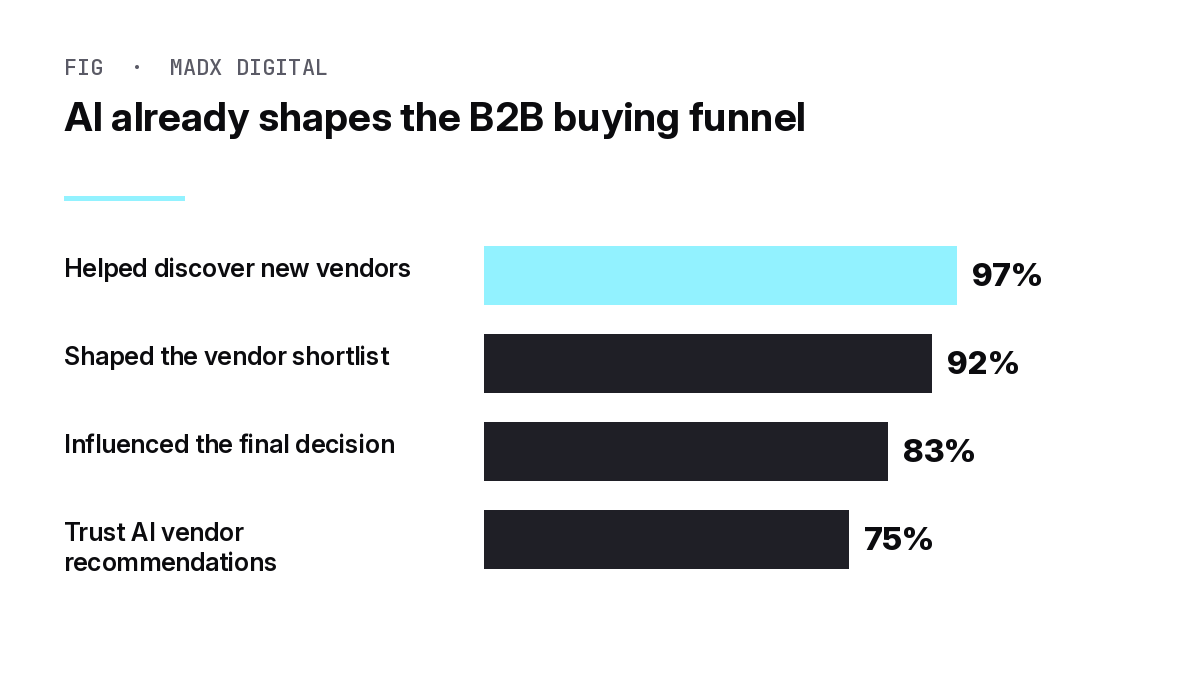
The number that should reset how marketers think is smaller. Only 7% of those buyers say they notice a vendor in an AI response because they recognise the name. Fit beats fame. For a challenger brand that is the opening, and for an incumbent coasting on recognition it is the warning.
Buyers still verify, and that is your second chance
An agent recommendation is a trigger, not the final word. Semrush found that once AI names a vendor, 71% of buyers visit that vendor's website, 63% search for it on Google and 38% check reviews on G2 or similar. Three in four still use search as part of the same decision. A strong agent mention with a weak site or thin reviews loses the buyer at the very next click, which is why AI visibility and traditional SEO have to move together.
Which agents your buyers actually use
It is not one assistant. In the same study, 71% of buyers used ChatGPT for product research, 61% used Google Gemini and 45% used Microsoft Copilot, with Perplexity and Claude behind them. Buyers move between tools for a single decision, so visibility has to be cross-platform rather than tuned to one engine. The practical side of running this inside a team sits in AI agents for marketing.
Where agents enter the funnel
Agents are not only a top-of-funnel toy. Semrush found 72% of buyers use AI during early research, 62% while actively comparing vendors and 45% to support the final decision. And 84% are using it to inform purchases worth $1,000 or more. These are real budgets and multi-stakeholder deals, which is why we treat the buying process itself in AI agents and B2B buying.
The categories buyers research this way are squarely in scope for SaaS. Semrush found agencies and service providers topped the list at 51%, followed by SaaS and software tools at 46% and marketing tools at 45%. If you sell software to other businesses, your category is already being filtered by an agent before a human ever books a call.
The six surfaces that decide if an agent picks you
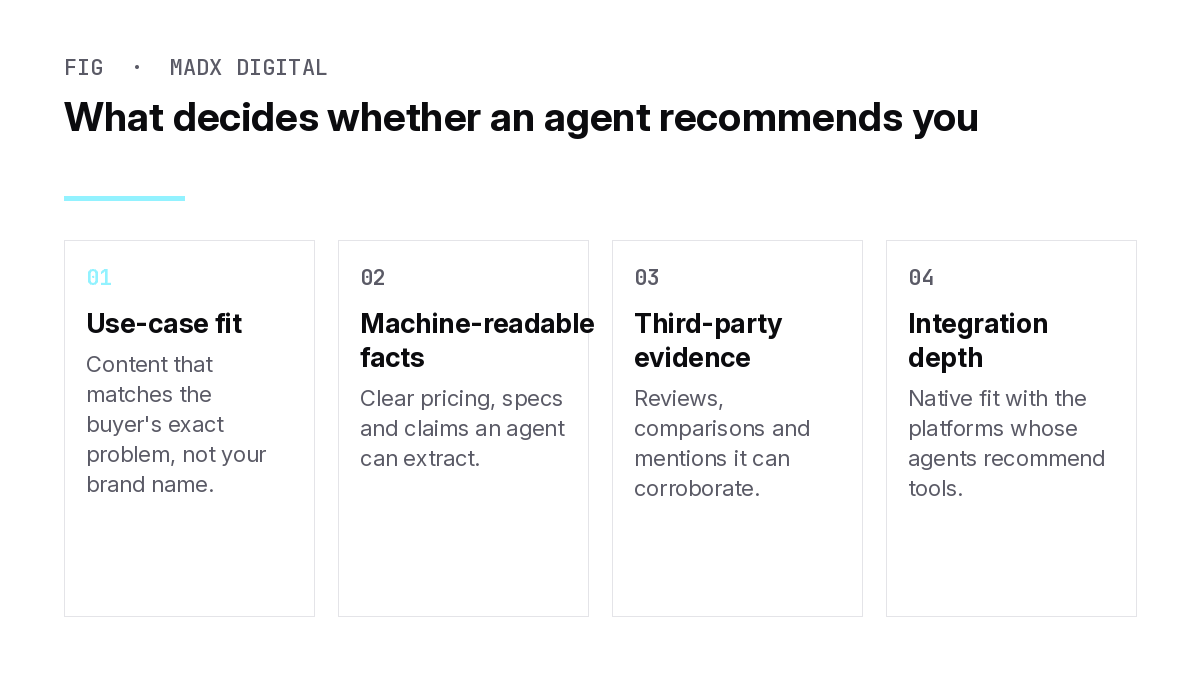
An agent does not weigh your billboard. It weighs evidence it can read, and six surfaces carry most of that weight. You can influence every one of them.
1. AI answers and citations
Being cited in the AI answers your buyers read is table stakes. If an agent cannot find you in the response, you are not in the running at all. Our work on ranking in AI search results covers the mechanics of getting surfaced in the first place.
2. Agentic search and browsing
Agents do not stop at a single answer. They browse, open pages and use tools to compare options against each other. What they can parse on your site decides what they can repeat about you, and we go deeper in how agentic search works.
3. Structured, machine-readable facts
Pricing an agent cannot read is pricing that cannot be compared, so the product gets dropped from comparisons by default. Clear specs, plans and claims in structured form are not a nicety. They are how you stay in the set. Our schema and structured data guide is the place to start.
4. Third-party evidence
Agents corroborate before they commit. Reviews on G2 and Capterra, comparison pages and independent mentions are the proof an agent leans on when your own site makes a claim. This is where MADX's work on review sites and comparison content does the heavy lifting.
5. Integration depth
When the agent lives inside a platform, native fit becomes distribution. A tool that plugs cleanly into the ecosystem whose agent is recommending gets surfaced more often than one that does not. Product and marketing stop being separate bets at this point. A deep, well-documented integration is now a distribution channel in its own right.
6. The optimisation layer itself
Finally there is the discipline of making all of the above legible to agents on purpose. We call that agentic SEO, and it is the engine room of this whole hub. Think of it as the method that turns the other five surfaces into a repeatable system.
Why agents skip vendors
The failure modes are worth naming, because each one is a gap you can close. In the Semrush data, 33% of buyers say AI recommendations are too generic for their use case, 27% say they do not reflect real pricing or contract structures, and 25% say AI missed vendors they knew were relevant. Generic positioning, hidden pricing and thin third-party coverage are the three ways to get left out.
What changes for the B2B SaaS marketing team
If agents pick on evidence, the marketing team's job changes shape. Three things move first: the metrics, the content and the positioning.
Metrics: from clicks to reference rate
Sessions and click-through tell you how humans found you. They say nothing about whether an agent recommends you. The new scoreboard is mentions, citations and reference rate across the agents your buyers use, and we cover the how in measuring AI search visibility.
Content: from persuasion to proof
Human-facing copy persuades. Agent-facing content has to be verifiable. Use-case pages, documented outcomes, honest pricing and specifics an agent can lift are worth more than another thought-leadership essay. The table below shows how the playbook shifts.
Positioning: fit over fame
Because only 7% of buyers notice a vendor by name, sharp use-case positioning now outperforms broad brand awareness in the surfaces agents read. Semrush found the thing buyers do notice is a vendor that closely matches their use case, cited by 53% of them. Say exactly who you are for and what you replace. Vague wins nobody the recommendation.
Mind the buying committee
One more wrinkle the data exposes: AI use is uneven inside a buying group. Semrush found only 39% of respondents say most stakeholders use AI during vendor research, while 52% describe adoption as mixed. The person who found you through an agent may not be the one who signs. So being the agent's pick gets you in the room, but you still need the human-facing proof that wins the rest of the committee.
Where human marketing still wins
None of this retires the human craft. Brand, narrative and relationships still close deals, and they still shape the reviews and mentions an agent later reads. The shift is not from human marketing to machine marketing.
It is that your best human work now has to leave a trail an agent can follow. A great launch that never shows up in a review, a comparison or a structured claim is a great launch an agent cannot repeat. Do both, and the two reinforce each other.
A 90-day agentic-readiness starting point
You cannot fix six surfaces at once. Start where agents already form opinions about you, then widen out. Here is the sequence we use with SaaS teams.
Weeks 1 to 4: see what agents say
Baseline how the major agents describe and recommend your category, and where you appear or do not. Our AI visibility primer and a set of buyer-intent prompts give you the starting map. You cannot improve a picture you have not looked at.
Weeks 5 to 8: fix what agents read
Make your pricing, specs and core claims machine-readable, tighten your use-case pages and clean up the structured data. This is the unglamorous work that actually moves the pick. It also compounds, because every agent that reads you cleanly repeats you more accurately.
Weeks 9 to 12: build the evidence agents trust
Earn the third-party proof an agent corroborates against: reviews, comparison placements and independent mentions. This is MADX's core discipline, and it is what our AI search agency work and our free AI search audit are built around. It is also the slowest surface to move, which is exactly why starting it early pays off.
The honest counterpoint
Is this overblown? Partly. Agents still hallucinate, buyers still verify, and a human signs most B2B contracts. Semrush found 75% of buyers say they trust AI recommendations, yet nearly all check before committing.
So treat agentic marketing as the new front door, not the whole house. The verdict is simple. The humans still decide, but the agent increasingly decides who the humans get to consider. Earn the shortlist, and you keep earning the meeting.
Frequently asked questions
What is agentic marketing?
Agentic marketing is the practice of making a brand discoverable and recommendable to AI agents that research, shortlist and buy on a human's behalf. It extends AI-search visibility from appearing in answers to being the option an agent actually picks.
How is agentic marketing different from GEO?
Generative engine optimisation gets you mentioned in an AI answer a human reads. Agentic marketing targets the decision an autonomous agent makes after that, where there may be no click and no second choice. GEO is a foundation; agentic marketing is the outcome.
Is agent-mediated B2B buying actually happening yet?
In part. Semrush found 92% of B2B professionals say AI has already shaped their vendor shortlist, and Gartner projects 90% of B2B buying will be AI agent intermediated by 2028. Fully autonomous purchasing is still early, but agent-influenced shortlisting is mainstream now.
How do AI agents decide which software to recommend?
They weigh evidence they can read: use-case fit, machine-readable facts like pricing and specs, third-party proof such as reviews and comparisons, and integration depth. Brand recognition barely registers, since only 7% of buyers notice a vendor because they know the name.
What should a B2B SaaS team do first?
Baseline how agents describe your category, make your pricing and claims machine-readable, then build the third-party evidence agents corroborate against. Measure reference rate and citations rather than clicks alone.
Does agentic marketing replace SEO?
No. It builds on it. Traditional and AI search still drive discovery, and buyers verify AI recommendations with their own searches. Agentic marketing adds a layer that targets the agent-made recommendation on top of solid SEO foundations.
.png)
Latest articles
What we've published in the past 30 days — across SEO, GEO, content, and digital PR.