.webp)





.webp)
GEO
Calculating...
Oct 2026
Agentic AI vs Generative AI: What the Shift Means for B2B Marketers
Agentic AI vs generative AI, explained for B2B marketers: reactive content versus proactive action, why the shift matters, and what to do about it now.
Agentic AI vs generative AI comes down to one thing. Generative AI produces an output when you prompt it. Agentic AI pursues a goal on its own, planning steps and using tools to get there. One writes the email; the other decides to send it, to whom and when.
What generative AI is
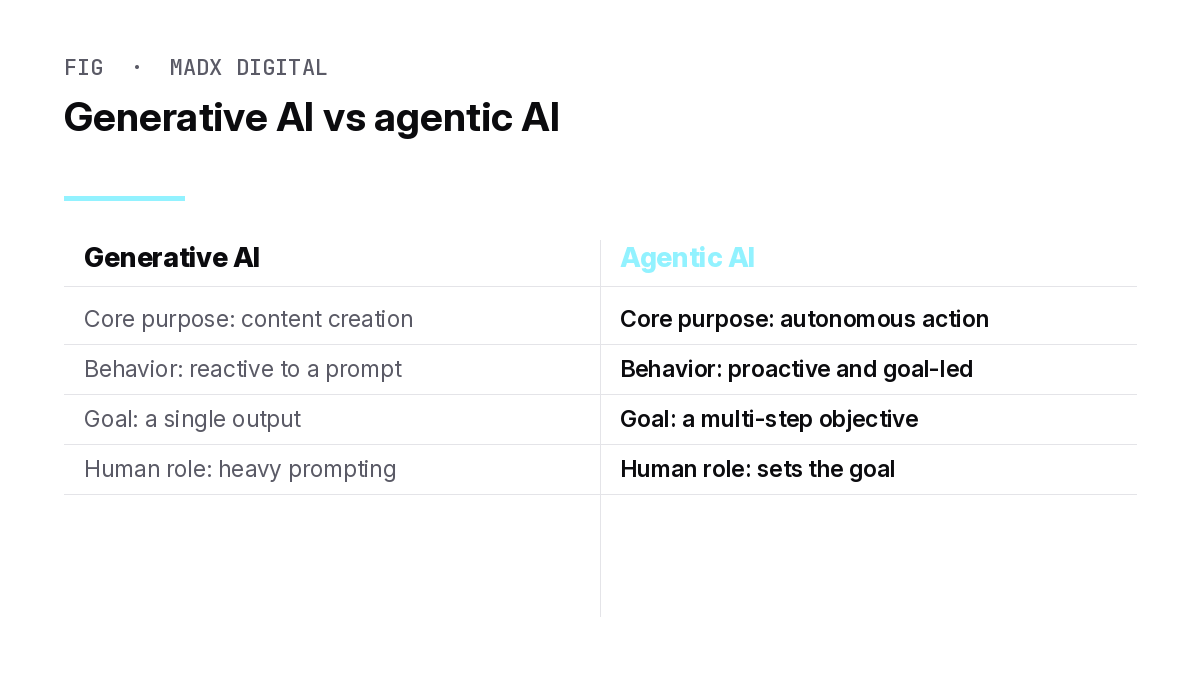
Generative AI is a reactive content creator. It waits for a prompt, then produces text, images or code based on patterns in its training data. It is the technology behind most AI writing and image tools.
How it behaves
A generative model predicts the next most likely element in a sequence, one word or pixel at a time. That is why it is so good at drafting and so dependent on a human to ask. Left alone, it does nothing. It is a brilliant responder, not an initiator.
What it is good and bad at
Generative AI is excellent at drafting, summarising and ideation, and it has reset how fast teams produce content. Its limit is that it does not decide or verify. It will write a confident paragraph whether or not the facts hold, and it will not go and check. That gap is exactly what agentic systems try to close by adding planning, tools and steps.
What agentic AI is
Agentic AI is a proactive system that pursues a goal. Given an objective, it plans a sequence of steps, uses tools to carry them out and adapts as it goes, with a human usually kept in the loop for oversight.

The three parts of an agent
Salesforce breaks an agent into three parts: a planning module that splits a goal into steps, memory that holds context across those steps, and tool use that lets it call external systems, APIs and apps. Put together, those three turn a model that talks into a system that does.
That autonomy raises the stakes for how you present your brand. A person who misreads your pricing can ask a follow-up question. An agent that cannot parse your pricing simply drops you from the comparison and moves on. The margin for ambiguity shrinks when the reader is a system acting on what it finds.
They work together
This is not an either-or. An agent often uses a generative model as one of its tools, calling it to draft an email or summarise a page inside a larger task. The agent is the doer. The generative model is one instrument it reaches for.
A concrete example
Salesforce gives a clean illustration. An agent handling a delayed shipment checks the tracking system, finds the package is stuck, then calls a generative model to write a personalised update to the customer, and finally sends it and closes the ticket. The agent plans and acts. The generative model only writes the words when asked.
The differences that matter
For a marketer, four differences decide how your brand gets found. The table lays them out, then we translate each into what changes for you.
From answers to actions
Generative search gives a buyer an answer to read. Agentic search gives a buyer a shortlist, a comparison, sometimes a completed purchase. The difference changes what you optimise for, which is why we treat the mechanism on its own in how agentic search works.
There is a practical consequence hiding in that shift. A human skims and infers; an agent extracts and compares. So the same page has to carry clean, explicit facts, not just persuasive prose, or the agent has nothing solid to act on.
From being cited to being chosen
In a generative answer you want to be mentioned. In an agentic flow you want to be picked, because the agent may act on one option without showing the rest. Getting from mention to pick is the whole subject of agentic SEO.
Agentic AI vs AI agents: a quick clarification
People use agentic AI and AI agents almost interchangeably, and that is mostly fine. An AI agent is a single system that plans and acts. Agentic AI is the broader approach, often several agents and models working together. For a marketer the practical point is the same either way: software is now being evaluated by something that acts, not just a person who reads.
Where copilots fit
A copilot sits closer to generative AI than to a true agent. It helps a person do a task, drafting or suggesting, but it does not run a multi-step job on its own. Knowing the difference stops you from over-preparing for autonomy that a given tool does not yet have.
Why the shift reshapes discovery and buying
This is not an academic distinction. The move from generative to agentic AI is changing who does the buying research in B2B, and the numbers are already large.
Gartner predicts that by 2028, 90% of B2B buying will be AI agent intermediated, pushing over $15 trillion of B2B spend through AI agent exchanges. Even if that timeline slips, the shape of the change is clear.
It is already many tools, not one
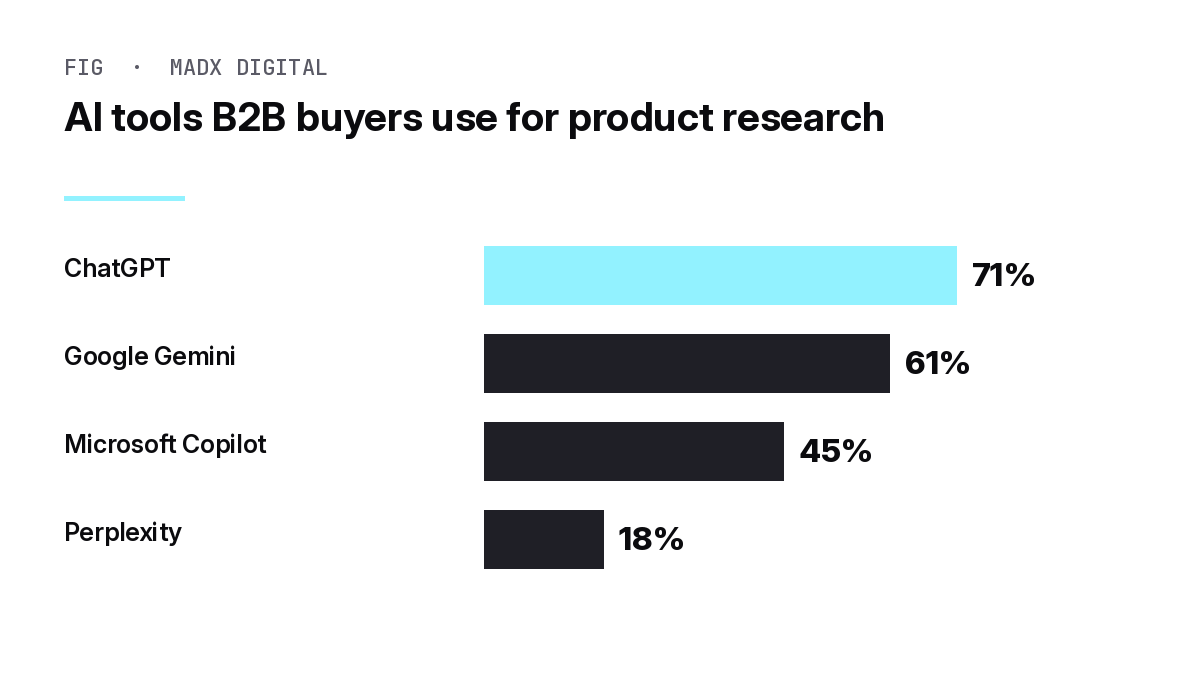
Buyers are not waiting. A Semrush survey of 643 US B2B professionals found 71% use ChatGPT for product research, 61% use Google Gemini and 45% use Microsoft Copilot. They move between tools inside a single decision, so you cannot optimise for one engine and call it done.
Not just discovery, the whole funnel
The same research shows AI is not confined to the top of the funnel. Semrush found 92% of B2B professionals say AI has already shaped their vendor shortlist and 83% say it influenced their final decision, with buyers using it during early research (72%) and active comparison (62%) alike. An agent that touches the shortlist and the final call is an agent worth preparing for.
Fit beats familiarity
One Semrush finding reframes the whole exercise. Only 7% of buyers notice a vendor in an AI response because they recognise the name, while 53% notice the vendor that closely matches their use case. In a generative or agentic answer, precise fit outperforms brand recognition, which is good news for focused challengers and a warning for coasting incumbents.
The strategic picture
Step back and the pillar view applies. The generative era rewarded showing up in answers. The agentic era rewards being the option an agent acts on. We tie the two together in our guide to agentic marketing, and the answer-engine foundations still sit in our generative engine optimisation guide.
What marketers should do now
The verdict is not to abandon generative-era work. It is to extend it. Keep earning citations in AI answers, then make sure an agent can act on what it finds about you.
Three moves this quarter
First, make your core facts, pricing and use cases machine-readable so an agent can lift them. Second, earn third-party evidence an agent can corroborate, since it will not take your word alone. Third, start measuring whether agents recommend you, not just whether humans click. Our work on ranking in AI search and a free AI search audit are the fastest way in.
How to tell it is working
Watch for the agentic signals, not just the generative ones. Track how often agents mention and recommend you on your core category prompts, whether they describe you accurately, and whether that presence turns into pipeline. If your reference rate in agent answers climbs while competitors flatline, the work is landing.
What stays the same
Plenty carries over. Strong content, clear positioning and real customer proof mattered in the generative era and matter more now. The change is that each of those has to leave a machine-readable trace, because the reader passing judgment is increasingly an agent. Good marketing still wins; it just has to be legible to software as well as to people.
The honest caveat
Agentic AI is early and uneven. Agents still make mistakes, and most still ask a human before they act on anything that matters. Treat the generative-versus-agentic shift as a direction to prepare for, not a switch that flipped overnight. The brands that prepare now will simply be the ones agents already trust when the volume arrives.
So treat this as a direction, not a scramble. Keep the generative-era habits that work, add the agentic-era habits that are becoming essential, and you cover both the AI that answers today and the AI that acts tomorrow. That is the practical meaning of agentic AI vs generative AI for a marketing team.
Frequently asked questions
What is the main difference between agentic AI and generative AI?
Generative AI is reactive: it produces content when prompted. Agentic AI is proactive: it plans and executes a series of steps to reach a goal, using tools along the way. Salesforce sums it up as reactive versus proactive.
Is agentic AI just generative AI with extra steps?
No. Agentic AI adds planning, memory and tool use on top of models. It can use a generative model as one of its tools, but the agent is the system that sets a plan and acts, while the generative model only responds.
Why does the difference matter for B2B marketing?
Because agents, not only people, now research and shortlist software. Gartner projects 90% of B2B buying will be AI agent intermediated by 2028. Marketing has to move from being readable in answers to being usable by an agent that acts.
Do I need to optimise differently for agentic AI?
You extend, not replace. Keep earning citations in AI answers, then make your facts machine-readable and your claims verifiable through third parties so an agent can act on them. That combined discipline is what we call agentic SEO.
Which AI tools are B2B buyers actually using?
Semrush found 71% use ChatGPT for product research, 61% Google Gemini and 45% Microsoft Copilot, with Perplexity and Claude behind. Buyers switch between tools for one decision, so cross-platform visibility matters more than any single engine.
.png)
Latest articles
What we've published in the past 30 days — across SEO, GEO, content, and digital PR.