.webp)





.webp)
GEO
Calculating...
Oct 2026
AI Agents and B2B Software Buying: How the Shortlist Gets Made Now
AI agents now research and shortlist B2B software. See where they sit in the buying process, how shortlists get built, and how to stay on the list.

AI agents are entering the B2B software buying process at every stage, from scoping a category to building the shortlist and supporting the final decision. They read sites, docs and reviews, filter options against the brief and hand a buyer a ranked short list. For vendors, the job is to still be on that list when the agent is done.
Where agents sit in B2B buying today
Agents are not stuck at the top of the funnel. Buyers now pull AI into research, comparison and the final decision, which means an agent can touch a deal from first scoping to signature.

The projection, checked at the source
Gartner predicts that by 2028, 90% of B2B buying will be AI agent intermediated, pushing over $15 trillion of B2B spend through AI agent exchanges. The same set of predictions expects firms that run 80% of customer-facing processes on multiagent AI to pull ahead. Read together, agents are heading for the centre of the buying process, not the edge.
What is already true
You do not have to take the 2028 number on faith to act. Semrush found 92% of B2B professionals say AI has already shaped their vendor shortlist and 83% say it influenced their final decision. The agents are not hypothetical. They are in the deals you are working right now.
The momentum is broad, not niche. Gartner also expects agent and GenAI use to drive a $58 billion shakeup of everyday productivity tools through 2027, a sign of how quickly agent-first habits are forming across the software a buyer touches. The behaviours forming now are the ones that harden into defaults.
Real budgets, real categories
This is not limited to cheap tools bought on a whim. Semrush found 84% of buyers use AI to inform purchases worth $1,000 or more, and software sits near the top of the categories researched this way at 46%. If you sell B2B software, an agent is likely vetting you before a human ever books a call. The broader picture sits in our guide to agentic marketing.
It is not one assistant
Buyers also spread across tools, so you cannot win by tuning for one. Semrush found 71% use ChatGPT for product research, 61% Google Gemini and 45% Microsoft Copilot, often switching between them for a single decision. An agent acting for a buyer inherits that spread, which makes cross-platform visibility the baseline rather than a nice-to-have.
How an agent builds a shortlist
An agent builds a shortlist the way a sharp analyst would, only faster. It gathers the brief, filters to what fits, checks the evidence and returns a ranked few. Each step is a place you can be kept or cut.

It starts from the buyer's brief
The agent turns a human goal into criteria: budget, must-have features, integrations, maybe compliance needs. Anything it cannot confirm about you against those criteria is a reason to drop you. This is why the way agents run a search matters so much, which we cover in how agentic search works.
It filters on fit, not fame
Brand recognition barely helps here. Semrush found only 7% of buyers notice a vendor because they recognise the name, while 53% notice the one that matches their use case. An agent weighs fit the same way, so a precise match beats a famous logo.
It checks the evidence
Before it recommends, an agent corroborates. Reviews, comparison pages and independent mentions are what it leans on, which is why our work on how review sites shape AI recommendations is central to staying in the set.
A worked example
Picture a buyer asking an agent for a help-desk tool under a set seat price that integrates with their CRM. The agent reads vendor pages, checks which tools list that integration, drops the ones over budget, scans reviews for reliability complaints, then returns three names with a line on each. A vendor that buried its CRM integration in a PDF never makes that list, however good the product is.
Why vendors get filtered out early
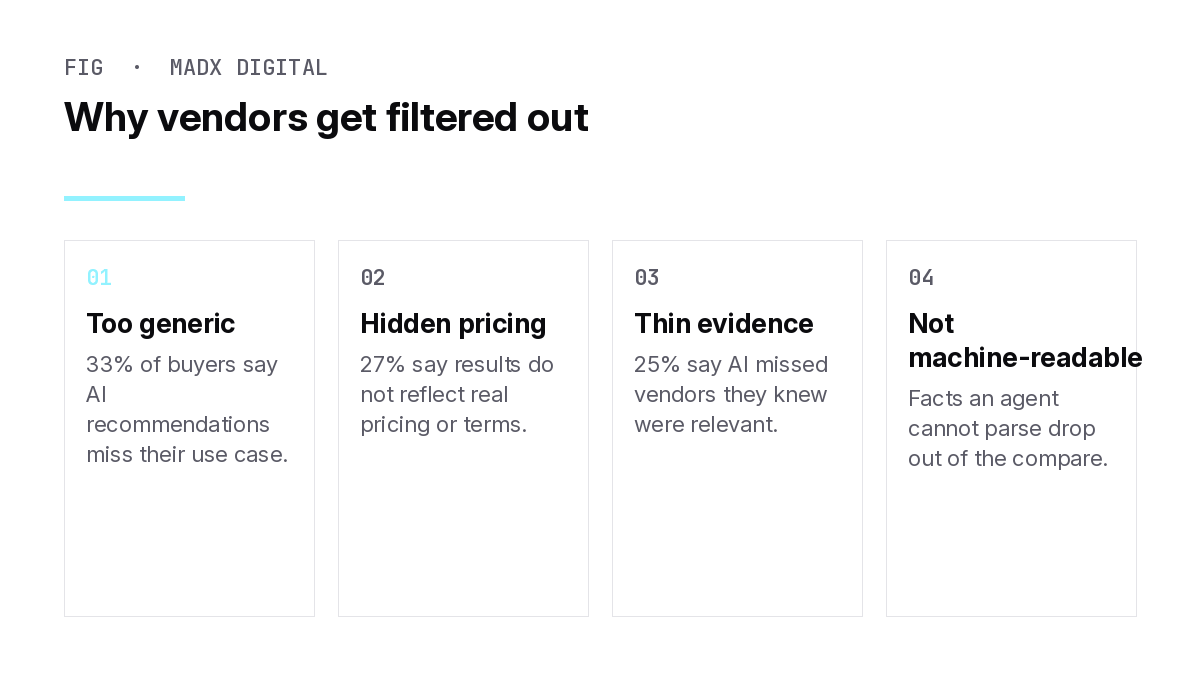
Most vendors are not cut because the product is weak. They are cut because the agent could not confirm the product fits. Three gaps do most of the damage.
Generic positioning
Semrush found 33% of buyers say AI recommendations are too generic for their use case. If your pages describe a broad category instead of a specific job, an agent cannot match you to a precise brief, so it reaches for a vendor that named the use case plainly.
Hidden pricing and terms
27% of buyers say AI results do not reflect real pricing or contract structures. If an agent cannot read your price, it cannot place you in a budget-filtered comparison. Hidden pricing does not protect you here. It removes you from the list.
Thin third-party evidence
25% say AI missed vendors they knew were relevant, often because those vendors lacked the external proof an agent corroborates against. If the only place your claims appear is your own site, an agent has nothing to verify them with. Our guide to getting recommended by AI covers how to build that proof.
Accuracy cuts both ways
There is a second risk beyond being left out: being described wrong. An agent that cannot find clear facts about you will fill the gap with its best guess, and that guess can be out of date or simply incorrect. A buyer reading a wrong price or a missing integration moves on just as fast as if you were absent. Clear, current, machine-readable facts are how you keep the agent from inventing a worse version of you.
How to stay on the shortlist
Staying on an agent-built shortlist comes down to three things: be readable, be comparable, be corroborated. Fix those and you are back in contention for the deals agents are already shaping.
Name the use case
Say exactly who you are for and what you replace, in plain text an agent can lift. Specific use-case pages do more for agent visibility than another broad overview. One page that nails a single job an agent can match beats five that gesture at a category. You can seed these from the real questions buyers ask, which we cover in buyer queries for AI prompt tracking.
Expose pricing and facts
Put pricing, plans and core specs where an agent can read them. You do not have to publish every number, but a buyer-agent that cannot estimate your cost will quietly favour a competitor it can. The optimisation craft behind this is agentic SEO.
Build the proof
Earn the reviews, comparisons and independent mentions an agent corroborates against. This is MADX's core discipline, and it is what our AI search agency work and free AI search audit are built to deliver. It is also the slowest layer to build, so start now.
Equip the human too
An agent gets you shortlisted, but a person usually signs. Semrush found AI adoption inside buying groups is uneven, with only 39% saying most stakeholders use it. So pair agent-ready content with the human-facing proof the rest of the committee still needs. The two jobs are covered together in AI agents for marketing.
Measure your shortlist rate
Treat this as something you track. Run your real buyer prompts across the main tools, see how often you make the shortlist and how often a competitor does instead, and watch whether the agent gets your pricing and use cases right. That gives you a punch list of fixes and a way to prove the work is moving your position over time, which is far more useful than a vague sense that AI matters now.
The honest caveat
None of this means the agent has the last word yet. Buyers still verify, humans still negotiate, and agents still get categories wrong. Treat the shortlist as the new gate, not the whole decision. Clear the gate and you keep the meetings you would otherwise never hear about.
The vendors that get ready early will not just appear more often; they will be described more accurately, shortlisted more consistently, and trusted sooner as agent-led buying becomes the norm rather than the experiment.
Frequently asked questions
Are AI agents really buying B2B software yet?
They are shaping the buying more than closing it. Semrush found 92% of B2B professionals say AI has already shaped their vendor shortlist, and Gartner projects 90% of B2B buying will be AI agent intermediated by 2028. A human still signs most deals, but agents increasingly decide who gets considered.
How does an AI agent choose which vendors to shortlist?
It turns the buyer's brief into criteria, filters out options that miss must-haves, checks third-party evidence, then ranks what is left. It weighs use-case fit far more than brand recognition, so a precise match beats a famous name.
Why would an agent leave my product off the list?
Usually because it could not confirm you fit. The common reasons are generic positioning, pricing it cannot read and thin third-party evidence. Each is a gap you can close with clearer, better-sourced content.
Does hiding pricing help or hurt with AI agents?
It hurts. If an agent cannot read your price, it cannot place you in a budget-filtered comparison, so you drop out by default. You do not have to publish every number, but your core pricing should be machine-readable.
What is the fastest way to stay on agent shortlists?
Be readable, comparable and corroborated. Name your use cases in plain text, expose pricing and specs an agent can parse, and build the reviews and comparisons it verifies against. Start with the evidence layer, since it takes longest to grow.
.png)
Latest articles
What we've published in the past 30 days — across SEO, GEO, content, and digital PR.