.webp)





.webp)
GEO
Calculating...
Oct 2026
Agentic Search Explained: How AI Agents Find and Evaluate Software
Agentic search is how AI agents browse, compare and shortlist software. See how it works, what agents can read, and how to be the option they pick.

Agentic search is a search run by an AI agent rather than typed by a person. The agent takes a goal, plans the steps, browses multiple sources, uses tools to compare options and returns a shortlist or a single pick. It is less like a query and more like handing the research to an assistant.
How an agentic search runs
An agentic search is a loop, not a single lookup. The agent interprets the goal, gathers evidence across sources, compares what it finds and returns a result, looping back when a step falls short.

It plans and uses tools
This is the agentic part. As Salesforce describes it, an agent has a planning module, memory and tool use, so it can break a goal into steps and call external systems to carry them out. In a search that means opening pages, running comparisons and pulling data, not just predicting the next sentence. We unpack that distinction in agentic AI vs generative AI.
It browses more than one source
A single answer leans on what the model already knows. An agentic search goes and looks, often across several engines in one session. Semrush found B2B buyers already spread across ChatGPT, Gemini and Copilot for product research, so an agent acting for them rarely trusts one source alone.
A worked example
Say a RevOps lead asks an agent to shortlist tools that sync Salesforce with their data warehouse under a set budget. The agent does not stop at one answer. It reads vendor sites, checks integration docs, scans a few review pages, filters to options that actually support the warehouse and fit the budget, then returns three names with reasons. Every step depends on what each vendor made readable.
A human still signs off
For now, a person usually stays in the loop. The agent does the legwork and proposes, and the human approves, especially on anything that costs money. That means the agent is shaping the shortlist more than making the final call, which is exactly why getting onto the shortlist matters so much. Influence the research and you influence the decision.
Agentic search vs an AI answer vs classic search
The quickest way to see what is new is to put the three side by side. Classic search returns links. An AI answer returns a synthesis. Agentic search returns a decision.
Why the shortlist is the prize
In classic search a buyer sees ten results and picks. In agentic search the agent may surface three, or act on one. If you are not in that short list, there is no second page to rescue you. Being chosen, not just mentioned, is the subject of agentic SEO, and the strategic view sits in our guide to agentic marketing.
Where AI Overviews fit in
AI Overviews and chat answers sit between classic and agentic search. They summarise, but they still hand the decision back to a person. Agentic search is the step beyond, where the system carries the decision further and sometimes acts on it. The three will coexist, so you are optimising for all of them at once, not choosing one.
The direction of travel is not subtle. Gartner projects that by 2028, 90% of B2B buying will be AI agent intermediated, moving over $15 trillion through agent exchanges. The buying process behind that shift is the subject of AI agents and B2B buying.
What agents can and cannot read
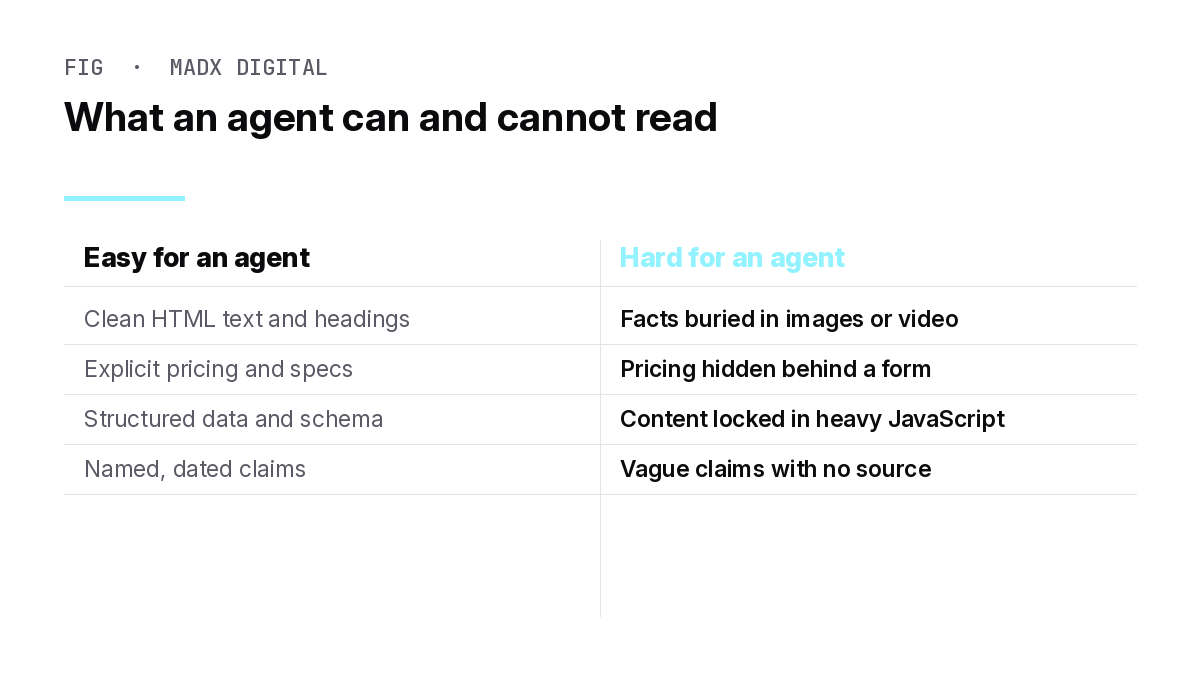
An agent can only repeat what it can parse. The gap between what reads well to a human and what reads cleanly to a machine is where most brands quietly lose the comparison.
Structured data and clear facts
Explicit pricing, specs and plans in machine-readable form are the difference between being compared and being dropped. If an agent cannot extract your price, it cannot place you in a price comparison, so you fall out by default. Our schema and structured data guide covers the how.
Crawlability and clean HTML
Agents read HTML text far better than content locked in images, video or heavy client-side JavaScript. If your key claims only render after a script runs, assume some agents will miss them. How the major crawlers behave is covered in our piece on AI crawlers.
Gated and hidden content
Anything behind a form, a login or a PDF an agent will not open is effectively invisible to it. That does not mean ungate everything, but your core facts should live somewhere an agent can reach without friction.
APIs and feeds
The most agent-ready brands go a step further and expose structured feeds or APIs an agent can query directly. You do not need that on day one. But as agents get better at tool use, a clean public source of your pricing, features and availability becomes a real advantage over a competitor an agent has to scrape and guess at.
Consistency helps too. When your pricing, positioning and category claims say the same thing on your site, your docs and third-party profiles, an agent gets a clear signal. When they conflict, it either picks the wrong version or discounts you for being unclear. Say the same thing in the same way everywhere it counts.
Signals you can influence today
You cannot control how an agent reasons, but you can control what it finds. Three signals move the needle, and all three are within reach this quarter.
Be readable
Put your most important facts in clean text with clear headings, not trapped in a graphic. An agent that can lift a sentence will quote it. One it has to guess at, it skips.
Be comparable
State pricing, integrations and use cases plainly so an agent can line you up against alternatives. Comparison is where agentic search spends most of its time, which is also why our work on how AI builds recommendations matters here.
Be corroborated
Agents verify before they commit. Semrush found that after an AI names a vendor, 71% of buyers visit the vendor site, 63% search Google and 38% check reviews on G2 or similar. Third-party evidence is what survives that check.

Where to start
Begin by watching how agents handle your category, then fix the reading and comparison gaps they expose. Our guide to ranking in AI search and a free AI search audit are the quickest way to see where you stand.
Measure what agents say
Treat agent visibility as something you track, not hope for. Run your core category prompts across the main tools, note where you appear in the shortlist and where you do not, and watch whether the agent describes you accurately. That baseline tells you which reading and comparison gaps to close first, and whether the work is moving your reference rate over time.
Start where buyers compare
If you only fix one thing, fix the pages where buyers compare options. Agentic search leans hardest on comparison and alternatives content, because that is where a shortlist gets built. Make sure those pages state the trade-offs plainly, name the alternatives honestly and carry the facts an agent needs to place you correctly. Get the comparison surface right and you earn a place in more shortlists than any amount of brand copy would win you.
The honest limit
Agentic search is still maturing. Agents miss things, favour sources they already trust and sometimes get your category wrong. That is a reason to make yourself easy to read now, not a reason to wait.
The brands that are legible today are the ones agents will lean on as the behaviour spreads. The cost of getting ready is mostly clarity, which helps your human buyers too, so there is little downside to starting early.
Frequently asked questions
What is agentic search?
Agentic search is a multi-step search run by an AI agent. Instead of returning links or a single answer, the agent plans, browses several sources, uses tools to compare options and returns a shortlist or a recommendation.
How is agentic search different from an AI Overview or ChatGPT answer?
An AI answer replies once, mostly from what the model knows. Agentic search acts across many sources it browses live, then compares and shortlists. The output is closer to a decision than a summary.
How do I make my site readable to AI agents?
Put key facts, pricing and specs in clean HTML text and structured data rather than images, forms or heavy JavaScript. If an agent can extract a claim, it can repeat it; if it has to guess, it skips you.
Does agentic search replace SEO?
No. Buyers still verify, with most visiting your site and searching Google after an AI names you. Agentic search adds a layer on top of SEO, so strong traditional search and AI visibility still matter.
What matters most for getting picked in agentic search?
Be readable, be comparable and be corroborated. Clean machine-readable facts get you into the comparison, and third-party evidence like reviews survives the verification step that follows an agent recommendation.
.png)
Latest articles
What we've published in the past 30 days — across SEO, GEO, content, and digital PR.