.webp)





.webp)
Marketing
Calculating...
Oct 2026
AI Agents for Marketing: A Practical Guide for B2B SaaS Teams
AI agents for marketing, explained for B2B SaaS teams: where agents help, where they fall short, and the use case most teams miss, being found by buyers.

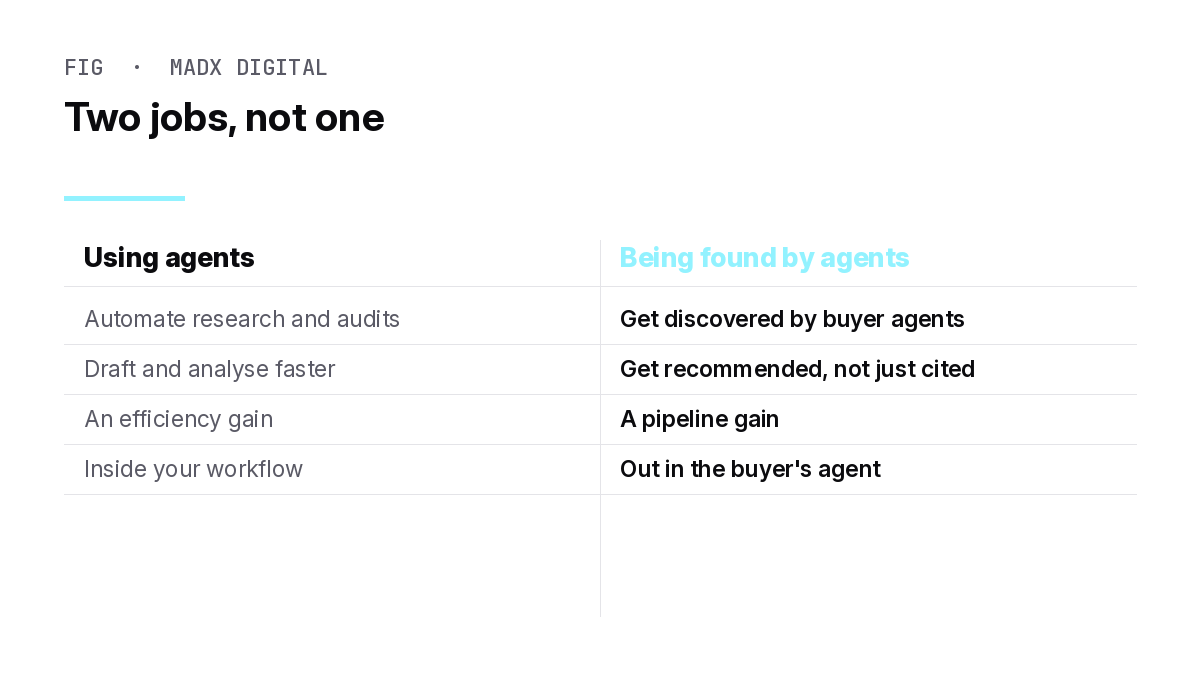
AI agents for marketing covers two things at once. One is using AI agents to run marketing and SEO tasks faster, from audits to trend-spotting. The other is making sure your brand is visible when a buyer's own agent researches and shortlists software. Most teams do the first and forget the second, and the second is where the pipeline is.
Where agents genuinely help a marketing team
Used well, an agent is like a capable junior who never tires of the repetitive analysis. You describe the outcome, it plans the steps, runs the work and comes back with recommendations. A handful of use cases pay off quickly.

Research and audits on a schedule
Ahrefs lays out a strong set of these: find pages losing traffic and why, group pages that cannibalise each other, spot rising trends before competitors, and surface the AI prompts where rivals appear and you do not. The common thread is repetitive analysis that an agent can run weekly without you babysitting it.
The setup that makes it work
An agent is only as good as the data and tools you connect to it. Give it access to your analytics, your SEO data and your CMS and it can act. Leave it as a chatbot and it can only opine. Ahrefs puts the point bluntly, and it matches what we see in practice.
Where the time actually goes
The win is rarely a single magic output. It is removing the hours a team spends pulling data, cleaning it and formatting reports, so the people are left with the judgment calls. Treat agents as a force multiplier on the boring middle of the work, not a replacement for strategy.
A worked example
Say you want to catch content decay before it hurts. Instead of pulling a report each month, you tell an agent to scan your library every Monday, flag pages sliding in traffic, diagnose the likely cause and draft a refresh plan for each.
You arrive to a prioritised queue, not a blank dashboard. The agent did the gathering and the first pass of diagnosis; you make the calls that need judgment. That division of labour is the whole point.
Beyond SEO tasks
The same pattern extends past SEO. Agents can monitor Reddit and communities for questions worth answering, audit your pages against E-E-A-T signals, and flag stale third-party content that is feeding AI wrong facts about you. None of these replace a marketer. They each hand one back hours a week that used to go on manual checking.
Where they fall short
The honest other side matters, because over-trusting an agent is how teams get burned. Agents are capable, not autonomous, and they fail in predictable ways.
They are not more accurate than the model underneath
An agent reasons with the same model it would in a chat window, so it can make the same mistakes with more confidence. On anything client-facing or high-stakes, a human has to check the output before it ships. The reasoning did not get smarter; it just got more capable of acting.
Big data and long jobs break them
Feed an agent a huge dataset and it may quietly skip rows or invent a pattern. Hand it a long, hands-off workflow and the number of things that can go wrong multiplies. Short, well-scoped tasks with a review step are far more reliable than a four-hour chain nobody is watching.
Keep a human in the loop
The teams that get value treat agents as assistants that propose, with a person who approves. That is not a limitation to engineer away today. It is the safe operating mode while the tools mature, and it is exactly how Gartner frames preparing for agents as a behavioural change, not just a technical one.
The oversight tax is real
There is a cost people forget: reviewing an agent's work takes time too. If a task needs heavy checking every run, the net saving can be small. The use cases that pay off are the ones where the agent is right often enough that a quick review beats doing it from scratch. Pick those first, and be honest when a task is not one of them.
The use case most teams miss
Here is the gap. Most marketing teams are busy using agents to do their work, while overlooking the bigger shift: their buyers are using agents too, and those agents decide which software gets recommended.
Your buyers already run agents
This is not hypothetical. Semrush found 92% of B2B professionals say AI has already shaped their vendor shortlist, and buyers spread across ChatGPT, Gemini and Copilot to do it. Gartner projects that by 2028, 90% of B2B buying will be AI agent intermediated, moving over $15 trillion through agent exchanges.
Being used is not being found
Automating your own reporting does nothing to make a buyer's agent recommend you. These are two separate jobs with two separate payoffs. The first saves hours; the second wins deals. The discipline behind the second is agentic SEO, and the buying process it feeds into is covered in AI agents and B2B buying.
What that requires
Being found by buyer agents means the same things every time: clear use-case fit, machine-readable facts and third-party evidence an agent can verify. Semrush found only 7% of buyers notice a vendor by brand name, while 53% notice the one that matches their use case, so precision beats awareness. The strategic frame is our guide to agentic marketing.
Why the two get conflated
The confusion is natural, because both wear the same label. But using agents is an internal efficiency project, while being found by agents is an external visibility project. They need different owners, different metrics and different budgets. Naming them separately is the first step to resourcing both instead of only the one that feels closer to home.
There is also a timing trap. The internal wins arrive in weeks, while the being-found work compounds over months, so teams chasing a quick result over-invest in the first. The brands that will look smart in a year are the ones funding the slower, external job today.
How to start
You can start on both jobs this quarter without a big rebuild. Begin with one internal use case, then turn to being found.

Pick one job and guard it
Choose a repeatable, low-risk task like a weekly declining-content scan, connect the data it needs, and keep it read-only on anything live until you trust it. Review the output, then let it run on a schedule. One reliable workflow beats ten half-working ones.
Then turn to being found
Once the internal win is banked, point the same energy at the bigger prize. Baseline how buyer agents describe your category, fix the facts they read, and build the evidence they trust. A free AI search audit and our AI search agency work are the fastest way to see where you stand and close the gaps.
Measure both sides
Track the internal win in hours saved and work shipped, and track the external win in mentions and recommendations across the agents your buyers use. Our guides to AI visibility tools and measuring AI search visibility cover the external side.
Who should own each side
Give the internal-efficiency work to whoever runs ops or analytics, since it is about workflows and data. Give the being-found work to whoever owns demand and content, since it is about positioning and evidence. If one person tries to carry both, the visible internal wins tend to crowd out the external work that actually moves pipeline.
The honest verdict
AI agents for marketing are genuinely useful today for the doing, and genuinely urgent for the being found. Use them to move faster, but do not mistake that for the whole game. The brands that win the next few years will be the ones other agents recommend, so spend at least as much effort being discoverable as you do being efficient. Efficiency is table stakes; discoverability is the advantage, and it compounds while your competitors are still automating reports.
Frequently asked questions
What are AI agents for marketing?
The term covers two things. One is using AI agents to run marketing and SEO tasks like audits, research and reporting. The other is making your brand discoverable to the agents your buyers use to research and shortlist software. Both matter, but the second drives pipeline.
What marketing tasks can AI agents actually do well?
Repetitive, data-heavy analysis: finding pages losing traffic, spotting keyword cannibalization, surfacing rising trends, and identifying AI prompts where competitors appear and you do not. They are strongest on scheduled research with a human reviewing the output.
Where do AI agents fall short in marketing?
They are not more accurate than the model underneath, they struggle with very large datasets and long hands-off workflows, and they need a human in the loop for anything client-facing. Scope tasks tightly and review the output.
What is the use case most marketing teams miss?
Being found by their buyers' agents. Teams focus on using agents internally while overlooking that buyers now use agents to shortlist vendors. Optimising to be discovered and recommended by those agents is the higher-value job.
How should a B2B SaaS team start with AI agents?
Pick one repeatable, low-risk use case, connect the data it needs, keep it read-only on live systems with a human reviewing results, then schedule it. In parallel, baseline how buyer agents describe your category and start closing the gaps.
.png)
Latest articles
What we've published in the past 30 days — across SEO, GEO, content, and digital PR.