.webp)





.webp)
SEO
Calculating...
Oct 2026
Alternatives and Comparison Pages: The AI Search Playbook
Alternatives and vs prompts decide B2B deals. Build comparison pages structured and honest enough that ChatGPT and Perplexity will cite them.
.png)
Alternatives and comparison pages are where B2B deals are won or lost in AI search. To get cited, build comparison content that is structured, specific, and honest about trade-offs, covering both your own "vs" pages and the third-party roundups that models read. Fair comparisons earn the citation. Self-serving ones get ignored.
Why Comparison Prompts Decide Deals
When a buyer types "alternatives to a named tool" or "tool A vs tool B", they are close to a decision and asking the assistant to break a tie. Whatever the model says next shapes the shortlist, so these prompts carry more weight than any top-of-funnel query. For more on this, see our guide to agentic search.
The behaviour data is blunt about it. In G2's 2026 Buyer Behavior Report, comparing vendor strengths and weaknesses is the single most common reason buyers open a chatbot for software research, and 69% went on to choose a different vendor than they first planned after the assistant weighed in.
The highest-intent query a buyer types
Comparison intent is the bottom of the funnel. A person asking "which is better for a 50-person team" is not browsing, they are buying. If the model names two competitors and skips you at that moment, you never enter the deal. That is why we treat comparison surfaces as a priority in the wider work of getting recommended by AI.
Picture the moment. A head of ops has narrowed to three tools and asks the assistant to compare them for a mid-sized team, and the answer becomes the slide they take to the buying committee. If your page supplied the fair, specific comparison the model leaned on, you are in that meeting. If it did not, a competitor framed the decision for you.
Owned and earned both feed the answer
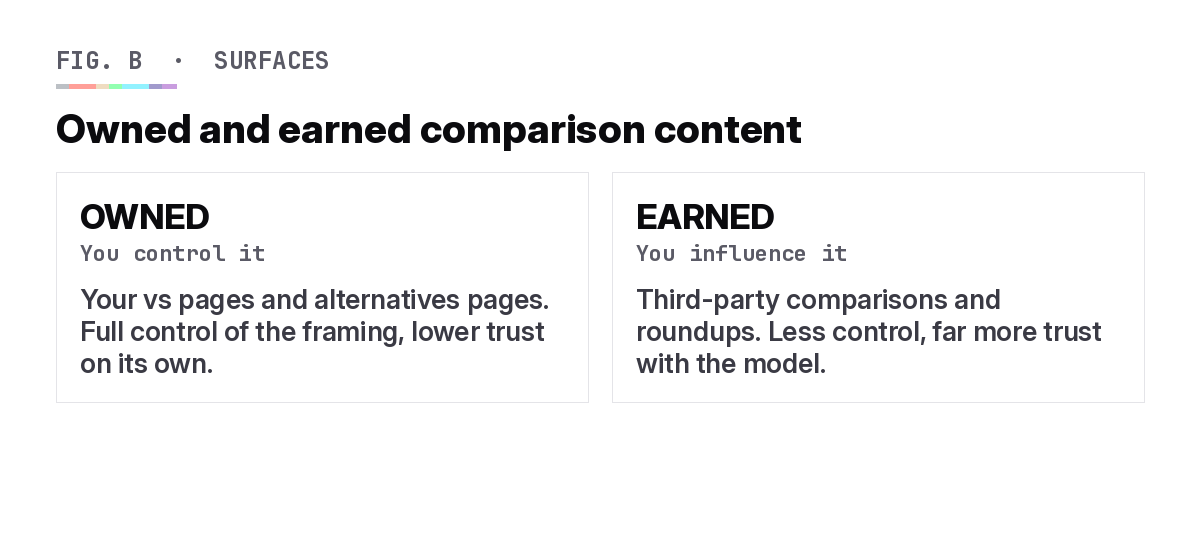
Two kinds of page shape a comparison answer. Your own "vs" and alternatives pages, which you control, and third-party comparisons and best-of roundups, which you influence. Models cross-reference both. A confident claim on your own page carries more weight when a neutral third party says the same thing, so the two work together.
This matters because AI-referred buyers are worth more. Visitors arriving from AI search convert at several times the rate of ordinary organic traffic, since they arrive already deep in a comparison. Winning the "vs" answer does not just add clicks, it adds clicks from people about to buy.
What Makes A Comparison Page Citable
A citable comparison page reads like a fair analyst wrote it, not a sales team. The model is looking for clear criteria, specific evidence, and a structure it can lift a sentence from without getting burned.

Structure the model can parse
Lead with the criteria that matter to the buyer, then compare on each one in a consistent order. Use a table for the head-to-head, and write a short, direct answer under each heading. A model lifts self-contained sentences, so make each comparison point stand on its own rather than hiding the verdict three paragraphs down.
Match the page to how buyers actually phrase the question. Research on the sources engines rely on shows they favour pages that answer the exact query cleanly, and the most-cited sources tend to be the clearest ones. If the buyer asks "which is better for a small team", that sentence should appear on the page with a direct answer beneath it.
Honest framing beats hype
Say where the other tool is better. It sounds counterintuitive, but a page that admits a competitor wins on price or onboarding is far more likely to be quoted, because it reads as trustworthy. A page that claims total victory is a signal the model learns to distrust. Buyers feel the same way, so honesty helps both audiences at once.
Schema and clarity
Give the page clean structure and schema an AI can parse, so the criteria, entities and verdict are unambiguous. This will not manufacture a citation on its own, but it removes friction. When two comparison pages are equally fair, the clearer, better-structured one tends to get lifted.
Keep the page focused on one comparison. A single "A vs B" page that answers that question thoroughly beats a sprawling page trying to compare six tools at once, because the model can match it cleanly to a specific prompt. If you need to cover many rivals, build a page each and link them, rather than one page that does all of them shallowly.
Alternatives Pages Without The Cringe
Alternatives pages have a bad reputation because most are thinly veiled bait, ranking the host first and burying everyone else. Models and buyers both see through that. Done well, an alternatives page is a genuine service that earns citations.
The test is simple. Would this page still be useful to a buyer if a neutral third party published it. If the answer is yes, you have a resource an assistant will happily cite. If it only makes sense as a sales asset, expect the model to treat it as one and route the buyer elsewhere.
When to compare against yourself
Build an alternatives page even when you are the incumbent being compared against. If buyers are searching "alternatives to your tool", an assistant will answer with or without you, so you may as well shape the framing honestly. Acknowledge who you are not right for, and you keep the buyers you can actually serve while looking credible to the ones you cannot.
Cover the whole set, not just easy wins
Include the competitors you lose to, not only the ones you beat. A comparison that ignores the obvious rival reads as evasive, and the model notices the gap. Covering the full set, with a fair line on each, is what makes the page the definitive answer rather than a brochure.
Keep each entry current, too. Pricing and features change fast in SaaS, and a comparison that cites a competitor's old plan is easy for a model to distrust and easy for a buyer to disprove. A stale comparison is worse than none, because it quietly teaches the assistant that your page is unreliable. Revisit the head-to-heads that matter every quarter.
Common Mistakes That Get You Excluded
Most comparison pages fail for the same few reasons. Fixing them is often faster than writing anything new.
The mistakes that matter
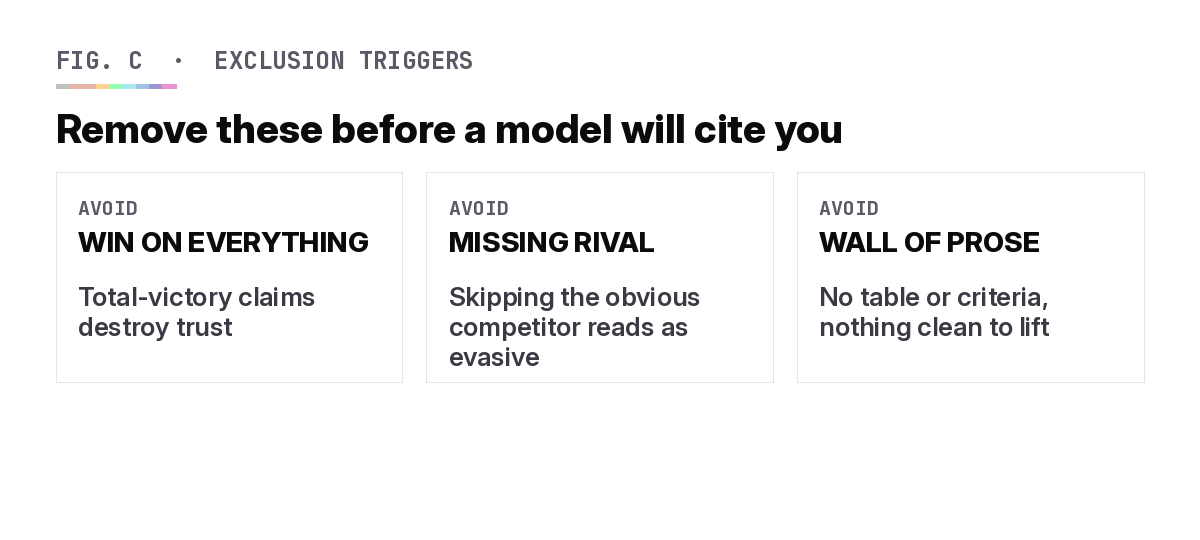
Three errors do the most damage. Claiming you win on every axis destroys trust. Leaving out the competitor buyers actually mention reads as evasive. Writing a wall of prose with no table or clear criteria gives the model nothing clean to lift.
Each one is common, and each one is fixable in an afternoon. Start by pulling up the page and reading it as a sceptical buyer, then cut every claim you cannot back with a specific feature, price or limit. What remains is usually the citable core.
There is a real tension here. Sales wants the page to sell, and a fair comparison feels like handing wins to rivals. Our experience across campaigns is that the honest page wins more deals, because it is the one the assistant repeats and the one the buyer believes. Sell with credibility, not with claims.
Measuring Comparison-Page Performance
Judge these pages by whether AI cites them on comparison prompts, not by rankings alone. Ask the assistants your key "vs" and "alternatives" questions and record whether your page is quoted and whether the verdict is fair.
Set a simple baseline before you change anything. Note who the assistants name today for each comparison, and how they describe you, so you have an honest before and after. Then rewrite one page, wait a few weeks for the engines to recrawl, and re-ask. Movement on the prompts that matter, not a jump in rankings, is the signal that the work is paying off.
Watch the framing as closely as the presence. If the model names you but describes you inaccurately, the source it is reading needs a sharper, more honest line. Track this across engines over time with the approach in our guide to AI share of voice, and reinforce your pages with review-site proof and earned coverage that echoes the same comparison. If you want a team to build and maintain these, our SaaS SEO service does exactly that, and you can start with a free AI visibility check.
Frequently Asked Questions
Should I build a comparison page against my own product?
Yes, if buyers are already searching for alternatives to you. An assistant will answer that prompt with or without your input, so an honest page lets you shape the framing and keep the buyers you can serve. Acknowledge who you are not right for, and you look more credible, not less.
Why does AI ignore my "vs" page even though it ranks?
Usually because it reads as pure sales copy. A page can rank on brand terms while still being a source a model will not trust for a neutral verdict. Rewrite it with clear criteria, a table, and honest trade-offs so it reads like an analyst wrote it.
Is it risky to admit a competitor is better at something?
It feels risky and it usually is not. A page that concedes a genuine strength is far more likely to be cited and believed, which wins more deals than a page claiming to win everything. Concede the small points to win the decision.
Do comparison pages need schema markup?
Schema helps by making your criteria and entities unambiguous, but it will not rescue a weak page. Treat it as friction removal, not a ranking trick. When two fair pages compete, the clearer, better-structured one tends to get lifted.
How many comparison pages should a SaaS have?
Enough to cover the competitors and alternatives your buyers actually mention, and no more. A handful of thorough, honest pages beats dozens of thin ones. Prioritise the head-to-heads that show up most in your buyer prompts.
Want this done for your brand? Get a free AI visibility audit.
Get my free AI visibility audit.png)
Latest articles
What we've published in the past 30 days — across SEO, GEO, content, and digital PR.