.webp)





.webp)
GEO
Calculating...
Oct 2026
How G2, Capterra and Review Sites Shape AI Recommendations
AI leans on G2 and Capterra to answer best software. Learn which review platforms drive citations and how to optimise your profiles for AI.

Review platforms like G2, Capterra and TrustRadius are now primary sources AI engines cite when they recommend software. To show up, keep an active, consistent, well-categorised profile on the four to six platforms that matter, with recent and authentic reviews. Your review presence is training data, not just a badge for the footer.
Why Review Platforms Feed AI Recommendations
When a buyer asks an assistant for the best tool in a category, the model reaches for sources that already aggregate real user opinion. Review platforms are built for exactly that, so they sit near the centre of how AI forms a recommendation. For more on this, see our guide to how AI agents build B2B shortlists.
The correlation is striking. In a 2026 study of software category queries, every tool ChatGPT named had Capterra reviews and 99% had G2 reviews, and brands in the top 20 of their category on those platforms were cited roughly three times more often in "best software" answers. Absence from these sites is close to absence from the answer.
It fits a wider pattern. Independent research on where the major engines draw citations puts aggregators and community sources near the top, well ahead of any single vendor's own pages. Review platforms are one of the few places where third-party opinion about you is structured, current, and easy for a model to read.
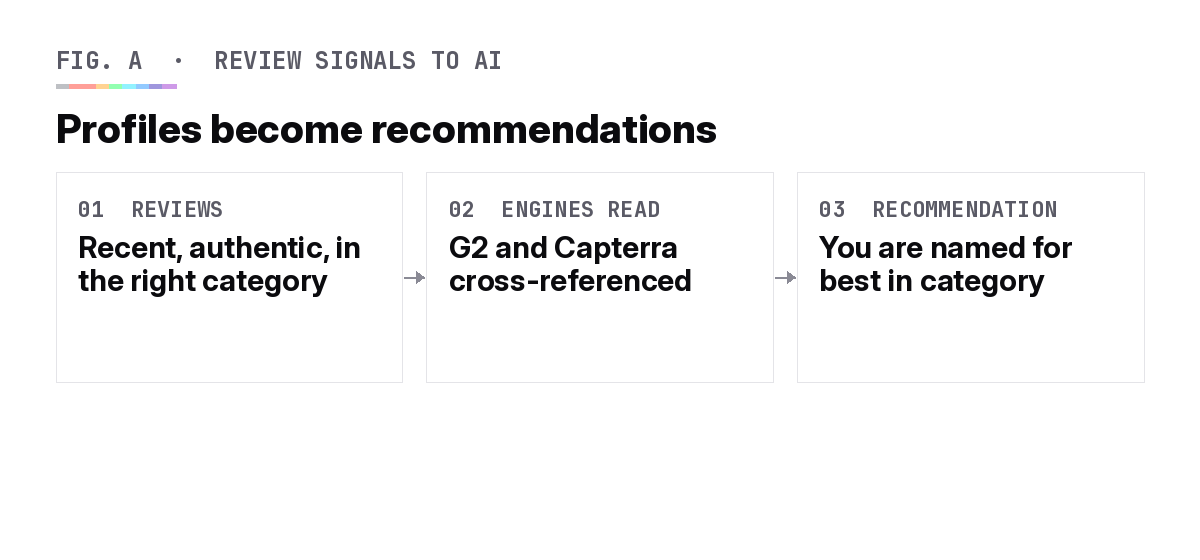
Reviews are training data now
Treat your G2 and Capterra profiles as inputs to a model, not as trophies. The category you sit in, the volume and recency of reviews, and the language customers use all become signals a model can read. Our guide to SaaS review best practices covers the platforms worth being on. A stale, thin profile teaches the assistant that you are a minor player, whatever your actual market position.
The confidence signal buyers trust
Buyers weight these citations heavily. In G2's 2026 Buyer Behavior Report, 45% of buyers say a citation from a software review site is the most confidence-inspiring signal in an AI-generated answer, and review sites are the one source besides chatbots that gains influence deeper in the funnel, rising from 40% at discovery to 47% at retention. This is bottom-of-funnel proof, which is why it fits squarely in the work of getting recommended by AI.
The reason is human. A buyer knows a vendor's own site will talk it up, but a wall of peer reviews feels like evidence. When an assistant backs a recommendation with a review-site citation, it borrows that credibility, and the buyer relaxes. That is why a strong profile does double duty, convincing the model and reassuring the person reading its answer.
Which Platforms Carry Weight
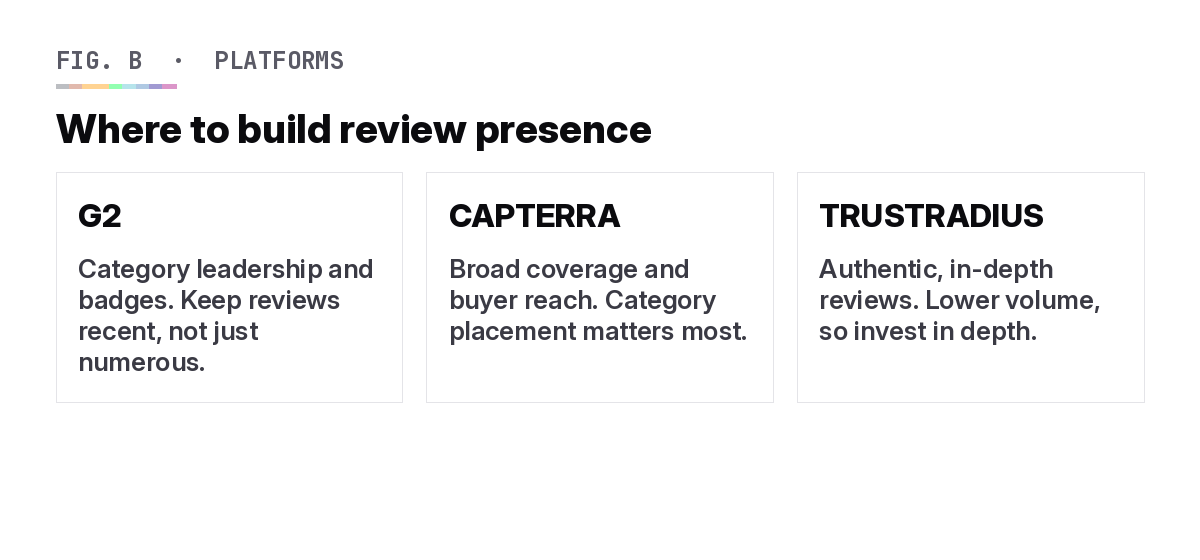
Not every review site pulls the same weight, and the mix varies by engine. The safe default is to be present and consistent across the handful that models cross-reference, rather than betting everything on one.
Spread matters for a specific reason. Because engines check several platforms, a single strong profile is more fragile than a consistent footprint across four to six sites. If your only presence is on G2 and a competitor is strong everywhere, the breadth of their signal can outweigh the depth of yours. Coverage plus consistency beats a single flagship profile.
Perplexity and cited sources
Perplexity shows its sources, and it draws heavily on third-party review platforms alongside community threads. If your Capterra or TrustRadius profile is thin, you simply have less chance of being one of its footnotes. This is the engine where review presence pays off most visibly.
Because Perplexity exposes its citations, it is also the easiest place to audit yourself. Ask it your category's "best" question and look at the footnotes. If review platforms show up but your profile is not among them, you have found a concrete gap to close, and a clear before-and-after to measure against later.
ChatGPT, Gemini and AI Overviews
ChatGPT keeps its citations tighter but still leans on the big aggregators, which is why the Capterra and G2 coverage in category answers is so high. Google's AI Overviews blend these with the wider web. Across all of them, a strong review footprint raises your odds, because the same profiles feed multiple engines at once.
What AI Reads On A Review Profile
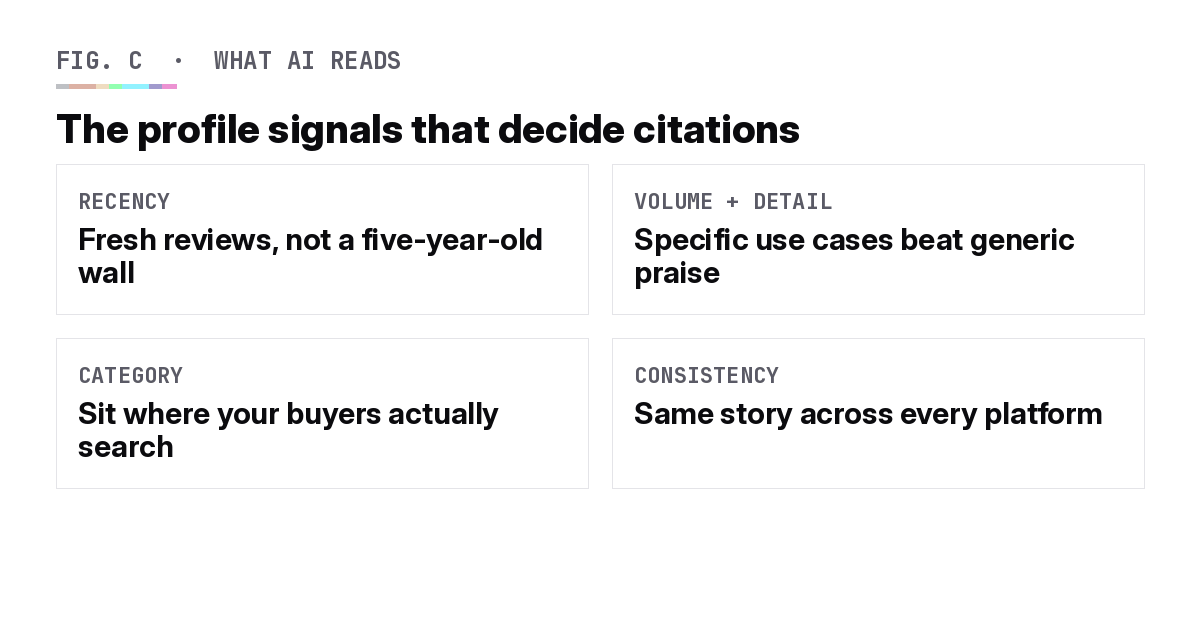
A model does not just count your stars. It reads the shape of your profile, and a few factors do most of the work.
Recency and volume
A wall of five-year-old reviews reads as a fading product. Steady, recent reviews signal that customers still choose and rate you, which is what a model wants to see before it recommends you today. Volume matters too, but a smaller set of fresh, detailed reviews often beats a large pile of stale ones.
Detail is doing quiet work here. A review that names a specific use case, integration or team size gives the model concrete language to match against a buyer's question. Generic praise reads as filler, while a specific review is the sentence an assistant can lift to justify recommending you for that exact scenario. Encourage customers to say what they use you for, not just that they like you.
Category placement and badges
Sit in the right category, because that is how the model maps you to a buyer query. G2 badges like Leader or High Performer get syndicated across dozens of aggregation sites, and each of those mentions becomes another signal a model can pick up. One well-earned badge quietly does work far beyond the G2 page it appears on.
Miscategorisation is a quiet killer. We have seen products sit in a broad, crowded category when their buyers search a narrower one, so the model never connects them to the right prompt. Getting the category right is often a bigger win than adding another twenty reviews, because it changes which questions you are eligible to answer.
Consistency across platforms
Engines cross-reference. If your G2 profile says one thing and your Capterra listing says another, that contradiction lowers the model's confidence in you. Present the same positioning, category and core strengths everywhere, so the signals reinforce rather than fight each other.
Fixing A Profile That Misrepresents You
Plenty of SaaS brands are being described inaccurately by AI, and the cause is often a neglected review profile feeding the model bad inputs. Fixing the source is now brand protection.
Where to start
Audit what the assistants say about you first, then trace each claim back to a source. Wrong category, an old tagline, a missing integration, a cluster of dated reviews complaining about a bug you fixed a year ago: these are the inputs to correct. Update the profile, encourage current customers to leave fresh reviews, and give the model newer, truer material to read.
Do not fake it. Both the platforms and the models are getting better at spotting artificial review patterns, and a burst of suspiciously similar five-star reviews can hurt more than it helps. Authentic, specific reviews from real customers are the only durable fix.
There is a fair counterpoint worth naming. Some argue review sites are gameable and therefore not worth serious effort, and it is true that a few brands inflate their numbers. Our take is that the gaming is exactly why authentic, detailed reviews stand out to both models and buyers. As detection improves, the honest profile becomes the durable advantage, not the shortcut.
Turning Reviews Into Citations
Reviews are only half the job. The goal is to turn a strong profile into an AI citation, which means making the profile easy to find, current, and consistent with your other surfaces.
Build a simple habit around it. Ask happy customers for a review at the natural moments, like after a successful onboarding or a renewal, so the flow stays steady rather than spiky. Respond to reviews, keep the profile details current, and refresh your category and positioning whenever the product moves. None of this is glamorous, and it is exactly the maintenance that keeps you in the answer month after month.
Reinforce the story. A review profile lands harder when your best-of placements and comparison pages say the same thing, and earned coverage echoes it. To check whether the work is landing, track your presence on buyer prompts with the method in our guide to AI share of voice. If you want a team to run it, our SaaS SEO service covers review presence as part of AI visibility, and you can start with a free AI visibility check.
Frequently Asked Questions
Do G2 and Capterra reviews really affect AI recommendations?
Yes. In a 2026 study of software category queries, nearly every tool the assistant named had reviews on the major platforms, and top-category brands were cited far more often. AI engines use these sites to gauge which tools are credible, so absence from them usually means absence from the answer.
Which review platform should a SaaS prioritise?
Start with G2 and Capterra because they have the broadest reach and citation weight, then add TrustRadius for authentic depth. The safer play is presence across four to six platforms rather than one, since engines cross-reference them. Consistency across all of them matters as much as the choice.
How many reviews do I need to show up in AI answers?
There is no fixed number, but recency and category placement matter more than raw volume. A steady flow of recent, detailed reviews in the right category beats a large pile of old ones. Aim to be in the top of your category rather than to hit a review count.
Can I buy reviews to speed this up?
No. The platforms have fake-review detection, and models are learning to spot artificial patterns, so bought reviews can hurt you. Focus on prompting genuine reviews from real customers, which is the only fix that lasts.
Why does AI describe my product inaccurately?
Usually because a stale or inconsistent review profile is feeding it old information. Audit what the assistants say, trace each claim to a source, and update your profiles with current, accurate details. Fresh, consistent reviews give the model better material to read.
Want this done for your brand? Get a free AI visibility audit.
Get my free AI visibility audit.png)
Latest articles
What we've published in the past 30 days — across SEO, GEO, content, and digital PR.