.webp)




.webp)
GEO
Calculating...
Oct 2026
How to Get Your B2B SaaS Recommended by AI
AI assistants now build B2B software shortlists. Learn how to get your SaaS recommended in ChatGPT, Perplexity and AI Overviews buyer answers.
Getting recommended by AI means being one of the few brands an assistant names when a buyer asks what to use. You earn it by showing up across the sources these models trust: third-party best-of lists, comparison content, review platforms, earned media, and your own structured pages. Rankings still help. Recommendations decide the shortlist.
Why AI Now Decides Your Shortlist
AI assistants have become the first stop in B2B software research, and they now shape which vendors make the shortlist before a buyer visits a website or talks to sales.
The shift is quick and measurable. In G2's 2026 Buyer Behavior Report, 51% of B2B software buyers say they now begin research with an AI chatbot more often than with Google, up from 29% in April 2025. Seven in ten now rely on chatbots for software research, up from 60% just seven months earlier. Roughly two-thirds spend six or more hours a week using these tools for work.
This is not a fad that will fade. Only 3% of buyers say the tools haven't changed how they research. Even the friction points signal permanence: 64% say they hit inaccurate AI recommendations often, and they keep using the assistants anyway. When a behaviour survives its own flaws, it is structural.
Across our SaaS campaigns we see the same thing in the numbers. Buyers arrive later, warmer, and with a shorter list. They have already asked an assistant to compare options, and they treat its answer as a starting point, not an ad.
The shortlist is built before sales
The average B2B shortlist has shrunk to roughly two or three names. Comparing vendor strengths and weaknesses is the single most common reason buyers open a chatbot for software research, ahead of basic product research or vendor identification. More than four in ten now use dedicated deep-research modes for software evaluations.
The implication is blunt. If your product isn't in that first comparison, you are not losing the deal at the demo. You are losing it before anyone fills in a form.
A tighter shortlist raises the stakes. The gap between second and fourth place used to be a slow drip of lost pipeline. Now it is a wall, because the buyer never sees names four and five.
What "recommended" looks like across engines
Recommendation is not one behaviour. ChatGPT tends to name a short set of tools and lean on a few trusted sources, keeping citations tight. Perplexity shows its working, often citing five to a dozen footnotes, and draws heavily on community threads and third-party review platforms.
Google's AI Overviews sit on top of the classic results and favour their own surfaces alongside the wider web. The engines differ in style, but the mechanic is shared. They all synthesise other people's content about you, weigh it, then decide whether to put your name forward.
A quick example makes the difference concrete. Ask ChatGPT for the best help-desk software and you get a tidy list of four names with a line each, while Perplexity returns footnotes to review sites, a Reddit thread, and two roundups. If your evidence is thin on the sources Perplexity trusts, you make the ChatGPT list and miss the Perplexity one. Your job is to make sure the content each engine reads points the right way.
Mentions, Citations, and Recommendations
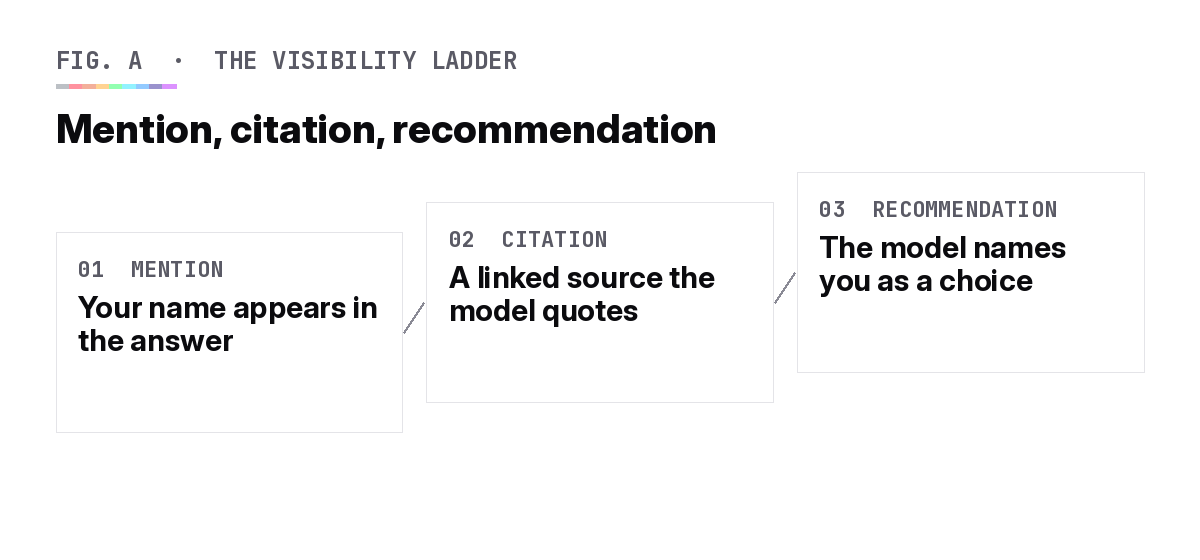
A mention is your brand appearing in an answer. A citation is a linked source the model used. A recommendation is the model actively putting you forward as a good choice. Bottom-funnel visibility depends on the last one.
The three, defined
Think of it as a ladder. A mention gets your name in the room. A citation makes you a source the model quotes and links. A recommendation is when the assistant tells the buyer you are worth choosing.
Most GEO advice optimises for the first two rungs because they are easier to track. The value sits at the top. A brand can rack up mentions and citations for "what is" queries and still never be the answer to "which should I buy".
Why bottom-funnel weights toward the recommendation
For a "what is" query, a mention or citation is enough. For "best CRM for a 40-person sales team" or "alternatives to a named competitor", the buyer wants a verdict, and the model gives one. That verdict is where deals move.
Trust compounds there too. 85% of buyers say they think more highly of a vendor when an assistant recommends it, and a third have bought from a vendor they had never heard of because the assistant vouched for it. A single favourable recommendation can outweigh a page-one ranking you spent a year earning.
We still do the ranking work, and our generative engine optimisation guide covers it in depth. For the bigger strategic picture of how software gets chosen when agents do the buying, see our guide to agentic marketing. We just stopped treating a ranking as the finish line.
Why counting mentions can mislead you
Here is the trap. Aggregate mention dashboards make brands look healthy when they are not. You can be mentioned constantly for definitional queries and never appear in the buyer ones that pay.
A high mention count with zero presence on "best" and "alternatives" prompts is a vanity number. That gap is exactly why we measure share of voice on buyer prompts instead of a single blended score.
The Five Surfaces AI Pulls From
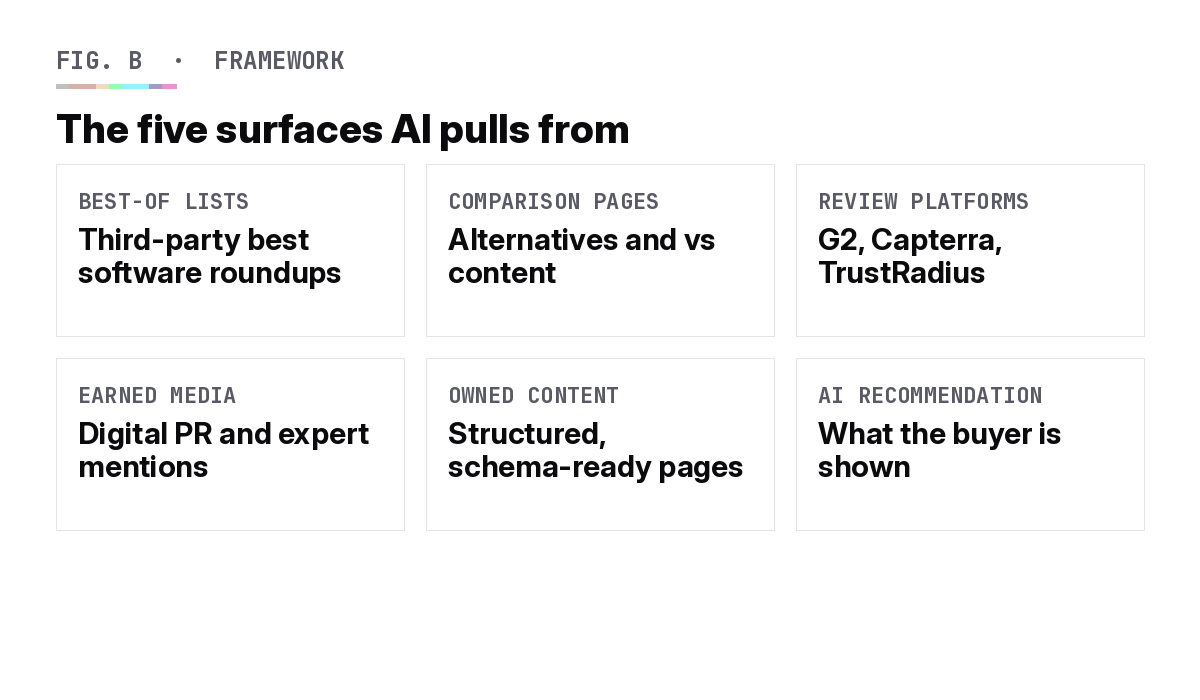
AI assistants build recommendations from five buyer surfaces: third-party best-of lists, comparison and alternatives pages, review platforms, earned media, and your own structured content. Win a few of them and you start showing up. Win none and you stay invisible, whatever your blog does.
Independent research backs this up. Analyses of where the major engines draw citations put community forums, review platforms and established media near the top, well ahead of any single vendor's own site. In other words, four of the five surfaces sit off your domain, which is precisely why owned content alone stalls.
Best-of and "best software" lists
"Best category tools" articles are the most quoted buyer surface, and you cannot buy your way into a good one. When an assistant answers "best project management software", it is often paraphrasing two or three roundups it trusts. Getting into those is slow, editorial work, not a link buy, and the placements that count are on sites with a real audience and a track record. We cover the method in our guide to getting featured in AI's best-software lists.
Alternatives and comparison pages
"X alternatives" and "X vs Y" are the highest-intent prompts a buyer types. Owned comparison pages and third-party roundups both feed the answer, and honesty is what gets you quoted. A fair, specific comparison earns a citation; a page that claims you win on everything gets skipped. Our comparison-page playbook shows how to build one an LLM will actually use.
Review platforms
Perplexity and other engines lean on G2, Capterra and TrustRadius when they answer "best X", so your review profile is now training data, not just a badge. 45% of buyers say a citation from a software review site is the most confidence-inspiring signal in an AI answer. Recency and volume matter as much as your star rating. More in how review sites shape AI recommendations.
Earned media and digital PR
News outlets and expert commentary get cited far above their share of the web, which turns digital PR into a citation channel rather than a link channel. A data story that a trade publication runs can end up quoted in an AI answer months later. We break down the approach in digital PR for AI search.
Your own structured content
Owned content still matters, especially clear, well-structured pages with schema an AI can parse. The catch is that models trust corroboration. If every claim about you lives only on your domain, an assistant has nothing to triangulate, and it hedges.
So treat owned content as the source of record, not the whole strategy. Owned content sets the story. The other four surfaces are what convince a model the story is true.
How the Surfaces Compound
The surfaces reinforce each other. A review-site profile feeds a best-of list, which gets picked up in earned media, which an assistant then cites. Working them together beats working any one in isolation.
A worked example
Say you sell project management software and you are absent from every "best project management tool" answer. You earn one credible placement, encourage a dozen recent G2 reviews, and pitch a data story to a trade outlet.
Each move is modest on its own. Together they give the model three independent signals pointing the same way, which is what it needs to name you with confidence. Six weeks later you are one of the four names ChatGPT returns, and the review volume keeps that citation fresh as models refresh.
Why triangulation is the whole game
Language models do not trust a claim because you made it loudly. They trust it because separate, credible sources agree. That is why one channel rarely moves the needle and a modest push across three or four does.
Think of each surface as a witness. One witness is a claim. Three witnesses telling the same story is a fact the model will repeat without hedging.
Where SaaS teams waste effort
The common mistake is pouring everything into owned blog content and expecting AI to reward it. Depth on your own site helps, but it cannot corroborate itself. We see teams publish their fortieth guide while their G2 profile sits stale and no third party has mentioned them in a year. Spread the signal instead of stacking it in one place.
A 90-Day Starting Sequence
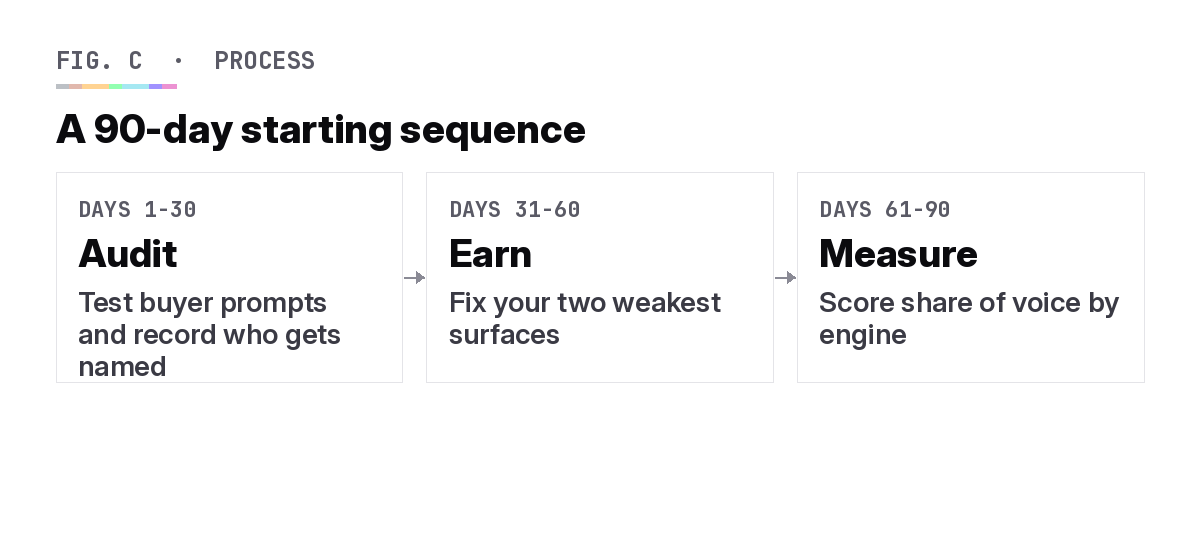
Start by auditing where AI already places you, then earn placements on the surfaces you are missing, then measure share of voice on buyer prompts so you invest where it moves pipeline.
Days 1 to 30, audit
Test the real prompts buyers use. Ask each major assistant your category's "best", "alternatives" and "vs" questions, and record who gets named and cited. Note which sources each engine leans on, because that tells you which surfaces to fix first. Our guide to measuring AI search visibility walks through the method.
Days 31 to 60, earn
Pick the two surfaces where you are weakest and go. For most SaaS brands that means pitching for best-of placements and fixing review-platform profiles. Chase recency, not just volume, since stale proof reads as a stale product.
Keep the effort narrow on purpose. Two surfaces done well beat five done half-heartedly, because the model needs credible corroboration, not scattered noise. If you would rather hand it off, our SaaS SEO team runs this as a service.
Days 61 to 90, measure
Track share of voice on your buyer-intent prompt set, by engine and against competitors, not just an aggregate mention count. A brand can look strong in an aggregate dashboard and be absent from two of three engines. Re-run the same prompt set you used in the audit, so the before and after are honest and comparable. Our guide to AI share of voice shows how to score it, and you can run a free AI visibility check to see where you stand today.
The Objections We Hear
Marketing leaders push back on this, and they are right to. Here are the three objections we hear most, and where we land on each.
"Isn't this just SEO with a new name?"
Partly. The fundamentals carry over: clear content, structured data, and real authority still do the heavy lifting. But the surface that decides a B2B deal has moved from a ranked list of ten blue links to a single synthesised answer that names two or three vendors.
That changes what you optimise and how you measure it. You are no longer chasing a position, you are chasing inclusion in an answer. Same roots, different finish line.
"AI referral traffic is tiny, so why bother?"
The volume is small and the quality is not. AI-referred visitors convert at several times the rate of ordinary organic traffic, because they arrive pre-qualified by the assistant. Add the 85% trust lift from being recommended and the shrinking shortlist, and a handful of AI recommendations can outweigh thousands of cold clicks. Judge this channel on pipeline, not sessions.
"Which engine should we prioritise?"
Start with the one your buyers actually use, then widen. ChatGPT handles the largest share of B2B software research today, so it is the sensible anchor, but Perplexity and AI Overviews matter more than their traffic suggests because they cite sources buyers click. The good news is that the five surfaces feed all of them, so the work compounds across engines rather than splitting your effort. Optimise the sources once, and you improve your odds everywhere.
"We can't control what AI says about us."
You cannot control the output, but you shape the inputs, and that is most of the battle. With 64% of buyers hitting inaccurate recommendations, fixing the sources a model reads is now brand protection, not just growth. You will not script the answer. You will change the evidence it is built from.
So keep the fundamentals, add the five surfaces, and measure the verdict rather than the vanity. The brands that win the next few years of B2B software buying will be the ones an assistant is confident enough to name.
Frequently Asked Questions
What does it mean to get recommended by AI?
It means an AI assistant names your product as a suggested option when a buyer asks what to use, rather than just mentioning you in passing. A recommendation is the assistant putting your brand forward as a good choice for the buyer's task. That is the moment that shapes a B2B shortlist.
How is being recommended by AI different from ranking in AI search?
Ranking gets your page cited as a source. A recommendation gets your product named as an answer. You can rank for informational queries and still be absent from the "best tool" and "alternatives" answers where buyers decide. Both matter, but the recommendation is what moves bottom-of-funnel deals.
Which AI assistants matter most for B2B SaaS?
ChatGPT handles the largest share of B2B software research, with Perplexity and Google's AI Overviews close behind for buyers who want cited sources. Each pulls from slightly different places, so you should test all three rather than optimise for one. Perplexity in particular leans on review platforms and community threads.
How long does it take to show up in AI recommendations?
That varies by surface. Review-profile improvements and owned content can register within weeks, while earned best-of placements and PR compound over one to three months as models refresh. Most SaaS teams see movement on buyer prompts within a quarter of consistent work across several surfaces.
Can you pay to be recommended by ChatGPT or Perplexity?
No. There is no paid placement inside the organic recommendation, and buying your way into a weak listicle tends to backfire because models favour sources they trust. You earn recommendations through genuine reviews, credible third-party placements, and clear structured content. That is slower, and it is also what makes the visibility durable.
How do you measure whether AI recommends your SaaS?
Build a set of the real buyer prompts in your category, ask each major assistant, and record how often you are named and cited against competitors. Track that share of voice by engine over time, not as a single aggregate score. An aggregate number can hide the fact that you are invisible in two of three engines.
Want this done for your brand? Get a free AI visibility audit.
Get my free AI visibility audit.png)
Latest articles
What we've published in the past 30 days — across SEO, GEO, content, and digital PR.