
.webp)





.webp)
GEO
Calculating...
Sep 2026
LLM SEO Tools for B2B SaaS
LLM SEO tools cover four jobs: monitoring, content, technical and benchmarking. Compare the leading options and build the right stack for your team size.

LLM SEO tools are software that helps you optimise for, and measure your presence in, large language model answers from ChatGPT, Perplexity, Gemini and Google AI Overviews. They span four jobs: monitoring visibility, optimising content, checking technical readiness, and benchmarking against competitors. Most teams combine two or three rather than relying on one.
The category is loud right now, and a lot of that noise is the same feature wearing different logos. Before you compare pricing pages, it helps to sort the market by the job you are hiring a tool to do. Do that and the shortlist gets short fast.
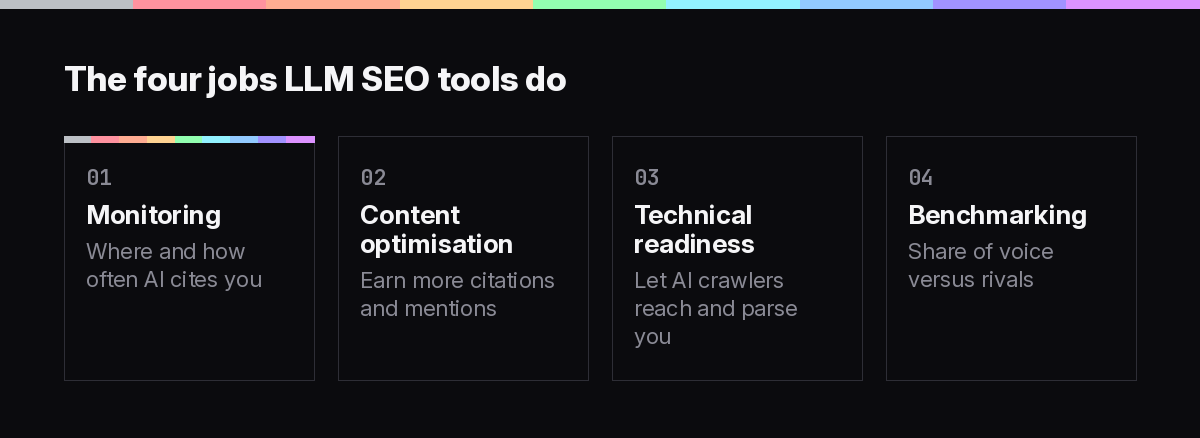
The Four Jobs LLM SEO Tools Do
Almost every tool in this space does one of four things well and gestures at the rest. Naming the four jobs is the fastest way to cut a crowded market down to a real shortlist.
Monitoring and visibility
These tools run prompts across the engines and report whether, and how often, you appear. This is the measurement layer, and it is the job most buyers start with. Our pillar guide to AI search monitoring covers the metrics that matter, and the AI rank tracker guide goes deeper on tracking specifically.
Content optimisation
These tools grade a page against what tends to get cited, then suggest structure, coverage and formatting changes. Kevin Indig's work on 1.2 million responses found 62% of AI answers use brand content without naming the brand, so shaping content for extraction, not just mention, is the real goal here.
Technical readiness
If GPTBot or PerplexityBot cannot reach your pages, nothing else matters. This job covers crawl checks, render-without-JavaScript tests, schema validation and llms.txt. It overlaps a full GEO audit, which is the deeper version of the same work.
Competitive benchmarking
The last job is relative: how your presence compares with named rivals, and which sources the models trust in your category. This is where share of voice lives, and it is the number that tends to move budgets.
Monitoring and Visibility Tools
This is the busiest corner of the market. Rankability alone compares more than 20 AI visibility tools, so sort them by who they are built for rather than by feature count.
Enterprise platforms
Profound is the name that comes up most for large brands, built for big prompt sets, citation intelligence and enterprise reporting. If you have an in-house team and a real budget, this tier is where deep analysis lives.
Mid-market trackers
Peec AI, Otterly.ai and ZipTie sit in the practical middle: solid prompt monitoring and competitor tracking without an enterprise contract. For most Series B SaaS teams, this tier is the sweet spot.
Suites you may already own
Semrush has added an AI Visibility Toolkit and Ahrefs has Brand Radar, so if you already pay for one, start there before adding a tool. Reviews from SE Ranking and Frase are fair places to compare. Our own current picks live in the AI visibility tools roundup.
Content and Technical Optimisation Tools
Monitoring tells you where you stand. This second group helps you actually move, which is where most of the compounding value sits.
Content graders
Tools like Frase and other content optimisers score a draft against the coverage, structure and formatting that tend to earn citations, then flag the gaps. Treat their scores as a prompt to think, not a target to game. Aleyda Solis has been clear that AI has changed what visibility even means, so the goal is genuinely useful, extractable content, not a higher tool score.
Schema and llms.txt helpers
A second set validates structured data and generates or checks an llms.txt file, so engines can parse and prioritise your pages. These are small jobs with outsized effect, since they remove friction the model would otherwise trip over.
Crawl and log checks
The most overlooked tools confirm AI crawlers can actually fetch your content and show what they requested. A page the bot cannot render is invisible no matter how good the copy. This is the technical floor every other tool assumes you have already covered.
How to Choose a Stack by Team Size
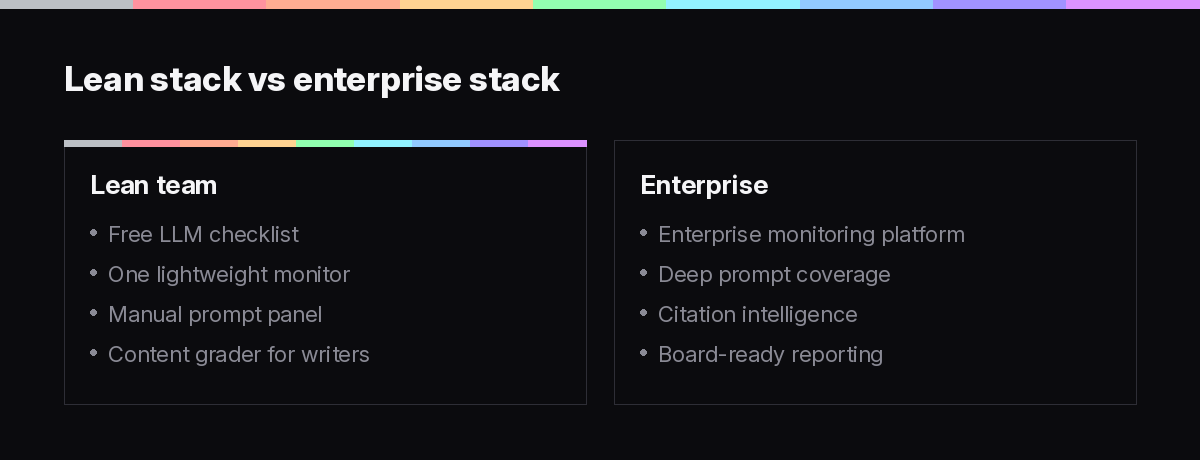
You do not buy a category, you buy a fix for your current bottleneck. Here is how the stack usually looks at three sizes.
Lean or solo
Start with a free checklist and one lightweight monitor. Run a manual prompt panel for the rest. At this size, spending on an enterprise platform is money you could put into content that earns citations instead.
Scaling team
Add a mid-market monitor for automated multi-run sampling and competitor tracking, plus a content grader your writers actually use. This is the point where manual tracking starts costing more than a subscription.
Enterprise
Layer in an enterprise platform for deep prompt coverage, citation intelligence and reporting that a board will read. Pair it with the analytics work in our AI search analytics guide so visibility connects to traffic.
The honest verdict
There is no single best LLM SEO tool, and any roundup that crowns one is flattening real differences between the four jobs. Buy the tool that fixes your bottleneck now, keep the stack small, and revisit it every quarter as the category matures. If you would rather not assemble it yourself, we build and run the stack inside every SaaS SEO engagement, and a free AI search audit will show which job to fix first. For the fundamentals, our GEO guide and AI SEO tools overview are good next reads.

Frequently Asked Questions
What are LLM SEO tools?
They are software tools that help you optimise for and measure your brand's presence in AI answers from ChatGPT, Perplexity, Gemini and Google AI Overviews. They cover four jobs: monitoring, content optimisation, technical readiness and competitive benchmarking.
Which is the best LLM SEO tool?
There is no single best tool, because the four jobs are genuinely different. Profound suits enterprise monitoring, Peec AI and Otterly fit mid-market teams, Semrush and Ahrefs suit existing users, and content graders like Frase help writers. Pick by the job you need done.
Do I need a dedicated LLM SEO tool or will Semrush or Ahrefs do?
If you already pay for Semrush or Ahrefs, start with their AI Visibility Toolkit or Brand Radar before adding a tool. Move to a dedicated monitor when you need deeper prompt coverage, more engines or competitor citation intelligence.
How much do LLM SEO tools cost?
Prices range from free checkers and low-cost mid-market trackers to enterprise platforms with four-figure monthly contracts. Match the spend to your team size and the bottleneck you are fixing rather than the longest feature list.
Can free tools track AI visibility?
Yes, for a baseline. Free checkers and a manual prompt panel logged in a spreadsheet will get a lean team started. You graduate to paid tools when prompt volume, engine coverage or historical trends outgrow manual work.
What is the difference between LLM SEO tools and GEO tools?
The terms are used interchangeably. Both describe software for improving and measuring visibility in AI answers. Some vendors prefer GEO for generative engine optimisation, others say LLM SEO, but the four jobs are the same.
Want this done for your brand? Get a free AI visibility audit.
Get my free AI visibility audit.png)
Latest articles
What we've published in the past 30 days — across SEO, GEO, content, and digital PR.


