.webp)





.webp)
GEO
Calculating...
Aug 2026
AI Visibility Tools: How B2B SaaS Brands Track Their Presence in AI Search
AI visibility tools show whether ChatGPT, Gemini and Google cite or recommend your B2B SaaS brand. Compare the top platforms and how to measure it right.

AI visibility tools are software that checks whether AI search engines like ChatGPT, Google's AI Overviews, Gemini and Perplexity mention, cite or recommend your brand. They run a set of prompts on a schedule, record every answer, and score your presence, your share of voice against rivals, and which sources the model pulled from.
That sounds simple. In practice, picking a tool and reading its dashboard is where most B2B SaaS teams get stuck, because the numbers only mean something once you know what the tool can and cannot see.
We build AI search visibility for B2B SaaS companies, so we've run most of these platforms against live client accounts. This guide covers what they actually measure, the tools worth knowing in 2026, how to measure visibility without fooling yourself, where every tool falls short, and how to choose one for your stage. If you want the underlying market data first, our AI search statistics roundup sets the scene.
What AI visibility tools actually track
Every AI visibility tool does the same core job. It sends a list of prompts to a set of AI engines, captures the responses, and turns them into metrics you can watch over time. The differences are in how many engines they cover, how often they run, and how honestly they handle the fact that AI answers change every time you ask.
Before you compare products, get one distinction straight. It changes which metric you should care about.
Mentions and citations are not the same thing
People use the words interchangeably. They shouldn't. A citation is a link the model shows as a source, usually in a little reference list. A mention is the model naming your brand inside the answer, with or without a link.
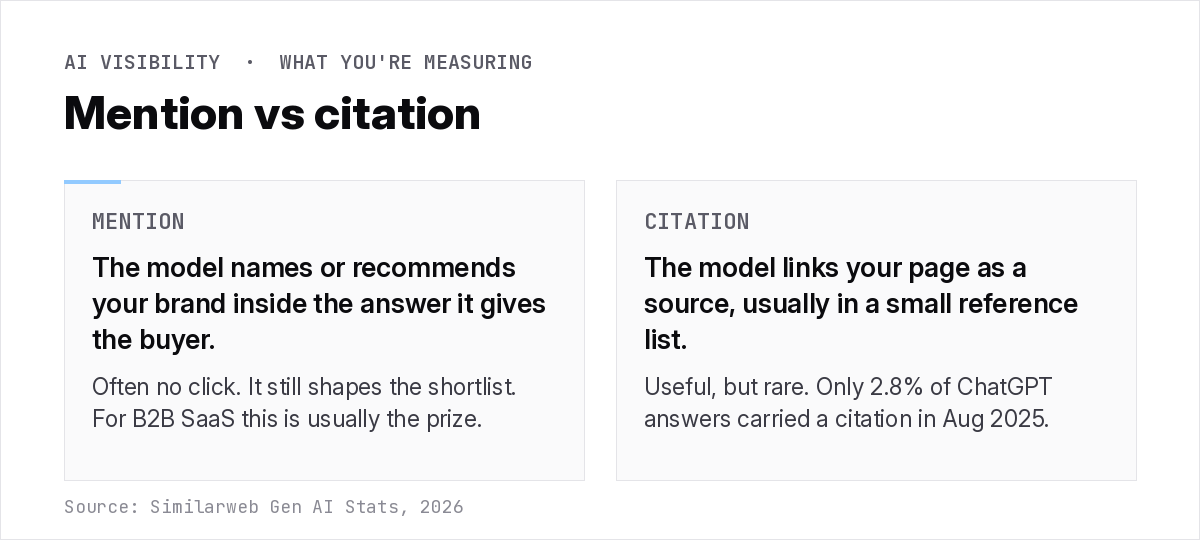
For a B2B SaaS brand, the mention is often the prize. When a buyer asks ChatGPT for "the best contract management software for a mid-market legal team" and your product is in the three it names, that recommendation does the selling. There may be no click at all, and it still shifted the shortlist. A citation is useful, but a link buried under an answer that recommends a competitor is a consolation prize.
Similarweb's 2026 data shows why citations alone are a thin signal: in August 2025 only 2.8% of ChatGPT answers carried a citation at all, up from 0.6% in January. If you only track links, you're measuring the rare case and missing the recommendation that actually moves a deal.
The five metrics that matter
Strip away the branding and most tools report the same handful of numbers. These are the five worth putting on a dashboard.
Presence, or mention rate. How often your brand appears across your prompt set, per platform. This is the headline number and the one that moves first when a campaign works.
Share of voice. Your presence measured against named competitors on the same prompts. A 40% mention rate feels good until you learn the category leader sits at 80%.
Citation rate and sources. When the model does link out, which domains does it pull from? This tells you where to earn placements, and it is usually third-party pages, not yours.
Sentiment. How the model describes you when it names you. Useful in theory, and the softest of the five in practice, for reasons we'll get to.
Position within the answer. Named first, or fourth after three rivals? On a shortlist query, order is close to everything.
Why you can't blend the platforms
A common mistake is rolling every engine into one visibility percentage. Aleyda Solis, the international SEO consultant, is blunt about this in her measurement framework: the interfaces, source behaviour and link treatment differ enough that blending hides the signal.
Her point holds up in the tools. ChatGPT, Gemini, Perplexity and Copilot each build answers differently, and Google's AI Overviews behave differently again from its AI Mode. A brand can be strong in Perplexity and invisible in ChatGPT.
If your tool reports one blended figure, ask it to break the number out by platform before you trust it. Our guide to measuring AI search visibility goes deeper on the metric side.
The AI visibility tools worth knowing in 2026
The market split into two camps fast. Dedicated AI-visibility platforms built from scratch for this job, and established SEO suites that bolted visibility tracking onto tools you already use. Both can work. Which is right depends on your budget, your team, and how much you care about source-level detail.
Prices below are entry points as of mid-2026 and they move constantly, so treat them as a starting map, not a quote. Verify current pricing before you buy.
Option 1: dedicated AI-visibility platforms
These were built for this one job, and it shows in the depth of their prompt handling and reporting.
Otterly.AI is the cheap way in at around $29 a month. It tracks a small set of prompts daily across AI Overviews, ChatGPT, Perplexity and Copilot. Good for a first read on where you stand, light once you want category-wide analysis.
Peec AI is the one we reach for on agency work. Starter runs about €89 a month for 25 prompts, Pro about €199 for 100, it covers six engines across more than 115 languages with daily runs, and the shareable workspaces make client reporting painless.
AthenaHQ, built by former Google Search and DeepMind engineers, starts around $295 and leans into source intelligence: which exact URLs the models reference for your prompts. Profound sits at the enterprise end, entry around $399 with real coverage behind higher tiers, and it is the one large teams tend to standardise on. Evertune pushes volume, more than a million prompts a month, and sells depth to brands that pay for statistical confidence.
Option 2: the all-in-one suites
If your team lives in Ahrefs or Semrush already, the suite route keeps AI visibility next to your rankings and backlinks.
Ahrefs Brand Radar checks brand mentions and citations against a database of real user prompts, and its big advantage is context: you read AI visibility beside the organic data you already trust. It is an add-on, so budget for the platform cost on top. Semrush's AI Toolkit is a roughly $99 a month add-on that leans hard into sentiment and perception reporting plus strategic prompts, aimed at marketers who want the "how are we described" angle inside a suite they know.
Option 3: free checkers, and where they stop
Ahrefs, Semrush and others publish free AI visibility checkers, and there is no reason not to run one this afternoon. They give you a one-time snapshot for a few prompts.
What they can't do is track change over time, run a real buyer prompt set, or break results out by platform and persona. Treat them as a smoke alarm, not a monitoring system. For the wider category, our rundown of AI SEO tools covers the tools that help you produce and optimise content, which is a different job from measuring visibility.
How to measure AI visibility without fooling yourself
Here is the uncomfortable part. Buy any tool, point it at a lazy prompt set, and it will hand you confident numbers that mean very little. The tool is a fraction of the work. The prompt set and the method are the rest.
Build the prompt set from real buyer questions
The single biggest error we see is a prompt library stuffed with keywords stretched into questions. Buyers don't type keywords into ChatGPT. They describe a situation, a constraint and a job to be done, then ask for a recommendation.
Aleyda Solis makes the same case: build prompts that reflect the constraints real buyers actually use, not traditional search terms dressed up as questions. Weight the set toward shortlist and selection prompts, because that is where deals are won or lost. If you want a head start, our piece on buyer queries for AI prompt tracking walks through building that library.
Run each prompt enough times to beat the randomness
AI answers are non-deterministic. Ask the same question twice and the wording changes, sometimes the brands change too. Run a prompt once and you have an anecdote, not a measurement.
Rand Fishkin put real numbers on this. His team had 600 volunteers run identical prompts through Claude, ChatGPT and Google AI, 65 to 90 times per platform, and found that while every answer differed in wording, brand presence held up as a measurable frequency across the sample.
The practical takeaway: trust presence frequency measured across many runs, and distrust any tool or report that shows you a single answer as if it were the answer. A good tool runs prompts on a schedule and reports frequency. A weak setup screenshots one lucky response.
Weight the bottom of the funnel
Not all prompts carry the same commercial weight. "What is contract management software" is an education query. "Best contract management software for a 200-person legal team" is a buying query, and being named in that answer is worth ten of the first.

This is where mentions beat citations again, and where the comparison and "best of" content that models pull from earns its keep. If your brand isn't showing up on those prompts, that is the gap to fix first, and it is usually fixed off your own domain. Our guide on how to get mentioned in ChatGPT covers the placement side.
What the tools get wrong
Every vendor demo makes AI visibility tracking look precise. It isn't, yet, and pretending otherwise leads teams to over-trust a dashboard. Three limits are worth naming plainly before you sign a contract.
API answers are not the real interface
Most tools query models through their APIs, because that is the only way to run thousands of prompts affordably. The catch is that an API response can differ from what a real person sees in the ChatGPT or Gemini app, where memory, personalisation, location and the live web all shape the answer. Practitioners raise this constantly, and it is a fair challenge. Read tool numbers as a directional proxy for the real experience, not a perfect mirror of it.
Sentiment is the weakest signal
Sentiment scoring sells well and holds up poorly. Models describe brands inconsistently, and rolling that into a tidy positive-or-negative score papers over a lot of noise.
Fishkin is sharp on the wider point, arguing that teams over-invest in AI sentiment tracking while under-investing elsewhere. His research showed brand presence can be measured statistically, and it also showed how inconsistent the models are answer to answer. Watch sentiment for large, obvious shifts. Don't run a strategy off a two-point move.
Attribution is still broken
Even with clean visibility data, connecting an AI mention to revenue is hard. AI platforms report little about referrals, and much of the influence happens with no click, so the buyer arrives later through a branded search or a direct visit.
Similarweb found that after ChatGPT added clickable brand links in May 2026, homepage referrals jumped 354.7% week over week, which is exactly the pattern of people hearing about a brand in an answer and going straight to it. Useful, and still not clean attribution.
Treat AI visibility as a leading brand signal, and model its impact over time rather than demanding a last-click line. Our take on the role of brand mentions expands on this.
How to choose an AI visibility tool for your B2B SaaS
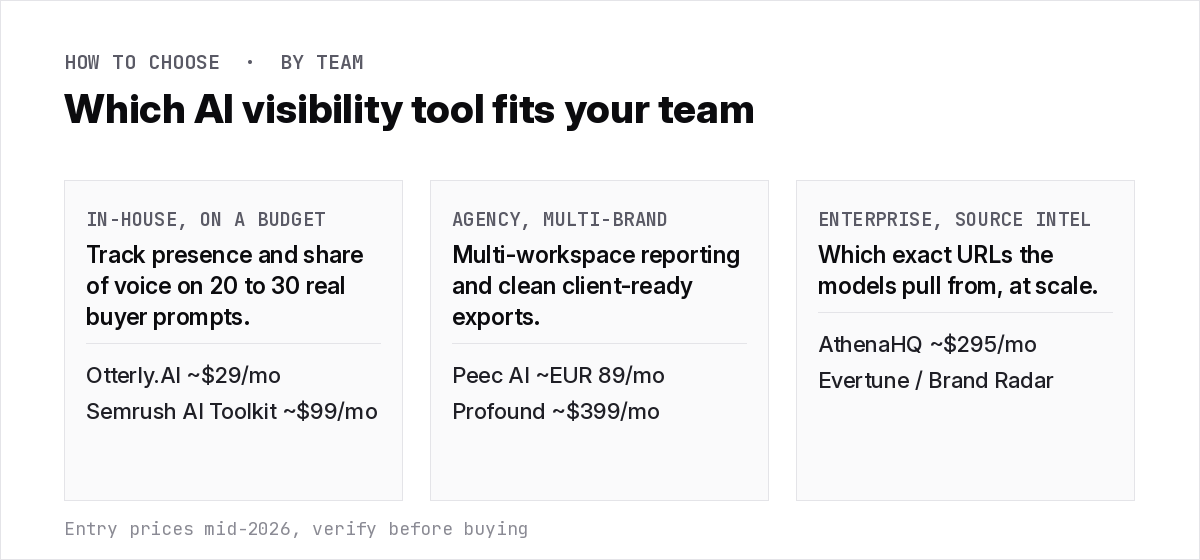
There is no single best tool, only the right fit for your stage and your team. Three situations cover most B2B SaaS companies we talk to.
If you're an in-house team on a budget
Start with a free checker to get a baseline this week, then move to Otterly at around $29 a month, or the Semrush AI Toolkit if you already pay for Semrush. Track presence and share of voice on 20 to 30 real buyer prompts, weighted to your top comparison queries. That is enough to see whether your work is moving the number.
If you're an agency managing several brands
You need multi-workspace reporting and clean client-ready exports. Peec AI is built for exactly this, and Profound is the step up when clients want enterprise coverage. Standardise on one so your prompt sets and definitions stay consistent across accounts, otherwise you can't compare brand to brand.
If you're enterprise and need source intelligence
When the question shifts from "are we visible" to "which exact pages are the models pulling from, and how do we get placed there," you want AthenaHQ, Profound or Evertune, and often Ahrefs Brand Radar alongside for the SEO context. The prize here is the source list, because it becomes your placement roadmap.
The honest verdict
Buy the cheapest tool that reports presence and share of voice by platform on a real buyer prompt set, then spend your energy on the prompts and the fixes, not the software. The tool tells you where you stand. Earning the mention, through comparison content, third-party placements and being genuinely worth recommending, is the work that moves it.
That is the part we handle for B2B SaaS teams. If you want to know where your brand stands in AI answers today and what is suppressing it, a free AI search audit is the fastest way to find out. Or read our generative engine optimization guide for the strategy behind the numbers.
Frequently Asked Questions
What are AI visibility tools?
AI visibility tools are software platforms that measure how often AI search engines like ChatGPT, Google's AI Overviews, Gemini, Perplexity and Copilot mention, cite or recommend your brand. They run a fixed set of prompts on a schedule, record every answer, and report your presence, your share of voice against competitors, and which sources the models pulled from. Marketers use them to see whether their brand shows up when buyers ask AI for recommendations.
How much do AI visibility tools cost in 2026?
Entry pricing ranges from around $29 a month for a lightweight tool like Otterly.AI to $399 a month and up for enterprise platforms like Profound, with dedicated tools such as Peec AI (from about €89) and AthenaHQ (from about $295) in between. Suite add-ons like the Semrush AI Toolkit (about $99 a month) and Ahrefs Brand Radar sit on top of a plan you may already pay for. Pricing changes often, so confirm the current tiers before you buy.
What is the difference between an AI mention and an AI citation?
A citation is a link the AI shows as a source, usually in a reference list. A mention is the AI naming or recommending your brand inside the answer itself, with or without a link. For B2B SaaS, the mention often matters more, because being recommended on a buyer query shapes the shortlist even when nobody clicks.
Are free AI visibility checkers accurate?
Free checkers from Ahrefs, Semrush and others give you a useful one-time snapshot for a few prompts, and they are worth running to get a baseline. What they can't do is track change over time, run a full buyer prompt set, or break results out by platform and persona. Treat them as a smoke alarm rather than an ongoing monitoring system.
Which AI visibility tool is best for B2B SaaS?
There is no single best tool, only the right fit for your stage. In-house teams on a budget do well with Otterly or the Semrush AI Toolkit, agencies managing several brands tend to prefer Peec AI or Profound for multi-workspace reporting, and enterprises that need source-level detail lean on AthenaHQ, Profound or Evertune. Pick the cheapest tool that reports presence and share of voice by platform on a real buyer prompt set.
How do you measure AI visibility for your brand?
Build a prompt set from the real questions buyers ask, weighted toward bottom-funnel comparison and shortlist queries, then run each prompt many times so you measure a frequency rather than a single lucky answer. Track presence, share of voice, citation sources and position within the answer, and keep each platform reported separately. The prompt set and the method matter more than which tool you choose.
.png)
Latest articles
What we've published in the past 30 days — across SEO, GEO, content, and digital PR.