.webp)





.webp)
GEO
Calculating...
Oct 2026
How to Run a GEO Audit
A GEO audit checks whether AI engines can crawl, extract and cite your site. Follow the four-layer framework to audit your AI search visibility and score it.

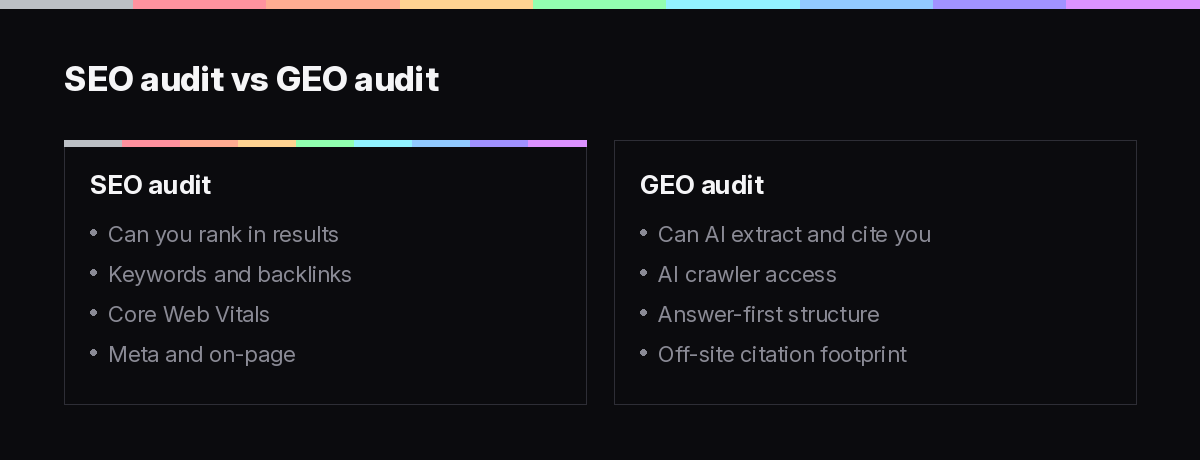
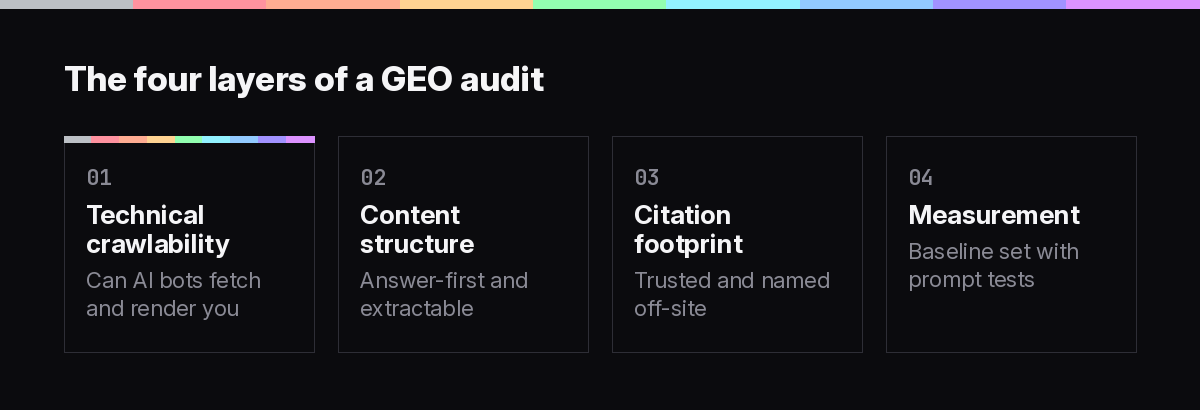
A GEO audit is a structured check of whether AI answer engines can reach, understand, trust and cite your website. It runs across four layers: technical crawlability, content structure, citation footprint and measurement. Unlike an SEO audit, which asks whether you can rank, a GEO audit asks whether a model can extract and attribute your content.
We run a version of this at the start of every AI-search engagement, and the finding is almost always the same. The content is fine. The problem sits lower down, in whether the crawlers can even see it, or in whether the wider web gives the model a reason to trust the brand. A GEO audit surfaces that in order, so you fix the gate before you polish the copy.

Layer 1: Technical Crawlability (The Gate)
Start here, always. Every other layer assumes AI crawlers can fetch and render your pages. If they cannot, the audit stops until you fix it, because invisible content cannot be cited.
Can GPTBot and PerplexityBot reach you?
Check robots.txt and your CDN or firewall rules for blocks on GPTBot, PerplexityBot, Google-Extended and ClaudeBot, then read your server logs to see what those agents actually requested. Blocking them, often by accident through a bot filter, is the most common and most expensive GEO mistake. Our guide to AI crawlers lists the agents to allow.
Does the page render without JavaScript?
Fetch a key page with a plain HTTP request and confirm the body text is present in the raw HTML. Many AI crawlers do not execute JavaScript, so content that only appears after a client-side render is content the model never sees.
Is your sitemap and llms.txt in order?
Confirm your XML sitemap is current and submitted, and consider an llms.txt file to point engines at your most important pages. These are small signals, but they lower the friction a model hits when it tries to parse your site.
Layer 2: Content Structure and Extractability
Once crawlers can reach a page, the question becomes whether they can lift a clean answer from it. This layer checks how easy your content is to extract.
Answer-first formatting
Check whether each key page leads with a direct, self-contained answer, or buries the point in the third paragraph. Engines lift the passage that answers the query cleanly, so front-loading a 40 to 60 word answer is one of the highest-return fixes. Our guide to structuring content for answer engines goes deeper.
Definitions, data and lists
Look for clear definition sentences, cited statistics and scannable lists. Kevin Indig's analysis of 1.2 million responses found 62% of AI answers use brand content without naming the brand, so structuring content to be genuinely extractable matters more than stuffing your name into it.
Schema and structured data
Verify that Organization, Article and FAQ schema are present, valid and complete. Structured data helps a model parse what a page is and who stands behind it. Our guide to schema for AI search covers the types that matter.
Layer 3: Citation Footprint and Authority
Models rarely rely on your site alone. This layer looks outward, at whether the wider web gives an engine a reason to trust and name you.
Entity consistency
Check that your brand, product and author information is consistent across your site, your knowledge panel, LinkedIn, Crunchbase and the review platforms. Inconsistent entity data makes a model less confident naming you, and confidence is what earns the mention.
Third-party mentions and reviews
Audit where you appear off-site, especially the listicles, comparison pages and review platforms that models lean on for category questions. Often the cited source in an answer is not a vendor at all but G2 or a "best tools" roundup, which tells you where to earn placements.
Source gaps
Run your priority prompts and record every source the model cites, yours and your rivals'. The pages that keep appearing are your target list. Weak authority is the quiet reason strong content still fails to get cited.
Layer 4: Measurement and Baseline
An audit that does not end in a number is just an opinion. The final layer turns findings into a baseline you can retest against.
Run the prompt test
Take 20 to 30 buyer prompts and run each three to five times across ChatGPT, Perplexity, Gemini and Google AI Overviews in a clean session. Because answers vary, SparkToro found under a 1-in-100 chance ChatGPT repeats the same brand list, so sample and aggregate rather than trusting one run. Our pillar guide to AI search monitoring covers the method, and the AI rank tracker guide covers tooling.
Score each layer
Give each layer a simple score and weight, so the audit produces a single readout and a ranked fix list. A page that fails crawlability scores zero overall, because nothing downstream can compensate for it.
Turn the score into a plan
The output is a ranked list: fix the gate first, then the highest-weighted gaps. Retest quarterly, because crawler behaviour and answer patterns keep moving. If you would rather have it run for you, a free AI search audit covers all four layers, and it is built into every SaaS SEO engagement. For what happens after buyers arrive, see AI search analytics and AI search ROI.

Frequently Asked Questions
What is a GEO audit?
A GEO audit is a structured check of whether AI answer engines can reach, understand, trust and cite your website. It runs across four layers, technical crawlability, content structure, citation footprint and measurement, and ends with a live prompt test to set a visibility baseline.
How is a GEO audit different from an SEO audit?
An SEO audit asks whether your content can rank in traditional search results. A GEO audit asks whether AI systems can extract, attribute and cite it. They overlap on technical basics, but a GEO audit adds crawlability for AI bots, extractability and off-site citation footprint.
How do you run a GEO audit?
Work the four layers in order: confirm AI crawlers can fetch and render your pages, check that content is answer-first and well structured with schema, map your off-site citations and entity consistency, then run buyer prompts across the engines to set a baseline and score each layer.
Why is crawlability the first step of a GEO audit?
Because it is the gate every other layer depends on. If GPTBot or PerplexityBot cannot reach a page, the model never sees your content, so no amount of strong copy or authority can earn a citation. Crawlability failures score zero overall.
How often should you run a GEO audit?
Run a full audit quarterly, and retest your prompt baseline monthly. AI crawler behaviour, answer formats and the sources models trust all keep shifting, so a point-in-time audit goes stale faster than a traditional SEO audit.
Can you run a GEO audit for free?
Yes. A first pass uses free tools: a plain HTTP fetch to test rendering, robots.txt and server logs for crawler access, a schema validator, and a manual prompt panel in a signed-out browser. Paid tools help once you need scale and historical tracking.
Want this done for your brand? Get a free AI visibility audit.
Get my free AI visibility audit.png)
Latest articles
What we've published in the past 30 days — across SEO, GEO, content, and digital PR.


