.webp)





.webp)
GEO
Calculating...
Oct 2026
AI Search Analytics for B2B SaaS
AI search analytics tracks AI referral traffic and behaviour in GA4. Learn why most AI traffic hides as Direct, how to detect it, and what the data means.

AI search analytics is the practice of measuring the traffic and behaviour of visitors who arrive from AI answer engines like ChatGPT, Perplexity, Gemini and Google AI Overviews. It is the downstream companion to visibility monitoring: monitoring tells you whether AI mentions you, analytics tells you what happens when those buyers click through.
There is a catch that trips up almost everyone. Open GA4, look for AI traffic, and it appears to barely exist. That is not because the traffic is missing, it is because most of it is wearing the wrong label. Fix that first, and AI search analytics becomes one of the more useful views you have.
Where AI Traffic Hides in Your Analytics
Start by understanding why your AI traffic looks smaller than it is. Three quirks bury it, and each one is fixable once you know it is there.
The Direct mislabel
When a visitor clicks a link inside an AI answer, the referrer is frequently stripped, so GA4 files the session under Direct. AuthorityTech reports that roughly 70% of AI traffic is mis-attributed as Direct. Left uncorrected, this alone makes AI search look like a rounding error.
The AI Assistant channel, and its gap
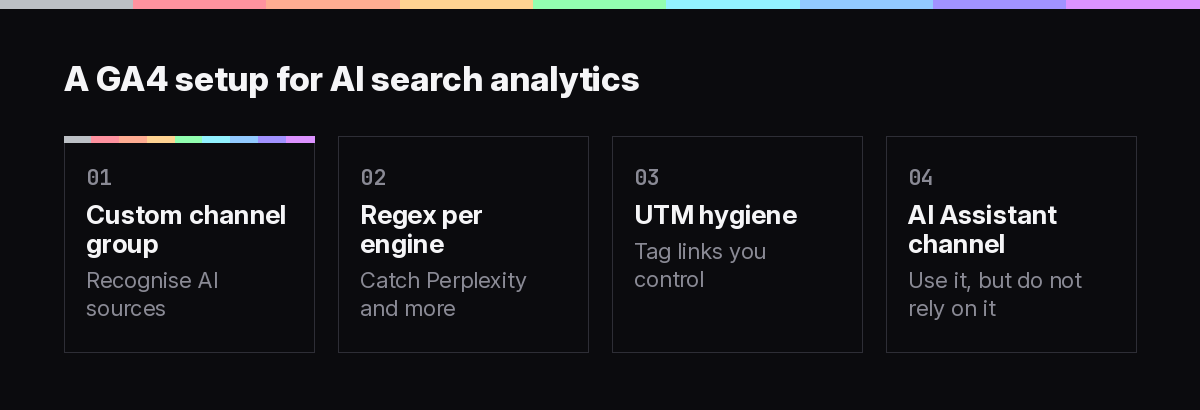
Google Analytics rolled out an AI Assistant default channel in 2026 that groups recognised chatbot traffic, which helps. But it does not catch every source, and it notably excludes Perplexity, a high-intent B2B referrer. Relying on the default channel alone still leaves a hole.
Zero-click influence you never see
Some AI visibility never produces a click at all, because the answer resolves the question in place. That influence still shapes demand, which is why AI search analytics pairs with the wider picture in our guides to zero-click searches and AI Overview click paths.
Setting Up AI Referral Tracking in GA4
The fix is a one-time setup that turns invisible AI traffic into a channel you can report. Three steps do most of the work.
Build a custom channel group
Create a custom channel group in GA4 that recognises AI sources by referrer and source or medium, so AI traffic stops hiding inside Direct and Referral. This gives you a clean AI channel to trend and compare, as Nadia Mohamed's GA4 walkthrough lays out step by step.
Add regex for the engines
Match the hostnames the engines use: chatgpt.com and openai, perplexity.ai, gemini.google.com and its variants, and copilot. A regular expression across source and referrer catches the ones the default AI Assistant channel misses, Perplexity included.
Keep UTMs clean
Where you control the link, in your own answer-engine profiles or syndicated placements, tag it with UTMs so attribution is unambiguous. Good UTM hygiene is the difference between a defensible AI channel and a pile of guesses. For the tooling that automates cross-engine tracking, see our LLM SEO tools guide and AI rank tracker guide.
What AI Visitors Do Differently
Once you can see AI traffic, the behaviour is distinct enough to change how you read your analytics. Do not judge it by the same yardstick as organic.
Fewer sessions, higher intent
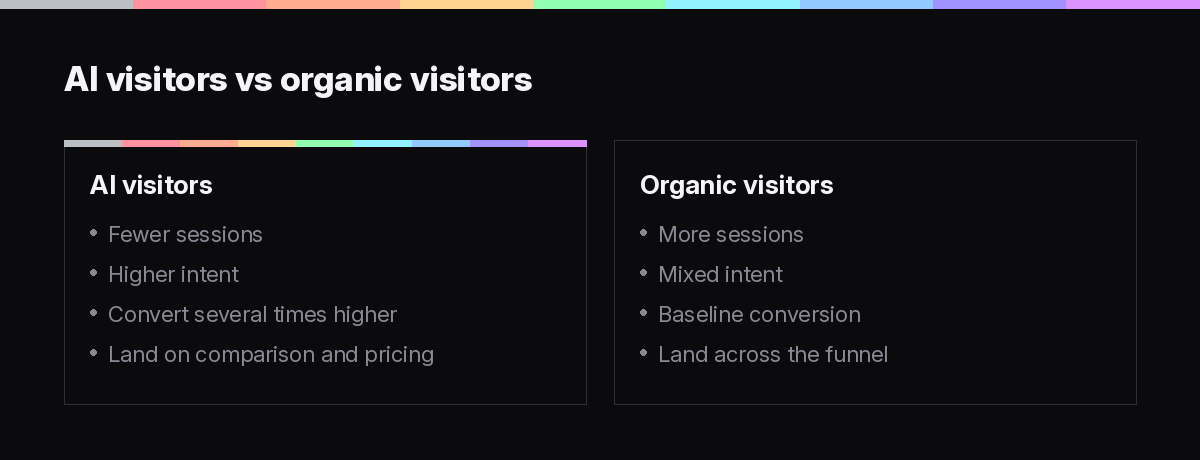
AI referrals are a small share of sessions for most sites, but they convert several times higher than organic. AirOps and others put AI referral conversion at multiples of organic search, because the model has pre-qualified the visitor before they arrive. We size the revenue side of this in our AI search ROI guide.
They land deeper in the funnel
AI traffic tends to arrive on comparison pages, alternatives pages and specific feature or pricing pages, not the homepage. The model has already done the top-of-funnel work, so it sends buyers to the page that answers a concrete question. Watch your landing-page report by AI channel to see it.
Engagement reads differently
Because these visitors arrive informed, session patterns can look shorter while still converting well. Aleyda Solis has noted that AI has changed what engagement even means, so read AI sessions against conversions, not against organic-style dwell time.
Turning Analytics Into Action
Analytics only earns its keep when it changes what you do next. Here is how to close the loop.
Find the pages AI already trusts
Sort your AI channel by landing page. The pages already pulling AI traffic show you what the models find useful, which is a direct signal for where to invest more and what format to repeat.
Feed it back into GEO
Match the landing-page data against your visibility monitoring, so you can see which content both gets cited and converts. That overlap is your priority list. Pair it with a GEO audit to fix the pages that should be earning AI traffic but are not.
The honest verdict
AI search analytics is worth setting up now, even while the data is imperfect. Correct the Direct mislabel, build a real AI channel, and read it on its own terms, and you get an early, honest view of a channel most of your competitors are still ignoring. Skip the setup and you will keep concluding, wrongly, that AI sends you nothing. Start with the pillar guide to AI search monitoring for the visibility side, and a free AI search audit or our SaaS SEO team can stand up the tracking with you.

Numbers tell you half of it. Pair them with a way to track what AI says about your brand across the assistants your buyers use.
Frequently Asked Questions
What is AI search analytics?
AI search analytics is the measurement of AI referral traffic and on-site behaviour: the sessions, engagement and conversions of visitors who arrive from AI answer engines like ChatGPT, Perplexity, Gemini and Google AI Overviews. It is the downstream companion to AI visibility monitoring.
How do I track AI traffic in GA4?
Build a custom channel group that recognises AI sources by referrer and source or medium, add regular expressions for chatgpt.com, perplexity.ai, gemini.google.com and copilot, and keep UTMs clean on links you control. This surfaces AI traffic that GA4 otherwise files as Direct.
Why does AI traffic show up as Direct?
Because the referrer is often stripped when a visitor clicks a link inside an AI answer, so GA4 has nothing to attribute the session to and defaults it to Direct. Around 70% of AI traffic is mis-attributed this way unless you set up detection.
Does GA4 track AI traffic automatically?
Partly. GA4 added an AI Assistant default channel in 2026 that groups recognised chatbot traffic, but it does not catch every source and excludes Perplexity. You still need a custom channel group and regex to capture AI traffic fully.
How is AI referral traffic different from organic?
AI referrals are fewer in number but higher in intent, converting several times above organic because the model pre-qualifies the visitor. They also land deeper in the funnel, on comparison, alternatives and pricing pages rather than the homepage.
What should I do with AI search analytics data?
Identify which landing pages already earn AI traffic, match that against your visibility monitoring to find content that both gets cited and converts, and invest there. Use the gaps to prioritise a GEO audit of pages that should be earning AI traffic but are not.
Want this done for your brand? Get a free AI visibility audit.
Get my free AI visibility audit.png)
Latest articles
What we've published in the past 30 days — across SEO, GEO, content, and digital PR.


