
.webp)





.webp)
GEO
Calculating...
Oct 2026
AI Search Monitoring for B2B SaaS
AI search monitoring tracks how often ChatGPT, Perplexity and Google AI Overviews name your brand. Learn the four signals to measure, and how to start.

AI search monitoring is the practice of tracking how often, and how favourably, an AI answer engine like ChatGPT, Perplexity, Google AI Overviews or Gemini surfaces your brand when buyers ask about your category. It replaces keyword rank tracking with four signals: presence frequency, share of voice, citations, and referral traffic.
We build this into every engagement at MADX, and the same question comes up on every kickoff call. A head of marketing has read that buyers now ask ChatGPT which vendor to shortlist, they have started publishing for it, and they want to know one thing: is it working? That is a fair question with an awkward answer. The tools most teams reach for were built for Google, and Google is no longer the whole game.

What AI Search Monitoring Actually Is
AI search monitoring measures your brand's presence inside AI-generated answers, not your position in a list of blue links. When a buyer asks an answer engine "what is the best tool for X" or "who should I shortlist for Y", monitoring tells you whether you showed up, how you were described, and which sources the model leaned on to say it.
How it differs from rank tracking
Rank tracking assumes a stable, ordered results page you can occupy at position three or seven. AI answers do not work that way. The model composes a fresh response each time, pulling from its training and from live retrieval, so there is no fixed slot to own. You are either included in the answer or you are not, and inclusion shifts from run to run.
That single shift changes the whole measurement job. Instead of asking "what position do I rank", you ask "how often do I appear, against whom, and on the back of which sources". If you have been treating AI visibility as a subset of SEO, this is where the two disciplines separate. Our explainer on AEO, GEO and SEO draws that line in more detail.
Monitoring versus optimisation
Monitoring is the measurement layer. It sits above the work of actually earning citations, which is the job of generative engine optimisation. You optimise to get mentioned, then you monitor to see if it worked. Skip the monitoring and you are flying blind, pouring effort into content with no read on whether an engine ever picks it up.
Why AI Visibility Is So Volatile
AI answers are non-deterministic. Ask the same question twice and you can get two different vendor lists, in two different orders, citing two different sources. This is the hard truth that makes single-point tracking useless, and the data on it is now hard to ignore.
SparkToro ran the definitive test. Rand Fishkin's team had 600 volunteers run 12 prompts through ChatGPT, Claude and Google AI Overviews a combined 2,961 times. They found less than a 1-in-100 chance that ChatGPT recommends the same list of brands twice for the same prompt, and roughly a 1-in-1,000 chance of the same list in the same order.
Aleyda Solis has pointed at the same instability from the brand side, noting that only about 30% of brands stay visible from one AI answer to the next, and around 20% across five consecutive runs. So even a brand that shows up today can vanish tomorrow, for no change you made.
What volatility means for how you measure
If one run tells you nothing, the fix is samples: run each prompt three to five times, in a clean session with no account signed in, and aggregate. One appearance is noise; appearing in eight of ten runs is a signal. This is the single most important habit in AI search monitoring, and it is the one most spreadsheets and cheap tools quietly skip.

The mention-versus-citation wrinkle
There is a second layer under presence. Kevin Indig's analysis of 1.2 million ChatGPT responses found that 62% of AI answers use brand content without naming the brand. Your research can shape an answer while your name never appears. Good monitoring separates the two: a citation with a link, a mention by name, and an uncredited use of your material are three different outcomes, and only two of them show up if you are only counting named mentions.
The Four Signals Worth Monitoring
Once you accept that position is the wrong unit, four signals do the real work. Track these and you have a defensible picture of AI visibility, without pretending to a precision the medium does not allow.
1. Presence frequency
The percentage of your monitored prompts where you appear, across repeated runs. This is your headline number. It moves slowly and it is comparable over time, which is exactly what you want from a core metric.
2. Share of voice against competitors
Presence in isolation flatters you. The question a board cares about is relative: when a buyer asks the model to name vendors, what share of those slots do you hold versus your named rivals. Share of voice turns a vanity count into a competitive read. We go deeper on the method in our guide to AI share of voice.
3. Citations and sources
Answer engines lean on a handful of sources per response. Monitoring which URLs get cited, yours and everyone else's, tells you what to build and where to earn placements. Often the cited source is not the vendor at all but a review site or a listicle, which reframes the whole strategy.
4. AI referral traffic
The final signal is the one that reaches your site. When someone clicks through from an AI answer, that visit should be counted and, ideally, tied to pipeline. It is small today and badly under-counted, but it converts. We will come back to why in the section on setup, and in the dedicated guide to AI search analytics.
How to Set Up Monitoring Without Buying Anything
You do not need software to start, and starting manual makes you a sharper buyer later. Here is the setup we use before any tool enters the picture.
Build a prompt panel
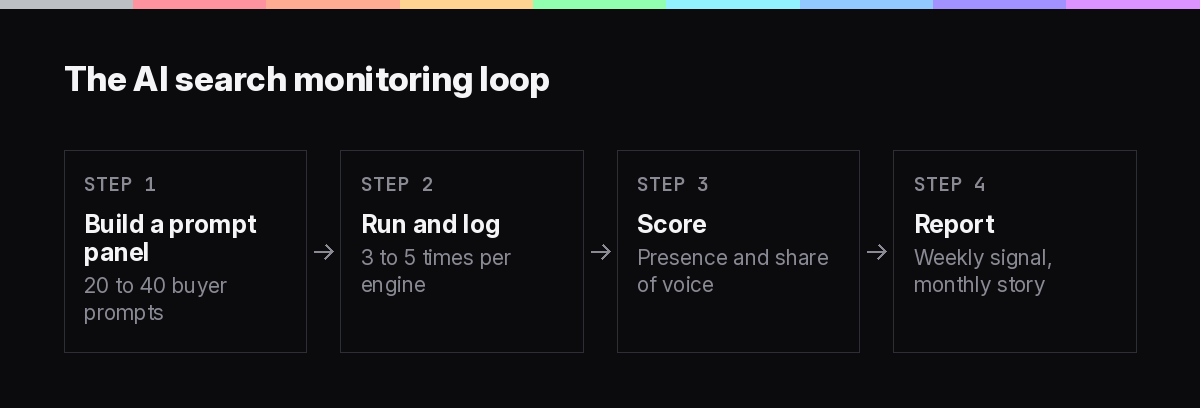
List 20 to 40 prompts your buyers actually type. Skip the definitional questions and focus on the ones with commercial intent: "best X for Y", "X alternatives", "is X or Y better for Z". These are the prompts where being named changes a deal. If you already track buyer queries for prompt monitoring, start there.
Run clean, run repeatedly
Use a private window with no account signed in, a fresh tab per run, and run each prompt three to five times across ChatGPT, Perplexity, Gemini and Google AI Overviews. Log whether you appeared, in what position within the answer, and which sources were cited. It is tedious. It is also the exact thing paid tools automate, so doing it once teaches you what to demand from them.
Score it simply
A spreadsheet with prompts down the side and engines across the top is enough. Compute presence frequency and share of voice per engine, and keep the cited URLs in a second tab. You now have a baseline, which is the thing you were missing.
When to graduate to a tool
Buy software when the sample size beats you, usually past 40 prompts across four engines run weekly, or when you need historical trends and competitor tracking you cannot maintain by hand. The market is crowded: Rankability alone compares more than 20 AI visibility tools, from enterprise platforms like Profound to lighter trackers. We break down how to choose in our guides to LLM SEO tools and AI rank trackers, and our current picks live in the AI visibility tools roundup.
Building a Cadence Your Team Will Keep
A monitoring setup that no one runs is worse than none, because it creates false confidence. The goal is a rhythm light enough to survive a busy quarter.
Weekly signal, monthly story
Check presence and share of voice weekly, because they move and because a sudden drop is worth catching early. Save the deeper read, citation shifts, new competitors, referral trends, for a monthly review that goes to leadership. Weekly keeps you honest. Monthly keeps you strategic.
Give it one owner
Assign the panel to one person, even if a tool does the collection. Someone has to read the numbers, notice the story, and turn it into a content or PR action. Monitoring without an owner becomes a dashboard no one opens.
Report the number that moves budget
Leadership does not care about raw appearance counts. Show share of voice against named rivals and the trend line, then connect it to the referral traffic and pipeline it drives. That is the bridge from "interesting" to "fund this", and it is the subject of our guide to AI search ROI.
So is any of this really trackable?
Here is the honest verdict. Fishkin is right that rank tracking, in the old sense, is dead in AI search, and anyone selling you a single "you rank #3 in ChatGPT" number is selling a fiction, but he is equally right that frequency across many runs is real and measurable. Treat AI search monitoring as a statistical exercise rather than a positional one and it works; treat it like Google rank tracking and it will lie to you. If you want a second set of hands on the setup, our team runs this inside every SaaS SEO engagement, and you can start with a free AI search audit.

Frequently Asked Questions
What is AI search monitoring?
It is the practice of tracking how often and how favourably AI answer engines such as ChatGPT, Perplexity, Gemini and Google AI Overviews mention your brand when buyers ask about your category. It measures presence, share of voice, citations and referral traffic rather than keyword position.
How is AI search monitoring different from rank tracking?
Rank tracking assumes a stable ordered results page. AI answers are generated fresh each time, so there is no fixed position to hold. SparkToro found under a 1-in-100 chance ChatGPT repeats the same brand list, so monitoring measures appearance frequency across many runs instead of a single rank.
How often should you run AI search monitoring?
Run each prompt three to five times to average out volatility, and refresh weekly for presence and share of voice. Reserve a deeper monthly review for citation shifts, new competitors and referral trends to report to leadership.
Can you monitor AI search visibility for free?
Yes, to start. A prompt panel of 20 to 40 buyer questions, run in a clean browser session and logged in a spreadsheet, gives you a real baseline. You move to paid tools when the sample size or the need for historical trends outgrows manual work.
Which AI engines should you monitor?
Cover ChatGPT, Perplexity, Google AI Overviews and Gemini at a minimum, since they drive most measurable B2B AI referrals. Add Microsoft Copilot if it is common in your buyers' stack.
What is a good AI share of voice for B2B SaaS?
There is no universal benchmark because it depends on category size and competitor count. The useful target is directional: a rising share against your named rivals over successive months, measured on the same prompt panel each time.
Want this done for your brand? Get a free AI visibility audit.
Get my free AI visibility audit.png)
Latest articles
What we've published in the past 30 days — across SEO, GEO, content, and digital PR.


