.webp)




.webp)
GEO
Calculating...
Oct 2026
AI Rank Trackers for AI Search
An AI rank tracker measures brand presence across ChatGPT, Perplexity and AI Overviews. Learn what to measure, how to track it, and how to choose a tool.

An AI rank tracker is a tool that monitors how often, and how prominently, AI answer engines like ChatGPT, Perplexity, Gemini and Google AI Overviews mention your brand for the prompts your buyers use. The honest catch: AI answers have no fixed ranking, so a good tracker measures appearance frequency and share of voice across many runs, not a single position.
The phrase "AI rank tracker" is doing something slightly dishonest, and it is worth naming before you spend a budget on one. It borrows a word, rank, from a world where positions were stable and countable, and AI answers are neither. So the tool you actually want is not a rank tracker in the old sense. It is a presence and share-of-voice tracker wearing a familiar label.
Why AI Rankings Don't Behave Like Google Rankings
In classic search, position 3 today is usually position 3 tomorrow, which is what made rank tracking work. AI answers throw that stability out. Three forces make a fixed AI rank close to meaningless.
Non-determinism
Language models sample their output, so the same prompt yields different wording, different vendors and different sources on repeat runs. SparkToro's study, where 600 volunteers ran 12 prompts 2,961 times, put numbers on it: under a 1-in-100 chance of the same brand list twice, and about 1-in-1,000 for the same list in the same order. A single reading is a coin toss, not a rank.
Personalisation and context
Answers shift with the account, location, chat history and the exact phrasing of the question. Two buyers asking the same thing can see different shortlists. There is no single "results page" to occupy, so there is no single rank to report.
The repeatability problem
Put those together and one truth follows: any AI rank tracker that shows you a clean, single position number is hiding the variance that matters. The useful signal only appears when you run a prompt many times and look at the distribution. That is a different measurement job, and it is the one worth paying for.
What a Good AI Rank Tracker Measures
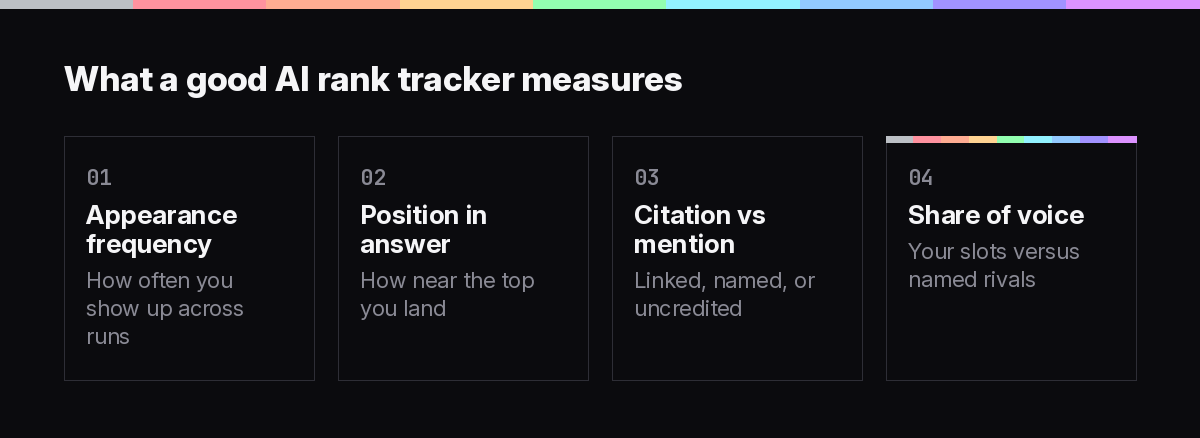
Judge any tool by whether it reports these four things. If it only gives you a single rank, it is selling comfort, not insight.
Appearance frequency
The headline metric: across many runs of a prompt, what percentage include your brand. This is stable enough to trend and it is the closest honest analogue to a ranking. Our pillar guide to AI search monitoring covers how to read it.
Position within the answer
Being named first in a shortlist beats being named eighth. A capable tracker records where in the response you land, because buyers skim the top of an answer just as they skimmed the top of a results page.
Citation versus mention
There is a real difference between a linked citation, a mention by name, and your content shaping an answer with no credit. Kevin Indig's analysis of 1.2 million responses found 62% of AI answers use brand content without naming the brand. A tracker that only counts named mentions misses most of your influence.
Competitor share of voice
Your presence only means something next to rivals. The best trackers show your share of the vendor slots against a named competitor set, which is the number that survives a board meeting. We break the method down in our guide to AI share of voice.
How to Track AI Rankings Yourself First
Before you buy, run the manual version for two weeks. It is the fastest way to learn what to demand from a paid tool, and often enough on its own for a small brand.
Build a fixed prompt set
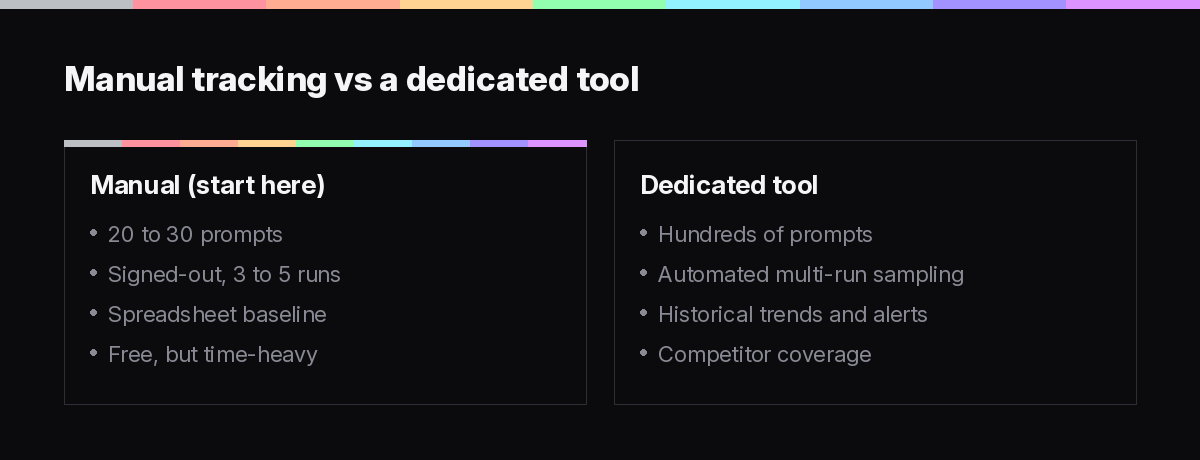
Choose 20 to 30 commercial prompts your buyers actually use, the "best", "alternatives" and "X vs Y" questions where being named wins deals. Keep the set fixed so week-on-week numbers are comparable.
Sample, don't snapshot
Run each prompt three to five times per engine in a clean, signed-out session. Record appearance, position and cited sources every time. One run is anecdote. Five runs is data.

Log it so it trends
A simple sheet, prompts by engine, with a presence percentage and a share-of-voice count, gives you a baseline and a trend. The moment maintaining that sheet costs more than a subscription, you have your answer on whether to buy.
How to Choose an AI Rank Tracker
Once manual tracking creaks, the market is ready for you, and it is busy. Rankability alone compares more than 20 AI search visibility tools. Use these criteria to cut the list.
What to look for
Insist on multi-run sampling (not single snapshots), the four metrics above, competitor tracking, and exportable historical trends. If a tool cannot show variance across runs, it is measuring the wrong thing. Frase, Profound, Peec AI, Semrush and Ahrefs Brand Radar all approach this differently, and review roundups are a fair starting point.
Engines covered
Confirm it tracks the engines your buyers use, at least ChatGPT, Perplexity, Google AI Overviews and Gemini. Coverage gaps are common, and a tool that skips the engine your market lives in is worthless to you however polished it looks.
When manual stops scaling
Here is the verdict. Rank tracking, in the old "you are position 3" sense, is dead in AI search, but a tool that samples properly and reports frequency and share of voice earns its price the moment your prompt set or engine list outgrows a spreadsheet. If you would rather we run the tracking as a service, it is built into every SaaS SEO engagement, and a free AI search audit is a fast way to see your baseline.
For the wider software landscape, see our LLM SEO tools guide, the AI visibility tools roundup and the guide to AI search analytics.
Frequently Asked Questions
What is an AI rank tracker?
It is a tool that repeatedly queries AI answer engines like ChatGPT, Perplexity and Google AI Overviews with a fixed prompt set and reports how often and how prominently your brand appears. Because AI answers vary, it measures appearance frequency and share of voice rather than a single fixed position.
Do AI rank trackers actually work?
They work when they sample each prompt many times and report the distribution. They do not work if they show a single rank number, because SparkToro found under a 1-in-100 chance ChatGPT repeats the same brand list, so one reading is noise.
How is an AI rank tracker different from a normal rank tracker?
A normal rank tracker records your fixed position in a stable results page. An AI rank tracker cannot, because generated answers have no fixed position, so it measures frequency of appearance, position within the answer, citations and competitor share instead.
Which engines should an AI rank tracker cover?
At a minimum ChatGPT, Perplexity, Google AI Overviews and Gemini, since these drive most measurable B2B AI referrals. Add Microsoft Copilot if your buyers use it. Confirm coverage before you buy, as gaps are common.
Can I track AI rankings for free?
Yes, to begin. Run a fixed set of 20 to 30 buyer prompts three to five times per engine in a signed-out browser and log appearances in a spreadsheet. Move to a paid tool when the prompt volume or the need for historical trends outgrows manual work.
How often should I check AI rankings?
Sample weekly for appearance frequency and share of voice, and review deeper monthly for citation shifts and new competitors. Always average several runs per prompt rather than trusting a single check.
Want this done for your brand? Get a free AI visibility audit.
Get my free AI visibility audit.png)
Latest articles
What we've published in the past 30 days — across SEO, GEO, content, and digital PR.


