


Content
Calculating...
Oct 2026
Content Refresh: How to Update Old Content So Google and AI Engines Cite It Again
How to run a content refresh that wins back rankings and AI citations: what to change, what to leave alone, passage-level edits and a cadence for B2B SaaS.

A content refresh is a substantial update to an existing page, on the same URL, that brings its facts, evidence and structure up to date so it ranks and gets cited again. For B2B SaaS that means front-loading answers, rewriting stale passages, replacing old stats with dated sources, and covering what competitors now cover.
Most SaaS teams have more upside sitting in old posts than in their content calendar. The pages already rank for something, they've earned links, and Google already understands what they're about.
What's changed is the bar. A refresh in 2026 has to work for AI retrieval as well as for Google, and that changes what you edit. This guide is the spec we use, and it's one part of our content audit process.
What is a content refresh?
A content refresh is a meaningful update to a page that keeps its URL, topic and intent, but replaces whatever has gone stale. It sits between a light edit and a full rewrite, and it's the right call for most decaying pages.
Refresh vs rewrite vs republish
These three get used loosely, so it's worth being precise before you brief anyone.

Why refreshing usually beats publishing new
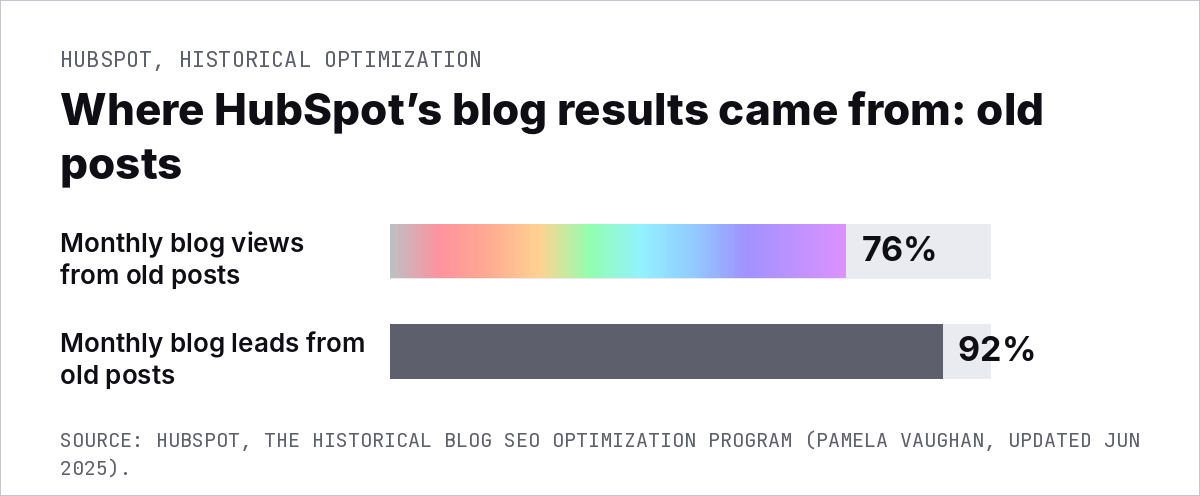
The economics are hard to argue with. HubSpot's write-up of its historical optimization program found 76% of its monthly blog views and 92% of its monthly blog leads came from older posts. Optimising those older posts increased their monthly organic search views by an average of 106%, and more than doubled the leads they generated.
It's become standard practice, too. Orbit Media's 2026 blogging survey of 1,042 content marketers notes that the share updating older articles hit a high of 73% in its 2020 to 2022 results.
The other reason is AI search. A new page has to earn trust from scratch. A refreshed page carries its history and its links into the AI answer, which is where our clients' buyers increasingly start.
Which pages should you refresh first?
Start with pages that are close to winning and close to revenue: striking-distance rankings, pages that used to be cited by AI engines, and pages with outdated product facts. That order gets results fastest.
Striking-distance pages
Pages sitting in positions 5 to 15 for a query with buyer intent are the best first refreshes. They already rank, so a better answer and fresher evidence often moves them onto page one within weeks.
To find them, filter Search Console's Performance report by page, then look at the queries each page ranks for with high impressions and a low click share. A page with thousands of impressions at position nine on a commercial query is worth more than a page at position two on a term nobody buys from.
Pages AI engines used to cite
If a page was cited on your tracked prompts last quarter and isn't now, find the page that replaced it and read it closely. It's usually newer, more specific, or easier to quote. Our guide to content decay covers how to spot this before it shows up in pipeline.
Pages with outdated product facts
Wrong pricing, retired features and old screenshots hurt trust with readers and with AI engines checking your claims against your own docs. These refreshes are quick and they protect the brand, so they jump the queue regardless of traffic.
The refresh spec: what to change
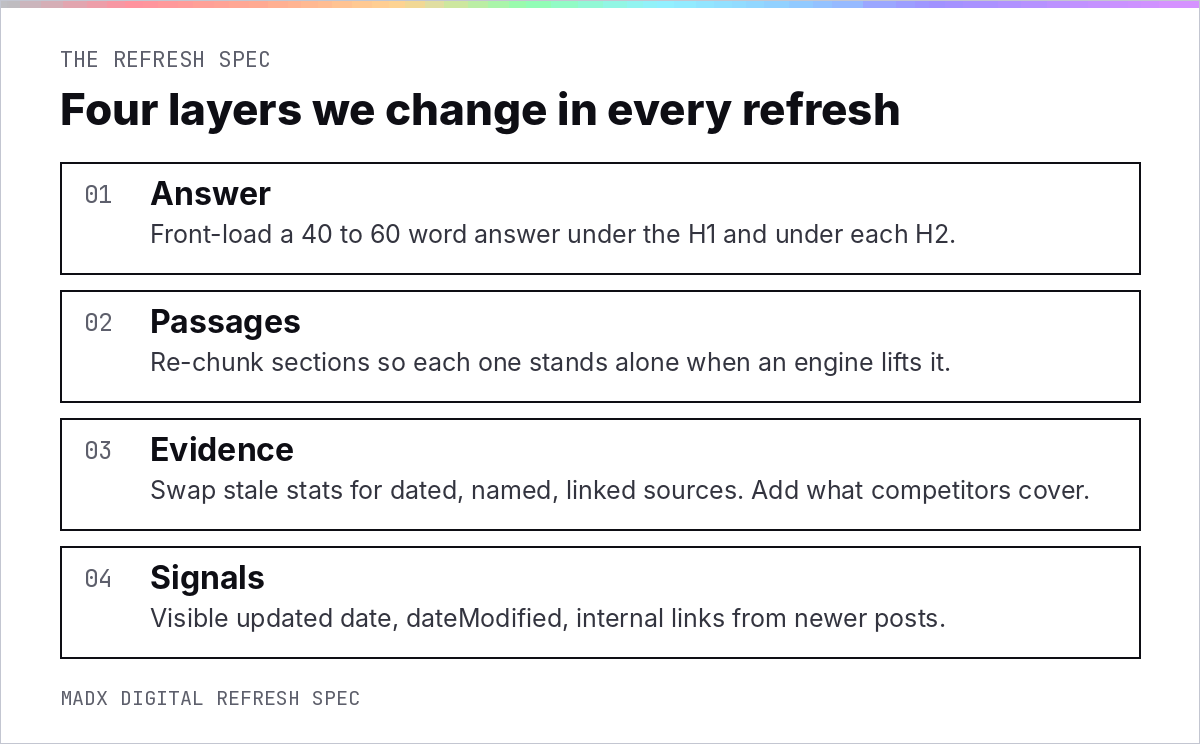
Change four layers in every refresh: the answer, the passages, the evidence and the freshness signals. That's the minimum for a page to compete in Google and get lifted into AI answers.
Front-load the answer and re-chunk the passages
Put a direct 40 to 60 word answer under the H1, and open every H2 with a one or two sentence answer to that section's question. Then check that each section makes sense if someone reads it on its own.
That second part matters because of how retrieval works now. Mike King of iPullRank put it plainly in his SEO Week keynote:
If a passage only makes sense after the three paragraphs before it, it's hard to retrieve. Our guide to structuring content for answer engines goes deeper on the formatting.
Replace stale evidence with dated, named sources
Swap every stat older than about two years for a current one from the original publisher, with the source named and linked in the sentence. Undated claims and figures borrowed from other blogs are exactly what makes a page easy to replace.
Follow every number back to where it started. If a blog cites a blog that cites a survey, link the survey and check the figure matches. We cut more stats than we keep on most refreshes, and the pages read better for it.
Your own data beats everyone else's. A benchmark from your product, an anonymised pattern from customer accounts, or a before-and-after from a real rollout gives AI engines something they can't get anywhere else, which is the best reason to cite you.
Cover what competitors now cover
Read the current top five results and the pages AI engines cite for your main query. List the subtopics they cover that you don't, add the ones that genuinely help, and add at least one angle nobody else has. Our guide to content formats for AI search helps here.
Update the date and schema honestly
Once the page has really changed, update the visible "last updated" date and the dateModified value in your structured data. That signal matters: Seer Interactive's 2026 study found 75% of the pages LLMs cite were updated in the last year, and more than a quarter of those were first published over two years ago.
Ahrefs' study of 17 million citations found ChatGPT prefers to cite URLs that are 393 days newer than organic Google results in its in-text references. Freshness clearly counts, but only real freshness. Google is explicit about the shortcut:
What not to touch in a refresh
Keep the URL, keep the links the page has earned, and keep the passages that already win. A refresh that throws away what works can lose more than it gains.
Before editing, check which queries the page ranks for and which sentences match them. Those passages stay, even if you tighten them. Keep internal links pointing in, keep anchor targets that other pages use, and keep any table or definition that AI engines already quote.
The trickiest call is the date. One camp republishes every refresh with today's date to grab the freshness boost. The other never changes the date, so nobody can accuse them of gaming it. Our verdict sits in the middle: change the date when the content has changed substantially, show a clear "last updated" label, and leave it alone for typo fixes.
How often to refresh, and how to measure the lift
Refresh your highest-value pages at least once a year and your fastest-moving ones, like comparisons and pricing-adjacent pages, every quarter. Then measure each refresh against its own baseline six to eight weeks later.
The measurement matters more than ever. Ahrefs found that the presence of an AI Overview now correlates with a 58% lower average clickthrough rate for the top-ranking page, so clicks alone undersell a good refresh. Track rankings, clicks, conversions, and citations on the prompts the page should win.
Freshness is its own topic, and our guide to content freshness in SEO covers what Google and AI engines actually reward. For tooling, our breakdown of content audit tools shows what each one is good for.
If you'd like a team to run the refresh cycle for you, our SaaS SEO agency does exactly this for B2B SaaS libraries every week.
Frequently Asked Questions
What is a content refresh?
A content refresh is a substantial update to an existing page on the same URL. It replaces outdated facts and stats, improves the answers and structure, covers missing subtopics, and updates freshness signals, so the page can rank and be cited by AI engines again.
How often should you refresh blog content?
Refresh your most valuable pages at least once a year, and fast-moving pages like comparisons, alternatives and anything tied to pricing or features every quarter. Pages that are decaying or losing AI citations should be refreshed as soon as you spot it.
Does updating old blog posts help SEO?
Yes, when the update is meaningful. HubSpot reported an average 106% increase in monthly organic search views on old posts it optimised. Cosmetic changes or a new date on unchanged content don't help, and Google's guidance warns against it.
Should I change the publish date when I update a post?
Update the visible last-updated date and dateModified only when the content has changed substantially. Keep the original publish date where your template shows it, and don't change dates for small edits.
Should I change the URL when refreshing content?
No. Keeping the URL preserves the page's rankings, backlinks and citation history. If a URL has to change, use a permanent 301 redirect from the old one and update your internal links.
How do I refresh content for AI search?
Front-load a direct answer under the H1 and at the start of each section, make every section understandable on its own, replace stale stats with dated and named sources, and update dateModified after real changes. Then track whether AI engines cite the page on the prompts it targets.
Want this done for your brand? Get a free AI visibility audit.
Get my free AI visibility audit
Latest articles
What we've published in the past 30 days — across SEO, GEO, content, and digital PR.