.webp)





.webp)
GEO
Calculating...
Aug 2026
AEO vs GEO vs SEO: What's the Difference for B2B SaaS?
AEO vs GEO vs SEO explained for B2B SaaS: what each term means, why AEO and GEO are the same job, and which one to actually focus on.

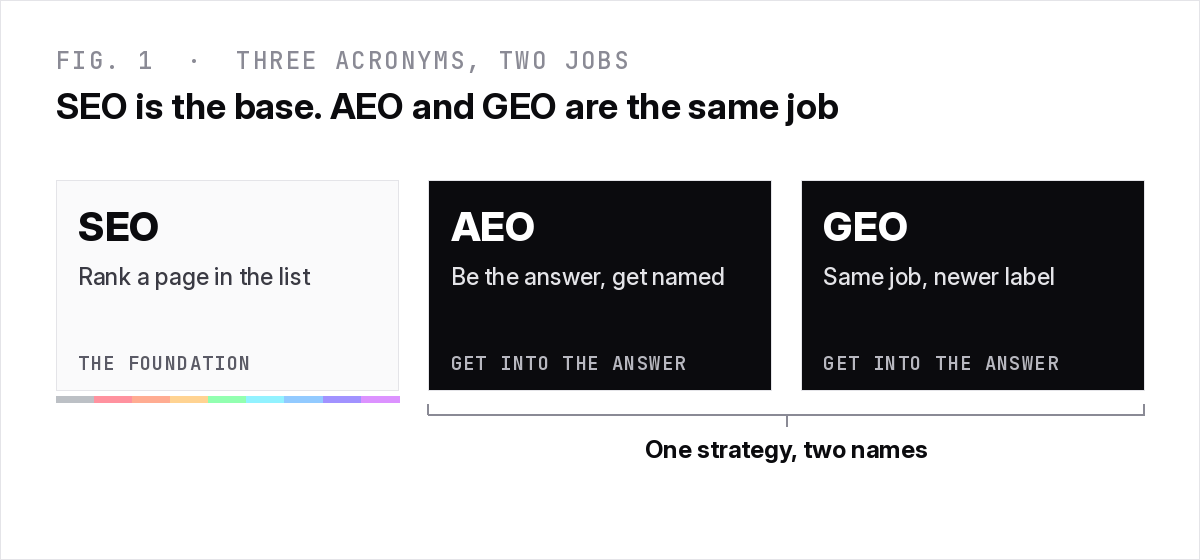
AEO, GEO and SEO all try to make your content findable, but they aim at different targets. SEO optimises to rank a page in a list of links. AEO (answer engine optimization) and GEO (generative engine optimization) both optimise to get your brand quoted and recommended inside an AI answer. For B2B SaaS, SEO is the base and AEO is where the buyer decisions now happen.
What AEO, GEO and SEO actually mean
Three acronyms, two real jobs. SEO is about ranking pages; AEO and GEO are both about getting into AI answers. Here's each one in plain terms before we get to the arguments.
SEO: rank a page
Search engine optimization is the discipline of getting a page to rank in a list of search results. You optimise for keywords, links and crawlability, and you win when your page sits near the top for a query. Thirty years of practice, well understood, still useful.
AEO: be the answer
Answer engine optimization is optimising to be the answer a machine gives, not a link it lists. The term grew out of the featured-snippet and voice-search era, when Google started answering questions directly. Now it means getting your content extracted and your brand named by ChatGPT, Perplexity and Google AI Mode. We unpack the full discipline in our guide to answer engine optimization for B2B SaaS.
GEO: get cited in generative answers
Generative engine optimization is the same idea with a newer, broader name. It went mainstream when Andreessen Horowitz published its "Act II of search" thesis in May 2025, framing GEO as the successor to SEO. GEO leans academic and covers all generative surfaces, but in day-to-day practice it describes the same work as AEO.
Are AEO and GEO the same thing?
Yes, for any practical purpose. AEO and GEO describe the same work of getting cited and recommended in AI answers, and the differences people draw between them rarely change a single task on a content calendar.
The case that they're identical
Both aim at the same outcome: your brand inside the answer. Both rely on the same tactics, clear structure, entity clarity, strong trust signals and third-party validation. The team at Profound, who build AI-visibility software for a living, are blunt that this is one strategy wearing two names.
The narrow case that they differ
You can draw a thin line if you want to. Purists say "answer engines" means direct-answer surfaces like featured snippets and voice, while "generative engines" means LLMs that write novel text. There's also a branding split: a16z pushed GEO, so investors and vendors lean that way, while many SEOs prefer AEO because "GEO" already means geography.
Our verdict on the naming
Don't spend a meeting on it. The acronym you choose has zero impact on whether ChatGPT recommends your product. We use AEO because it's clearer and it doesn't collide with geo-targeting, but if your leadership read the a16z memo and say GEO, use GEO. The mechanics of generative engine optimisation are what matter.
How AEO and GEO differ from SEO
This is the distinction that actually pays rent. AEO and GEO share fundamentals with SEO, but the objective, the signals and the scoreboard all change once the target is an answer instead of a ranking.
Different objective
SEO wins a position on a results page. AEO wins a sentence inside an answer. A buyer used to scan ten links and choose; now a model reads the sources and hands over a shortlist, which is exactly why we broke down how query fan-out works. The endpoint moved, so the work moved with it.
Different ranking signals
Ranking first doesn't guarantee you get cited. Kevin Indig's analysis of what content works well in LLMs found the signals that drive AI citations diverge from the ones that drive Google rankings. Passage-level clarity, entity coverage and third-party mentions carry weight that a raw backlink count does not. Building topical authority across a topic is what earns that entity coverage.
We see this constantly. A page can own position one for its head term and still be absent from the AI answer, because the model scored a competitor's cleaner passage or trusted a review site over the brand's own claims. The ranking is necessary, but it's no longer the finish line.
Different metrics
Here's where teams get stuck. If you keep reporting average keyword position, you'll miss the whole game. AEO is measured in mentions and citations across buyer prompts, which we cover in AI visibility for B2B SaaS. Same website, completely different scoreboard.
Which one should B2B SaaS focus on?
Focus on SEO as the foundation and AEO as the layer that wins deals. You can't skip the fundamentals, and you can't stop at them either, because your buyers now make shortlists inside a chatbot.
SEO is still the base
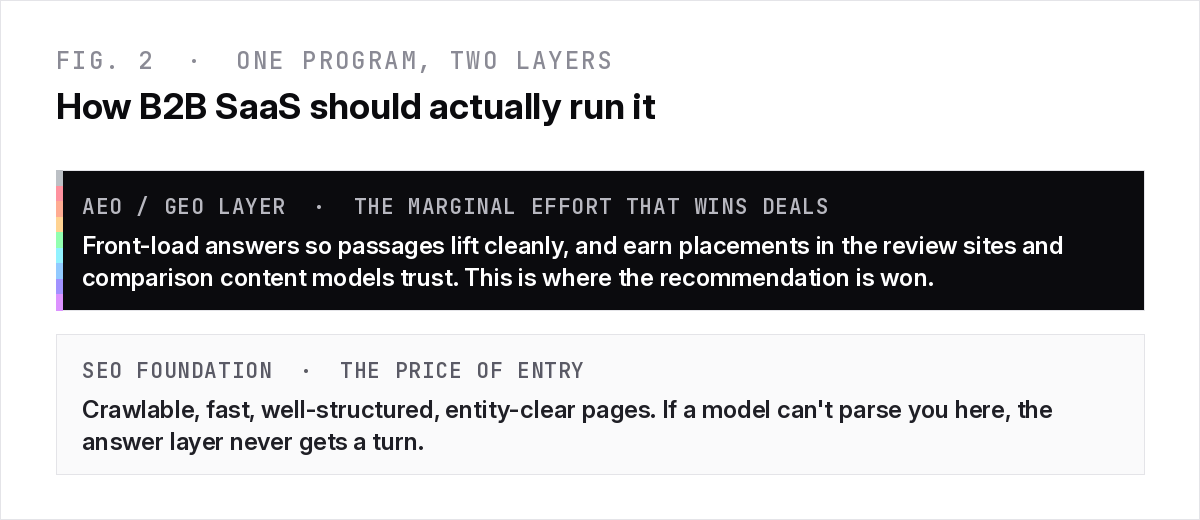
None of the AI work matters if a model can't crawl and parse your pages. Clean structure, fast pages, clear entities: that's SEO, and it's the price of entry. Skip it and you're invisible to the retrieval step before AEO even gets a turn.
The distinction that actually pays
For SaaS, the outcome worth chasing is the recommendation. G2's 2026 "Answer Economy" research found 85% of buyers think more highly of a vendor when an AI recommends it, and 69% chose a different vendor than planned on AI guidance. That's revenue moving on whether you're named, not on where you rank.
Don't buy three strategies
Treating SEO, AEO and GEO as three separate line items is how budgets get wasted. They're one program with two layers. Get the foundation crawlable and clear, then invest the extra effort in being extracted and recommended on the buyer prompts that decide deals.
The tell that you're overpaying: two vendors sending you two reports that measure different things about the same pages. One tracks rankings, the other tracks mentions, and neither owns the outcome. Consolidate to one team and one scoreboard, and the "which acronym" question answers itself.
How to do all three at once
Do the SEO fundamentals once, and most of your AEO groundwork comes with them. The overlap is large, so the practical question is where to spend the extra effort that AEO needs on top.
The overlap you get for free
Crawlable, well-structured, entity-clear content serves both a search engine and an answer engine. Clear headings, accurate facts and clean markup help you rank and help a model extract you. Do that work once and both disciplines benefit.
Where to spend the extra effort
The AEO-specific work is what most SEO programs skip. Front-load answers so passages lift cleanly, a method we detail in structuring content for answer engines, and earn placements in the third-party comparison content models trust. If you'd rather have a team run the whole program, that's what our B2B SaaS AI search team does.
Where to start
Audit the base first, then layer AEO on the pages that touch buyer decisions. Our AEO audit checklist walks the sequence step by step. Start with your comparison and category pages, since those are the ones a model reaches for on a buyer question. Stop debating the acronym, get the foundation right, then go win the recommendation.
Frequently asked questions
What is the difference between AEO and GEO?
For practical purposes, none. AEO (answer engine optimization) and GEO (generative engine optimization) both mean getting your brand cited and recommended in AI answers. AEO grew from the featured-snippet era; GEO was popularised by Andreessen Horowitz in 2025. The work is the same, so pick the label your team prefers.
Is AEO the same as SEO?
No. SEO optimises a page to rank in a list of results; AEO optimises passages to be extracted and quoted in a single AI answer. They share fundamentals like clean structure and crawlability, but what gets cited by an LLM differs from what ranks on Google, so the tactics and metrics change.
Is GEO replacing SEO?
Not replacing, layering on top. SEO fundamentals still decide whether a model can crawl and parse your pages at all. GEO and AEO add a second job on that base: getting your content extracted and your brand recommended inside AI answers. You need both.
Which is better for B2B SaaS, AEO or GEO?
The naming doesn't matter, but the focus does. For B2B SaaS, aim your effort at getting recommended on buyer prompts like "best tool for X" and "[competitor] alternatives", since G2 found 85% of buyers think more highly of a vendor an AI recommends. Call that AEO or GEO, the work is identical.
Do I need both SEO and AEO?
Yes, and they're cheaper together than apart. Treat them as one program with two layers: SEO gets your pages crawlable and clear, AEO gets them extracted and recommended in answers. Most of the SEO groundwork also serves AEO, so the extra AEO effort is smaller than buying two separate retainers.
.png)
Latest articles
What we've published in the past 30 days — across SEO, GEO, content, and digital PR.