.webp)





.webp)
GEO
Calculating...
Aug 2026
Query Fan-Out for B2B SaaS
Query fan-out splits one buyer prompt into a dozen hidden AI searches. Here is how B2B SaaS brands get cited and recommended across all of them.


Query fan-out is the technique AI search engines use to actually answer you. Instead of running your exact words, Google AI Mode, ChatGPT and Perplexity break your prompt into many related sub-queries, search them all at once, then merge the results into one response. For B2B SaaS, that means your content now competes across a whole topic, not a single keyword.
What is query fan-out?
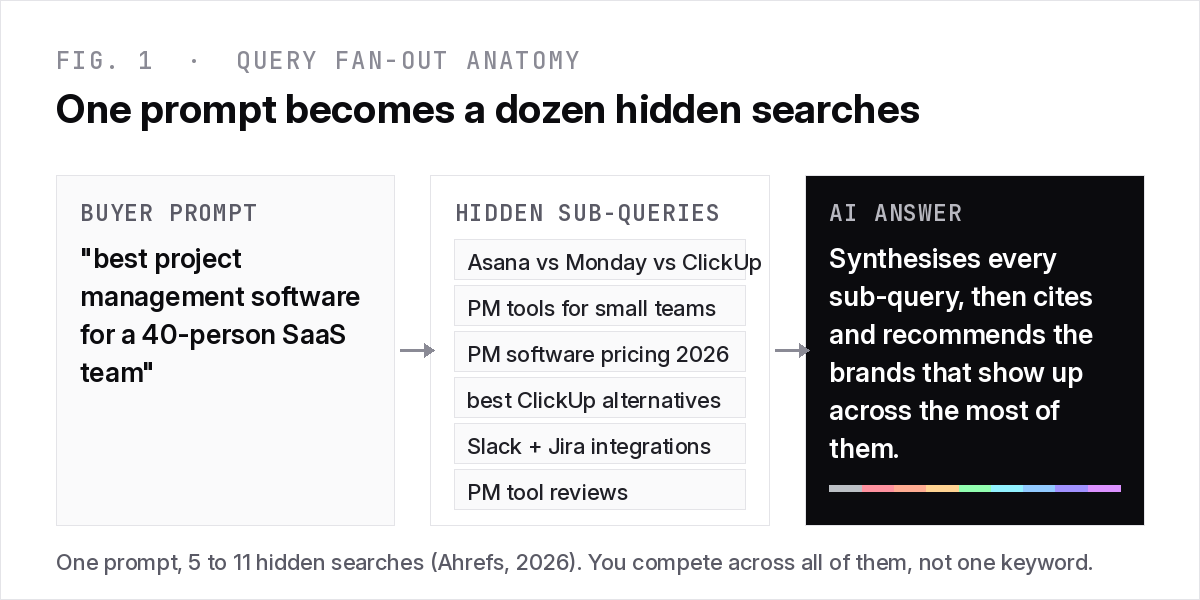
Query fan-out is when an AI search engine takes one query and expands it into multiple related searches to build a fuller answer. Rather than matching your exact phrase, it predicts the sub-questions behind your request and searches those too, in parallel, before writing a single reply.
Google confirmed the mechanic when it launched AI Mode at I/O 2025. The phrasing matters, so here it is from the source.
From one-to-one search to one-to-many
Classic search was one-to-one. You typed a phrase, Google returned pages that matched that phrase. It later became many-to-one, where "Sydney plumber" and "plumbing service in Sydney" could be served by the same result.
AI search flips the model to one-to-many. As Ahrefs lays out in its query fan-out breakdown, one search is expanded into many so the model can gather enough context to answer well. Your job is no longer to win a phrase. It is to be present across the cloud of searches that phrase triggers.
How many searches one prompt sets off
More than you would guess. Ahrefs found that a simple shopping prompt made 5 to 11 searches in AI Mode, while ChatGPT Deep Research ran 420 for the same request. Google's own Deep Search can issue hundreds of searches for one question.
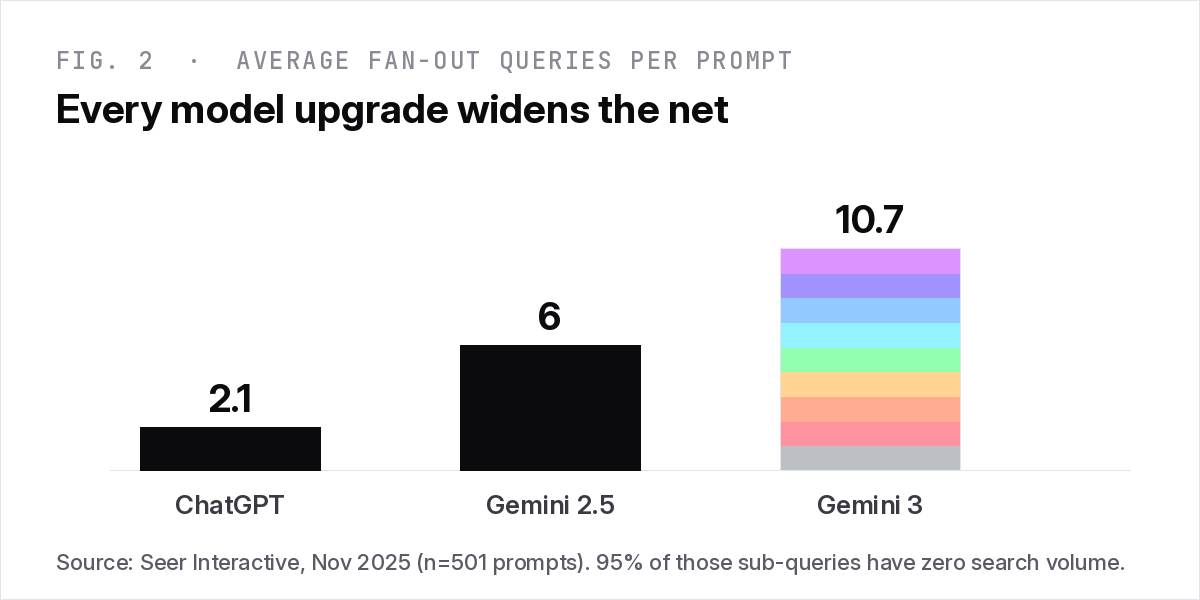
The trend is up and to the right. Seer Interactive tested 501 prompts on the Gemini 3 API and found an average of 10.7 fan-out queries per prompt, with a low of 3 and a high of 28. That is up 78% from Gemini 2.5, which averaged 6.0. Every model upgrade widens the net, so the number of searches you can appear in keeps climbing.
The seven shapes a fan-out query takes
Fan-out queries are not random. Working from Google's patent filings, researchers have grouped them into recurring forms. Knowing these tells you which angles the model will go looking for.
How query fan-out actually works
Query fan-out works in four moves: the model reads your intent, breaks the prompt into sub-queries, runs them in parallel across many sources, then merges and re-ranks everything before writing an answer. The merge step is where most of the interesting decisions happen.
Decomposition, parallel retrieval, and rank fusion
First, the model decomposes your prompt. "How to start a business" becomes separate searches for business plans, legal setup, funding, marketing and accounting. Those run at the same time across web indexes, knowledge graphs and product databases.
Then the results get combined. Ahrefs describes the system using reciprocal rank fusion, a method that rewards pages showing up consistently across many of those result lists. A page ranking second in one list and fifth in another accumulates score from both.
Why a number-one ranking no longer guarantees you show up
Here is the uncomfortable part. You can rank first for your money keyword and still be absent from the answer, because the model is scoring content against sub-queries you never optimised for. Mike King at iPullRank, who reverse-engineered the AI Mode patents, puts it plainly.
Across the B2B SaaS accounts we run, this is the single hardest idea to sell into a marketing team. The instinct is still to chase one head term. Fan-out means that a page which only answers the head term, and nothing around it, gives the model very little to work with.
The data backs this up. A large Surfer study found that pages ranking across several fan-out queries are 161% more likely to be cited in AI Overviews than pages ranking only for the main query. The same study reported that roughly 68% of cited pages did not sit in the traditional top ten at all, so breadth across the fan-out matters more than a single strong position.
Why query fan-out rewires B2B SaaS discovery
For B2B SaaS, query fan-out is not an abstract search mechanic. It changes where deals start and who gets shortlisted, because your buyers are already researching through these systems and the fan-out decides which vendors get named.
Your buyers research through an AI now, not a search box
The behaviour shift is real and fast. G2 research reported by Demand Gen Report found that 51% of B2B buyers now use AI chatbots for software research, and many start there before Google. A category buyer no longer scans ten blue links. They ask one question and read one synthesised answer.
That answer was assembled from a dozen fan-out searches the buyer never saw. If your brand did not surface across those searches, you were never in the room, and no amount of retargeting fixes a shortlist you did not make.
It gets harder to intercept, too. Much of this research now happens self-serve, long before anyone fills in a form or books a demo. By the time a buyer reaches your sales team, the AI has often already framed the category, named the front-runners and set the criteria they will judge you against.
The money sits in comparison and best-tool sub-queries
Not all fan-out queries are equal. The ones that move revenue are the bottom-funnel searches: "best tool for X", "A vs B", "alternatives to C". Seer found that 26.4% of Gemini 3 fan-out queries already contained a brand name, and that when your brand shows up in the fan-out, your odds of being cited climb sharply.
In Seer's payroll example, four of sixteen fan-out queries named ADP, and ADP was recommended in the answer. That is the whole game for B2B SaaS. You want the model to have already learned that your product belongs in the consideration set for your category's buying questions.
That is also why a real comparison page earns its keep. When the fan-out generates "A vs B" and "alternatives to C" searches, a page that lays out the options honestly, with a table of the criteria buyers actually weigh, gives the model a clean passage to lift. Thin comparison pages that only flatter your own product tend to get skipped, because they do not answer the sub-query the model was sent to resolve.
Mentions and citations are not the same thing
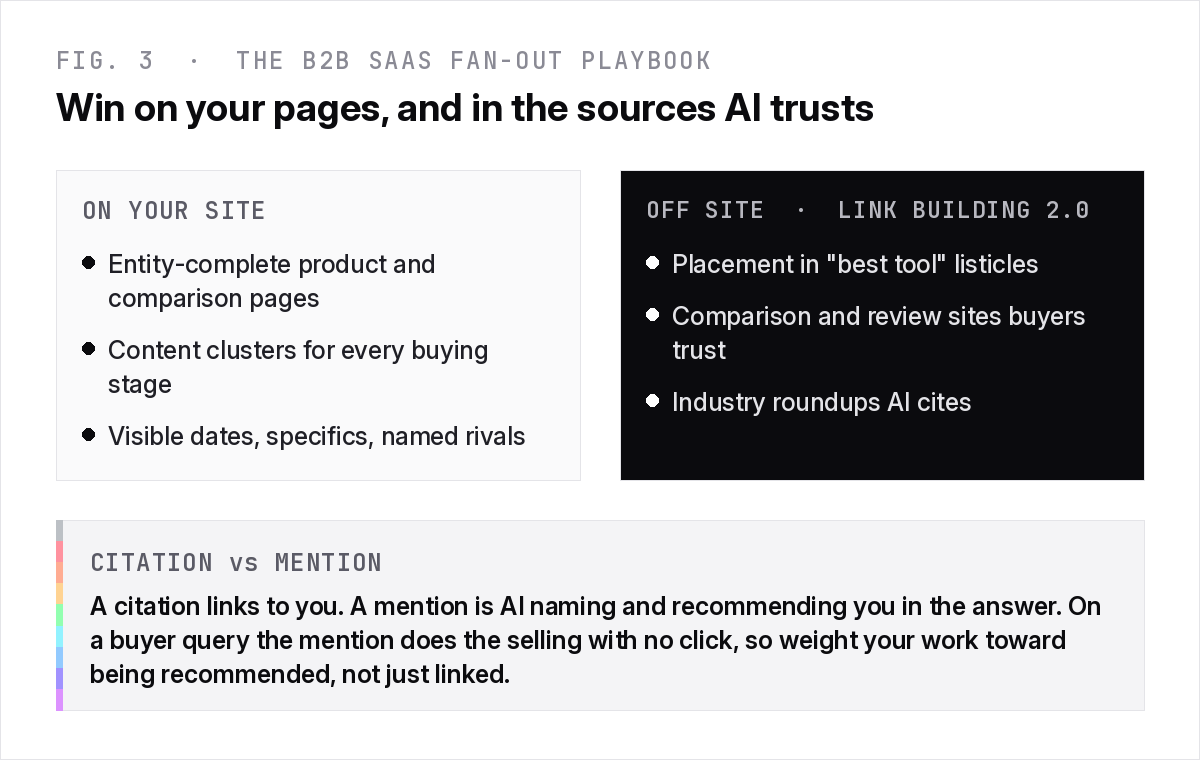
This distinction is worth getting right, because most reporting blurs it. A citation is a link to your page as a source. A mention is the AI naming or recommending your brand in the answer, with or without a link.
For a buyer query like "best CRM for a Series B SaaS", the mention is the more valuable outcome. A recommendation does the selling on the spot, no click required, while a citation buried at the bottom might never get read. Weight your prompt sets, your reporting and your content toward earning the recommendation, then treat the citation as a bonus.
How to see the fan-out queries for your category
You cannot optimise for searches you cannot see, and the fan-out queries are hidden by default. The good news is that you can reconstruct them two ways: simulate them, or pull them from tools that observe real AI responses.
Option 1: simulate them with Qforia
Qforia is a free tool Mike King built to mimic the fan-out. You paste in a query and a Gemini API key, choose AI Overview or AI Mode, and it returns a set of synthetic sub-queries in line with the patent-documented types. It is the fastest way to get a first map of how a model might decompose one of your buyer questions.
Treat the output as a hypothesis, not gospel. It shows you the shape of the fan-out, which is exactly what you need to plan coverage.
Option 2: pull them from Brand Radar, Profound, and Semrush
Several platforms now surface fan-out data from real answers. Ahrefs Brand Radar has an AI responses report that shows the fan-out queries behind ChatGPT and Perplexity prompts, plus a cited-pages report that reveals which third-party sources the models pull from. Profound built a dedicated query fan-out analysis, and Semrush and Otterly track brand visibility across AI prompts too.
The workflow is the same whichever you pick. Start with the prompts that matter to your buyers, capture the fan-out and the sources being cited, then compare that against where your brand actually appears. The gap is your roadmap. Our own guide to measuring AI search visibility walks through the tracking side in more depth.
Read the patterns, not the exact phrases
Here is the trap. Fan-out queries look like long-tail keywords, so teams try to write a page for each one. Don't. Seer found that 95% of fan-out queries have zero search volume, and Ahrefs notes they are synthetic and probabilistic, so the same prompt produces different fan-outs on different runs.
Chase the pattern instead. If comparison and pricing sub-queries dominate your category, the answer is a strong comparison page and clear pricing content, not fifty near-duplicate posts targeting phrases no human ever types.
How to earn visibility across the fan-out
Optimising for query fan-out comes down to two fronts: make your own pages easy to pull from across a full topic, and get your brand into the third-party sources the model fans out to. You need both, because the fan-out reaches well beyond your domain.
On your site: entity-complete pages and stage-by-stage clusters
Start by making your pages entity-complete. For a product, that means every attribute a buyer filters on is stated clearly: who it is for, what it integrates with, pricing, security posture, deployment. The model resolves your product across all of these dimensions, so gaps read as missing features.
Name your entities explicitly and back them with structured data. When you say who a feature competes with, or which category a product belongs to, you give the model something concrete to match against the comparative and reformulation sub-queries. Vague, brand-first copy that never names a competitor or a use case leaves the model guessing, and it will guess in favour of whoever was clearer. Covering a topic by meaning rather than by keyword is the essence of semantic SEO.
Then build clusters that cover every buying stage, from category education to comparison to implementation. Add visible published and updated dates, because Seer found 21.3% of fan-out queries include a year, which means recency signals on the page itself help. Our breakdown of the best content formats for AI search and the wider generative engine optimisation guide go deeper on structure.
Off your site: get placed where AI fans out (Link Building 2.0)
Most high-intent fan-out queries send the model to third-party sources: "best of" listicles, comparison sites, review platforms and industry roundups. You cannot publish those about yourself, which is exactly why they carry weight in an answer.
This is the heart of what we call Link Building 2.0: earning placements in the buyer guides and comparison content that AI already cites for your category. When the fan-out for "best CRM for SaaS" pulls a listicle, you want to be named in that listicle.
Prioritise with data rather than guesswork. Use a cited-pages report to see which specific third-party domains the models already trust for your buyer prompts, then work down that list by how often each source appears. A single placement in a review site that the fan-out pulls for ten of your priority prompts is worth more than a dozen links nobody's AI ever reads. If you would rather we map and close those placements for you, that is what our B2B SaaS AI search team does day to day.
Measure topic share of voice, not single rankings
Change what you report. A single keyword position tells you almost nothing about fan-out, because you are being scored across a whole topic. Track citation and mention frequency across your category's buyer prompts, grouped by topic, and watch the trend rather than any one position.
There is a fair counter-argument worth naming. Since 95% of fan-out queries have zero search volume and shift run to run, some argue chasing them is noise. That critique is right about the exact phrases and wrong about the strategy. You should never target individual synthetic queries, but the patterns they reveal, comprehensive topical coverage and strong entity data, are the most durable AI-visibility investments available right now.
So build for the pattern, measure at the topic level, and let the individual citations take care of themselves. For the traditional side of the same shift, our guide to Google AI Mode SEO and how to rank in AI search results pair well with this piece.
Frequently asked questions
What is query fan-out in simple terms?
Query fan-out is when an AI search engine takes your one question and quietly runs many related searches to answer it. Instead of matching your exact words, it predicts the sub-questions behind your request, searches them all at once, and blends the results into a single reply.
How many queries does Google AI Mode fan out into?
It varies with how complex your prompt is. Ahrefs observed 5 to 11 searches for a simple prompt, and Seer Interactive measured an average of 10.7 fan-out queries per prompt on Gemini 3, ranging from 3 to 28. Google's Deep Search can issue hundreds for a single research question.
How do I see the fan-out queries for my keyword?
Two ways. Simulate them with a tool like Qforia, which returns synthetic sub-queries for any prompt, or observe real ones in platforms like Ahrefs Brand Radar, Profound and Semrush that report the fan-out behind live AI answers. Start with your buyer prompts, then compare the fan-out against where your brand appears.
Does query fan-out apply to ChatGPT and Perplexity too?
Yes. Query fan-out is used across every major AI search system, including Google AI Mode, ChatGPT, Claude and Perplexity. The number and shape of sub-queries differ by model, but the core behaviour of expanding one prompt into many searches is the same.
How is query fan-out different from traditional SEO?
Traditional SEO optimises a page to rank for a specific keyword. Query fan-out scores your content against a whole cluster of related sub-queries at once, so ranking first for one term no longer guarantees you appear in the answer. The focus shifts from single keywords to complete topic coverage and strong entity data.
Should I create a separate page for each fan-out query?
No. Around 95% of fan-out queries have zero search volume and change from run to run, so building a page per query wastes effort. Optimise for the patterns instead. If comparison and pricing sub-queries dominate your category, invest in a strong comparison page and clear pricing content rather than many thin posts.
.png)
Latest articles
What we've published in the past 30 days — across SEO, GEO, content, and digital PR.