.webp)





.webp)
GEO
Calculating...
Aug 2026
GEO vs SEO: What B2B SaaS Should Actually Invest In (2026)
GEO and SEO are not rivals. See how B2B SaaS should split effort between ranking in Google and getting cited in AI answers like ChatGPT and AI Overviews.

GEO (generative engine optimization) and SEO are not rival strategies. SEO earns rankings and clicks in traditional search. GEO earns mentions and citations inside AI answers from ChatGPT, Perplexity, and Google AI Overviews. For B2B SaaS in 2026 you need both, because buyers now research across both surfaces before they ever fill in a form.
Key takeaways
- SEO optimizes for rankings and clicks in traditional search. GEO optimizes for being named and cited inside AI answers. They share most fundamentals and split on goals and measurement.
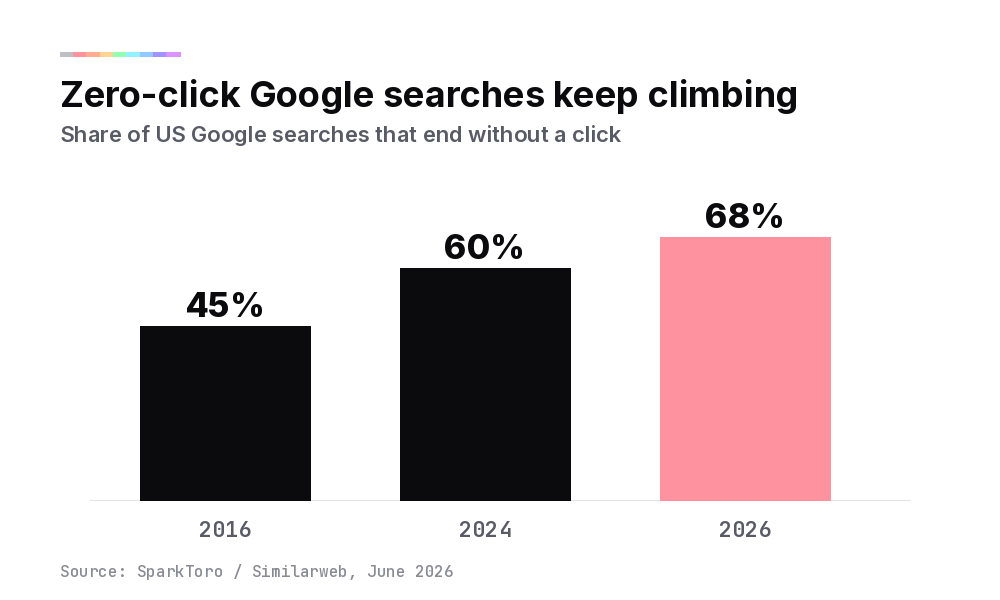
- AI search is now a real buying surface. ChatGPT passed 800 million weekly users, and 68% of US Google searches now end without a click.
- For B2B SaaS, a mention (the AI recommending your brand) often beats a citation (a link), because a recommendation on a "best tool" query does the selling before any click.
- SEO still feeds GEO. The pages that rank in Google are the same pages AI engines pull from, so strong SEO raises your odds of being cited.
- Run one integrated program, not two teams. Split effort by funnel stage and query type, and track share of voice in AI answers next to rankings and organic traffic.
- The Princeton GEO study found targeted optimization can lift visibility in AI answers by up to 40%.
What we'll cover
- GEO vs SEO: what's actually different
- Why "GEO vs SEO" is the wrong question
- How AI search changed B2B SaaS buying
- GEO vs SEO ranking factors
- Mentions vs citations: the distinction that matters most
- Does SEO still matter in the age of AI search?
- How to run GEO and SEO together
- How to measure GEO vs SEO (and the tools that help)
- GEO vs SEO for B2B SaaS: which to prioritise
GEO vs SEO: what's actually different
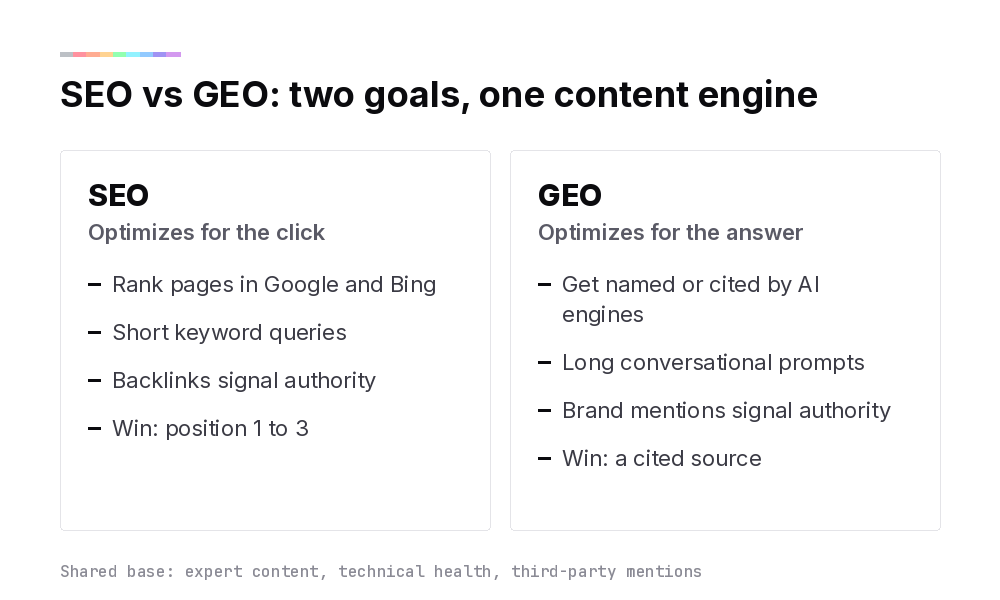
The core difference is the goal. SEO tries to rank your page in a list of blue links so a person clicks through to your site. GEO tries to get your brand named, cited, or recommended inside an AI-generated answer, whether or not anyone clicks. Same content foundation, different finish line.
SEO (search engine optimization) is the practice of improving how well your pages rank in traditional engines like Google and Bing. It leans on keywords, crawlable technical foundations, on-page structure, and a backlink profile that signals authority. The payoff is a position in the results and the click that follows.
GEO (generative engine optimization) is the practice of improving how often, and how favourably, your brand shows up inside AI-generated answers. Generative engines synthesise an answer from multiple sources instead of handing back ten links. Your job shifts from owning a position to being one of the few sources the model draws on. Answer engine optimization (AEO) is a close cousin, usually used to describe optimizing for direct-answer features and answer boxes. In practice the three overlap so much that most teams treat GEO as the umbrella for all AI-answer visibility.
SEO vs GEO at a glance
SEOGEOPrimary goalRank a page, earn the clickGet named or cited in the answerSurfaceGoogle, Bing results pagesChatGPT, Perplexity, AI Overviews, AI ModeQuery styleShort keywords (≈4 words)Long conversational prompts (≈23 words)Authority signalBacklinks and PageRankConsistent brand mentions across trusted sourcesCore KPIRankings, organic clicks, trafficShare of voice, citation rate, referral qualityWin conditionPosition 1 to 3Being one of a handful of cited sources
Why "GEO vs SEO" is the wrong question
Framing this as a versus fight leads teams to defund the thing that feeds their AI visibility. The two disciplines share most of their DNA. What changes is where the work shows up and how you measure it.
Look at what a generative engine actually rewards. It favours content that is well structured, demonstrably expert, frequently referenced across the web, and easy to parse into a clean answer. That list is close to what good SEO has always asked for. The gaps are real but narrower than the hype suggests: personalization across multi-turn prompts, optimizing for topics and context instead of exact keywords, and a new class of visibility metrics that live inside answers rather than results pages.
Aleyda Solis, one of the most widely followed voices in search, mapped the overlap in detail and landed on a measured conclusion.
“There's definitely an overlap between the optimization pillars between LLMs and traditional search engines, although there are also important differences that need to be taken into account when establishing a strategy for each.”
Aleyda Solis, founder of Orainti · SEO vs GEO comparison
So the useful move isn't to pick a side. You build one content and authority engine, then optimize the last mile differently for each surface. Our own guide to generative engine optimization treats GEO as an extension of a strong SEO base, not a replacement for it.
How AI search changed B2B SaaS buying
The reason this matters now is that a meaningful share of B2B research has moved into AI tools, and that share is growing fast. Your buyers are forming shortlists inside a chat window before they touch your website.
The usage numbers are hard to ignore. ChatGPT reached 800 million weekly active users in October 2025, up from around 400 million earlier that year. On the Google side, 68% of US searches ended without a click in the first four months of 2026, according to SparkToro and Similarweb data, up from 60% in 2024. AI Overviews now show on more than 20% of searches and cut click-through by close to 60% when they appear.
Buyer behaviour has followed. Gartner found that 45% of B2B buyers used generative AI during a recent purchase, mainly to gather information on vendors and products, drawing on roughly seven information sources along the way. When an AI answer names three tools and skips yours, you are not on the shortlist, and you never saw the query.
GEO vs SEO ranking factors
SEO ranking factors and GEO visibility factors rhyme, but they are not identical. SEO still rewards crawlable pages, keyword-aligned content, and a strong backlink profile. GEO rewards clarity, structure, corroboration across sources, and being the kind of brand an engine has seen described consistently. Building topical authority across your category is what makes that consistency compound.
The most useful research here is the founding academic study of the field. Researchers from Princeton and IIT Delhi tested optimization methods across roughly 10,000 queries and found that targeted changes could lift a source's visibility in generative answers by up to 40%.
Definition · what lifts AI visibility
In the Princeton GEO study, the changes that moved the needle most were adding relevant statistics, quoting credible sources, and citing authoritative references. Not keyword stuffing. The content moves that make an answer engine trust and reuse your page are the same ones that make a human editor trust it.
In B2B SaaS specifically, one factor outranks the rest, and it catches plenty of teams off guard: how your brand gets described on pages you don't own. Engines lean on third-party corroboration. If review sites, roundups, and buyer guides describe your product in the language your buyers use, the model is far more likely to surface you. This is exactly why we treat off-site placement as core GEO work, not a bolt-on. You can see the mechanics in our breakdown of how AI actually builds recommendations.
Mentions vs citations: the distinction that matters most
Get this one right and GEO strategy gets much clearer. A citation is when an engine credits your page as a source, usually with a link. A mention is when the engine names or recommends your brand inside the answer, with or without a link. In B2B SaaS, the mention is usually worth more.
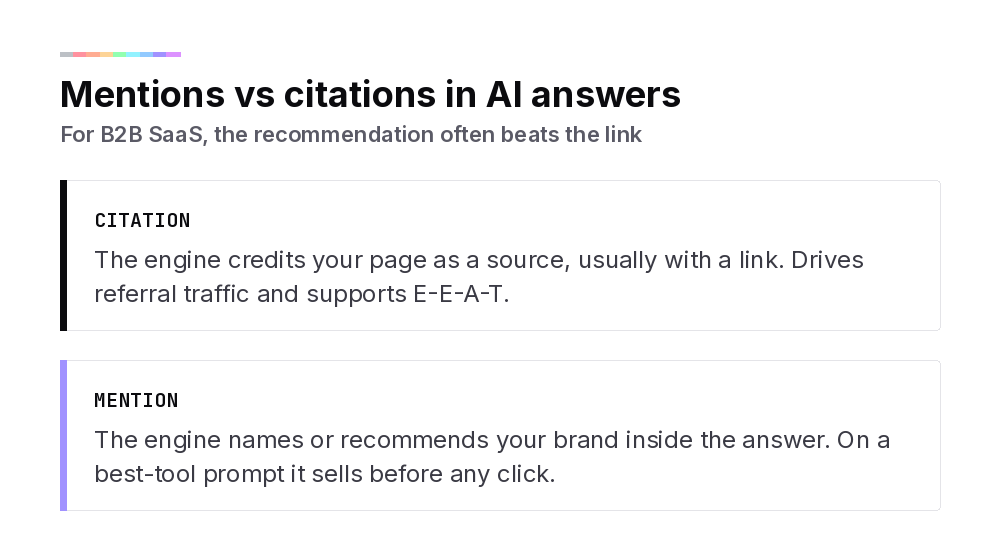
Think about how a buyer uses ChatGPT. They ask for the best contract management tool for a mid-market legal team. If the answer lists three products and yours is one of them, you have been pre-sold by a source the buyer trusts, before any click. That is a mention doing bottom-funnel work. A citation on a definitional query is useful, but it rarely carries the same buying weight.
Across many B2B SaaS campaigns we see the same pattern. The queries worth winning are the comparison and recommendation prompts near the buying decision, not the top-funnel "what is" questions. That shapes everything downstream: the prompt sets you track, the content you build, and the third-party placements you pursue. If you want a starting list, our post on buyer queries for AI prompt tracking maps the prompts that matter.
Does SEO still matter in the age of AI search?
Yes, and arguably more than before, just not as a pure traffic play. SEO is now the supply line for GEO. Google's AI Overviews and most AI assistants lean heavily on pages that already rank well, so the work that earns rankings also earns citations.
Rand Fishkin, who has published zero-click research for years, put the shift plainly in his 2026 analysis.
“Your SEO still matters as much or more than ever before, it just won't earn you traffic the way it once did.”
Rand Fishkin, founder of SparkToro · 2026 zero-click search study
For a SaaS marketing leader, the shift is to stop judging SEO on sessions alone. A page can bleed organic clicks and, in the same month, quietly become the source three different assistants cite when buyers ask about your category. That influence is real pipeline, even when the analytics dashboard shows flat traffic. It is also why the fundamentals still apply: our guide to ranking in AI search results starts from technical and content basics, not tricks.
How to run GEO and SEO together
The efficient model is one program with two output layers, not two competing teams. You build authority and content once, then tune the last mile for results pages and for answers separately. The split below is roughly what we run across most B2B SaaS accounts.
Start with the shared base. Publish genuinely expert content, keep the site crawlable for both Googlebot and AI crawlers, and earn consistent third-party mentions on the sites your buyers already trust. That base pays off on both surfaces. Then layer the surface-specific work: schema, internal links, and title optimization for SEO, and clean answer-first passages, statistics, and comparison content for GEO.
Field note · how we split effort
On most B2B SaaS programs we run, the rough allocation is 60% into the shared base (expert content, technical health, digital PR and third-party placements) and 40% split between SEO last-mile and GEO last-mile. The base is where both channels compound. Teams that fund two separate motions usually overspend and under-rank on both.
Map the work to funnel stage. Traditional SEO still wins top-funnel informational and branded queries where clicks flow. GEO earns its keep on the mid and bottom-funnel comparison prompts where buyers build shortlists. Getting placed in the buyer guides and roundups that engines cite is the same earned-placement discipline we call Link Building 2.0, and it feeds both channels at once. If AI Overviews are a priority for your category, our strategies to rank in AI Overviews go deeper on the on-page side.
How to measure GEO vs SEO (and the tools that help)
Measurement is where the two disciplines separate most. SEO has mature tooling for rankings, clicks, and traffic. GEO needs a different stack that samples AI answers, tracks how often your brand appears, and shows which sources the engines cite instead of you.
For SEO you already know the KPIs: rankings, organic clicks and impressions, and assisted conversions. For GEO the metrics that matter are share of voice in AI answers, citation rate, sentiment, and the quality of any referral traffic that does arrive. A growing set of tools now tracks these directly.
AI visibility tools, 2026
ToolWhat it tracksEntry priceProfoundBrand presence and how AI describes you across major engines$399/moPeec AIPrompt-level visibility and competitor share of voice€89/moAhrefs Brand RadarShare of voice, cited sources, and content types driving citations$129/mo baseSemrush AI ToolkitPrompts as keywords, share of voice, sentiment and perception$99/moOtterly AILightweight monitoring of brand mentions across AI answers$29/mo
Pricing and features move monthly, so treat the table as a starting point and validate before you buy. We keep a fuller, tested breakdown in our AI SEO tools guide, and a practical framework in how to measure AI search visibility. Whatever you pick, the goal is the same: a single dashboard that shows rankings and organic traffic next to AI share of voice, so no one has to argue about which channel deserves credit.
GEO vs SEO for B2B SaaS: which to prioritise
If you are forced to sequence, anchor on your buyers and your category. Most B2B SaaS teams should keep SEO running for the queries that still send clicks, and add GEO fast for the comparison and recommendation prompts where AI is already shaping shortlists. The right split depends on how much of your category's research has already moved into AI tools.
A useful lens comes from Mike King of iPullRank, who argues the whole discipline is converging into what he calls relevance engineering: a blend of information retrieval, content strategy, and digital PR aimed at every search surface at once, rather than two separate playbooks.
Relevance engineering blends information retrieval, content strategy, and digital PR to earn visibility across every search surface, not just the ten blue links.
Position of Mike King, CEO of iPullRank · on relevance engineering
The honest answer to "GEO vs SEO", then, is that the versus is a trap. Fund the shared engine, measure both surfaces, and weight the last mile toward wherever your specific buyers are actually researching this quarter. For most SaaS categories in 2026, that means SEO to hold the clickable ground you still own, and GEO to win the recommendations that increasingly decide the shortlist. If you want help pressure-testing the split for your category, our team does exactly this through our AI search optimization service and our generative engine optimization work.
Frequently Asked Questions
Is GEO replacing SEO?
No. GEO is extending SEO, not replacing it. Traditional search still sends clicks for branded, local, and high-intent transactional queries, and the pages that rank in Google are the same ones AI engines cite. The smarter framing is one program that optimizes for both results pages and AI answers.
What does GEO stand for in marketing?
GEO stands for generative engine optimization. It is the practice of improving how often and how favourably your brand appears inside AI-generated answers from tools like ChatGPT, Perplexity, Google AI Overviews, and AI Mode. The goal is being named or cited in the answer rather than ranking in a list of links.
How is GEO different from AEO?
AEO (answer engine optimization) usually refers to optimizing for direct-answer features and answer boxes, while GEO focuses on visibility inside fully generative AI responses. In practice the tactics overlap heavily, so most B2B SaaS teams treat GEO as the umbrella term and fold AEO tactics into it rather than running them separately.
Do B2B SaaS companies need a separate GEO strategy?
You need a GEO layer, not a separate department. Most of the work (expert content, technical health, and third-party mentions) is shared with SEO. Where you diverge is the last mile: answer-first passages, comparison content, and tracking share of voice in AI answers instead of only rankings and clicks.
How do you measure GEO performance?
Track share of voice in AI answers, citation rate, sentiment, and the quality of any AI referral traffic. Tools like Profound, Peec AI, Ahrefs Brand Radar, and the Semrush AI Toolkit sample prompts across engines and show where your brand appears versus competitors. Pair that with your normal SEO reporting so both surfaces sit on one dashboard.
Can you do GEO without doing SEO first?
Not effectively. Generative engines lean heavily on pages that already rank and on brands described consistently across trusted sites. Without an SEO and authority foundation, there is little for the models to retrieve or trust. Strong SEO is the supply line that makes GEO possible.
Want this done for your brand? Get a free AI visibility audit.
Get my free AI visibility audit.png)
Latest articles
What we've published in the past 30 days — across SEO, GEO, content, and digital PR.