
.webp)





.webp)
GEO
Calculating...
Oct 2026
Measuring AI Search ROI
AI search traffic is small but converts 4 to 5 times organic. Learn how to measure AI search ROI, correct the attribution gap, and report it to leadership.

AI search ROI is the measurable business return from being visible in AI answers, tracked as the pipeline and revenue that AI referral traffic and AI-influenced buyers generate. It is real but easy to undercount, because the traffic is small, converts far above organic, and is often mislabelled in analytics.
This is the question every CMO asks about AI search, and it is fair to ask it sharply. The channel is new, the volume looks tiny in a dashboard, and the attribution is genuinely messy. So the case for AI search ROI has to be built on purpose, not assumed. Here is how we build it.
The Measurement Problem
Before the upside, face the hard part. AI search ROI is hard to see because the data arrives broken, and if you do not correct for that, you will conclude the channel does nothing.
Most AI traffic hides as Direct
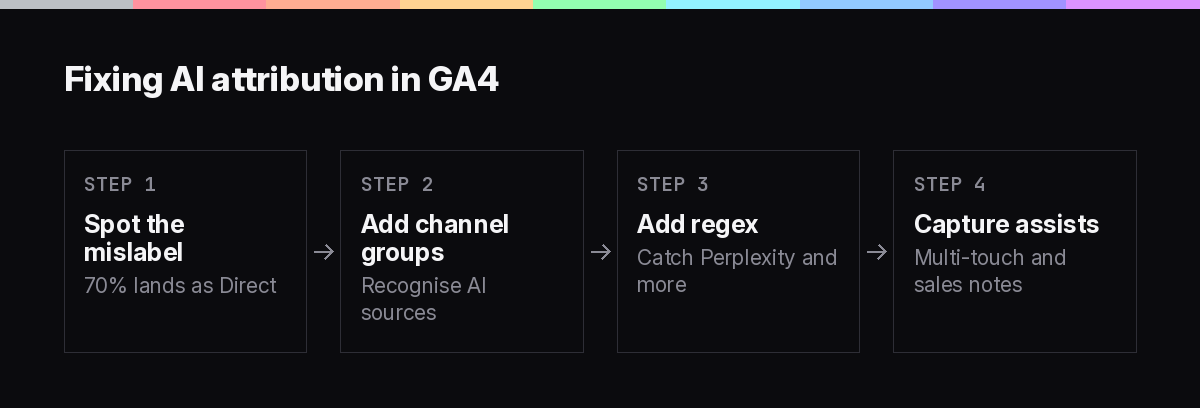
When a buyer clicks from an AI answer, the referrer is often stripped, so the visit lands as Direct. AuthorityTech reports that around 70% of AI traffic is mis-attributed as Direct in GA4. If you judge AI search by its labelled sessions alone, you are looking at a fraction of the real number.
The AI Assistant channel and its Perplexity gap
Google Analytics now groups recognised AI chatbot traffic under an AI Assistant channel, which reached broad availability in June 2026. It helps, but it does not catch everything, and notably it excludes Perplexity, one of the highest-intent B2B sources. Our AI search analytics guide covers how to close that gap.
The branded-search halo
AI search also drives demand you never see as AI traffic. A buyer reads about you in ChatGPT, then Googles your brand and converts as branded organic. That halo is real influence, and it is why last-click alone will always understate AI search.
What the Conversion Data Actually Shows
Here is the part that flips the argument. The traffic is small, but it converts at a rate that makes the volume almost beside the point.
Four to five times organic
Multiple 2026 analyses land in the same range: AI referral traffic converts roughly four to five times higher than organic search. One study of 312 B2B firms found a 14.2% conversion rate for AI referrals against 2.8% for Google organic. These visitors arrive pre-qualified, because the model has already filtered and framed the shortlist.
It varies by engine
Not all AI traffic is equal. Per-engine data shows ChatGPT and Perplexity converting far above Gemini, so where you win visibility matters as much as whether you win it. Track conversion by source, not just in aggregate.

Small volume, high intent
For most sites AI referrals are still around 1% of sessions, though B2B tech runs higher. Judge the channel on conversion and influence, not raw traffic, or you will kill a high-return programme because it looks small in a chart.
A Simple AI Search ROI Model
You do not need perfect attribution to build a defensible model. You need a consistent chain and honest caveats.
From sessions to pipeline
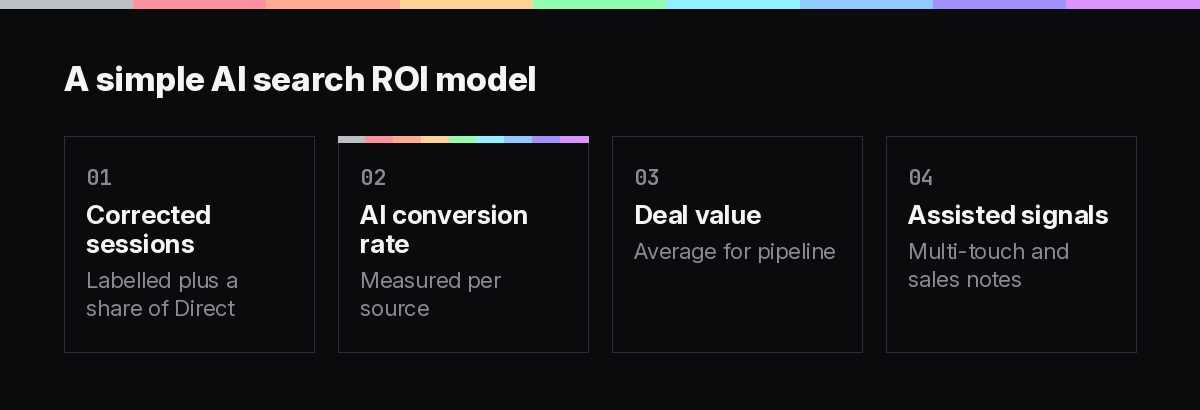
Start with corrected AI sessions (labelled plus a reasoned share of Direct), apply your measured AI conversion rate, then your average deal value. That gives a directional pipeline number you can defend, as long as you state the assumptions.
Assisted conversions count
Add assisted conversions, where AI search was an early touch on a path that closed through another channel. A first-touch and multi-touch view will always show AI search doing more than last-click admits. Our take on the wider AI search attribution problem sets expectations here.
Qualitative signals are data too
Ask sales to log when a prospect says they found or vetted you through ChatGPT or Perplexity. In a new channel, a dozen of those notes a quarter is a leading indicator worth reporting, not an anecdote to dismiss.
Reporting AI Search to Leadership
The final job is translation. Leadership funds what it understands, so report AI search in terms a board already trusts.
Lead with share of voice and influence
Show your AI share of voice against named rivals and the pipeline it plausibly influences, both trending over time. A rising share against competitors is a story a board understands, even before last-click revenue catches up.
Caveat honestly
State what you cannot yet attribute. Credibility comes from naming the under-counting and the assumptions, not from a confident number you cannot defend. Overclaiming here is the fastest way to lose the budget next quarter.
Leading versus lagging
Here is the verdict. AI search ROI today is a leading-indicator story: visibility and high-intent conversion now, attributed revenue as tracking matures. Treat it as an investment you can already measure directionally, report it with honest caveats, and it earns its budget; pretend it is a clean last-click channel and it will not survive scrutiny.
For the tracking foundation, pair this with a GEO audit and the pillar guide to AI search monitoring. When you want a benchmark, a free AI search audit and our SaaS SEO team can set one up.
Frequently Asked Questions
What is AI search ROI?
AI search ROI is the business return from being visible in AI answers, measured as the pipeline and revenue driven by AI referral traffic and AI-influenced buyers. It corrects for the under-counting that makes AI search look smaller than it is in standard analytics.
Does AI search traffic actually convert?
Yes, and well. Multiple 2026 studies put AI referral conversion at four to five times organic search, with one study of 312 B2B firms reporting 14.2% for AI referrals versus 2.8% for Google organic. The visitors arrive pre-qualified by the model.
Why is AI search ROI hard to measure?
Because around 70% of AI traffic is mis-attributed as Direct in analytics, the AI Assistant channel in GA4 excludes sources like Perplexity, and AI search also drives branded demand you never see as AI traffic. Last-click reporting badly understates it.
How do you calculate the ROI of AI search?
Take corrected AI sessions, apply your measured AI conversion rate and average deal value for a directional pipeline number, then add assisted conversions and qualitative sales signals. State the assumptions, because the inputs are estimates rather than clean last-click data.
How should I report AI search ROI to leadership?
Lead with AI share of voice against competitors and the pipeline it influences, both trending over time, and caveat what you cannot yet attribute. Frame it as a leading-indicator investment, not a clean last-click revenue channel.
Is AI search worth it if the traffic is only 1% of sessions?
Usually yes, because the channel converts several times higher than organic and influences branded demand you count elsewhere. Judge it on conversion and pipeline influence rather than raw session share, or you risk cutting a high-return programme for looking small.
Want this done for your brand? Get a free AI visibility audit.
Get my free AI visibility audit.png)
Latest articles
What we've published in the past 30 days — across SEO, GEO, content, and digital PR.


