.webp)





.webp)
SEO
Calculating...
Aug 2026
Topical Authority: How B2B SaaS Brands Become the Answer AI Engines Trust
Topical authority now decides which brands AI engines cite. See the 2026 category ownership data and the MADX framework for winning your category seat.

Topical authority is the degree to which search engines and AI assistants treat your site as a trusted specialist on one subject, based on how deeply, consistently and verifiably you cover it. It decides which brands get cited in ChatGPT and AI Overviews, not just which pages rank in Google.
That definition matters because the question buyers ask has changed. They used to ask Google for ten links. Now they ask an assistant for one answer, and the assistant picks the brand it trusts most on that specific topic. The shortlist got shorter, so the trust threshold got higher.
Across our B2B SaaS campaigns we see the same pattern: the brands that win AI mentions are rarely the biggest domains. They're the ones that made a category unambiguous to machines. This guide covers what topical authority actually is, how engines assess it, what the 2026 ownership data shows, and the framework we use to build it.
What topical authority is (and isn't)
Topical authority is earned subject-matter trust: a site that covers one topic completely, accurately and from experience gets treated as the reference for that topic. It's a property of your whole content system, not of any single page.
The idea predates AI search by a decade. Google's move from matching keywords to understanding topics started with the Hummingbird rewrite in 2013 and accelerated through BERT and MUM, each step pushing evaluation up from the page to the topic and the source behind it. What changed in the last 2 years is who consumes the signal. It used to feed a ranking; now it also feeds an answer, and an answer has far fewer seats.
Three ingredients keep showing up in every serious treatment of the subject. Coverage means answering the full set of questions the topic contains, not just the high-volume ones. Coherence means the coverage connects, page to page, with consistent terminology. Corroboration means independent sources confirm you belong in the category, and missing any one of the three makes the other two underperform.
Topical authority vs domain authority
Domain authority is a link-based score for the whole site. Topical authority is subject-specific, and the two often diverge. Kevin Indig's analysis of the Semrush data found that domain-level metrics correlate with ChatGPT category ownership only about half the time. A DR 90 generalist can lose an AI answer to a DR 55 specialist that covers the topic properly.
That's good news if you're a SaaS brand competing against publishers. You don't need their link profile. You need deeper, cleaner coverage of your category than they'll ever produce, because your team lives in the subject and theirs writes about 40 subjects a month.
Why the term outgrew SEO
Topical authority used to be an SEO growth tactic: cover a topic fully, rank for more of it. AI search raised the stakes. When AI Overviews appear on roughly 16% to 25% of US queries (Semrush, late 2025) and assistants compress research into a shortlist, the authority question stops being "where do we rank" and becomes "does the machine name us at all".
Google itself is still the arena. BrightEdge's 2025 research put Google at 90.6% of global search share, and Similarweb found 95.3% of ChatGPT users still visit Google. One authority strategy now has to serve both surfaces at once. We wrote more about that shift in our generative engine optimisation guide.
How Google and LLMs assess authority
Both systems reduce to the same question: is this source a coherent specialist or an occasional visitor to the topic? They just check it in different ways, and you need to pass both checks.
Google's site-level signals
Google evaluates focus at the site level, not just page by page. Mike King's team at iPullRank operationalises this with embeddings: represent the whole site as a vector, then measure how far each page sits from that centre.
The practical read: every off-topic post you publish dilutes the signal for the topics you actually sell. Focused sites feel this as compounding gains. Scattered sites feel it as a ceiling. Our semantic SEO guide explains how those embeddings work in plain English.
This is also where E-E-A-T meets topical authority. Google's quality rater guidelines ask whether a source demonstrates experience, expertise, authoritativeness and trust for its subject, and the algorithmic proxies for those qualities are largely topic-level: who wrote it, what else the site says about the subject, and who else vouches for it. A focused site gives the algorithm a clean yes on every proxy at once.
How LLMs pick their sources
When an assistant needs current facts, it fans a prompt out into sub-queries, retrieves pages from search indexes, and reads small slices of them. Dan Petrovic's research at Dejan found Google's AI systems work to a grounding budget of roughly 2,000 words, extracting as little as 13% of a long page. The model never reads your site the way a person does. It samples it.
Sampling rewards breadth of coverage across many retrievable pages, which is exactly what a well-built topic cluster provides. It also rewards passages that stand alone, the core idea behind our approach to pillar pages.
The fan-out step is worth understanding because it multiplies the surface area a specialist can win. A single prompt like "best onboarding software for fintech" might spawn sub-queries about pricing, security compliance, integrations and reviews. A brand with one landing page can match one sub-query. A brand with a full cluster can match six of them, and every match is another chance to be pulled into the answer.
Notice what this makes redundant: chasing individual fan-out queries with one page each. The queries are synthetic and unstable, so the winning move is covering the stable themes they roll up to. That's a topical authority strategy by another name.
Mentions vs citations
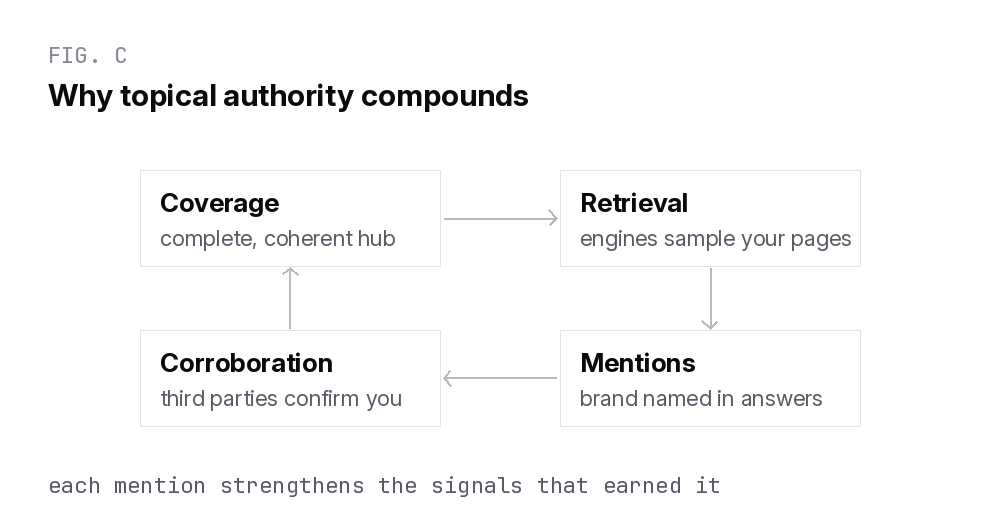
There are two ways to appear in an AI answer, and they're not equal. A citation is a link in the sources list. A mention is your brand named inside the answer itself, in the shortlist a buyer actually reads. On bottom-of-funnel prompts like "best X for Y", the mention is the prize, and it's driven less by your own pages than by the third-party buyer guides and comparisons the model retrieves.
Citations still matter: they're how your content earns the mention on informational prompts, and how you audit what the model reads. But if your AI strategy only counts citations, you're measuring the footnotes and ignoring the recommendation.
Our working split: on informational prompts, aim to be the cited source, because that's where your cluster content gets read. On commercial prompts, aim to be the mentioned brand, because that's where deals start. The two goals share one foundation, but they're earned in different places: the first mostly on your site, the second mostly off it.
The 2026 data on category ownership
The clearest evidence that topical authority carries into AI search is Semrush's 2026 study of 50,000 brands across 1,094 US categories in ChatGPT. It tracked which brands get named, month after month, per category. The design matters: 5 buyer-style prompts per category, snapshotted monthly from January through June 2026, across more than 220,000 domains. That's the closest thing our industry has to longitudinal evidence on how AI answers pick brands.
Most categories still have no owner
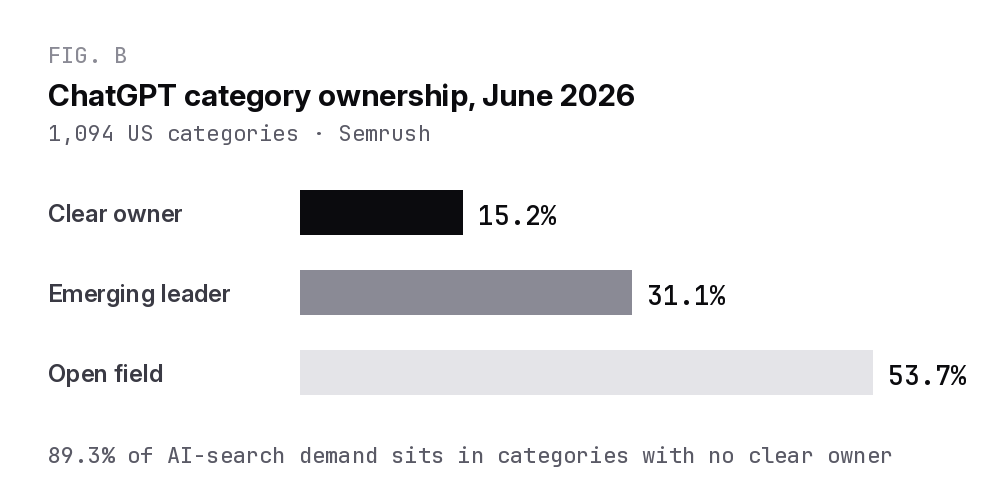
In June 2026, only 15.2% of categories had a clear owner, meaning one brand named in at least 4 of 5 test prompts with a lead of 5 points or more. Another 53.7% were open fields with several contenders. Weight that by search demand and 89.3% of estimated AI-search demand sits in categories with no clear owner.
Owners keep the seat
The same study found clear owners retained first place in 90.4% of next-month comparisons. Authority in AI answers behaves like a moat: expensive to build, cheap to defend. That asymmetry is the whole argument for moving before your category settles.
What owners have in common
Ownership correlated with topic-specific traits rather than raw domain strength: relevant coverage, cited content quality, reputation, and how well the source fits the prompt. When the study compared owners with the second-placed brand in each category, the differences clustered around fit and consistency, not size. That should reframe how SaaS teams read their own chances against bigger names.
Indig's caution is worth repeating, though. The data shows the traits, not the recipe, and nobody can promise a mention from a system that's both probabilistic and personalised. What you can do is stack every trait the owners share and measure whether your share of mentions rises. That's what the next section is for.
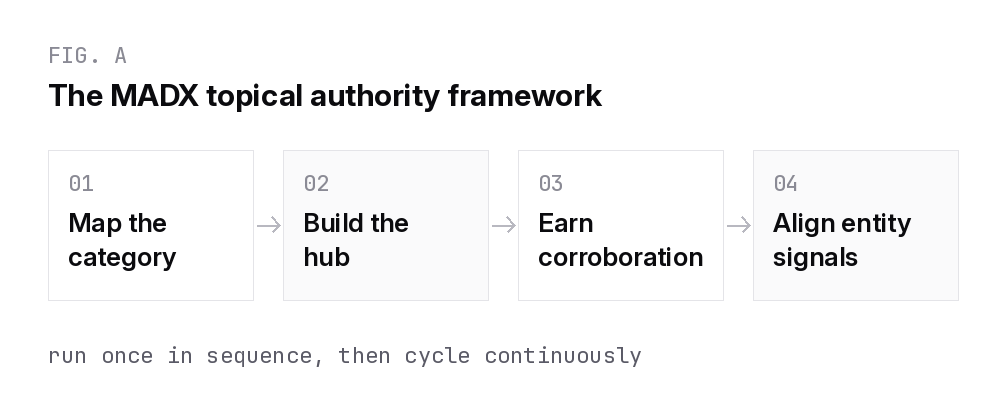
The MADX framework for building topical authority
This is the sequence we run for B2B SaaS clients, and the same one behind the cluster you're reading now. Four stages, each feeding the next.
Order matters more than people expect. Teams that jump straight to publishing skip the map and end up with overlap. Teams that start with PR before the hub exists earn mentions that point at nothing. Run the stages in sequence the first time through, then cycle them continuously, because a category map from last year is already missing this year's questions.
Stage 1: map the category
Start from how machines decompose your topic, not from a keyword dump. Pull the fan-out queries assistants generate, cluster them with classic keyword research, and you get the set of questions an authority is expected to answer. Aggregation is the point here. Individual fan-out queries are unstable, but the themes they roll up to are consistent, and those themes become your cluster nodes.
Two filters make the map usable. First, cannibalisation: check every planned node against what you've already published, and merge or link instead of duplicating. Second, intent spread: a rankable map mixes a head term you'll grow into with lower-difficulty questions you can win this quarter. The cluster you're reading was planned exactly this way, with each node locked to a distinct primary keyword before a word was written.
Stage 2: build the hub
Cover the map with one pillar page that frames the whole category and a set of cluster articles that each answer one distinct question in depth, all interlinked. Depth beats volume. Ten interlinked pieces that resolve a topic completely will outperform 50 loosely related posts, because both Google's site focus measures and LLM retrieval favour coherence.
Structure each piece for extraction as much as for reading. Front-load a direct answer, open every section with a sentence that survives being lifted out of context, and put comparisons in tables. Interlink with descriptive anchors that name the destination topic, since those anchors teach machines how your pages relate. And publish in sequence, pillar first, so every cluster article has its hub to point at from day one.
Some categories also support pages you generate at scale rather than write one by one, which is where programmatic SEO for B2B SaaS extends the hub with integration, comparison and use-case pages.
Stage 3: earn corroboration
Machines don't take your word for your own expertise. They check whether independent sources say the same thing, which is why placements in buyer guides, comparison pages and category roundups move AI visibility so directly. We call this Link Building 2.0: the goal is being present and consistently described in the third-party content models retrieve, not collecting links for their own sake.
Prioritise the sources the answers already trust. Run your category's buyer prompts, list every third-party page the responses cite, and treat that list as your placement pipeline. A mention in a mid-tier buyer guide that ChatGPT retrieves weekly is worth more to your AI visibility than a high-DR link from a page no model ever reads.
Stage 4: keep entity signals consistent
Authority attaches to an entity, so the entity has to be unambiguous. Your site, schema, LinkedIn, G2 profile and press coverage should describe the same company, in the same category, with the same positioning. Inconsistency here quietly caps everything else, and it's the most common failure we find in audits. Our entity SEO guide and knowledge graph optimization guide cover the mechanics.
A quick self-test: paste your homepage, your LinkedIn about section and your G2 description side by side. If a stranger couldn't tell they describe one company in one category, a language model can't either. Repositioned recently? Assume every third-party description still carries the old story until you've updated it.
How to measure topical authority
You can't manage authority with rankings alone anymore. We track it on two boards: classic search performance and AI mention share, reviewed together. Neither board alone tells the truth, because a site can rank well while assistants recommend a competitor, and a brand can win mentions on momentum its rankings no longer justify. The pairing is the diagnostic.
Search-side metrics
Track share of voice across the whole cluster keyword set rather than a handful of head terms, plus the internal-link coverage and freshness of the hub itself. Rising long-tail rankings across a cluster usually precede head-term movement by months. That's the compounding phase, and it's where most teams lose patience.
A monthly cadence is enough. Log positions for every node keyword, count referring domains to the hub, and note which pages Google surfaces for the category's question queries. If long-tail positions climb while the head term sits still, the system is working. If nothing moves for two quarters, the map was wrong, and the fix is coverage or consolidation, not more volume.
AI-side metrics
Track how often your brand is mentioned on the prompts that map to your category, your share against the current leader, and which third-party sources the answers cite. Mention share is the ownership metric. Citation sources are the to-do list, because every buyer guide the model trusts and you're absent from is a placement target. Our guide to measuring AI search visibility covers tooling, and our free AI SEO audit will show you where you stand today.
Mistakes that cap authority, and realistic timelines
Four failure modes account for most stalled programmes we inherit. Publishing volume without a map, so coverage has holes and overlaps. Leaving old off-topic content live, which drags the site's focus score. Treating the hub as finished when its stats and examples age out within a year, and skipping corroboration entirely, which leaves a technically perfect cluster no third party confirms.
The fix for all four is the same discipline: one category, mapped completely, maintained continuously, and backed by placements. Boring to describe. Rare to execute.
On timelines, expect the search side to move within 3 to 6 months from a standing start, with mention share following. The order is stable across campaigns even when the pace isn't. And because owners keep their seat in 90.4% of monthly checks, the return on getting there first is unusually durable for a marketing investment.
Topical authority is slow, deliberate work, which is exactly why it defends so well. If you'd rather compress the timeline with a team that has run this play across dozens of B2B SaaS categories, our SaaS SEO agency builds and executes the full framework, from category map to measurement. Either way, start before your category picks its owner. The fundamentals of B2B SaaS SEO still apply; the deadline moved.
Frequently Asked Questions
How long does it take to build topical authority?
For most B2B SaaS sites, meaningful movement takes 3 to 6 months of consistent publishing and interlinking, with AI mention share following the search gains. Small, well-defined categories move faster than broad ones. The compounding phase starts once the cluster covers the topic completely, so partial coverage delays everything.
How many articles do you need for topical authority?
Enough to answer every distinct question in your category map, which for a typical SaaS niche is one pillar page plus 10 to 30 cluster articles. There's no magic number. A tightly interlinked set that resolves the topic outperforms a larger volume of loosely related posts, because engines measure coherence, not count.
Does topical authority work for AI search like ChatGPT?
Yes. Semrush's 2026 study of 50,000 brands found category ownership in ChatGPT is real, rare and durable: only 15.2% of categories had a clear owner, and owners kept first place in 90.4% of monthly comparisons. The signals that build ranking authority, deep coverage, corroboration and consistent entity data, are the same ones LLMs retrieve against.
Is topical authority a Google ranking factor?
Google has never confirmed a ranking factor called topical authority, but it measures closely related things: site-level focus, semantic relevance between pages, and E-E-A-T style trust signals. In practice, sites that concentrate coverage on one subject consistently outrank equally strong generalists on that subject's queries.
What's the difference between topical authority and domain authority?
Domain authority is a third-party score estimating the strength of a site's whole backlink profile. Topical authority is subject-specific trust built through coverage depth and corroboration. They often diverge: a niche specialist regularly beats higher-DR generalists inside its own topic, both in rankings and in AI answers.
Can a small SaaS brand outrank big publishers on topical authority?
Yes, and it happens constantly. Domain metrics explain ChatGPT category ownership only about half the time, and 89.3% of AI-search demand sits in categories with no owner yet. A focused brand that covers its category completely, earns placements in the buyer guides models cite, and keeps its entity signals consistent can take an unclaimed seat.
.png)
Latest articles
What we've published in the past 30 days — across SEO, GEO, content, and digital PR.