.webp)





.webp)
Digital PR
Calculating...
Sep 2026
Digital PR for AI Search: Earning the Mentions LLMs Cite
News and expert mentions are what LLMs cite. Learn how to run digital PR as an AI-citation channel and measure it by citations, not coverage.

Digital PR for AI search means earning coverage in the news and editorial sources that language models cite, then measuring it by citations rather than clip counts. Lead with original data, target the outlets AI already trusts, and keep your message consistent across every mention. Done this way, PR becomes one of the strongest ways to get recommended by AI.
Why PR Became An AI-Citation Channel
Language models lean heavily on journalism and editorial content when they answer, which puts earned media near the centre of AI visibility. A mention in the right publication is no longer just a link and a brand moment, it is raw material a model will quote.
The data is striking. Meltwater's 2026 tracking across eight LLMs found that earned and news media accounted for close to 40% of all citations, with a single major outlet generating tens of thousands of them. If you want to be in AI answers, being in the press is one of the most direct routes there is.
It also compounds with the other buyer surfaces. The same coverage that a model cites gives editors a reason to add you to a roundup and gives your sales team a proof point to reference. This is why we treat PR as part of an AI-visibility programme rather than a standalone brand exercise, since a strong story pays off in several places at once.

From links to citations
Traditional digital PR chased links and domain authority. That still matters, but the scoreboard has changed. The question now is whether a model quotes the coverage when a buyer asks about your category, which is a different and higher bar than a backlink. A story that earns a link but never gets cited is only doing half its job.
The shift also raises the value of quality over quantity. A single citation in a source the model trusts can outweigh a dozen links from sites it ignores. So the target list looks different: fewer, better outlets, chosen because the engines already read them, not because they will hand out a link. That is a healthier brief for a PR team anyway.
The trust transfer
Distribution changes everything. Agility PR found a median lift of 239% in AI search visibility when the same content ran through third-party news outlets rather than sitting on the brand's own site. The model trusts the outlet, and that trust transfers to you. This is the same mechanism behind our pillar on getting recommended by AI: independent corroboration beats self-published claims.
The Mentions LLMs Actually Cite
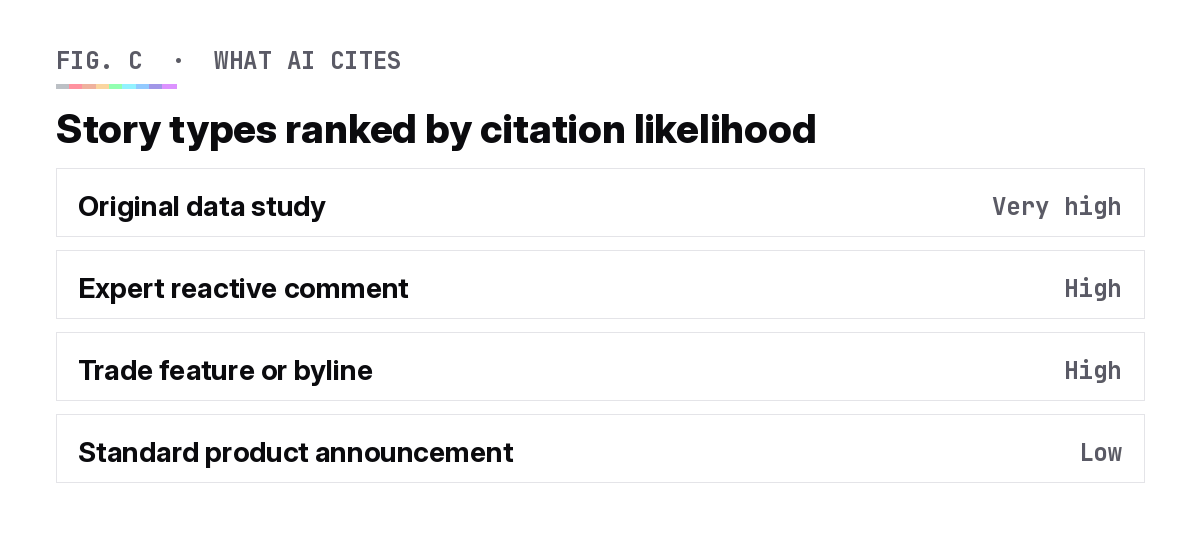
Not all coverage is equal in the eyes of a model. A few kinds of mention get quoted far more than a standard product announcement, and knowing which ones lets you spend your PR effort where it actually earns citations.
News and trade press
Established news outlets and respected trade publications are cited well above their share of the web. A placement in a title your buyers already read does double duty, reaching humans and feeding the models at once. These are the anchors of an AI-focused PR programme.
Trade press deserves special attention for B2B SaaS. A niche publication your buyers respect can carry more weight with a model, on your specific category, than a general-interest giant. The engines learn which sources are authoritative for which topics, so a focused trade placement often punches above a broad one when the query is about your exact space.
Expert commentary
Putting a named expert from your team on the record gives a model a person and a quote to attribute. Reactive comment on a breaking story, a considered take in a trade feature, or a byline in a respected outlet all create citable, attributable statements. The more your people are quoted by name, the more the model associates your brand with authority.
Data-led stories
Original data is the most reliable way to earn a citation. A model loves a specific, sourced statistic, and journalists love a fresh number to write around. Run a survey, analyse your own anonymised platform data, or publish a benchmark, and you give both audiences something they cannot get elsewhere.
The reason data travels so far is durability. A good statistic gets quoted again and again, in the original article, in follow-up pieces, and eventually in an AI answer months later. One strong data story can seed citations across a dozen outlets, each of which becomes another source a model can read. That is a far better return than a one-off announcement that is forgotten in a week.
A Digital-PR Play Built For Citation
An AI-focused PR programme looks a little different from a coverage-chasing one. The aim is not the biggest logo, it is the most citable mention in a source the models trust.
Lead with data
Start every campaign by asking what number only you can provide. Your platform sees patterns no one else does, and a defensible statistic is the hook that earns coverage and the sentence a model lifts later. Package it clearly, cite your method, and make it easy to quote.
Reactive and proactive together
Run both motions. Proactive data stories build your baseline authority over months, while fast reactive comment on breaking news wins quick, quotable mentions. The reactive wins keep your experts in the conversation between the bigger proactive campaigns. Neither works as well alone.
Keep the message consistent
Say the same core thing everywhere. If your data story, your byline and your spokesperson all reinforce one clear claim, the model sees a consistent signal and grows more confident repeating it. Scattered, contradictory messaging teaches it nothing it can rely on.
Pick one or two messages you want to own and repeat them with discipline. A brand that is consistently associated with a specific claim, backed by a specific number, becomes the obvious source a model reaches for on that topic. Trying to be quoted on everything usually means being quoted on nothing.
Measuring PR By Citations, Not Coverage
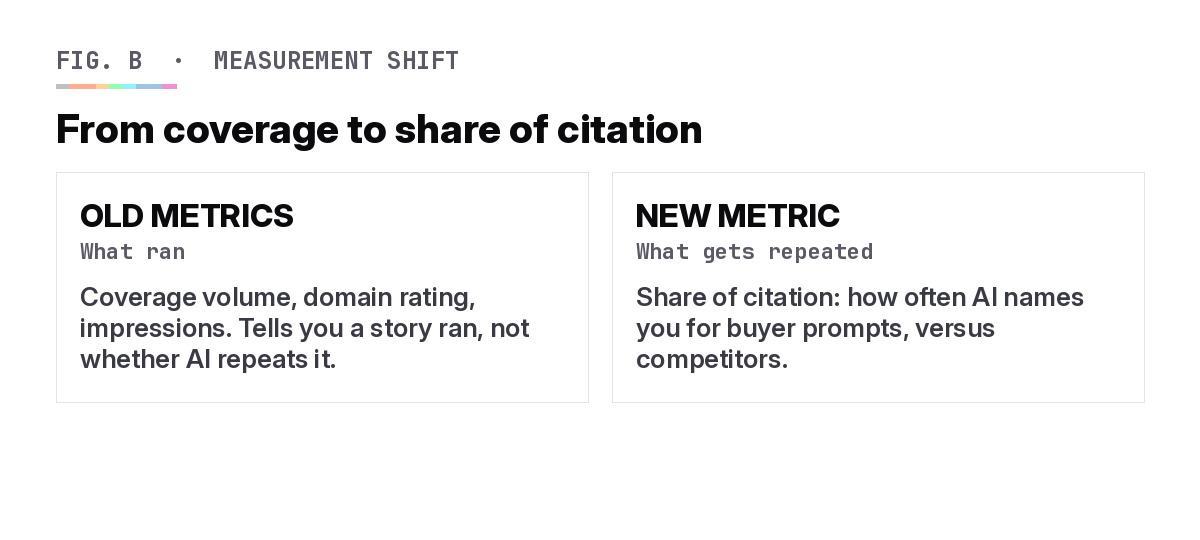
The old PR metrics miss the point now. Coverage volume and domain rating tell you a story ran, not whether a model repeats it, so the metric to add is share of citation.
What to track
Count how often your brand is named in AI answers for your buyer prompts, and which coverage the model cites when it does. Tie each citation back to the campaign that earned it, so you learn which stories and outlets actually move the needle. That feedback loop is how PR stops being a faith-based line item and starts being a measurable channel.
It changes how you brief, too. Once you can see which outlets and story types earn citations, you stop chasing vanity logos and start pitching the sources that pay off. Over a couple of quarters the programme tightens around what works, and PR budget starts to look less like a cost and more like a visibility investment with a readable return.
There is a fair counterargument. Some say attribution here is too fuzzy to bother with, and it is true that AI citations are harder to track than clicks. Our view is that fuzzy measurement of the thing that matters beats precise measurement of the thing that does not. Track share of citation directionally, and it still tells you more than a flawless coverage report.
Where PR And Link Building 2.0 Meet
Digital PR for AI search is the same idea as modern link building, approached from the media side. Both are about earning credible third-party signals that models trust, rather than manufacturing them on your own domain. The label matters less than the principle: earn the mention honestly, in a source the engines respect, and the visibility follows.
Work them together. A data story that earns press also gives editors a reason to add you to their best-of lists, strengthens your comparison pages, and echoes your review-site story. To see whether the coverage is translating into AI presence, track it with the method in our guide to AI share of voice, and lean on classic B2B link building fundamentals where they still apply. If you want a team to run PR as an AI-citation channel, our SaaS SEO service does exactly that, and you can start with a free AI visibility check.
Frequently Asked Questions
How is digital PR for AI search different from normal PR?
The goal shifts from coverage volume to cited mentions in sources AI trusts. You still earn press, but you prioritise the outlets and story types that models quote, and you measure success by share of citation rather than clip counts. Data-led stories and named expert commentary do most of the work.
Does press coverage really improve AI visibility?
Yes, and often dramatically. Studies show the same content earns far more AI visibility when a third-party outlet publishes it than when it sits on your own site, because the model trusts the outlet. News and editorial media are among the most-cited sources in AI answers.
What kind of PR story gets cited most by AI?
Original data studies, expert reactive comment, and trade features are the most citable, while standard product announcements rarely get quoted. A defensible, specific statistic is the strongest hook, because both journalists and models want a number they can attribute. Lead with data wherever you can.
How do I measure whether PR is earning AI citations?
Track how often your brand is named in AI answers for your buyer prompts, and which coverage the model cites. Tie each citation back to the campaign that earned it so you can see what works. Very few teams do this yet, which makes it a genuine advantage.
Do I still need links and domain authority?
Yes, the fundamentals still help, but they are no longer the whole scoreboard. A story that earns a link but never gets cited is only doing half its job. Aim for coverage that both links to you and gets quoted when a buyer asks about your category.
Want this done for your brand? Get a free AI visibility audit.
Get my free AI visibility audit.png)
Latest articles
What we've published in the past 30 days — across SEO, GEO, content, and digital PR.