.webp)





.webp)
GEO
Calculating...
Sep 2026
How to Get Your SaaS Featured in AI's Best Software Lists
Best-of lists are the most-cited AI buyer surface. Learn how to find the roundups LLMs pull from and earn a placement that survives model refreshes.

To get your SaaS into AI's "best software" answers, earn placements in the third-party roundups those models trust. Find the lists that already rank and name your competitors, pitch the editor who can update them with a clear reader benefit, and keep the entries current. These lists shape the shortlist more than your own site does.
Why Best-Of Lists Punch Above Their Weight
When an AI assistant answers "best project management software", it rarely invents a ranking. It paraphrases two or three roundups it already trusts, so a placement in the right list is a placement in the answer.
This is the surface that decides the modern shortlist. As we cover in our pillar on getting recommended by AI, buyers now build their vendor list inside the assistant, and the "best of" roundup is the raw material it reads.
The behaviour data backs this up. In G2's 2026 Buyer Behavior Report, comparing vendor strengths and weaknesses is the single most common reason buyers open a chatbot for software research. A good roundup does that comparison for them, which is exactly why the model reaches for it.
The most-cited buyer surface
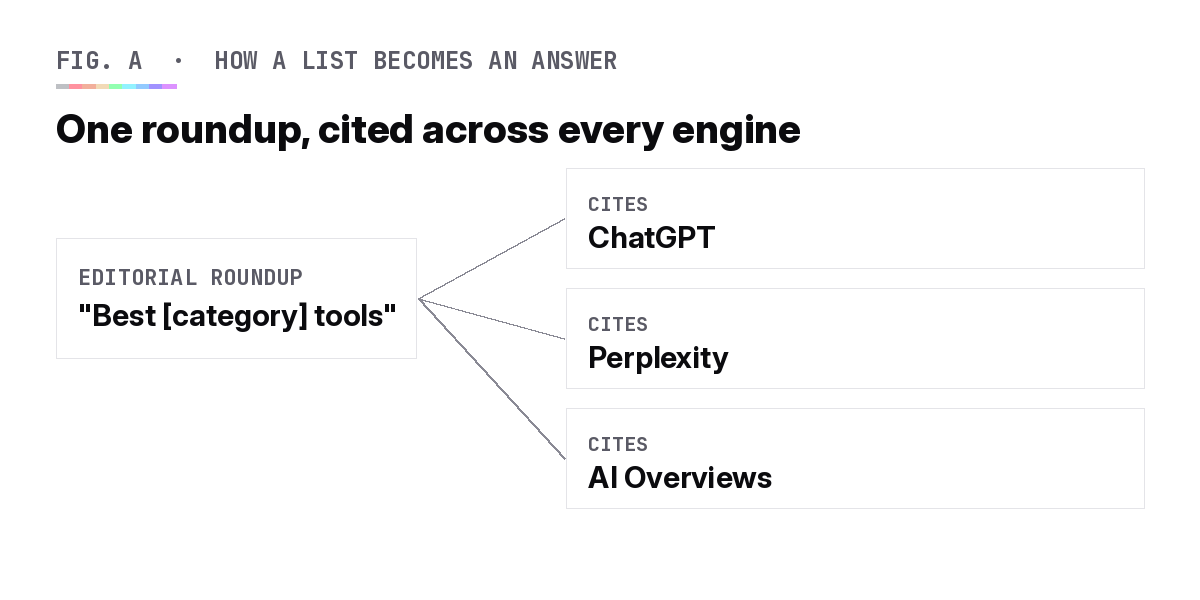
Studies of where the major engines draw citations put curated roundups and community threads near the top. Analyses of the sources LLMs cite most show a short set of trusted publishers doing outsized work. A single strong list can feed answers across ChatGPT, Perplexity and Google's AI Overviews at once.
The concentration is the point. Research on AI citations finds that a small group of trusted sources shapes a large share of what buyers see, so being in even a handful of the right roundups pays off far beyond their raw traffic. This is why we treat best-of placement as a priority, not a nice-to-have.
Why you cannot buy your way in
Paid inclusion is the trap. Models learn which sites are reliable, and pay-to-play list farms are exactly the ones they discount. A placement on a low-authority page you paid for does little, and it can dent trust if the page reads as an advert.
The lists that move the needle are editorial, on sites with a real audience and a track record. That makes them harder to earn, which is also what makes them worth earning. This is the heart of what we call link building for the AI era: placement in content people and models trust, not volume for its own sake.
Find The Lists That Actually Get Cited
Before any outreach, build a shortlist of the roundups worth chasing. Most teams skip this and pitch everything, which wastes goodwill and time.
Prompt-test your category
Start with the assistants, not a keyword tool. Ask ChatGPT, Perplexity and Google's AI Overviews your category's "best" questions, then note which articles they cite or paraphrase. Those cited pages are your primary targets, because you already know the models read them.
The three-filter shortlist
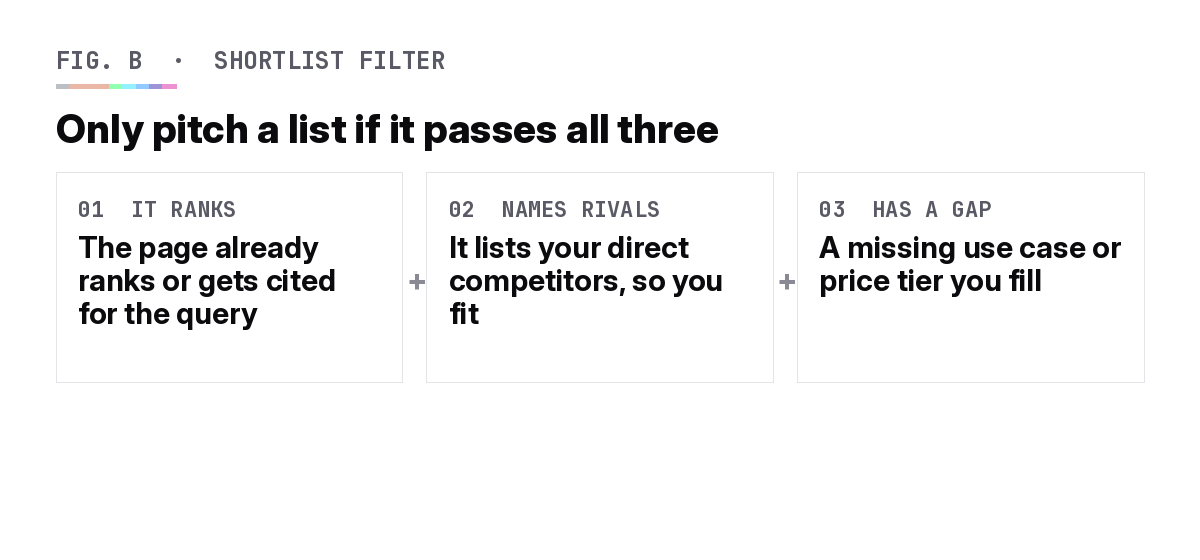
Run every candidate through three filters. First, does it already rank or get cited for the query. Second, does it name your direct competitors, which proves editorial fit. Third, is there a genuine gap your product fills, like a missing use case or price tier.
If a page fails any filter, drop it. Chasing a roundup that does not rank, or one where you do not belong, burns effort you could spend on a list that will actually carry you.
Track citations over time
Turn this into a living list, not a one-off audit. Keep a simple record of which articles the assistants cite for your key prompts, and re-check it every month or two. Engines swap their sources as pages rise and fall, so a roundup that was invisible in spring can become a primary citation by autumn. Watching that movement tells you where to pitch next, and it doubles as an early warning when a competitor displaces you.
Earn The Placement
Outreach for editorial lists is a favour economy. You are asking a busy editor to change a live, ranking page, so the pitch has to make their article better, not just help you.
Find the person who can update it
Skip the generic contact form. Identify the author, content lead, or SEO owner who can actually edit the piece. A pitch that lands with the person holding the keys is worth ten that sit in a shared inbox.
The pitch that works
Lead with the reader. Point to the exact section or comparison criterion your product improves, then make the value verifiable with a one-line summary, pricing, and a screenshot or comparison row the editor can check in seconds. Keep it to one clear question: is this a fit for your roundup.
We build these placements for clients through our SaaS SEO service, and the pattern holds across categories. The pitches that win read like a helpful tip from a peer, not a link request from a stranger.
A quick example. Instead of "please add us to your best CRM list", a strong note reads: "Your list covers enterprise CRMs well, but readers asking for a sub-20-seat option have nowhere to land. Here is a two-line summary and a screenshot if it helps." It names the gap, hands over verifiable proof, and leaves the decision with the editor. That is a note a busy content lead can act on in a minute.
Time the follow-up right
One polite follow-up after a week is fine. More than that reads as pressure and hurts the relationship you want to keep. If the answer is no, ask what would make your product a fit later, since lists get rewritten and today's no is often next quarter's yes.
What gets you rejected
Editors reject the obvious things fast. A vague pitch, an inflated claim they cannot verify, or a request to be ranked first all signal a link grab. So does pitching a list where you clearly do not fit. Respect the editorial standard and you get a yes far more often.
Keep The Citation Alive
A placement is not a one-time win. Lists get rewritten, competitors lobby for their own spots, and models refresh, so a spot you earned last year can quietly disappear.
Unlinked mentions are the quick win
Search the roundups in your space for your brand name without a link. Each one is a warm ask: you are already good enough to mention, so a link and a fuller entry is an easy yes. This is the highest return outreach you can run, and most teams never do it.
Freshness and review cadence
Revisit your placements quarterly. Check that your entry is still there, still accurate on pricing and positioning, and still linked. Feed editors a reason to keep you current, like a new feature or a fresh data point, so your entry stays the one they trust.
Assume your competitors are pitching the same editors. A roundup is a moving ranking, and the brands that stay near the top are the ones that keep the relationship warm and keep giving the editor reasons to feature them well. Treat each placement as an account to nurture, not a box to tick. The half-day a quarter it takes to keep three or four strong lists current is some of the highest-return work in AI search.
Measure Placement Impact
Judge this work by whether AI starts naming you, not by the number of links you added. Re-run your category's "best" prompts a few weeks after a placement goes live and watch whether you start appearing.
Track three things. First, presence: are you named in the answer at all. Second, position: are you in the first two or three names or buried at the bottom. Third, framing: is the model describing you accurately and favourably.
A placement that gets you named but mislabelled is a signal to fix the source, not to celebrate. Watch the wording the assistant uses, because that language usually traces back to a specific line in a roundup you can ask the editor to sharpen.
Give it time, and do not judge a single placement in isolation. As we explain in the pillar, recommendations come from several sources agreeing, so one list rarely flips an answer on its own. The honest read is the trend across your prompt set over a quarter, not the day after a single email lands.

Pair this with your other surfaces. A best-of placement lands harder when your review-site profiles and comparison pages tell the same story, and digital PR gives editors a reason to notice you. To track whether it is working across engines, use the method in our guide to AI share of voice. If you would rather have it run for you, start with a free AI visibility check.
Frequently Asked Questions
How do I find which best-of lists AI actually cites?
Ask ChatGPT, Perplexity and Google's AI Overviews your category's "best" questions and note which articles they cite or paraphrase. Those pages are your primary targets because you already know the models read them. Prioritise the ones that also rank in classic search.
Can I pay to be added to a best software list?
You can, but the lists worth being on do not sell placements, and models tend to discount pay-to-play pages. Paid inclusion on a low-authority site adds little and can read as an advert. Earn editorial placements instead, since those are the ones AI trusts.
What should a listicle outreach email actually say?
Point to the exact section your product improves, explain why it helps the reader, and make the value verifiable with a short summary, pricing and a screenshot. Send it to the person who can edit the article, and ask one clear question about fit. Keep it short and specific.
How long until a placement shows up in AI answers?
Usually a few weeks to a couple of months, as engines recrawl the updated page and refresh their sources. Placements on pages that already rank tend to register faster. Re-run your buyer prompts after a few weeks to check.
Are unlinked mentions worth chasing?
Yes, they are the best return on effort. If a roundup already names you without a link, a short email asking the author to add one converts at a high rate. Audit for these before you pitch any brand new placements.
Want this done for your brand? Get a free AI visibility audit.
Get my free AI visibility audit.png)
Latest articles
What we've published in the past 30 days — across SEO, GEO, content, and digital PR.