.webp)




.webp)
GEO
Calculating...
Oct 2026
Why AI Recommends Your Competitors (and How to Change It)
AI recommends your competitors because their signals are stronger, not their product. How AI picks brands, why rivals win, and how to flip the recommendation.
AI recommends your competitors because the sources it trusts mention them more often, more consistently, and in the right context for the buyer's question. It is not picking the best product. It is repeating the strongest pattern of independent signals, and the good news for a challenger is that you can change that pattern with focused work.
How AI picks which brands to recommend
AI picks brands to recommend by reading its trusted sources and surfacing the names that appear most strongly in the context of the question. Three forces do most of the work: co-occurrence, consensus and freshness.

This matters because the recommendation is where the buyer decides. OpenAI's Sam Altman said at Dev Day in October 2025 that more than 800 million people use ChatGPT every week, and Gartner expects traditional search volume to fall 25% by 2026. More of your category's shortlists are being drafted inside an AI answer.
Co-occurrence, consensus and freshness
Co-occurrence is how often your brand appears alongside the topic the buyer asked about. If the phrase "best onboarding tool for fintech" and your name keep showing up together across the web, the model learns to associate them. Consensus is how many independent sources agree you belong in that set. Freshness is how recent those signals are, because models and their retrieval layers favour current pages.
Optimizing how your content states these associations helps too. The research that introduced generative engine optimization found GEO methods can lift a source's visibility by up to 40% in generative responses. Clear, well-sourced content that ties you to the buyer's problem is easier for a model to pick up and reuse.
Notice what is missing from that list: being the biggest or the best. Models do not run a bake-off. They surface the brand whose signals most strongly fit the question, which is why a sharp, well-covered challenger routinely out-recommends a bigger rival that has let its category association go vague. That is good news if you are not the market leader, and a warning if you are.
Why a competitor wins and you do not
A competitor wins the recommendation when its signals are stronger on the exact question that matters, not because its product is better. Diagnose the gap before you try to close it.
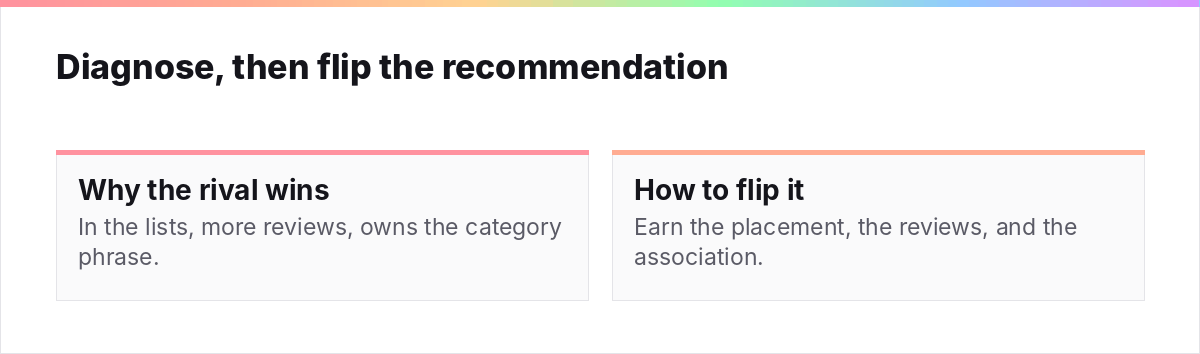
Run the buyer prompt you keep losing, several times across the main engines, and read why the rival is named. This is the competitive slice of a full AI reputation audit. Usually it is one of three things: they appear in the best-of and comparison articles the model is reading and you do not, they have a fuller, fresher set of reviews, or they are simply tied more tightly to the category phrase the buyer used. Each of those is fixable, and naming which one is in play is half the battle.
Separate the fixable from the structural
Be honest about which gaps you can close quickly. A missing roundup placement or a thin review profile is fixable within a quarter. A rival that has owned the category conversation for years has a deeper moat, and closing it takes sustained work, not one campaign. Sort your findings into quick wins and longer plays, and start the slow ones now, because they are the ones that compound.
The competitive levers that flip it
Flip the recommendation by strengthening the three signals the model reads, starting with the one you are weakest on. The levers are earned, not bought, which is why they hold up.

Get into the content that forms the shortlist. That means earning a place in the best software lists and comparison and alternatives pages that cover your category, which is the practical heart of getting recommended by AI. One accurate placement in a list buyers trust can do more than months of on-site work.
Then widen the base. A single mention is fragile, but the same accurate association repeated across reviews, directories, press and community threads gives the model the consensus it looks for. You are not chasing volume for its own sake, you are building agreement among independent sources that you belong in the set the buyer is choosing from.
Own the category phrase
Decide the exact phrase you want to be recommended for, then use it consistently on your site, in your profiles, and in the coverage you earn. If you want to win "best onboarding tool for fintech", that phrase and your name need to travel together across the web. Scattered, vague positioning gives the model nothing firm to attach you to, so it reaches for the competitor whose association is clearer.
This is mechanics, not manipulation. You are not tricking the model, you are earning real, accurate signals that reflect a product genuinely built for that buyer. Understanding how AI builds its recommendations is what lets you work with the grain rather than against it.
Measuring recommendation share
Measure recommendation share as the percentage of runs where you are the named pick, tracked against your real rivals, because one answer is noise. In research from SparkToro and Gumshoe.ai, the same brand list came back less than 1 in 100 times across 2,961 runs.
Run your key competitive prompts monthly, record how often you are named versus each rival, and watch the gap close as your signals improve. Fold it into your AI brand monitoring and your wider AI reputation program so recommendation share sits beside presence and sentiment, and re-check it after every placement you earn.
Pick two or three rivals to benchmark against, not the whole market. These are the names that actually show up next to you in real answers and real deals. Tracking recommendation share against that short list keeps the metric honest and the work focused, and it gives leadership a number they immediately understand: how often AI picks us over the companies we actually lose to. That one line tends to land harder in a board deck than any amount of traffic data.
Mentions, citations and the buyer
Two things happen when AI answers a buyer: it mentions brands by name, and it sometimes cites sources with a link. Both matter, and for different reasons, so pursue both rather than fixating on one.
A citation can earn a click and lends your page authority, which compounds over time. A mention is what the buyer actually reads and carries into the decision. On a bottom-funnel question like "best tool for X", the mention is usually what tips the choice, so weight your effort toward being the recommended name on exactly those queries.
Tie it back to pipeline so the work stays funded. A rising recommendation share on your three or four highest-intent buyer prompts is a leading indicator of pipeline, in a way that a raw traffic number no longer is when the click never happens. Framing the work this way, as winning the buyer's shortlist rather than chasing visits, is what keeps it resourced through a budget review.
The mention and the citation reinforce each other. Being cited as a source on your category builds the authority that makes you more likely to be mentioned as a pick, and being mentioned as a pick drives the branded searches that strengthen everything else. If a rival keeps winning the queries that precede your deals, that is the problem worth solving first, and it is day-to-day work for our B2B SaaS AI search team. A free AI search audit will show you exactly which recommendations you are losing and why.
Frequently Asked Questions
Why does ChatGPT recommend my competitor instead of me?
Because the sources ChatGPT trusts mention your competitor more often, more consistently, and in closer context to the buyer's question. It is reading the pattern of independent signals, not judging which product is better, so the brand with stronger and fresher signals tends to win the pick.
How does AI decide which brands to recommend?
Through co-occurrence with the buyer's topic, consensus across independent sources, and freshness. If your name and the category keep appearing together across trusted, current pages, the model learns to put you forward. If a rival owns that association, it gets recommended instead.
What is co-occurrence in AI recommendations?
Co-occurrence is how often your brand appears alongside a given topic or category across the web. When "best onboarding tool for fintech" and your name repeatedly show up together in trusted sources, the model associates the two and is more likely to recommend you for that question.
How do I get AI to recommend my product?
Earn a place in the best-of and comparison content buyers read, build consistent mentions across independent sources, win recent specific reviews, and state your category clearly on your own pages. These strengthen the signals the model reads, which is what shifts the recommendation over time.
Do reviews change which brand AI recommends?
They can. Review platforms read as independent, so a fuller, fresher set of specific reviews gives the model current, trustworthy material that supports recommending you. Thin or dated review profiles leave it leaning on whatever other sources are stronger, which is often a competitor.
How long does it take to flip an AI recommendation?
Usually weeks to a few months, because the signals you are changing, placements, mentions and reviews, take time to publish and for models and their retrieval layers to pick up. Track recommendation share across runs so you can see the gap to a rival closing rather than guessing.
Want this done for your brand? Get a free AI visibility audit.
Get my free AI visibility audit.png)
Latest articles
What we've published in the past 30 days — across SEO, GEO, content, and digital PR.