.webp)





.webp)
GEO
Calculating...
Oct 2026
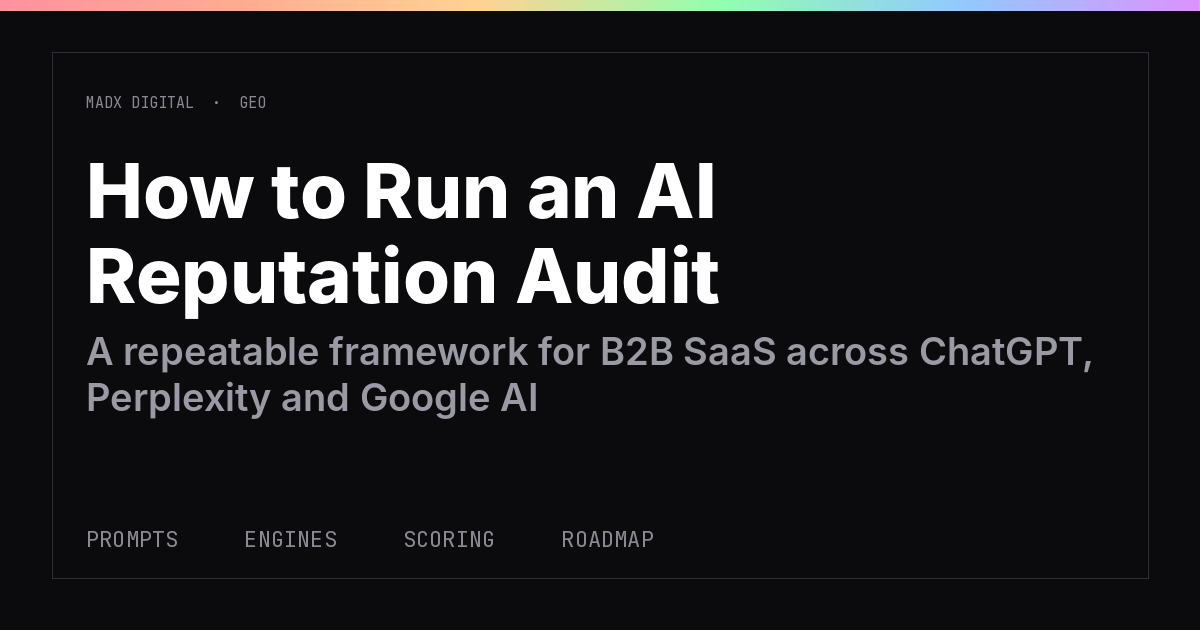
How to Run an AI Reputation Audit for Your B2B SaaS
An AI reputation audit measures what ChatGPT, Perplexity and Google AI say about your B2B SaaS. A repeatable framework: prompts, scoring and a roadmap.
An AI reputation audit is a repeatable check of how AI assistants present your brand: whether they mention you, how they frame you, whether the facts are right, and how often they recommend you against rivals. You run a fixed set of buyer prompts across the main engines, score the answers, and turn the gaps into a plan.
What an AI reputation audit covers
An AI reputation audit covers the four layers that decide whether an AI answer helps or hurts you: presence, sentiment, accuracy and recommendation. Together they tell you not just whether you show up, but whether showing up does you any good.

Running one matters because buyers are already there. OpenAI's Sam Altman said at Dev Day in October 2025 that more than 800 million people use ChatGPT every week, and Gartner expects traditional search volume to fall 25% by 2026. An audit turns a vague worry about what AI says into a measured baseline you can act on.
How it differs from a technical GEO audit
A technical GEO audit checks whether AI systems can crawl, read and parse your site: your markup, your structure, your schema. That is plumbing, and it matters. An AI reputation audit is different. It ignores your plumbing and looks only at the output, the actual sentences the models produce about you when a buyer asks.

You want both, in order. Fix the plumbing so models can read you, then audit the reputation to see what they say once they can. This guide covers the reputation side, as one piece of a wider AI reputation program.
The practical sign you need a reputation audit, not just a technical one, is sales feedback. When reps say prospects arrive with odd ideas about your pricing, your category or who you are built for, the plumbing is probably fine and the output is the problem. That is precisely what this audit measures, and it is why it belongs with the growth team rather than buried in an engineering backlog.
Building your prompt set
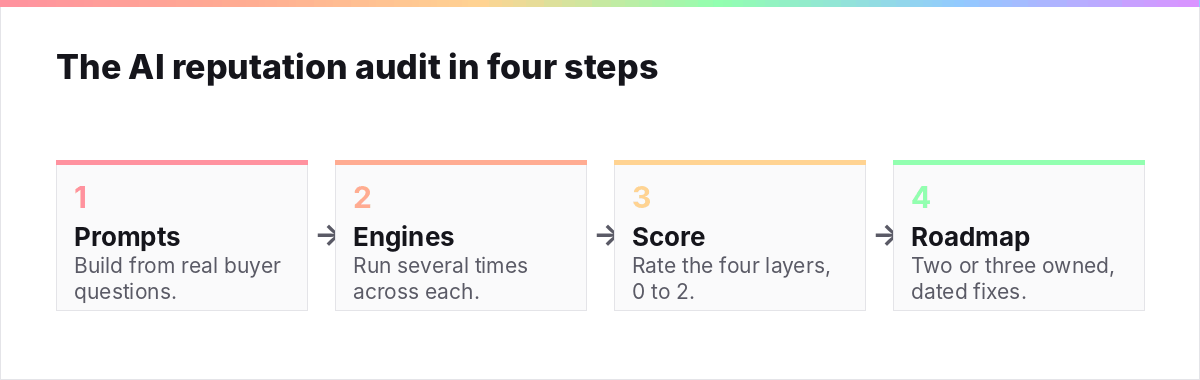
Build your prompt set from the questions real buyers ask, not the way you describe yourself. The prompt set is the audit. Get it wrong and you measure the wrong conversations.
Cover the buying arc. Include category questions (best tool for a job), competitive questions (alternatives to a named rival, you versus a competitor), fit questions (is this good for a given industry or team size), and objection questions (is it secure, does it integrate with X). Twenty to thirty prompts that mirror your real pipeline beat a hundred generic ones.
Weight the prompts that sit near a decision
Not every prompt deserves equal weight. A "best tool for X" or "alternatives to Y" question sits right before a buying decision, so a poor result there costs you real revenue. A broad "what is X" question is worth checking but matters less to pipeline. Tag each prompt by funnel stage when you build the set, so that when you score the audit you can lead with the bottom-funnel results that move money rather than the tidy top-funnel ones.
Engines, runs and sampling
Run every prompt across the engines your buyers use, several times each, because a single answer is not evidence. For most B2B SaaS that means ChatGPT, Perplexity and Google's AI answers, with others added if your audience lives there.
Sampling is not optional. In research from SparkToro and Gumshoe.ai, the same brand recommendation list came back less than 1 in 100 times across 2,961 runs. Run each prompt five to ten times per engine and record what share of runs mention you, frame you well, and recommend you. The spread is the finding, not any one answer.
Save the raw answers verbatim. The exact wording is what lets you classify each result and, later, prove a fix worked. It is also the most persuasive thing you can put in front of leadership, far more than a score.
Keep the conditions steady so your trend means something. Use the same prompts, the same phrasing, and where you can the same region and account state each time, since a logged-in or localised session can change what you see. You are trying to measure your reputation moving, not accidentally measure a change in how you ran the test.
Scoring the four layers
Score each layer on a simple, consistent scale so the audit produces a ranked list rather than a stack of impressions. Keep it coarse enough to apply quickly across hundreds of answers.
Average each layer across all runs to get four scores you can track over time. Do not blend them into one number, because the fixes differ. A low presence score is a visibility problem, a low accuracy score is a source problem, and a low recommendation score is a competitive one.
Then split the scores by funnel stage using the tags you set earlier. A healthy top-funnel score with a weak bottom-funnel one is a common and dangerous pattern: you look fine in the summary, yet you are losing the exact prompts where buyers choose. Reading the scores this way is what turns a flat average into a story leadership can act on.
Keep the first audit simple and resist the urge to over-engineer the scoring. A coarse scale applied consistently to every answer tells you more than an elaborate rubric you abandon halfway through. You can always add nuance later, once the habit is established and you know which distinctions actually change a decision. The audit you run every month beats the perfect one you run once and never repeat.
From findings to roadmap
Turn the audit into a roadmap by picking the two or three fixes with the most to gain and giving each an owner and a date. An audit that ends as a report changes nothing. An audit that ends as three owned actions changes your answers.
Map each finding to the right next move. A low accuracy score routes to fixing wrong AI answers. A rival winning the recommendation routes to why AI recommends your competitors. Weak framing routes to AI brand sentiment work.
Then stand up AI brand monitoring so the next audit is a quick re-run, not a cold start. The first audit is the expensive one, because you are building the prompt set and the baseline from scratch. Every audit after that is a comparison, which is both faster and far more useful, since a trend tells you whether your work is paying off.
What a good roadmap looks like
A good roadmap is short and specific. It names the two or three highest-value fixes, gives each an owner, and sets a date and the score it is trying to move. A long list of observations is not a roadmap, it is a way to feel busy while nothing changes.
Here is the shape we aim for: correct the SSO claim on the two sources driving it, owned by content, done this month, to lift the accuracy score on enterprise prompts. One sentence, fundable, and checkable at the next audit. Three lines like that beat a forty-slide deck every time.
Re-run the audit on a fixed cadence, monthly or quarterly, so you can show the four scores moving. If you want a rigorous first audit done for you, with the prompt set built from your pipeline and the answers read and scored, that is exactly what our B2B SaaS AI search team delivers, and the free AI search audit is the fastest and simplest way to get your first baseline.
Frequently Asked Questions
What is an AI reputation audit?
It is a repeatable check of how AI assistants present your brand across presence, sentiment, accuracy and recommendation. You run a fixed set of buyer prompts across the main engines, score the answers, and produce a baseline plus a ranked list of fixes.
How is it different from a GEO or AEO audit?
A GEO or AEO audit checks whether AI systems can crawl, read and parse your site. An AI reputation audit ignores the plumbing and looks at the output, the actual sentences models produce about you. You want both, with the technical audit first and the reputation audit to see what they then say.
How many prompts should an AI reputation audit include?
Twenty to thirty prompts that mirror your real buying conversations are plenty for most B2B SaaS. Pull them from sales calls and lost-deal notes rather than a brainstorm, covering category, competitive, fit and objection questions. A tight, realistic set beats a huge generic one.
Which engines should you test?
Start with ChatGPT, Perplexity and Google's AI answers, since that is where most B2B SaaS buyers research. Add Microsoft Copilot or others if your audience uses them. Consistency across runs matters more than covering every engine once.
How often should you run the audit?
Monthly or quarterly for most brands, with an extra audit around a launch, rebrand or pricing change. Once you have a baseline and monitoring in place, each re-run is a quick comparison rather than a fresh project.
Can you run an AI reputation audit yourself?
Yes. Build a prompt set, run each prompt five to ten times across the main engines, save the answers, and score presence, sentiment, accuracy and recommendation on a simple scale. It is manual work, but it gives you a real baseline and a clear list of what to fix first.
Want this done for your brand? Get a free AI visibility audit.
Get my free AI visibility audit.png)
Latest articles
What we've published in the past 30 days — across SEO, GEO, content, and digital PR.