.webp)




.webp)
GEO
Calculating...
Oct 2026
How to Fix Wrong AI Answers About Your Brand
AI stating wrong facts about your B2B SaaS? Here is how to find the errors, correct the sources models read, and measure whether the fix actually stuck.

To fix wrong AI answers about your brand, you change the sources the model reads: correct your own pages, fix the third-party listings it trusts, add clear structured facts, and update entity records like Wikidata. You cannot edit the model directly, but you can make the right answer the easy one to give.
Why AI gets your facts wrong
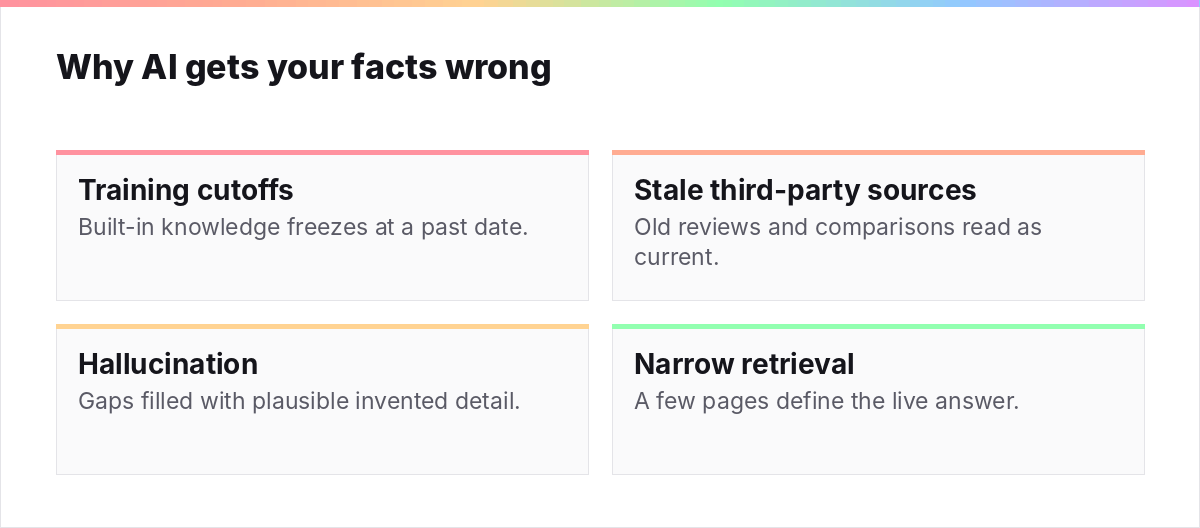
AI gets your facts wrong because it is reconstructing your brand from scattered, dated and sometimes contradictory material, then stating the result with total confidence. There are four common causes, and each points to a different fix.
The stakes rise as these tools take over research. OpenAI's Sam Altman said at Dev Day in October 2025 that more than 800 million people use ChatGPT every week, and Gartner expects traditional search volume to fall 25% by 2026. A wrong price or a missing feature in an AI answer now reaches buyers at scale, silently.
Training cutoffs, stale sources, hallucination and retrieval
Training cutoffs freeze a model's built-in knowledge at a past date, so recent changes are simply absent. Stale third-party pages, an old review or an outdated comparison, get read as current. Hallucination fills gaps with plausible but invented detail. And when the model searches live, it pulls only a handful of pages, so one wrong source can define the answer.
The inconsistency makes this harder to spot. In research from SparkToro and Gumshoe.ai, the same brand list came back less than 1 in 100 times across 2,961 runs, so a wrong claim might surface in only some answers. You have to sample to catch it.
A common example
A SaaS team ships SSO and a new enterprise tier, then keeps hearing from sales that prospects think they lack SSO. The culprit is usually not the product. It is an old comparison page and a year-old review that both predate the launch, and the model is reading those. The fix is not louder marketing, it is updating the two sources the model actually trusts.
How to find what is wrong
Find the errors before you fix anything, because the fix depends on the error type. Run your real buyer prompts several times across ChatGPT, Perplexity and Google AI, and read the answers for false claims about pricing, features, integrations, positioning and availability.
Write down the exact wrong wording and how often it shows up. A claim that appears in most runs is a priority. One that shows up once is worth noting but not panicking over. This is the same method as a full AI reputation audit, narrowed to accuracy, and it gives you a ranked list of what to correct first.
Rank the errors by how close they sit to a buying decision. A wrong claim on a "best tool for X" or an "alternatives to Y" prompt costs you real deals, so it jumps the queue. A minor inaccuracy on a general explainer prompt matters less, even if it is more annoying. Fix the ones that show up where buyers are choosing first, then work back up the funnel.
The levers that correct AI answers
You correct AI answers by changing the sources the model trusts, in rough order of impact. There is no button to edit the model, so the work is making the accurate version easy to find and verify.

Start with your own pages and structured data
Make sure your pricing page, feature pages and about page state the current facts plainly, then mark them up with structured data so machines read them without guessing. Optimizing content this way is measurable. The research that introduced generative engine optimization found GEO methods can lift a source's visibility by up to 40% in generative responses. An llms.txt file and clean schema both help you state the facts in one clear voice.
Then fix the third-party sources
Models cross-check you against independent pages, so a wrong claim often lives in a review profile, a directory or an old comparison, not on your site. Update what you can edit, ask platforms to correct what you cannot, and earn fresh, accurate coverage that outweighs the stale source. Context matters as much as the correction itself.
Where the error is entity-level, for example the model thinks you were acquired or placed in the wrong category, check your Wikipedia and Wikidata entries and your knowledge panel. Those records feed many downstream answers, so a correction there travels a long way.
Use feedback channels, but do not rely on them
Most assistants now offer a thumbs-down or a way to flag a bad answer, and it is worth using when you hit a clear error. Treat it as a small nudge, not a fix. A single piece of feedback rarely changes future answers on its own, and you have no visibility into whether it was acted on. The durable change always comes from correcting the sources the model reads, so spend your real effort there and use feedback as a free extra.
What you can and cannot control
Be honest about the limits, because some of this is outside your hands and chasing it wastes effort. You control your own pages, your structured data, and the accuracy of sources that accept edits or corrections.
You do not control the model's training cutoff, its internal weights, or exactly when it next refreshes. So set expectations with leadership. A correction is a probability shift, playing out over weeks, not an instant edit. The right mindset is patient and evidence-led, which is the whole point of treating this as ongoing AI reputation management rather than a one-off cleanup.
One trap to avoid is trying to force a correction with keyword-stuffed pages or thin content that simply repeats the right fact everywhere. Models and their retrieval layers discount that quickly, and it can hurt the credibility you are trying to build. A few clear, well-placed, genuinely useful sources beat a pile of shouty ones, for the model and for the buyer who eventually clicks through.
Measuring whether the fix stuck
Measure whether the fix stuck by re-running the same prompts over the following weeks and watching the error rate fall. Because answers vary, judge it by the share of runs that now state the fact correctly, not by a single clean answer.
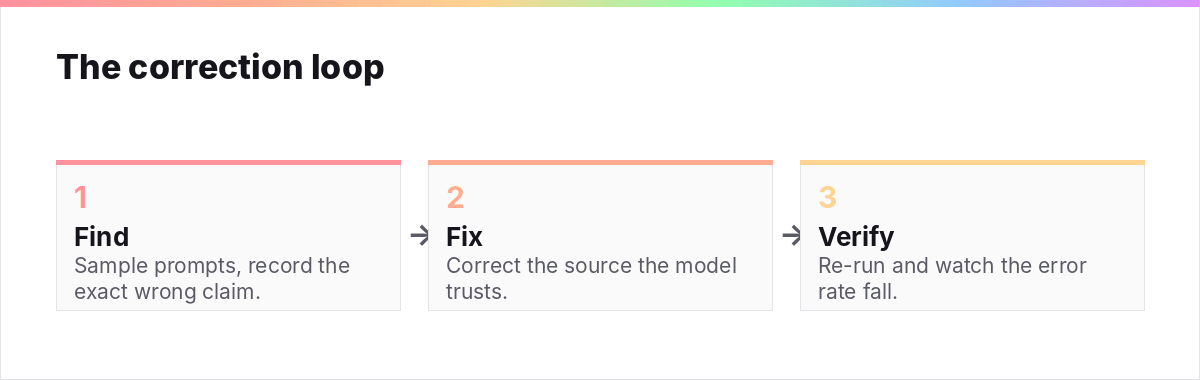
Build the loop into a habit rather than a fire drill. Find, fix, verify, then move to the next error on the ranked list. Teams that run this monthly tend to keep their accuracy high with small, steady effort, while teams that only react lurch from one embarrassing answer to the next and never get ahead of it.
Set up AI brand monitoring so a returning error triggers an alert rather than a surprise in a lost deal. Keep a short log of what you changed and when, so you can tie a drop in the error rate to the specific fix that caused it.
Expect some flutter. An error can clear in one engine while lingering in another, because each refreshes its sources on its own clock. Judge success per engine as well as overall, and do not declare victory off a single good screenshot. The honest marker is a sustained fall in the error rate across runs, holding for a few weeks.
If a wrong answer is costing you deals and you want it chased down and corrected at the source, that is exactly the work our B2B SaaS AI search team does, and a free AI search audit will surface the biggest errors first.
Frequently Asked Questions
Why does ChatGPT get our pricing or features wrong?
Usually because it learned from data before your change, or it is reading an outdated pricing article or review. Models freeze knowledge at a training cutoff and lean on third-party pages, so a fact you updated months ago can still be stated the old way until those sources refresh.
Can you report a wrong AI answer to get it corrected?
Some assistants offer feedback or a thumbs-down on a response, and some entity records like Wikidata accept edits. These help, but the reliable fix is correcting the underlying sources the model reads, since that is what shapes future answers rather than one chat session.
Does llms.txt help fix inaccurate answers?
It can help by giving crawlers a clean, machine-readable statement of your key facts in one place. It is not a magic switch, and support varies, but as part of a wider effort to state your facts consistently across your site and structured data, it is a low-cost, sensible addition.
How long does it take to correct a wrong AI answer?
Expect weeks, not minutes. Your own pages can be read again fairly quickly, but third-party sources and entity records refresh on their own schedule, and the model blends many inputs. Treat a correction as a probability that climbs over time, measured across many runs.
What about a competitor's false claim about us in AI?
Trace where the model is reading it, then counter it with accurate, well-sourced content and corrections on the platforms involved. You usually cannot delete a competitor's page, but you can make the accurate, independently supported version the stronger and fresher signal.
Who should own fixing AI accuracy issues?
The same team that owns organic growth or AI search, working with product and support for the correct facts. It fits naturally inside an AI reputation program, where monitoring flags the error, someone corrects the source, and the fix is verified on the next cycle.
Want this done for your brand? Get a free AI visibility audit.
Get my free AI visibility audit.png)
Latest articles
What we've published in the past 30 days — across SEO, GEO, content, and digital PR.