
.webp)




.webp)
GEO
Calculating...
Sep 2026
How to Get Mentioned in ChatGPT
Getting mentioned in ChatGPT comes down to earning brand mentions across the sources AI trusts. Here is the off-page playbook for B2B SaaS brands.
.mx-kt{border:1px solid #E4E4E8;background:#FAFAFB;border-radius:8px;overflow:hidden;margin:0 0 30px;font-family:Inter,sans-serif;}.mx-kt-bar{height:4px;background:linear-gradient(90deg,#FF929F 0%,#FFAC92 20%,#FFD392 40%,#92FFB0 60%,#92CAFF 80%,#DC92FF 100%);}.mx-kt-in{padding:20px 24px;}.mx-eyebrow{font-size:11px;font-weight:700;letter-spacing:.08em;text-transform:uppercase;color:#5A5A66;margin-bottom:12px;}.mx-kt ul{margin:0;padding-left:20px;color:#1F1F26;font-size:15px;line-height:1.65;}.mx-kt li{margin:7px 0;}.mx-toc{border:1px solid #E4E4E8;background:#FFFFFF;border-radius:8px;padding:18px 24px;margin:0 0 30px;font-family:Inter,sans-serif;}.mx-toc ol{margin:6px 0 0;padding-left:22px;color:#1F1F26;font-size:15px;line-height:1.85;}.mx-toc a{color:#1f6feb;text-decoration:none;}.mx-box{border:1px solid #E4E4E8;border-left:3px solid #0B0B0E;background:#FAFAFB;border-radius:6px;padding:16px 20px;margin:26px 0;font-family:Inter,sans-serif;font-size:15px;line-height:1.62;color:#1F1F26;}.mx-note{border-left-color:#5BB8FF;}.mx-tw{margin:26px 0;overflow-x:auto;font-family:Inter,sans-serif;}.mx-t{border-collapse:collapse;width:100%;font-size:14px;}.mx-t th{background:#F4F4F6;text-align:left;font-size:11px;font-weight:700;letter-spacing:.05em;text-transform:uppercase;color:#5A5A66;padding:10px 14px;border-bottom:1px solid #E4E4E8;}.mx-t td{padding:11px 14px;border-bottom:1px solid #E4E4E8;color:#1F1F26;vertical-align:top;line-height:1.55;}.mx-t td:first-child{font-weight:600;}.mx-q{border:1px solid #E4E4E8;border-radius:8px;background:#FFFFFF;padding:22px 26px;margin:30px 0;font-family:Inter,sans-serif;}.mx-q-bar{height:3px;width:56px;background:#0B0B0E;margin-bottom:14px;}.mx-q p{margin:0 0 12px;font-size:19px;line-height:1.5;color:#0B0B0E;font-weight:600;}.mx-q-cite{font-size:13px;color:#5A5A66;font-weight:400;}.mx-q-cite a{color:#1f6feb;text-decoration:none;}.mx-fig{display:block;width:100%;margin:28px 0;border:1px solid #E4E4E8;border-radius:8px;overflow:hidden;background:#FFFFFF;}.mx-img{display:block;width:100%;height:auto;}.mx-cap{font-size:12px;color:#5A5A66;padding:10px 14px;border-top:1px solid #E4E4E8;font-family:Inter,sans-serif;line-height:1.5;}
Key takeaways
- Getting mentioned in ChatGPT is mostly an off-page job. Across the B2B SaaS accounts we run, the pages that shape an AI answer usually sit on other people's domains, not yours.
- A citation is a link back to you as a source. A mention is the AI naming or recommending your brand in the answer. For B2B SaaS, the mention on a buyer query is the one that sells.
- LLMs repeat brands that show up often, recently, and consistently across the sources they trust: "best [category]" lists, comparison pages, review sites like G2, and community threads on Reddit.
- Aleyda Solis found 84 to 93% of AI citation weight for SaaS brands comes from third-party sources. Ahrefs found 43.8% of ChatGPT's cited pages are "best of" listicles.
- Measure visibility rate (the share of relevant prompts that mention you), not rank. Position in an AI answer is close to random.
To get mentioned in ChatGPT, you need your brand named across the third-party sources ChatGPT trusts: "best [category] tool" listicles, comparison and alternatives pages, review sites like G2, and community threads on Reddit. ChatGPT does not rank pages the way Google does. It repeats the brands that appear often, and consistently, across the content it trained on and retrieves.
What we'll cover
- What it means to get mentioned in ChatGPT
- How ChatGPT decides which brands to mention
- The off-page playbook: where to earn AI mentions
- The on-page foundations that make you mentionable
- How to measure AI mentions and prove they work
What does it mean to get mentioned in ChatGPT?
Getting mentioned in ChatGPT means your brand name appears inside the answer when someone asks a relevant question, such as "what's the best onboarding tool for B2B SaaS?" It is not about your website ranking first. It is about ChatGPT considering your brand a safe, obvious thing to say.
That distinction trips up a lot of marketing teams. They pour effort into their own blog, watch it rank on Google, and still never get named by an AI tool. The reason is simple once you see it. ChatGPT builds an answer from patterns it has seen across the whole web, so a brand only its own site talks about looks thin.
Mentions vs citations: why the difference matters
People use "mention" and "citation" as if they are the same thing. They are not, and for B2B SaaS the gap between them is where the money is.
CitationMentionWhat it isA link crediting you as a source for a claimThe AI naming or recommending your brand in the answer, link or no linkLooks likeA footnote or source chip next to a sentence"Tools worth looking at include Acme, …"Value for B2B SaaSTraffic and credibility on informational queriesA recommendation on a buyer query that does the selling with no clickHow you earn itReference-grade content the AI quotesFrequent, consistent brand mentions across trusted third-party sources
Definition
A brand mention in AI search is any instance where a model names your product in its answer. Unlike a backlink, it does not need to be clickable to work. The model treats the pattern of who gets talked about, and in what company, as evidence of what to recommend.
Why mentions are the bottom-funnel prize
When a buyer asks ChatGPT "best CRM for a 30-person sales team," the brands it lists get shortlisted before a single vendor site is opened. That is a bottom-funnel moment, and it happens without a search result, an ad, or a click you can see.
The buyers are already there. G2 reports that half of B2B software buyers now start their research with AI chatbots, and Semrush's survey of 600-plus professionals shows the same move into vendor discovery. If the model does not know you exist, you are cut from the list before the buyer ever reaches your site.
The format doing that work is the humble listicle. Ahrefs analysed 26,283 URLs cited by ChatGPT across 750 search terms and found 43.8% of them were "best of" listicles, the single most common page type in its sources. If your competitors are on those lists and you are not, ChatGPT is quietly recommending them instead of you.
This is why we treat AI mentions as a demand-capture channel, not a branding nicety. It is the same instinct behind classic link building, pointed at a new surface.
How ChatGPT decides which brands to mention
ChatGPT mentions the brands that appear most often, most recently, and most consistently across the text it was trained on and the pages it retrieves at answer time. There is no ranking algorithm rewarding your best page. There is a probability engine repeating what it has seen.
The currency is mentions, not links
Rand Fishkin put this more bluntly than anyone. The old game rewarded links pointing at your pages. The new one rewards your name showing up in the right places, whether or not those places link to you.
"The currency of large language models is not links. The currency of large language models is mentions, specifically, words that appear frequently near other words, across the training data."
Rand Fishkin, SparkToro, in How Can My Brand Appear in Answers from ChatGPT, Perplexity, Gemini
In practice that means the job is to make your brand the phrase that keeps appearing next to your category. If you want to be recommended for "SaaS billing," you need to be named on the pages that already talk about SaaS billing. That association work is the core of entity SEO.
The corroboration threshold
One mention rarely moves an answer. What moves it is enough independent, credible sources saying similar things about you that the model becomes confident enough to commit. Researchers call this the corroboration threshold, and it is why a single guest post does little on its own. Building that web of consistent signals is what knowledge graph optimization is for.
It also explains the randomness. SparkToro's testing shows a model can give a different brand list on each run of the same prompt, so chasing a fixed "position" is a mistake. You are trying to raise the odds that you appear, not to win a fixed slot.
Where the evidence actually lives
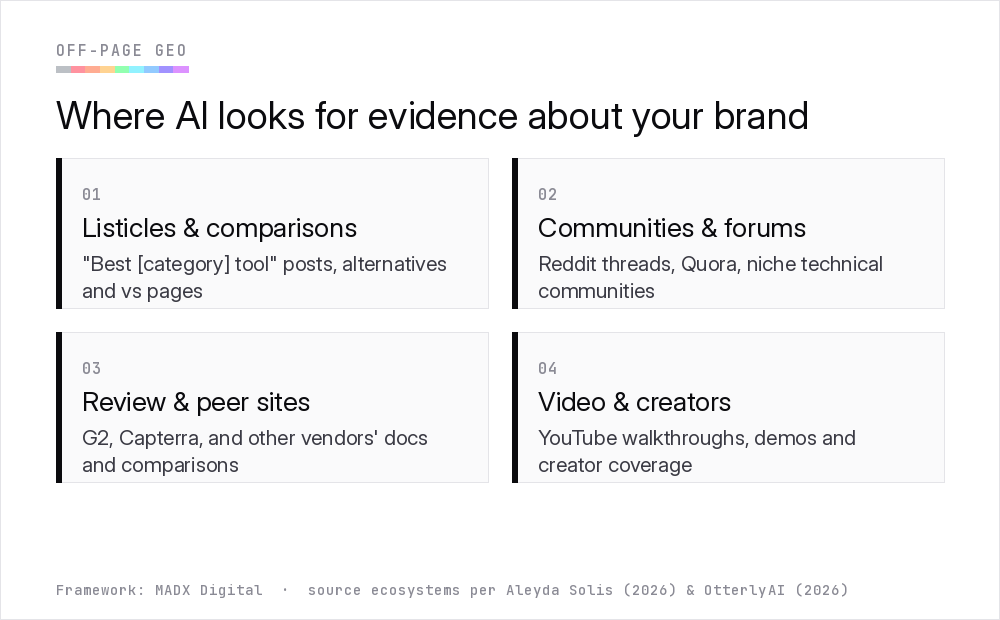
Here is the finding that should reset most content budgets. When Aleyda Solis benchmarked 15 leading SaaS brands across CRM, collaboration, and finance, she found the overwhelming majority of the evidence AI uses about them sits off their own domains.

Peer software vendors were the largest single source type in ChatGPT, roughly 25% of head-source mentions. Communities and forums were the only ecosystem with a double-digit share on both ChatGPT and Google AI Mode. Your own pages matter, but they are a minority of the story.
The channel mix also shifts by platform. Video barely registers in ChatGPT yet is the single biggest external source in Google's AI Mode, at roughly 23%. A brand that wants both needs YouTube walkthroughs and demos as much as written coverage, which is why we plan platform by platform rather than shipping one asset everywhere.
"Publishing authoritative content on your own site is necessary but rarely sufficient. With 84 to 93% of citation weight sitting on third-party sites, the external ecosystem … needs to be treated as a first-class AI visibility channel with its own strategy and owner, not a promotional afterthought."
Aleyda Solis, in What It Takes for SaaS Brands to Win in AI Search
We see the same pattern across client accounts. The brand can influence the answer without ever getting the click, so the work has to happen where the model is actually reading. If you want the underlying mechanics, our guide on how AI builds recommendations goes deeper.
The off-page playbook: where to earn AI mentions
If most of the evidence lives off your site, most of the work does too. The playbook below is what we run for B2B SaaS clients who want to be recommended, not just indexed. We call it Link Building 2.0, because the target is placement in the content AI trusts rather than raw link volume.
Get into the "best [category]" lists and comparison pages
Start where the citations concentrate. Find the "best [your category]" posts, alternatives pages, and vs comparisons that already rank and already get cited, then earn an accurate spot on them. A single well-placed inclusion on a repeatedly reused comparison page outweighs a pile of low-value coverage.
Correcting how you appear matters as much as appearing. If a widely cited list describes you wrongly or ranks you last, that is the version the model repeats. Pitch the publisher, supply proof you belong, and keep the facts current. Our note on the best content formats for AI search covers which of your own pages to build alongside these placements.
Earn a genuine presence on Reddit and communities
Reddit is the most cited domain across every major AI platform, according to OtterlyAI's analysis of more than one million AI citations. Community platforms captured 52.5% of all citations in that study, ahead of brand domains. Models lean on forums because they read as real, unpaid experience.
That makes Reddit both powerful and risky. You cannot buy your way in, and heavy-handed self-promotion gets removed or ratioed fast. The durable move is sustained, honest participation in the subreddits where your buyers already are, so your brand gets mentioned by other people over time.
Claim review platforms and peer software surfaces
Review sites like G2 and Capterra, and the documentation and comparison pages of adjacent vendors, are heavy citation sources for evaluation queries. In Aleyda Solis's benchmark, peer software vendors were the biggest single ChatGPT source type for SaaS. These pages carry ratings, alternatives, and integration language the model reuses.
Keep your profiles complete, your categories accurate, and your recent reviews flowing. Then map the adjacent tools your buyers combine you with and make sure their integration and comparison pages describe you correctly. This is unglamorous work that compounds.
Technology publications like TechRadar and PCMag feed ChatGPT's evaluation answers too, so a digital PR push that lands you in a credible roundup pays off twice: once for the human reader, and again for the model that repeats the roundup later.
Does gaming AI mentions actually work?
Honestly, the cheap version works in the short term, and it is worth being clear-eyed about that. Fishkin has documented people spinning up thin "best X" posts and even faking recent publication dates to jump AI visibility, because today's models lack the spam defences Google spent 20 years building.
Field note
The same weakness cuts both ways. Fishkin points to the CodeSmith case, where a competitor's coordinated negative Reddit campaign cratered a startup's reputation across Google and LLMs. Signals that can be gamed up can be gamed down.
Our verdict after running these campaigns: skip the spam. It is fragile, it invites retaliation, and it evaporates the moment platforms tighten their filters, which they will. The version that lasts is the boring one. Earn real placements, build genuine community presence, and let accurate mentions accumulate past the corroboration threshold.
The on-page foundations that make you mentionable
Off-page earns the mention, but on-page decides whether the model can read and reuse you at all. Two foundations do most of the work: being crawlable, and being quotable. Neither is glamorous, and both are where we find the quickest wins on a new account.
Make sure AI can actually crawl and parse you
OtterlyAI found 73% of sites have technical barriers blocking AI crawler access. If GPTBot, ClaudeBot, OAI-SearchBot, or PerplexityBot cannot reach your pages, none of your content counts, no matter how good it is.
Check your robots.txt for those user agents, confirm your CDN is not blocking non-browser traffic, and make sure your core content renders without JavaScript. Our primer on AI crawlers lists the agents to allow and how to test them.
Write reference-grade, quotable content
Models favour content they can lift cleanly. OtterlyAI reports that chunked, quotable, schema-tagged pages earn 3 to 5 times more citations. The test Thomas Peham suggests is a useful one: would Wikipedia link to this page? If not, AI probably will not cite it either.

Write short, self-contained passages that answer one question each. Open with the answer, then support it. Add clear statistics with named sources, keep your homepage and pricing language current, and structure help content as carefully as marketing content, because the model treats it as evidence too.
How to measure AI mentions and prove they work
You cannot manage what you do not measure, and the wrong metric will send you chasing noise. The right one is visibility rate: across a fixed set of buyer prompts, what share mention your brand? Track that over time, per platform, and you have a number worth reporting.
Track visibility rate, not rank
Because AI answers change run to run, position is meaningless. SparkToro's testing found less than a 1-in-100 chance that ChatGPT or Google's AI returns the same brand list across repeated runs of the same prompt. Reporting "we rank third" is reporting a coin toss.
Build a representative prompt set of the questions your buyers actually ask, weighted toward bottom-funnel "best," "alternatives," and "vs" queries. Then track how often you appear, and how you are described. Our guide to measuring AI search visibility walks through building that set.
The tools that track brand mentions in AI
You do not need to check by hand. A category of tools now tracks how often models mention you, how you are described, and who you are compared against. Pricing shifts often, so confirm current rates before you commit.
ToolWhat it tracksRough entry pricePeec AIVisibility, citations, sentiment, share of voice and competitor comparison across AI enginesFrom about $95/moProfoundEnterprise-grade prompt and answer analytics across ChatGPT, Perplexity and Google AICustomAhrefs Brand RadarBrand mentions, citations and share of voice in AI Overviews and LLM answersAdd-on from about $199/moSemrush AI ToolkitMentions, sentiment and share of voice for teams already on SemrushAdd-on from about $99/moOtterly AIPrompt-level monitoring of mentions and citations across the main platformsBudget-friendly tiersAthenaHQMention monitoring and GEO reporting across ChatGPT and othersCustom
Whichever you pick, report citations and mentions as separate, connected numbers, and connect both to pipeline where you can. A model can name you without sending a click, or send traffic to a page it never cited, so a single blended "AI visibility" figure hides which layer is working.
For the full buyer-side playbook that ties these off-page mentions together, see our guide to getting your B2B SaaS recommended by AI.
The brands that win the AI answer are the ones treated as recommendable everywhere their buyers look, not just the ones with the best blog. If you want help building that presence, this is the exact work our AI search team runs, and you can book a call to talk it through.
Frequently Asked Questions
How long does it take to get mentioned in ChatGPT?
Expect a few months, not days. Model training and retrieval both lag, and you need enough independent sources talking about you to cross the corroboration threshold. Earned placements on high-authority lists and active community presence tend to show up fastest.
How do I check if ChatGPT already mentions my brand?
Ask ChatGPT the buyer questions your category triggers, such as "best [category] for [use case]," and see whether you appear and how you are described. For a repeatable read, run a fixed prompt set through a tracker like Peec AI, Otterly, or Ahrefs Brand Radar and watch the trend.
Do backlinks help you get mentioned in ChatGPT?
Indirectly. Links still help you rank and get crawled, which feeds retrieval, but the model responds to mentions more than to link equity. A brand named across many trusted pages will often be recommended over one with more backlinks but fewer mentions.
How is getting mentioned in ChatGPT different from ranking in ChatGPT search?
Ranking in ChatGPT search means being cited as a source for a claim. Getting mentioned means the model names or recommends your brand in the answer itself. For B2B SaaS the mention on a buyer query is usually more valuable, because a recommendation does the selling with no click. See our guide on how to rank in ChatGPT search for the citation side.
Can you pay to get mentioned in ChatGPT?
There is no ad slot inside the answer today. You can pay for the work that earns mentions, such as digital PR, review-platform presence, and placement in comparison content, but you cannot buy a guaranteed line in ChatGPT's response.
How do you get mentioned in Perplexity and Google AI Overviews too?
The same off-page foundations carry across, but the mix differs. Perplexity leans hard on communities, while Google AI Overviews favour brand domains and reward traditional authority more. Track each platform separately, and see our guide on ranking on Perplexity.
Want this done for your brand? Get a free AI visibility audit.
Get my free AI visibility audit.png)
Latest articles
What we've published in the past 30 days — across SEO, GEO, content, and digital PR.


