.webp)




.webp)
GEO
Calculating...
Sep 2026
Knowledge Graph Optimization: Getting Your Brand Into Google's (and AI's) Memory
Knowledge graph optimization earns your brand an accurate entity record that Google panels and AI answers rely on. A realistic playbook for B2B SaaS.

Key takeaways
- The Knowledge Graph is Google's database of entities and their relationships, and it's a memory layer AI systems lean on when describing brands.
- Brands earn a place through an unambiguous entity home, aligned Organization schema, and corroboration from sources like Wikidata, Crunchbase and the press.
- Most B2B SaaS brands won't get a Wikipedia page, and the honest playbook doesn't need one: consistency plus trusted third-party records does the work.
- A knowledge panel is the visible receipt of graph inclusion. Claim it, correct it, and keep the underlying sources aligned so it stays accurate.
- Measure progress by panel presence, how accurately assistants describe you, and your mention share on category prompts.
Knowledge graph optimization is the work of getting your brand accurately represented in Google's Knowledge Graph, the entity database that powers knowledge panels and feeds the systems behind AI answers. You earn a place by making your identity unambiguous and getting trusted third-party sources to confirm it.
It sounds abstract until you watch an assistant describe your company. The confident, accurate descriptions trace back to brands with clean graph records. The hedged, outdated or flat-wrong ones trace back to brands that never managed theirs.
This is the persistence layer of topical authority: rankings and mentions fluctuate, but a graph record compounds. This guide covers how the Knowledge Graph works, how B2B SaaS brands actually get in, and what's realistic when you're not famous enough for Wikipedia.
What we'll cover
- What the Knowledge Graph is and why LLMs care
- How brands get in
- Optimising your presence
- Knowledge panels for B2B SaaS
- Measuring your progress
What the Knowledge Graph is and why LLMs care
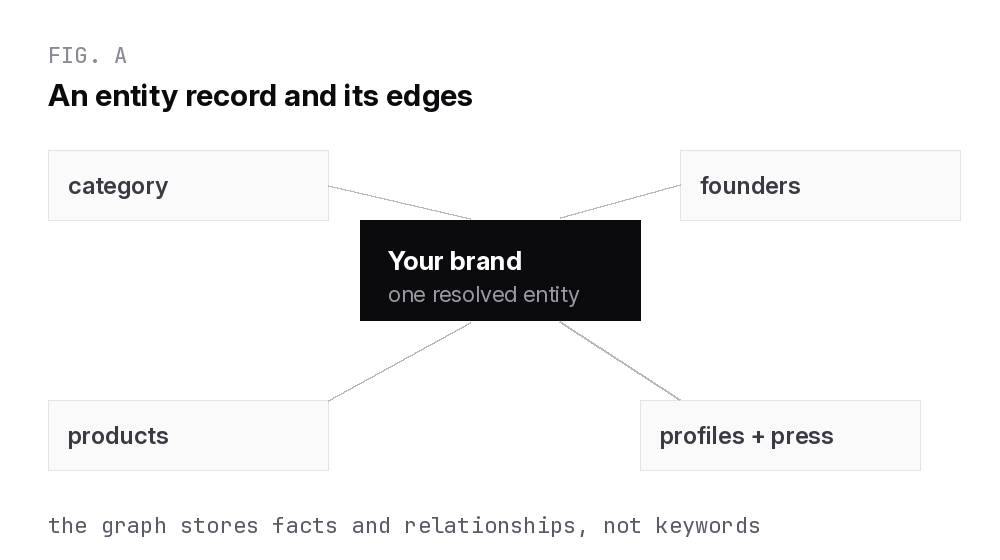
Google's Knowledge Graph is a structured database of entities, people, companies, products, places, and the relationships between them, launched in 2012 and populated from sources Google trusts. When Google is confident about an entity, it shows a knowledge panel and answers questions about it directly.
Definition
Knowledge graph optimization is the practice of establishing and maintaining an accurate entity record for your brand in Google's Knowledge Graph and equivalent databases, through consistent owned signals, structured data and corroborating third-party sources, so search engines and AI systems describe and recommend the brand correctly.
The AI connection
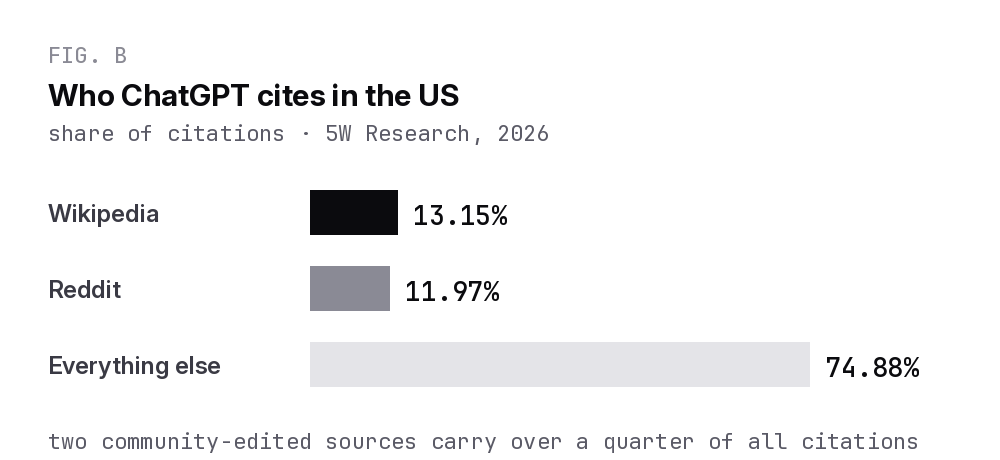
LLMs don't query Google's graph directly, but they learn from the same public sources that feed it and they retrieve the same corroborating pages at answer time. That's why the overlap is so strong in practice: 5W Research found Wikipedia and Reddit together drive over 25% of US ChatGPT citations, and Search Engine Land's Knowledge Graph guide reaches the same conclusion from the Google side. Fix the record once and both surfaces improve.
The two paths run on different clocks, which is worth understanding. Training data bakes your identity into the model months before anyone asks a question, while live retrieval reads today's sources at answer time. Corrections reach the retrieval path within weeks and the training path at the next model update. Both paths read the same records, so the work is identical; only the payoff schedule differs.
Where the graph shows up
You meet the Knowledge Graph more often than you notice: the knowledge panel on a branded search, the direct answers to factual questions about companies, and the entity facts woven into AI Overviews. Assistants echo the same layer when asked who a company is. If those surfaces describe you correctly today, thank a healthy record. If they don't, this article is the repair manual.
"We are building a comprehensive knowledge graph that proves our brand is the most authoritative answer, regardless of how the AI chooses to rephrase the question."Lily Ray, A Reflection on SEO & AI Search in 2025, January 2026
What a graph record is worth
A resolved record buys three things. Recognition: your brand stops being a string and becomes a known thing with a category. Accuracy: assistants describe you from confirmed facts instead of guessing from scraps. And durability: graph records persist between algorithm updates and model versions, which makes this some of the longest-lasting work in search.
How brands get in
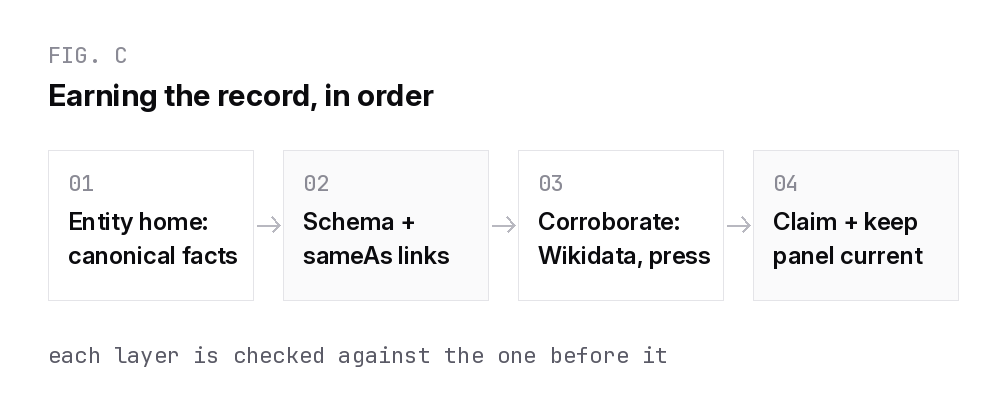
There's no application form. Inclusion is inferred from evidence, and the evidence has three layers: your declaration, machine-readable confirmation, and third-party corroboration. Build them in that order.
The order matters because each layer is checked against the one before it. Schema that restates a vague about page inherits the vagueness. Corroboration that contradicts your declaration creates doubt instead of confidence. Get the declaration right first and every later layer multiplies it.
Layer 1: the entity home
One page on your site, usually the about page, states the canonical facts: name, category, what the product does, who it serves, founding, headquarters. Plain language, no metaphors. This is the same foundation our entity SEO guide builds, because knowledge graph optimization is entity SEO's endgame.
Layer 2: structured data
Organization schema restates the entity home in machine-readable form and uses sameAs links to connect every official profile: LinkedIn, X, YouTube, Crunchbase, GitHub. This tells Google which records across the web belong to one entity, which is precisely the consolidation the graph needs before it will commit to you.
Layer 3: corroboration
Google seeds its graph from sources it trusts: Wikipedia and Wikidata, major data providers, authoritative press. You influence this layer by keeping Crunchbase and directory listings accurate, maintaining a correct Wikidata item, and earning coverage that states the same facts your entity home declares. Placements in category buyer guides help here too, the same Link Building 2.0 work that drives ChatGPT mentions.
For B2B SaaS specifically, the corroboration sources that punch hardest are the ones both graphs and assistants keep re-reading: G2 and Capterra category listings, Crunchbase, LinkedIn, and the two or three buyer guides that dominate your category's commercial SERPs. Prioritise those five before chasing anything exotic. A correct fact in a source nobody retrieves corroborates nothing.
The Wikipedia reality check
Most B2B SaaS companies don't meet Wikipedia's notability bar, and trying to force a page usually ends in deletion and embarrassment. The good news: a Wikipedia page is not required for a graph record or a knowledge panel. A Wikidata item with clean references, consistent data-source records and steady press coverage gets mid-market brands there reliably. Skip the shortcut, build the evidence.
Field note
The pattern we see with SaaS clients: the graph usually knows the company already, it just knows it thinly or wrongly. Fixing the thin record, aligning schema, correcting Crunchbase and Wikidata, tightening the about page, moves faster than teams expect, with panels appearing or correcting within weeks. Starting from zero is rare. Starting from messy is the norm.
Optimising your presence
Optimisation is mostly the disciplined version of what you'd guess: say the same true things everywhere machines look, and keep saying them as the company changes.
ActionWhereWhy it moves the graphTighten the entity homeAbout pageThe canonical statement everything else must matchAlign Organization schema + sameAsSite-wide markupConsolidates scattered profiles into one entityCorrect data sourcesWikidata, Crunchbase, directoriesThe records Google seeds and cross-checks fromMatch profile descriptionsLinkedIn, G2, Capterra, XHeavily retrieved corroboration for both Google and LLMsEarn consistent coveragePress, buyer guides, roundupsIndependent confirmation in category context
Consistency is the whole game
Every row of that table should tell one story. When answers describe a brand wrongly, the cause is usually not missing content but conflicting records, and Aleyda Solis's checklist says it cleanly.
"The fix is often not 'more content,' but stronger entity clarity and consistency across the site, structured data, profiles."Aleyda Solis, The AI Search Optimization Checklist, updated May 2026
Keep the record current
Graphs lag reality, so feed them promptly. Fundraise, rename, reposition or relocate, and the update list is the same table: entity home first, schema second, data sources third, profiles fourth. A quarterly half-hour review keeps drift from accumulating, and it's the cheapest maintenance in your whole search programme.
Mistakes that stall graph records
Three keep recurring in our audits. Inventing a Wikidata item stuffed with unreferenced claims, which gets stripped and damages credibility with editors. Marking up schema that contradicts the visible page, which machines treat as noise, and splitting identity across a company brand and a product brand with no sameAs bridge, so neither record accumulates enough evidence to resolve. All three are cheaper to avoid than to repair.
Knowledge panels for B2B SaaS
A knowledge panel is the box Google shows when it's confident about an entity, and for a brand it's the visible receipt that the graph resolved you. Panels matter beyond vanity: they anchor your branded SERP, and the facts inside them get read aloud by assistants.
Triggering a panel
Panels appear when confidence crosses a threshold, and the three layers above are how you raise it. In our experience the strongest additions for panel-less SaaS brands are a referenced Wikidata item, consistent major-directory records, and press that names the company with its category. There's no guaranteed timeline, which is one more reason to start before you need it.
Founders' panels are worth a mention here. A well-referenced founder entity, with consistent bios, bylines and a Wikidata item of their own, often resolves before the company does, and it lends the company record credibility through the association. If your founder speaks, writes or gets quoted, tidy their entity alongside the brand's.
Claiming and maintaining it
Once a panel exists, claim it through Google's verification process so you can suggest corrections. Claiming doesn't mean control: Google still weighs sources, so a wrong fact in the panel usually means a wrong fact in a source it trusts. Trace it, fix it at the source, and the panel follows.
Treat the branded SERP as part of the same asset. The panel sits beside your homepage listing, your review-site results and recent press, and buyers see them as one impression. A clean panel next to a two-year-old G2 description still leaks credibility. Audit the whole first page of your brand search when you audit the panel.
Measuring your progress
Knowledge graph work has unusually clean success signals, because the outputs are visible: the panel, the descriptions, the mentions. Check three things quarterly.
Keep the measurement lightweight or it won't survive contact with a busy quarter. One document, three sections, updated in under an hour: panel screenshots, assistant answers to the same five questions, and the mention counts on your category prompts. Trend lines across quarters tell the story better than any single reading, because model outputs wobble week to week.
Panel presence and accuracy
Does a knowledge panel exist for your brand, and is every fact in it correct and current? Screenshot it each quarter. The record of change is your progress report, and it catches regressions when a stale source re-contaminates a fact you'd fixed.
Check the panel from a logged-out browser and, if you sell internationally, from your main markets, since panels vary by region. The variations tell you which regional sources need attention, and they're easy to miss from a single office in one country.
How assistants describe you
Ask the major assistants what your company is and does, then grade for accuracy and consistency, exactly as described in our guide to measuring AI search visibility. Description quality improves before mention frequency does, so it's your leading indicator.
Mention share on category prompts
The end goal is being named when buyers ask for recommendations in your category. Track your share against competitors monthly, alongside the citation sources those answers use, with brand monitoring covering the wider mention landscape and our AI visibility guide for B2B SaaS covering the full measurement stack.
Knowledge graph optimization is quiet work with loud downstream effects: better panels, truer descriptions, more confident recommendations. It's also foundational to everything else in this cluster, from semantic SEO to the pillar strategy itself.
If you'd rather have the whole entity-to-graph pipeline handled, that's part of what our SaaS SEO agency builds for B2B SaaS brands. Either way, start with the about page. The graph is probably already reading it.
Frequently Asked Questions
What is the Google Knowledge Graph?
The Knowledge Graph is Google's database of entities, meaning people, companies, products, places and concepts, plus the relationships between them. Launched in 2012, it powers knowledge panels and direct answers, and it's built from sources Google trusts, including Wikipedia, Wikidata and authoritative data providers.
How do you get your company into the Knowledge Graph?
Build evidence in three layers: a clear entity home page stating your canonical facts, Organization schema with sameAs links consolidating your official profiles, and corroboration from trusted sources like Wikidata, Crunchbase, directories and press coverage. Google infers inclusion from agreement across those layers rather than from any application.
Do you need a Wikipedia page for a knowledge panel?
No. Wikipedia helps but isn't required, and most B2B SaaS companies don't meet its notability bar anyway. A referenced Wikidata item, accurate data-source records, consistent profiles and steady press coverage regularly earn panels for mid-market brands without any Wikipedia presence.
Does the Knowledge Graph affect ChatGPT and AI answers?
Indirectly but strongly. LLMs learn from and retrieve the same public sources that feed Google's graph, including Wikipedia, Wikidata and heavily cited profiles. A brand with clean, consistent records across those sources gets described more accurately and recommended more confidently across AI assistants.
How do you fix wrong information in a knowledge panel?
Claim the panel through Google's verification process, then trace the wrong fact to its source. Panels reflect trusted sources, so correcting the fact on your site, Wikidata, Crunchbase or the relevant press piece is what actually changes the panel. Suggested edits work best when the underlying sources already agree.
How long does knowledge graph optimization take to show results?
Corrections to existing records typically surface within weeks. Earning a first-time knowledge panel is less predictable and can take months, because it depends on Google's confidence crossing a threshold. The work compounds either way, since every aligned record also improves how AI assistants describe the brand today.
.png)
Latest articles
What we've published in the past 30 days — across SEO, GEO, content, and digital PR.