.webp)





.webp)
SEO
Calculating...
Aug 2026
Programmatic SEO for B2B SaaS: What Actually Works in 2026
Programmatic SEO still works for B2B SaaS in 2026, but only with real data and genuine utility. The practitioner playbook after Google's 2026 crackdown.

Programmatic SEO for B2B SaaS is the practice of pairing a structured data set with a single page template to generate hundreds or thousands of targeted pages at once, each built to answer one specific search. It still works in 2026, but only when every page carries real data or real utility a searcher cannot get anywhere else.
That last clause is where most SaaS programmatic projects live or die. We have watched teams ship 4,000 pages in a weekend and celebrate, then watch the traffic never show up, or show up and vanish in the next core update.
This is the practitioner version, written from the campaigns we run at MADX. It covers what programmatic SEO is, when it pays off for B2B SaaS, what Google's 2026 enforcement changed, and how we build page sets that survive. If you want the hands-on build after this, our step-by-step guide to doing programmatic SEO picks up where the strategy ends.
What programmatic SEO is (and is not) for B2B SaaS
Programmatic SEO uses one template and a data set to publish many near-identical pages, each targeting a distinct long-tail query. It is a production method, not a content type, and that distinction matters more than any tactic.
Templates and data, not mass-produced filler
Think of the template as the shape of the page and the data set as what fills it. A single "[tool] integrations" template, fed a list of 3,000 apps, becomes 3,000 pages without anyone writing 3,000 posts by hand.
The method is neutral. Point it at a rich data set and you get pages people bookmark. Point it at a thin one and you get filler that Google has spent two years learning to ignore.
How it differs from a content cluster
A content cluster is a handful of researched articles linked around a theme, like our own guide to building topic clusters. Programmatic SEO is the opposite end of the scale: many machine-assembled pages built from structured fields.
Both belong in a mature SaaS program. Clusters win the considered, editorial queries. Programmatic pages win the repetitive, patterned ones a writer would never cover one by one.
B2B SaaS is unusually well suited to this. Most SaaS products already sit on structured data, the integrations they support, the use cases they serve, the competitors buyers weigh them against. That data is the raw material a programmatic set needs, which is why the tactic shows up so often in SaaS growth and rarely in, say, a consultancy with nothing to template.
When programmatic SEO works, and when it backfires
Programmatic SEO pays off when a real pattern of demand exists and you hold data that answers it better than a generic page. It backfires when you generate pages for demand that is not there, or with content a reader gains nothing from.
The real-data-or-real-utility test
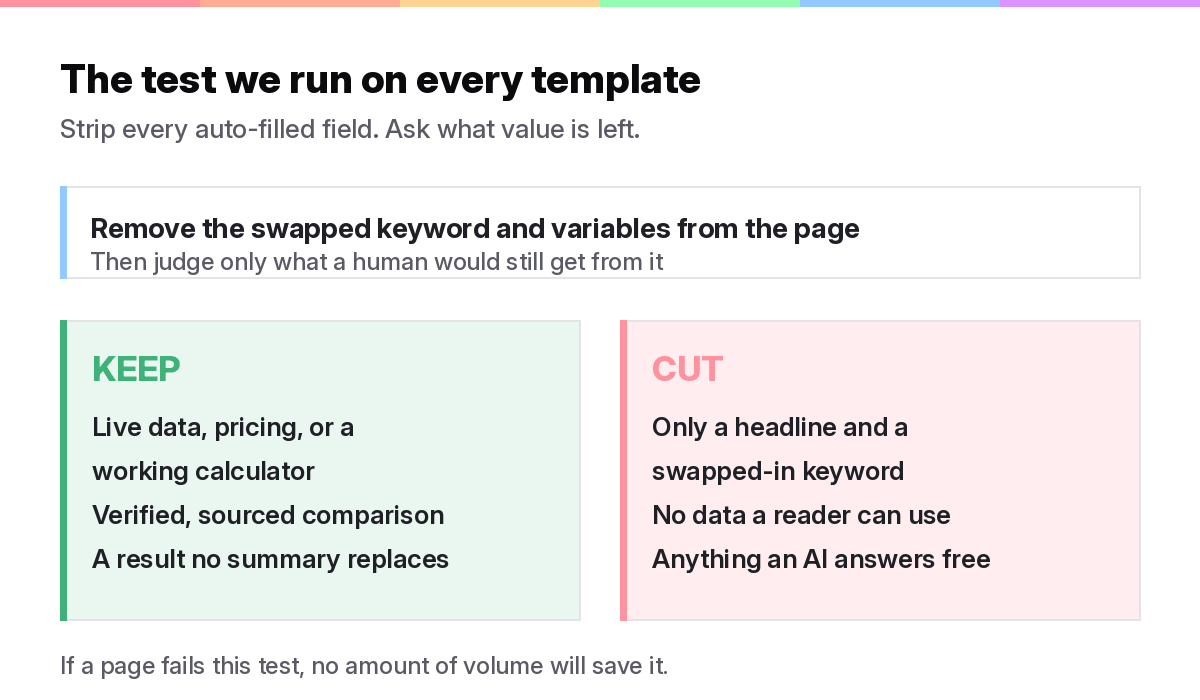
Before we approve a programmatic project, we run one test on the template: strip the auto-filled variables and ask whether what remains would help a human. If the page is only a headline and a swapped keyword, it fails. If it carries live pricing, a working calculator, verified data, or genuine comparison detail, it passes.
This is the line Google now polices, and it is the same line a skeptical buyer feels the moment they land on the page.
There is a reason we are strict about it. The upside of a programmatic set compounds slowly and the downside arrives fast, so the asymmetry rewards caution. A page you did not publish costs you nothing, while a thousand weak pages can pull a whole domain down with them.
The archetypes that earn their place
Across SaaS campaigns, a handful of page patterns carry their weight again and again. Each one works because it is backed by something a template alone cannot fake.
Notice the pattern. The archetypes with the lowest AI Overview exposure are the ones where a searcher still has to click to get what they came for. That is not a coincidence, and it shapes where we point programmatic effort now. Our teardown of six B2B SaaS programmatic examples shows each of these in the wild.
Which archetype fits depends on where your buyers already search. A workflow tool with hundreds of integrations has an obvious integration-page play. A category with heavy comparison shopping leans into alternatives pages instead. We map the archetype to real demand first, then to data we can stand behind, and build only where those two overlap.
Where it quietly burns trust
The failure mode is rarely dramatic. It is 5,000 "best [category] software in [city]" pages with no local data, sitting in the index, spreading your crawl budget thin and teaching Google that your domain publishes filler.
We have taken over sites where the single fastest win was deleting most of the programmatic library, not adding to it. Fewer, denser pages beat a warehouse of empty ones every time.
The 2026 rules: scaled content abuse and AI Overviews
Two forces reset the programmatic game in 2026: Google's enforcement of its scaled content abuse policy, and AI Overviews eating the low-intent long tail. Neither killed programmatic SEO, but together they raised the quality floor sharply.
What scaled content abuse actually means
The policy launched on 5 March 2024 alongside a core update, as part of three new spam policies from Google Search Central. For two years it was enforced patchily.
What the March 2026 enforcement changed
The March 2026 core update made scaled content abuse a primary target. Sites that had quietly built rankings on templated, low-substance pages saw traffic fall off a cliff, with many losing 50 to 80 percent of their organic clicks inside two weeks.
The lesson for SaaS teams is not to avoid programmatic pages. It is to make sure every generated page would survive being read by a human reviewer, because that is effectively the bar Google now applies.
How AI Overviews shrink the long tail
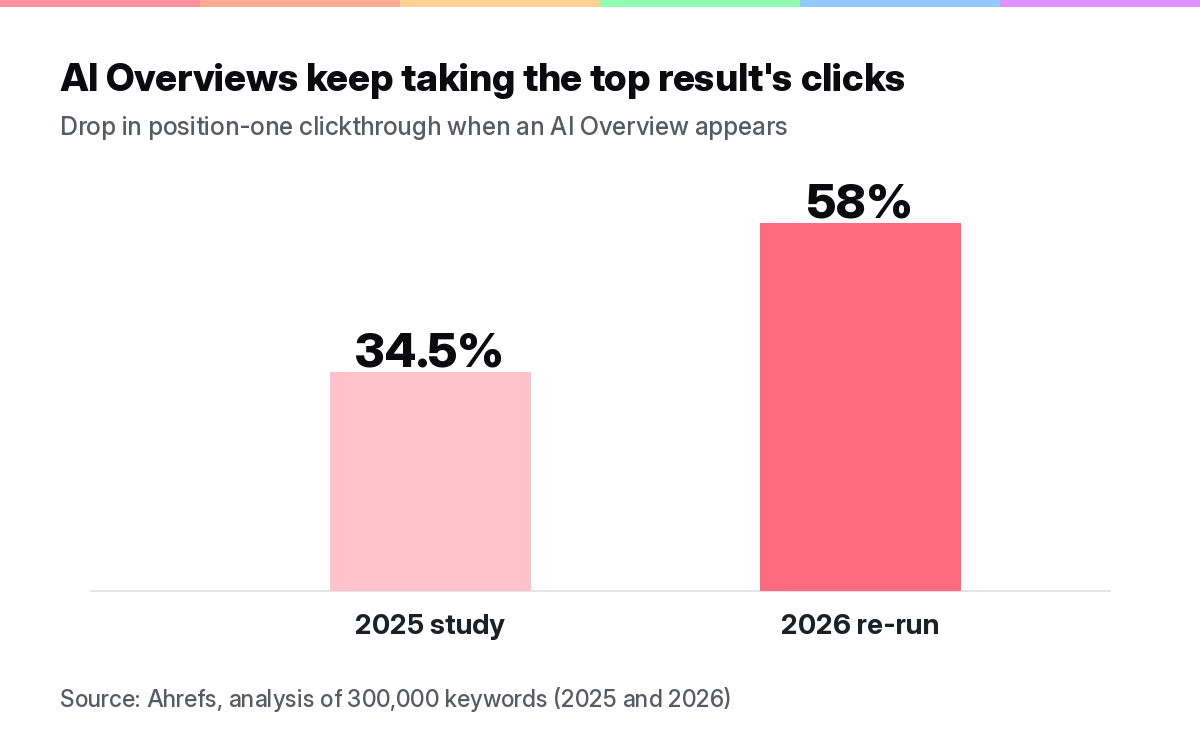
AI Overviews answer many informational queries directly, and they are pulling clicks with them. Ahrefs analysed 300,000 keywords and found the presence of an AI Overview cut the top result's clickthrough rate by 34.5 percent in its 2025 study, a figure its 2026 re-run pushed to 58 percent.
Google frames this differently. Its own leadership argues the feature helps publishers.
Both things can be true at once, and the reconciliation is simple. Pages that only restate a fact the AI already knows will lose, while pages that require a click, a calculation, or a real comparison keep their traffic. Pew Research found people click a traditional result in only 8 percent of visits where an AI summary shows.
Our verdict: build programmatic pages for action, not for answers a machine can give away for free. Cluster five of this hub, on programmatic SEO in the AI search era, goes deep on getting these pages cited rather than skipped.
You can check your own exposure in an afternoon. Pull the queries your programmatic pages target and see how many trigger an AI Overview or an AI Mode answer. Where they do, the page has to offer something the summary cannot, and it helps to know that Ahrefs found 76 percent of AI Overview citations come from the current top 10. Ranking well and being cited are now the same job.
The MADX build: from seed to published pages
Our programmatic build runs in five moves: find the pattern, assemble the data, design a template that earns the click, generate and QA, then publish in waves. The order matters, because most failures trace back to skipping the data and QA steps to get pages live faster.
Moves one and two: the seed pattern and the data set
We start by finding a head term with a repeatable modifier, the "[x] for [y]" or "[x] vs [y]" shape, then size how many real variations have demand. This is its own discipline, which we cover in keyword research for programmatic SEO. The data set behind the pattern is the moat, so we lean on first-party data, product data, and verified third-party sources rather than anything a competitor can copy in an afternoon.
Move three: a template that earns the click
The template needs a unique-value block near the top, the part that changes meaningfully per page and gives the reader a reason to stay. For an integration page that might be the specific triggers and actions. For a comparison page it is a live feature and pricing table.
A useful discipline is to write the unique-value block for the hardest page in the set first, the one with the least data behind it. If you can make that page genuinely worth reading, the rest of the set clears the bar comfortably. If you cannot, the pattern is too thin and it is better to learn that now than after publishing thousands of pages.
Moves four and five: generate, QA, and publish in waves
We generate a small batch first, not the whole set. A sample of 50 pages tells us whether the template holds up across the messy edges of real data, the missing fields and odd values that break a page.
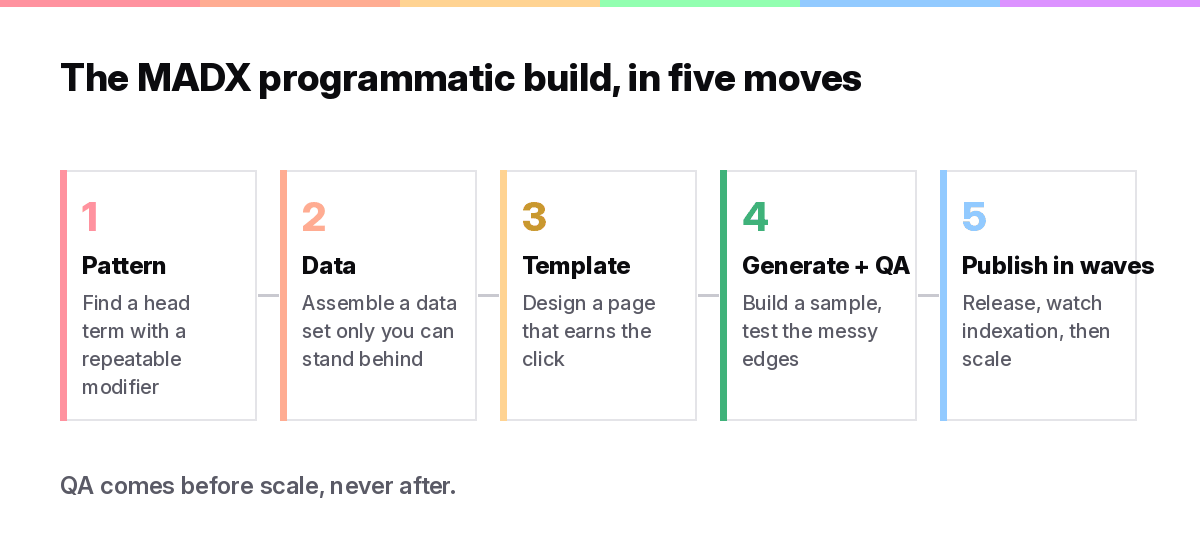
Then we publish in waves and watch indexation and early rankings before releasing the rest. If Google is slow to index or quick to ignore the first wave, that is a cheap warning, far cheaper than finding out across 5,000 live pages. This is exactly the kind of work our B2B SaaS SEO team runs end to end when a client wants scale without the risk.
Internal linking is the step teams skip and regret. A programmatic set that does not link to itself and back to the pillar pages above it leaves most of its authority stranded. We build the linking rules into the template, so each generated page points to its parent category, a few relevant siblings, and the money page it supports, with no one placing links by hand. The stack that makes this repeatable is covered in our programmatic SEO tools guide.
Measuring programmatic SEO without fooling yourself
The honest metric for programmatic SEO is traffic and pipeline from the pages that actually rank, not the raw count of pages published. A set of 10,000 pages where 200 do the work is a success with a lot of dead weight attached.
Leading indicators, not vanity counts
We watch indexation rate, the share of pages earning at least one impression, and the distribution of clicks across the set. Zapier is the reference point here. Its blog alone pulls 1.6 million organic visits a month, about 67.5 percent of its organic traffic, and its programmatic integration pages drive another 16 percent.
The same case study shows the floor. The first integration page in a chain earns real traffic while the deepest combinations earn nothing at all. A big programmatic set always has a long tail of pages that never catch, and that is fine as long as the winners pay for them.
Tie the set back to pipeline, not just sessions. We tag programmatic pages as their own group in analytics so we can see assisted conversions, demo requests, and signups that touched them. A page can earn modest traffic and still pull its weight if it sits on a real buying path, and another can post big numbers while attracting nobody who buys.
What to prune
Every few months we cut pages that have had time to prove themselves and earned no impressions, no clicks, and no links. Pruning dead pages concentrates crawl budget and signals quality, the same principle behind Google's helpful content guidance.
Pruning is maintenance, not failure. Even the best programmatic sets carry pages that never found demand, and clearing them on a schedule keeps the set healthy and keeps Google's read of your domain positive. We treat it like weeding a garden, not like admitting a mistake.
Eli Schwartz, who wrote Product-Led SEO, makes the point that the goal is answer and outcome, not gaming an algorithm. That is the right frame for programmatic SEO in 2026. Build pages a person is glad they landed on, measure the ones that work, and cut the rest without sentiment. If you want a second pair of hands on it, our free AI SEO audit is a fast way to see where a programmatic set is helping or hurting.
Frequently asked questions
Is programmatic SEO dead in 2026?
No. Programmatic SEO is not dead, but the low-effort version is. Pages built on real data or genuine utility still rank and convert, while thin template pages now lose traffic in core updates. The method works, the shortcuts do not.
Is programmatic SEO against Google's guidelines?
Programmatic SEO is allowed. What breaks Google's guidelines is scaled content abuse, which means publishing many pages mainly to manipulate rankings with little value to users. If each page genuinely helps a searcher, generating it programmatically is fine.
How many programmatic pages should a B2B SaaS launch?
Only as many as you have real demand and real data for. It is better to publish 300 pages that each answer a genuine query than 5,000 that mostly sit unread. Start with a small wave, prove it ranks, then scale into demand you can verify.
How long does programmatic SEO take to work?
Expect three to six months for a well-built set to index fully and start ranking, and longer for competitive patterns. Publishing in waves lets you read early signals within weeks and adjust the template before you commit to the full set.
Does programmatic SEO work with AI Overviews?
It works best for patterns where the searcher still needs to click, like integrations, comparisons, and interactive tools. Purely informational pages are more exposed, because AI Overviews often answer those queries directly and take the click with them.
Do programmatic pages get cited by AI tools like ChatGPT?
They can, when the page holds structured, sourced, unique data that a model finds worth quoting. Definition and comparison pages with clear, factual answers are the most likely to earn a citation, which is why data quality matters more than page volume.
Want this done for your brand? Get a free AI visibility audit.
Get my free AI visibility audit.png)
Latest articles
What we've published in the past 30 days — across SEO, GEO, content, and digital PR.