.webp)





.webp)
Content
Calculating...
Aug 2026
Topic Clusters: The Architecture Behind Search and AI Visibility
Topic clusters group a pillar page with focused articles so engines and LLMs treat you as the category authority. See the exact planning process we use.


A topic cluster is a group of interlinked pages built around one subject: a pillar page that covers the full topic, plus focused articles that each answer one specific question in depth. The structure tells search engines and AI assistants that your site resolves the whole topic, not just one query.
The model is a decade old, but AI search quietly made it more valuable. Assistants don't read one page and stop. They break a prompt into pieces and retrieve the best source for each piece, which makes a connected set of pages the right shape for how machines now consume content.
We use clusters as the delivery mechanism for topical authority on every B2B SaaS campaign we run. This guide covers how the model works, why query fan-out changed the maths, and the exact planning process we use, including the worked map behind the cluster you're reading.
What a topic cluster is
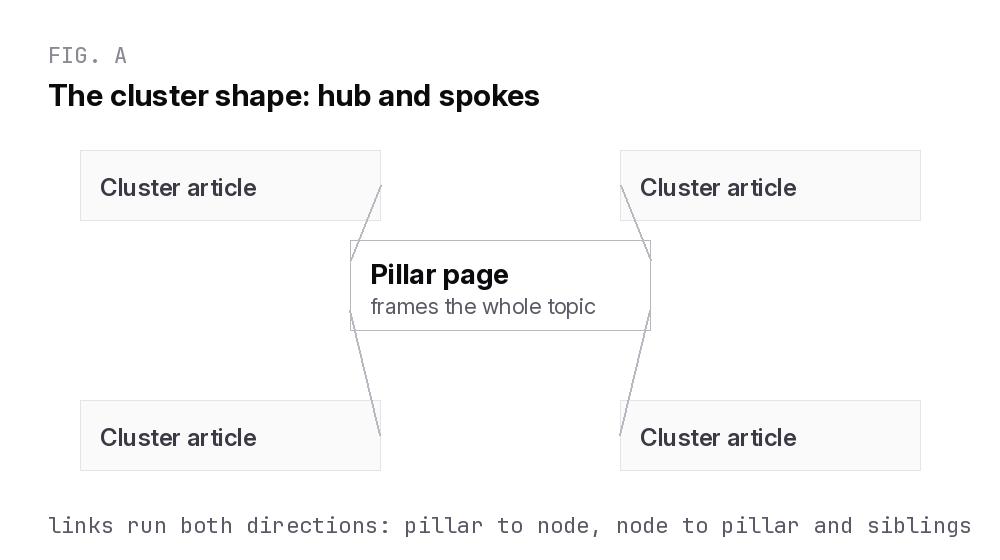
A topic cluster is a deliberate content architecture with three parts: a pillar page that frames the whole subject, cluster articles that go deep on one sub-question each, and internal links that bind them into a unit. Every page has one job, and the links declare how the jobs relate.
Hub and spoke vs silo
You'll see the same idea under different names. Hub and spoke is the cluster model with the pillar as hub. Siloing is an older, stricter version that walls topics off from each other and often blocks useful cross-links. We build hubs, not walls: cluster pages link to siblings and to other relevant topics whenever the link helps a reader, because those connections are signals, not leaks.
A concrete SaaS example makes the shape obvious. A customer onboarding platform might run a pillar on user onboarding, with cluster articles on onboarding checklists, activation metrics, in-app guidance, onboarding emails and time-to-value benchmarks. Each article wins its own searches. Together they tell every machine that reads them: this site resolves onboarding.
What a cluster is not
A category tag on your blog is not a cluster, and neither is a batch of posts that happen to share a theme. If the pages don't link to each other with meaningful anchors, machines see scattered content, whatever your editorial calendar says. The links are the architecture, which is why they get their own section below.
It's also not a volume play. We regularly audit SaaS blogs with 300 plus posts and no cluster among them, because every article was commissioned in isolation. The inverse exists too: 25 pages, properly mapped and linked, carrying a site's entire organic pipeline. Architecture beats archive size every time we measure it.
Why clusters fit query fan-out
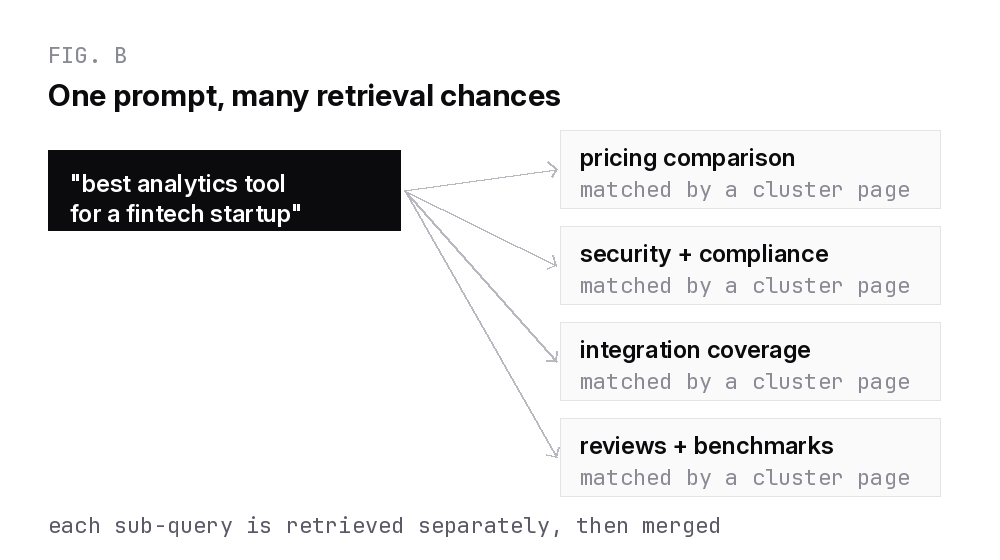
Query fan-out is the step where an AI assistant splits your prompt into several hidden sub-queries, searches them all, and assembles one answer from the results. It's the single best reason to organise content in clusters, because it multiplies the retrieval opportunities a topic contains.
How fan-out works
Ask ChatGPT for the best analytics tool for a fintech startup and it won't run one search. It runs several: pricing comparisons, security requirements, integration lists, reviews. Each sub-query is retrieved separately and synthesised into the final answer, as Semrush's explainer on the mechanism shows. Google's AI features work the same way, and Dan Petrovic's research found they read to a tight budget, extracting as little as 13% of a long page.
Now count your chances. One landing page can match one sub-query. A cluster with 8 focused pages can match most of them, and every match is another route into the answer. That's the quiet asymmetry: fan-out punishes thin coverage and pays specialists.
Aggregate the queries, don't chase them
The wrong response to fan-out is building a page per synthetic query. Those queries are generated on the fly, vary between users, and shift between sessions. The right response is aggregating them into stable themes and covering each theme properly once.
This is also why the payoff is durable. Kevin Indig's read of Semrush's 2026 ChatGPT data found 89.3% of AI-search demand sits in categories with no clear owner, and once a brand takes a category seat it holds it in 90.4% of monthly checks. Clusters are how you apply for the seat.
Read that as a deadline, not a comfort. While your category sits in the contestable pile, a coherent cluster can take it. Once someone else builds the wide lead, you're funding a siege instead of a sprint.
Planning a cluster for a SaaS category
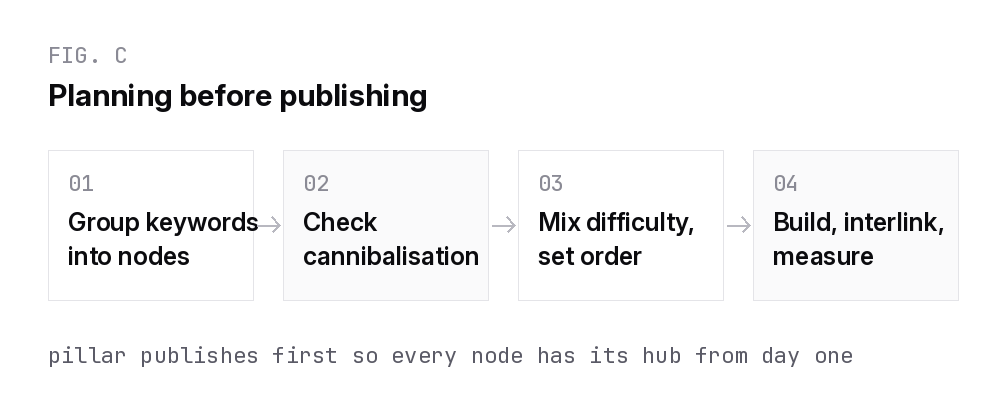
Good clusters are planned as maps before they're written as articles. The plan decides what exists, what each page targets, and how the pages connect. Skipping it is how sites end up with five posts fighting for one keyword.
Group keywords into nodes
Start with standard keyword research across the category, then group terms by the page that should answer them, using the SERPs as the referee. If two keywords return mostly the same results, they're one node. If the results differ, they need separate pages. Ahrefs' parent topic feature shortcuts a lot of this, and our SaaS keyword research guide walks through the full workflow.
Then layer in the questions machines generate. Fan-out emulation tools and the people-also-ask boxes both reveal sub-questions your keyword tool misses, especially comparison and constraint questions like "does X work with Y" or "X for regulated industries". Those low-volume questions are often exactly what an assistant needs answered before it will recommend anyone.
Check for cannibalisation before you write
Every planned node gets checked against your existing library. If a live post already targets the intent, link to it or refresh it instead of duplicating it. When we planned this hub, we checked all 344 posts on our own site and swapped out one node whose SERP turned out to be owned by product pages rather than guides. Ten minutes of checking beats a year of two URLs splitting one keyword's clicks.
Mix difficulty so the cluster can win early
A rankable map pairs a head term you'll grow into with lower-difficulty nodes you can win this quarter. Early wins aren't vanity: they build the internal link equity and topical footprint that eventually move the head term. A map where every node is KD 60 plus is a plan to be patient and poor.
Decide the publishing order
Pillar first, always, so every cluster article has its hub to link to on day one. After that, sequence by a simple score: business value times winnability. A mid-volume node with buying intent and weak competition outranks a high-volume trophy term in the queue. We publish clusters over weeks, not quarters, because the structure only starts signalling once most of it exists.
Building and interlinking the cluster
Execution has two halves: pages built for extraction, and links that declare structure. Both halves matter to machines that sample rather than read.
Write each node for retrieval
Open every article with a direct answer, keep sections self-contained, and put comparisons in tables. Structure is covered in depth in our pillar page guide, and the meaning side, entities and intent coverage, in our semantic SEO guide. The short version: a page that answers one question completely beats a page that gestures at five.
Clusters are the editorial half of a content program. For the patterns you generate at scale from a data set rather than write by hand, see our guide to programmatic SEO for B2B SaaS.
Interlink with intent
The pillar links down to every cluster article. Every cluster article links up to the pillar and across to 2 or 3 siblings where the connection is real. Use descriptive, in-sentence anchors that name the destination topic, never a bare "read more", because anchors are how machines learn what the target page is about.
Two hygiene rules finish the job. No orphans: every node must be reachable from the pillar. And no duplicate anchors pointing at different pages, which confuses the map you just drew. A quarterly crawl catches both in minutes.
Fix the map before you write, because retrofitting links into published prose always reads bolted-on. We draft every article with its interlinks already placed in sentences that would exist anyway. If a link needs a paragraph invented to house it, the link probably doesn't belong there.
A worked example and how to measure it
The clearest example we can show is the cluster this article belongs to, planned with the exact process above. One pillar, five nodes, every keyword locked against Ahrefs data before writing started.
Measure the cluster as a unit
Track three things monthly: share of voice across the cluster's whole keyword set, the number of nodes with rising long-tail positions, and AI mention share on the category's buyer prompts. With AI Overviews on roughly 16% to 25% of US queries and Google still holding 90.6% of global search share per BrightEdge, both boards count. Our guide to measuring AI search visibility covers the AI side in detail.
Set the baseline before the first article ships. Snapshot current rankings for every node keyword, run the category's buyer prompts through the major assistants, and record who gets named. Without the baseline you'll argue about attribution in month four. With it, the before-and-after makes the case for you.
When a cluster is finished
Never, honestly. Categories grow new questions, stats age, and competitors move. Revisit the map twice a year, refresh nodes whose data went stale, and add nodes when the fan-out themes shift. A maintained cluster compounds; an abandoned one decays politely for 18 months and then all at once.
If you'd rather have the map, the build and the maintenance handled, this is the core of what our SaaS SEO agency does for B2B SaaS brands, with the wider strategy covered in our B2B SaaS content strategy guide. Start with the map either way. The articles are the easy part.
Frequently Asked Questions
How many articles should a topic cluster have?
Most B2B SaaS clusters need one pillar page and 5 to 15 cluster articles, depending on how many distinct questions the category contains. The test is coverage, not count: if a buyer's realistic questions all have a dedicated page, the cluster is the right size. Add nodes when new questions emerge rather than padding upfront.
What's the difference between a topic cluster and a pillar page?
The pillar page is one component of the cluster: the broad page that frames the whole topic. The cluster is the full system, meaning the pillar plus the focused articles and the internal links connecting them. A pillar without cluster articles is just a long post with nothing to anchor.
Do topic clusters help with ChatGPT and AI search visibility?
Yes. AI assistants split prompts into multiple sub-queries and retrieve sources for each one, so a cluster gives your site several chances to be pulled into a single answer. Aggregated coverage of a category's themes is also the pattern behind brands that hold category ownership in ChatGPT month after month.
How do you interlink a topic cluster?
Link the pillar down to every cluster article, and link every cluster article up to the pillar plus across to 2 or 3 sibling articles where the connection is genuine. Use descriptive in-sentence anchors that name the destination topic. Avoid orphan pages and avoid reusing one anchor text for different targets.
Can you build a topic cluster with existing blog content?
Usually, yes, and it's often the fastest route. Map your existing posts against the category's questions, refresh the ones that fit, merge overlapping posts, and write only the missing nodes. Retrofitting links onto existing content regularly produces gains before any new article is published.
How long does it take for a topic cluster to work?
Expect early long-tail movement across nodes within 8 to 12 weeks and meaningful head-term and AI mention gains in 3 to 6 months. Speed depends on category competitiveness, site authority, and how completely the cluster covers the topic. Clusters compound, so the second cluster in a category usually moves faster than the first.
.png)
Latest articles
What we've published in the past 30 days — across SEO, GEO, content, and digital PR.