.webp)




.webp)
GEO
Calculating...
Apr 2026
Why Your Brand Isn’t Showing Up in Google AI Overviews
Not showing up in Google AI Overviews? Learn why rankings alone are not enough and how third-party brand mentions, reviews, Reddit, LinkedIn, and editorial cove

A lot of brands think they should already be showing up in Google AI Overviews.
They rank for relevant keywords.
They publish content consistently.
They have backlinks.
They may even have a decent amount of branded search.
But when buyers search high-intent queries like best [category] software, [brand] alternatives, or top tools for [use case], their brand is missing.
That is especially frustrating for teams already investing in Google AI Overview strategy, AI SEO, or broader generative engine optimization.
That usually leads to the wrong conclusion.
Most teams assume they need more content on their own site.
Or better technical SEO.
Or more backlinks.
Those things still matter.
They just do not fully explain AI visibility.
The bigger issue is that AI Overviews are not built from your website alone. They are built from corroborated evidence across the web.
Google itself says AI Overviews are shown when its systems determine generative AI can help people understand information from a range of sources.
That framing matters because it confirms the answer set is broader than your own domain, which is exactly how Google Search Help describes AI Overviews and how Google's AI features documentation frames eligibility and visibility.
If your brand is only talking about itself, Google has very little external proof that you deserve to be included.
That is the gap.
If you want to appear in AI-generated answers, you need to stop thinking only in terms of rankings and start thinking in terms of evidence.
What We’ll Cover
TL;DR
- Google AI Overviews do not simply reward the site with the most content
- Your website is one input, not the full evidence set
- Third-party mentions often matter more than most brands realize
- Buyer-intent queries increase the importance of off-site validation
- Reddit, LinkedIn, review platforms, editorial roundups, and industry blogs often shape who gets cited
- Strong SEO helps you get considered
- External corroboration helps you get selected
- The practical fix is to improve your mention footprint, not just publish more on-site content
What brands get wrong about AI Overviews
Most brands are still applying a traditional SEO mental model to a retrieval system that works differently.
The old assumption sounds like this:
If we publish enough content and earn enough links, Google will surface us everywhere that matters.
That is part of the reason so many teams still default to classic SaaS SEO, on-site SEO improvements, or more aggressive off-page SEO when AI visibility drops.
That logic was never fully true, and it is even less true now.
AI Overviews do not work like a simple ranking table where one page wins and everyone else loses. They are synthesized answers. Google pulls from multiple sources, blends them, and tries to present a concise answer that feels trustworthy.

That means your owned content is only one source among many.
If every strong claim about your brand exists only on your site, Google has a validation problem.
You might say you are one of the best tools in your category.
Your landing page might be well optimized.
Your product pages might be detailed.
But if no one else is saying similar things on third-party sites, forums, comparisons, review platforms, partner pages, or editorial content, you are asking Google to trust your self-description without enough supporting evidence.
That is a weak signal set.
If you have already built the basics, the more useful question is whether your brand has enough external validation and whether your pages are structured in a way that supports retrieval, which is where guides like this on how to rank on AI Overviews become more relevant than a generic content-volume plan.
This is where a lot of good marketing teams get stuck.
They are doing real SEO work.
They are producing content.
They are improving pages.
They are earning some links.
But they are still invisible in AI answers because they have not built enough off-site proof.
Why your brand is missing from Google AI Overviews
There are usually five reasons.
1. Your brand only exists strongly on your own website
If most of the information about your product, positioning, use cases, and value lives only on your site, Google has a thin evidence pool.
That does not mean your site is bad.
It means your brand lacks corroboration.
AI systems are much more comfortable referencing brands that show up repeatedly across multiple trusted environments.
That includes:
- Editorial articles
- Comparison posts
- Review sites
- Niche directories
- Community discussions
- Professional profiles
- Thought leadership content
When those signals are missing, your brand can rank in search and still fail to appear in AI summaries.
2. You are present, but not present in buyer-intent content
Not all mentions carry the same weight.
This is where many teams misread their own visibility.
You may have press mentions.
You may have a few backlinks.
You may have some awareness on social.
But if you are not mentioned on pages and discussions tied to decision-stage queries, that visibility may not help much.
The most valuable environments are the ones buyers use when narrowing options.
Think about queries like:
- Best payroll software for startups
- HubSpot alternatives
- Best SEO tool for agencies
- Top CRM for B2B sales teams
- Best project management software for remote teams
These are not awareness queries.
They are shortlist queries.
If your brand is absent from the pages and discussions around these searches, AI Overviews have fewer reasons to include you.
3. Your competitors have stronger external validation
AI visibility is relative.
You are not competing against a blank page.
You are competing against brands that are already being mentioned in the places Google can retrieve and trust.
That usually means your competitors have built a stronger presence across:
- Editorial listicles
- Software comparison pages
- G2 and similar review platforms
- Reddit threads
- LinkedIn posts from practitioners
- Industry newsletters
- Analyst-style roundups
If those brands are repeated often enough in relevant contexts, they become easier for AI systems to retrieve with confidence.
This matters because AI Overviews tend to favor patterns.
A brand that appears in multiple independent sources has a stronger claim than a brand making the same claim only on its own site.
4. Your SEO is solid, but your entity signals are weak
A lot of SEO teams still focus on pages and keywords while underinvesting in brand clarity.
That creates a problem.
Google needs to understand what your company is, who it serves, what category it belongs to, what problems it solves, and how it compares to alternatives.
If your site is vague, inconsistent, or fragmented across pages, your entity becomes harder to retrieve and place accurately.
This often shows up when:
- Your homepage uses clever language instead of clear category language
- Your product pages do not map cleanly to use cases
- Your messaging changes across channels
- Your brand is described differently on third-party sites
- Your site does not clearly connect brand, product, audience, and jobs-to-be-done
You can have good pages and still provide weak retrieval inputs.
5. You are measuring the wrong thing
Many teams still judge success by rankings, sessions, and backlinks alone.
Those metrics are not useless.
They are just incomplete.
A page can rank.
A site can gain traffic.
A campaign can earn links.
And your brand can still be absent when AI answers matter most.
That is why AI visibility needs its own measurement layer.
It also helps to separate this from older traffic-first reporting. We covered that shift in more detail in Why B2B SaaS Marketers Should Not Measure SEO Traffic.
You need to know:
- Is your brand mentioned in AI answers at all?
- For which queries?
- In what position?
- Which third-party sources keep appearing?
- Which competitors are consistently included instead of you?
Without that, teams keep shipping more content while missing the actual bottleneck.
How Google AI Overviews actually source information
The easiest way to understand AI Overviews is this:
Google is not only asking, “Which page ranks?”
It is also asking, “What does the broader web appear to agree on?”
That changes how visibility works.
AI Overviews are built from multiple sources
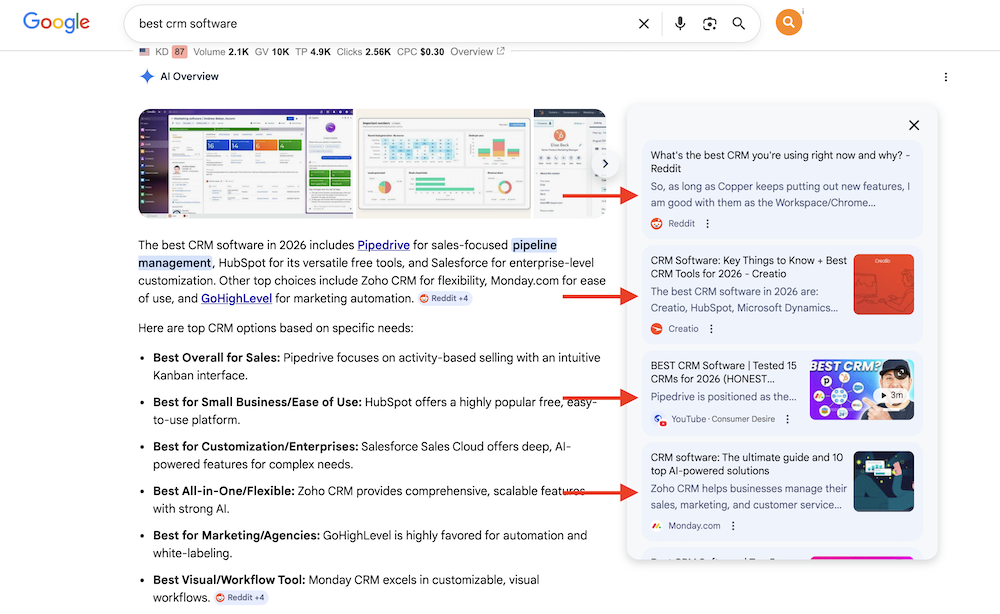
Google has made it clear that AI search features use information from a range of sources.
That matters because it shifts the goal.
You are no longer just trying to rank a page.
You are trying to become part of the web-wide evidence set for a topic.
Google's public guidance is useful here. Google Search Help says AI Overviews appear when its systems determine generative AI can be especially helpful for understanding information from a range of sources, while Google Search Central says there are no additional technical requirements beyond the normal eligibility requirements for appearing in Google Search.
That evidence can come from:
- Your own site
- Editorial articles
- Review platforms
- Forum discussions
- Professional networks
- Third-party comparisons
- Industry publications
This is why brands with modest traditional SEO strength can sometimes appear in AI answers.
They may not dominate the SERP with owned pages, but they are repeatedly mentioned by other sources that Google can retrieve.
AI Overviews blend traditional ranking systems with broader retrieval
This is not a clean replacement for SEO.
Google still uses core ranking systems.
Strong SEO still helps.
Structured pages still help.
Relevant content still helps.
But traditional SEO is now part of the qualification layer, not always the full selection layer.
That is an important distinction.
In many cases, SEO gets you into the pool.
External validation helps determine whether you get referenced.
That is why brands that focus only on on-site publishing often plateau.
They may improve rank positions without improving answer inclusion.
Mentions matter because they create corroboration
When a brand appears repeatedly across independent sources, Google has more confidence that the brand belongs in the answer set.
That does not mean every mention has equal value.
A random mention on an irrelevant site is weak.
A repeated mention in category roundups, peer discussions, and practitioner content is much stronger.
The real value is not the mention itself.
It is the agreement the mention represents.
If Reddit users, reviewers, niche blogs, and editorial writers all reference the same brand in similar contexts, that is a stronger retrieval pattern than a self-authored page alone.
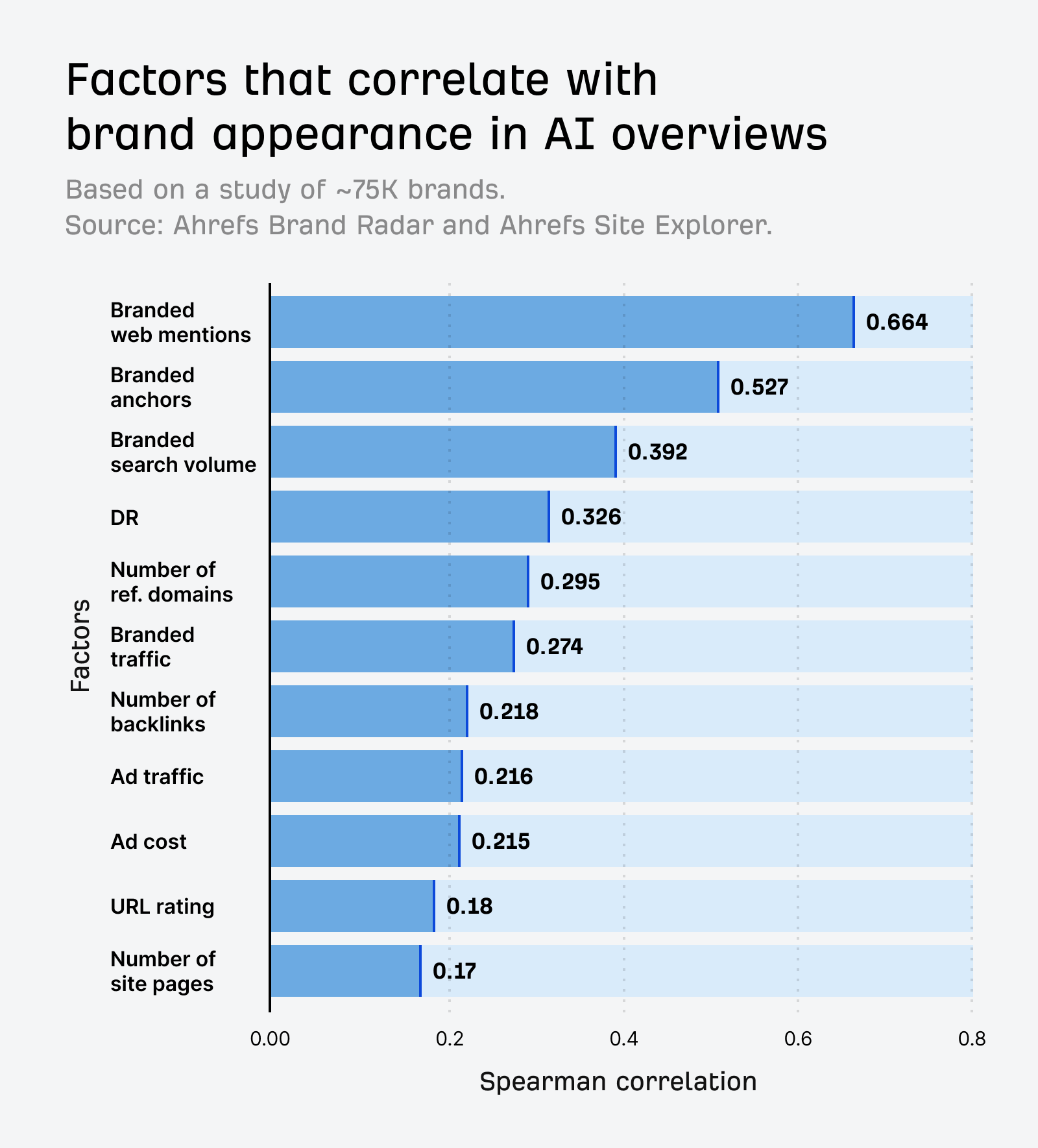
Several industry studies point in this direction. Ahrefs found that brand web mentions had a much stronger correlation with AI Overview brand visibility than backlinks, while AirOps reported that 85% of brand discovery mentions in AI search came from third-party sources.
Buyer-intent queries change the weighting of evidence
Buyer-intent queries are where the competitive gap becomes obvious.
When someone searches:
- Best email marketing platform
- Salesforce alternatives
- Best HR software for small businesses
- Best SEO tool for content teams
Google is trying to summarize options.
In those cases, third-party comparison and recommendation environments become much more important.
That is because Google needs evidence about who is worth considering.
Your homepage cannot do that job alone.
For decision-stage queries, the strongest inputs often come from pages and discussions that compare vendors, recommend tools, or reflect practitioner experience.
This is where external mention coverage becomes one of the biggest levers. Surfer's citation analysis and Semrush's cited-domain study both reinforce this broader pattern by showing how AI systems frequently pull from a blend of editorial, community, and professional platforms rather than a single source type.
Why rankings and backlinks alone do not guarantee AI visibility
This is the part many SEO teams need to hear.
Good SEO is still necessary.
It is just not sufficient.
You can rank well and still disappear from AI Overviews.
Ranking is not the same as being referenced
A high-ranking page can help Google understand your site.
It can also make your content more accessible for retrieval.
But being referenced in an AI answer is a separate outcome.
That outcome depends on whether Google sees enough evidence that your brand should be included in a synthesized response.
If the answer is trying to name the best tools, best vendors, top options, or strongest alternatives, Google is looking for a broader consensus than your own pages can provide.
Backlinks are useful, but they are not the whole story
Backlinks still matter because they support rankings, authority, discovery, and trust.
But AI answer visibility appears to rely on more than just classic link equity.
A plain brand mention on a trusted page can still matter.
A recommendation in a community thread can still matter.
A repeated mention on comparison pages can still matter.
This is why a pure link-building mindset can miss the point.
You do not just need links.
You need presence.
That is also why simple link acquisition and true brand visibility should not be treated as the same thing. If you want a deeper breakdown of the difference, our articles on brand mentions, brand monitoring, and SaaS reviews best practices are useful follow-ons here.
The question is not only, “Who links to us?”
It is also, “Where is our brand being discussed in the moments buyers are making choices?”
Ahrefs' analysis of AI Overview brand visibility found that web mentions outperformed backlinks by a wide margin as a correlational signal, which supports the broader idea that AI retrieval systems care about external corroboration, not just classic link equity.
Content volume can become a distraction
A lot of brands respond to weak AI visibility by publishing more.
More blog posts.
More glossary pages.
More top-of-funnel content.
More landing pages.
That can help traditional search coverage.
But it often does very little for AI Overviews if the underlying issue is lack of third-party validation.
Publishing 50 more articles on your own domain does not solve the fact that external sources are not mentioning you.
That is why some content programs look busy but produce limited AI visibility gains.
They are expanding owned inventory without improving off-site evidence.
What actually improves your chances of showing up
If the problem is weak corroboration, the solution is to build stronger evidence across the web.
That means thinking beyond your site.
1. Increase third-party mentions in the places buyers already look
This is the highest-leverage move for most brands.
You want your company to show up where category decisions are being shaped.
That usually includes:
- Reddit threads
- LinkedIn posts
- Software review sites
- Industry blogs
- Niche media publications
- Comparison pages
- Community roundups
- Partner ecosystems
The goal is not to manufacture noise.
The goal is to create relevant, repeated visibility in places that already influence buyer decisions.
Start by asking:
- Where do buyers compare tools in our category?
- Which platforms show up most often for our high-intent keywords?
- Which third-party pages already mention our competitors?
- Where are category conversations already happening without us?
That gives you a practical target list.
2. Prioritize mention quality and contextual relevance
Not every mention helps equally.
A generic press release on a weak site is not the same as a thoughtful inclusion in a respected comparison article.
The best mentions are:
- Relevant to your category
- Close to buyer-intent searches
- On sites Google already retrieves
- Written in language that clearly places you in a use case or category
- Surrounded by contextual detail, not just a brand name drop
This is why mention strategy should be selective.
You want high-signal placements, not vanity coverage.
3. Build presence on the platforms AI systems keep retrieving
Most brands know they should care about reviews and editorial placements.
Fewer think seriously about communities and professional networks.
That is a mistake.
If your category is discussed on Reddit, you need to understand what people there are saying.
If buyers rely on LinkedIn for recommendations, you need credible people talking about your product in that environment.
If review platforms shape perception in your market, your profile cannot be an afterthought.
This does not mean spamming every channel.
It means choosing the platforms that repeatedly appear for your category and investing in real coverage there.
Surfer highlights Reddit and LinkedIn as recurring source types in multiple verticals, while Semrush found Reddit and LinkedIn among the top cited domains across ChatGPT, Google's AI Mode, and Perplexity during its study period.
4. Strengthen your website as the homebase for retrieval
Off-site mentions matter more than many brands assume.
But your site still matters.
A lot.
Think of your website as the canonical homebase.
It should make it very easy for Google to understand:
- What your product is
- Who it is for
- What problems it solves
- Which category it belongs to
- How it differs from alternatives
- Which use cases and customer segments it serves
This is where clear messaging beats clever messaging.
Your site should not make Google guess.
Practical improvements include:
- Category language on core pages
- Consistent brand and product naming
- Strong use-case pages
- Clear comparison pages where relevant
- FAQ sections that answer real buyer questions
- Structured internal links between category, use case, and solution pages
- Reviews, testimonials, proof points, and case studies that reinforce positioning
Your site alone will not make you visible in AI Overviews.
But a weak site can absolutely make external signals harder to connect.
That is why fundamentals like schema for SaaS SEO, on-page SEO elements for SaaS websites, and even getting your homepage positioning right matter more than they first appear.
5. Create off-site assets that earn repeated retrieval
This is where many teams need a broader content strategy.
Not all valuable content belongs on your domain.
Some of the most useful AI visibility work happens through off-site assets such as:
- Guest contributions on industry sites
- Founder or team thought leadership on LinkedIn
- Expert quotes in editorial roundups
- Partner pages and integration pages
- Comparison contributions
- Review generation and profile improvement
- Community participation that creates useful public discussion
This is not just brand marketing.
It is retrieval engineering in public.
For most teams, that means combining content, mentions, reviews, digital PR, and distribution rather than treating them as separate channels. That is also why services like brand mentions, digital PR, and AI Overview optimizations increasingly overlap.
You are increasing the chances that Google can find and trust your brand in multiple environments.
A practical framework for improving AI Overview visibility
If you want something tactical, use this process.
Step 1: Audit where your brand appears today
Start by mapping your current evidence footprint.
Look at:
- AI answers for your most important commercial queries
- Third-party sites that mention you
- Third-party sites that mention competitors but not you
- Review platform coverage
- Reddit and LinkedIn visibility
- Category roundups and alternatives pages
You are trying to answer one question:
Where does the web already validate us, and where are we absent?
Step 2: Segment your target queries by buying stage
Do not treat all keywords the same.
If your team needs a process for that, start with a proper keyword research guide or a working LLM optimization checklist so the query set reflects both SEO and answer-engine visibility.
Group them into buckets like:
- Category discovery
- Comparison
- Alternatives
- Best-of queries
- Use-case queries
- Competitor queries
Your absence on a mid-funnel informational query is not as urgent as your absence on a shortlist query.
Focus where commercial impact is highest.
Step 3: Identify the repeated source types behind the answers
Look for patterns.
Are AI Overviews in your category repeatedly pulling from:
- Review sites?
- Editorial listicles?
- Reddit?
- LinkedIn?
- Product directories?
- Forum-style discussions?
This tells you which ecosystems matter most.
You do not need to guess.
You need to observe the retrieval pattern and build for it.
That is also the logic behind resources like our rank in AI Overviews guide and rank in ChatGPT guide, both of which are useful if you want to compare source patterns across platforms.
Step 4: Close the mention gap intentionally
Once you know where the gaps are, build a focused plan.
That might include:
- Outreach for category list inclusion
- Partner co-marketing
- Review acquisition
- Community engagement
- Founder-led content on LinkedIn
- Digital PR tied to category expertise
- Guest posts on niche sites with commercial relevance
This is where most brands should spend more time.
Not on publishing another 3,000 words on their own blog that no third-party source will reference.
Step 5: Re-measure AI visibility, not just SEO metrics
Track whether your brand starts showing up more often.
Useful metrics include:
- Brand mention rate in AI answers
- Share of presence across target query sets
- Position within answer outputs when relevant
- Number of third-party sources mentioning your brand
- Number of buyer-intent pages where you appear off-site
- Competitor comparison coverage
This gives you a clearer feedback loop than rankings alone.
BrightEdge reported that AI Overview citation overlap with organic rankings grew from 32% to 54%, which means rankings matter more than they did at launch, but they still do not explain the full picture.
Where to focus first if you have limited time
Most teams do not have the resources to do everything at once.
That is fine.
If you want the highest-priority moves, start here.
Fix your category clarity on-site
Make sure your homepage, product pages, and use-case pages clearly state what you do.
Avoid vague positioning.
Avoid clever headlines that hide the category.
Avoid fragmented messaging across pages.
Improve your review and comparison presence
If buyers rely on review platforms and comparison searches in your category, this is usually low-hanging leverage.
A thin profile or weak review footprint can limit trust.
Build a shortlist of third-party pages that mention competitors
Find where competing brands are being recommended and work backward.
Why are they there?
What angle got them included?
Who wrote the piece?
Can you contribute a better perspective or become relevant to future updates?
Invest in credible off-site voices
In many categories, brand visibility improves faster when practitioners, customers, partners, or respected operators mention you publicly.
Not every signal needs to come directly from your company account.
Stop treating volume as the main answer
If you are already publishing regularly, be careful not to confuse activity with progress.
More content is not automatically more evidence.
The shift marketers need to make
The biggest change here is mental.
You are not just optimizing pages anymore.
You are building public evidence.
That means your brand strategy, content strategy, PR, partnerships, SEO, reviews, and community presence all start to overlap.
This is why AI visibility can feel frustrating.
The lever is no longer isolated to one channel.
But it also creates an opportunity.
The brands that understand this earlier will build a stronger moat.
If your competitors are still focused only on rankings and backlinks, while you are systematically improving your corroboration across the web, you can become much easier for AI systems to retrieve and recommend.
That is the real game.
Additional resources
- Google Search Help: AI Overviews
- Google Search Central: AI features and your website
- Ahrefs: An Analysis of AI Overview Brand Visibility Factors
- AirOps: The Influence of Off-Site Signals in AI Search
- BrightEdge: AI Overview citations now 54% from organic rankings
- Surfer: AI Citation Report
- Semrush: The Most-Cited Domains in AI
Conclusion
If your brand is not showing up in Google AI Overviews, the problem is usually not that you need more pages on your own site.
The bigger problem is that Google does not see enough external evidence to include you with confidence.
Your site still matters.
SEO still matters.
Rankings still matter.
But AI answers are built differently.
They pull from a broader evidence set, especially for high-intent queries where buyers are comparing options.
That means visibility now depends on more than what you publish.
It depends on what the rest of the web says about you.
The brands that win here do two things well:
- They build clear, structured, retrieval-friendly pages on their own domain
- They build relevant third-party mentions in the places buyers already trust
If you are missing from AI answers, start there.
Audit your mention footprint.
Map the gaps.
Prioritize the sources that shape buying decisions.
Then build evidence on purpose.
If you want a faster starting point, pair this article with the brand mentions tracker and the LLM optimization checklist to turn the advice into an actual workflow.
Frequently Asked Questions
Why am I ranking in Google but not showing in AI Overviews?
Because ranking and answer inclusion are not the same thing. A ranked page can help Google understand your site, but AI Overviews often rely on broader corroboration across third-party sources before including a brand in a synthesized answer.
Do backlinks help you appear in Google AI Overviews?
Yes, but indirectly in many cases. Backlinks still support authority and rankings, which can improve visibility overall. They are just not the only input. Brand mentions, reviews, community discussion, and editorial coverage can also influence whether you get referenced.
What types of sites influence Google AI Overviews the most?
It depends on the category and query, but common source types include editorial publications, review platforms, Reddit, LinkedIn, niche blogs, directories, and product comparison pages. The key is not the label of the site. It is whether Google repeatedly retrieves it for buyer-intent searches.
How do I get my brand mentioned in AI answers?
Start by improving the evidence around your brand. Strengthen your category clarity on-site, then build third-party mentions where buyers compare options. Focus on relevant reviews, list inclusions, partner pages, thought leadership, community discussion, and editorial coverage.
Does publishing more blog content help with AI Overview visibility?
Sometimes, but only if the missing piece is on-site coverage or clarity. If your bigger issue is lack of third-party validation, publishing more on your own blog may do very little. More owned content is not the same as more external evidence.
Are Reddit and LinkedIn important for AI visibility?
In many categories, yes. They can be especially important when buyers use them for recommendations, comparisons, and practitioner opinions. If those platforms keep appearing in retrieval patterns for your target queries, they deserve real attention.
How should I measure AI Overview visibility?
Track whether your brand appears in AI answers for target commercial queries, how often competitors appear, which source types are cited, and where your mention footprint is weak. Rankings and traffic still matter, but they do not fully explain answer visibility.
What should I fix first if my brand is invisible in AI Overviews?
Start with three things: clarify your category and use cases on-site, audit your third-party mention footprint, and improve your presence on the external pages and platforms buyers actually use when comparing solutions.
.png)
Latest articles
What we've published in the past 30 days — across SEO, GEO, content, and digital PR.