.webp)





.webp)
GEO
Calculating...
Oct 2026
AI Reputation Management for B2B SaaS
AI reputation management is how B2B SaaS brands shape what ChatGPT, Perplexity and Google AI say about them. Here is the framework, the levers and the program.

AI reputation management is the practice of shaping what large language models like ChatGPT, Perplexity and Google AI say about your brand: whether they mention you, how they describe you, whether the facts are right, and whether they recommend you over rivals. For B2B SaaS, it is fast becoming the work that decides the shortlist.
What AI reputation management actually is
AI reputation management is the work of influencing how AI assistants represent your brand when a buyer asks them for help. It covers four things at once: whether you get mentioned, how you are described, whether the description is correct, and whether you get recommended against the competition.
A lot of teams conflate this with AI visibility, and the two are not the same. AI visibility asks a yes or no question: did the brand show up. Reputation asks the harder question that moves deals. When the brand showed up, what did the model say, and did that help or hurt?
A company can be highly visible and still lose. The model calls it the expensive option, or lists a feature it dropped two years ago, or frames a competitor as the safer pick. Presence got the brand into the answer. Reputation decided what that presence was worth.
Why this is a B2B SaaS problem specifically
B2B software buyers are researchers. They ask pointed questions: best tool for X, alternatives to Y, is Z good for enterprise. The answer is a short, confident paragraph that names a few vendors and characterizes each one.
That paragraph now does the job a first-page ranking used to do, except there is no blue link to click and no second page to scroll. If your brand is described badly there, you rarely learn why a deal went cold. The bad framing happened inside a chat window you never saw.
Across SaaS campaigns we keep seeing the same pattern. The brands that get recommended are not always the biggest. They are the ones the models can read clearly and cross-check against trusted third-party sources. That is a reputation outcome, and you can work on it.
What AI reputation management is not
It is not spin, and it is not gaming the model. You cannot bully ChatGPT into praising a product that reviewers dislike, and attempts to plant fake praise tend to get found out. The work is making the true, current, favourable facts about your brand easy for a model to find, verify and repeat. When the reality is good and the record is clear, the answer usually follows.
Why AI gets your brand wrong
AI gets your brand wrong because it assembles an answer from scattered, dated and often contradictory sources, then phrases it with total confidence. Four forces drive the errors, and knowing them tells you where to act.
The shift behind all of this is real and quick. Gartner predicts that traditional search engine volume will drop 25% by 2026 as people move queries to AI chatbots and virtual agents. On the demand side, OpenAI's Sam Altman said at the company's Dev Day in October 2025 that more than 800 million people use ChatGPT every week. Your buyers are already in these tools, asking about your category.
Training cutoffs and stale facts
Models learn from data up to a cutoff date, then answer as if the world stopped there. A pricing change, a rebrand, a new integration or a positioning shift can take months to filter through. The model fills the gap with whatever it last saw, which is how you end up described as the product you were two years ago.
Third-party sources carry more weight than your own site
When a model decides what your brand is for, it leans on what other sites say, not just your homepage. Review platforms, comparison pages, forum threads and press all feed the answer.
This is the heart of Link Building 2.0. The content that shapes AI answers is mostly content you do not own, so earning the right mentions is the job, not a nice-to-have.
Retrieval only reads a handful of pages
When an assistant searches the live web to answer, it pulls a small set of pages and writes from those. If the pages it happens to grab are a competitor comparison and an old review, that is your reputation for that answer. The fix is making sure the sources most likely to be retrieved are accurate and on message.
The answer changes every time you ask
This one surprises people. Rand Fishkin of SparkToro and Patrick O'Donnell of Gumshoe.ai had 600 volunteers run 12 identical prompts through ChatGPT, Claude and Google's AI, across 2,961 runs. The same brand list came back less than 1 in 100 times, and the same list in the same order less than 1 in 1,000 times.
So there is no fixed AI ranking to chase. There is a distribution of answers, and your job is to tilt it in your favour.
The four layers of AI reputation
Your AI reputation breaks into four layers, and they stack: presence, sentiment, accuracy, then recommendation. Most teams measure presence and stop, which is why they can see that they appear but cannot explain why they still lose.

Read the layers as a funnel. Presence is table stakes and gets you considered, while sentiment and accuracy decide whether that consideration survives the buyer's follow-up questions. Recommendation is the payoff, where the model actively puts you forward.
Work them in order. Fixing your framing is pointless if you are not in the answer at all, and winning the recommendation is impossible while the model still thinks your pricing is double what it is.
Mentions and citations both count
Two things happen in an AI answer: the model mentions brands, and sometimes it cites sources with a link. Both matter, for different reasons. A citation can send a click and lends a page authority, while a mention is what the buyer actually reads and remembers.
On a best-tool question, the mention is usually what tips the decision. So chase both, and weight the mention on the bottom-funnel questions where buyers are close to choosing.
Each layer gets its own deep guide in this hub. We cover framing in AI brand sentiment, correcting errors in how to fix wrong AI answers, and the competitive pick in why AI recommends your competitors.
How to audit where you stand today
Start with an audit, because you cannot manage a reputation you have not measured. The method is simple to run, and the output is a baseline you can act on this week.
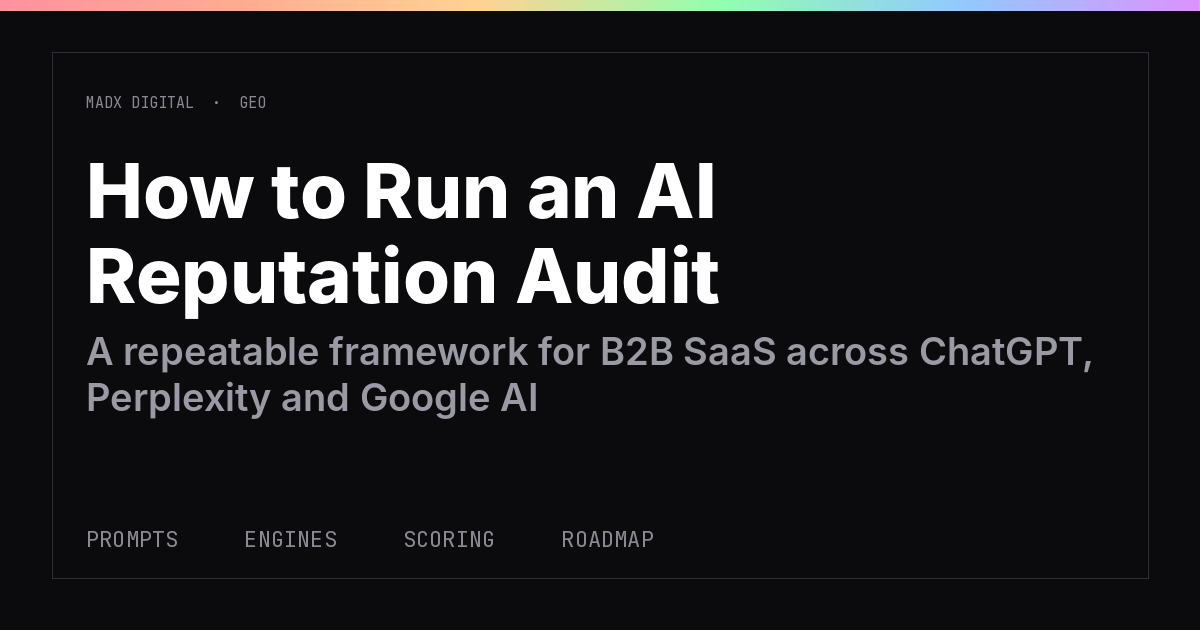
Build a set of real buyer prompts, run each one several times across ChatGPT, Perplexity and Google AI, and score what comes back on all four layers. Because answers vary, sample each prompt enough times to see the pattern rather than a single outcome. We walk through the full method, including a scorecard, in the guide to running an AI reputation audit.
Two habits make the audit useful. Write prompts the way buyers type them, not the way you describe yourself. And keep the raw answers, because the exact wording tells you whether the problem is presence, framing or a plain factual error.
A good audit answers three questions quickly: which buyer prompts you lose and to whom, where the model is simply wrong about you, and which competitor keeps getting named as the safe choice. Those three findings usually point at the same two or three fixes. That is what turns a scary spreadsheet into a short, fundable plan your leadership will actually back.
Once you have a baseline, set up ongoing AI brand monitoring so you catch changes as they happen instead of stumbling on them during a lost deal review.
The levers that shape what AI says
The levers that move your AI reputation sit mostly off your own website, which is why this is hard and why it rewards teams that do the work. Here is where effort pays off.

Content optimization does measurably move results. The research paper that introduced the term generative engine optimization, or GEO, found that GEO methods can boost a source's visibility by up to 40% in generative engine responses. Clear structure, cited claims and plain statements of fact all help a model read and reuse you correctly.
Earned mentions in the content models trust
Models cross-check brands against third-party sources, so the single most effective move is earning accurate mentions in the buyer guides, comparison pages and best-of lists that cover your category. This is the practical core of getting recommended by AI, and it is why MADX frames link building around placement, not volume.
Consistent, machine-readable brand facts
Models reward consistency. When your category, pricing model, core features and ideal customer are stated the same way across your site, your profiles and third-party pages, the model has an easy, low-risk answer to give.
When those facts conflict, it hedges or guesses. Structured data, a clear about page and an llms.txt file all help you state the facts plainly and in one voice.
Reviews and community signals
G2, Reddit and similar sources show up constantly in AI answers because they read as independent. A steady flow of recent, specific reviews gives the model current, positive, verifiable material to draw on. Thin or dated review profiles leave it reaching for whatever else it can find, which is often a competitor's narrative.
Digital PR and earned media
Press coverage and expert commentary do double duty. They build the authority models associate with a category, and they create fresh, datelined pages that retrieval tends to favour. A single strong feature in a publication your buyers respect can outweigh a dozen low-quality mentions, both for people and for the models reading on their behalf.
Your owned pages still do work
Off-site levers matter most, but your own site is the reference the model checks against. Clear product pages, a current pricing page, an about page that states your category plainly, and comparison pages that fairly explain where you fit all give the model a trustworthy anchor.
When a third-party claim and your own site agree, the model gains confidence and repeats the claim. When they disagree, you have handed it a reason to hedge, or worse, to trust the other source. Keeping your owned facts tidy is the cheapest reputation work you can do, and it is entirely in your control.
Building an AI reputation program
Treat AI reputation as a standing program, not a one-off project, because the inputs keep moving and so does the output. A workable program has an owner, a cadence, and a short loop from measurement to action.

Give it an owner and a cadence
Put the program with whoever owns organic growth or demand, and run it monthly. Audit the four layers, pick the two or three fixes with the most to gain, ship them, then watch the distribution move over the following weeks.
Pair it with your wider AI share of voice and brand mentions tracking, so reputation sits next to presence rather than in a separate report nobody opens.
Measure distributions, not vanity ranks
Be skeptical of any tool that sells you a single AI ranking. Given how much answers vary, a tidy number hides more than it shows. Fishkin put it bluntly in the same research.
Track four things over time: the share of answers where you appear, the share where the framing is on message, the rate of factual errors, and your recommendation share against named rivals. Those move with real work, and they map straight back to pipeline.
What to report upward
Leaders do not need a dashboard of raw prompts. They need to know whether the brand is winning or losing the AI answer for the questions that precede a purchase, and whether that is trending the right way. Report the four measures as trends, tie them to named competitors, and flag the one fix you are making next.
Where to start this quarter
If you do one thing, audit your category prompts and fix the biggest factual error you find. If you do three, add a push for recent reviews and a placement effort in the comparison content buyers trust.
Either way, the brands that win the AI answer are not waiting for the models to get them right on their own. They are doing the unglamorous work of fixing facts, earning mentions and checking the result, month after month. When you want a partner for that heavy lifting, this is the work our B2B SaaS SEO and AI search team does every day, and a sensible first step is a free AI search audit.
Frequently Asked Questions
What is AI reputation management?
It is the practice of shaping how AI assistants like ChatGPT, Perplexity and Google AI present your brand across four layers: whether they mention you, how they describe you, whether the facts are right, and whether they recommend you. For B2B SaaS it increasingly decides which vendors make a buyer's shortlist.
Is AI reputation management different from GEO or AI visibility?
Yes. GEO and AI visibility focus on getting you to appear in AI answers. Reputation management focuses on what the answer says once you appear: the framing, the accuracy, and whether you beat rivals. Visibility is the door, reputation is what happens in the room.
Can you actually change what ChatGPT says about your brand?
Often, yes, though not instantly. You influence it by fixing the sources models read: your own site facts, structured data, third-party reviews, and the comparison content that covers your category. Changes tend to show up over weeks as models and their retrieval sources refresh, not overnight.
How do you measure AI reputation if the answers keep changing?
You sample. Run each buyer prompt several times across the main engines and measure the distribution: how often you appear, how often the framing is on message, how often the facts are right, and how often you are recommended. One screenshot proves nothing, but a pattern across many runs is reliable enough to act on.
Who should own AI reputation in a B2B SaaS company?
Usually whoever owns organic growth, SEO or demand generation, because the levers overlap with content, PR and reviews. It works best as a named monthly responsibility rather than something everyone assumes someone else is watching.
How often should we audit our AI reputation?
Monthly is a sensible default for an active B2B SaaS brand, with a fuller review each quarter. Audit more often around a launch, a rebrand or a pricing change, since those are exactly the moments AI answers go stale and competitors can define you.
Want this done for your brand? Get a free AI visibility audit.
Get my free AI visibility audit.png)
Latest articles
What we've published in the past 30 days — across SEO, GEO, content, and digital PR.