.webp)





.webp)
Content
Calculating...
Aug 2026
Pillar Pages: What They Are and How to Build One That Gets Cited
Pillar pages anchor a topic cluster and feed AI answers. Learn the anatomy, the build steps and the mistakes that stop pillars ranking or being cited.
.png)

A pillar page is a comprehensive page that covers an entire topic at a strategic level and links out to a cluster of focused articles covering each subtopic in depth. It anchors the cluster: every supporting article points back to it, and it points down to every supporting article.
Done well, a pillar ranks for the category's head terms and becomes the page AI assistants lift answers from. Done badly, it's a 6,000-word wall that nobody, human or machine, gets anything out of.
We've built pillar pages for dozens of B2B SaaS categories, including the topical authority pillar this article supports. This guide covers the anatomy that works in 2026, the build process, real examples, and the failure modes we keep rescuing.
What a pillar page is (and isn't)
A pillar page is the hub of a topic cluster: broad where cluster articles are deep, strategic where they're tactical. Its job is to frame the whole subject, answer the questions a newcomer brings, and route readers and link equity to the focused pages.
Pillar vs cluster article vs landing page
The three page types get confused constantly, and the confusion produces pages that do no job well. The split is simple: pillars explain a topic, cluster articles answer a question, landing pages sell a product.
A fourth type sits outside that trio: programmatic pages, generated at scale from a data set, which we cover in our guide to programmatic SEO for B2B SaaS.
Why pillars matter more in AI search
Assistants answer broad questions by synthesising several sources, and a pillar is your bid to be the framing source, the one that defines the terms and the structure of the answer. Broad prompts also fan out into sub-queries, and the pillar's job is to catch the framing sub-query while your cluster articles catch the specific ones. No pillar, no anchor for either.
There's a second, quieter benefit. The pillar is where your brand states its definition of the category in clean, quotable language. When a model synthesises an answer about your topic, the framing source shapes the vocabulary of the whole response. Brands that own the framing get described in their own terms; everyone else gets described in someone else's.
Pillar anatomy for the AI era
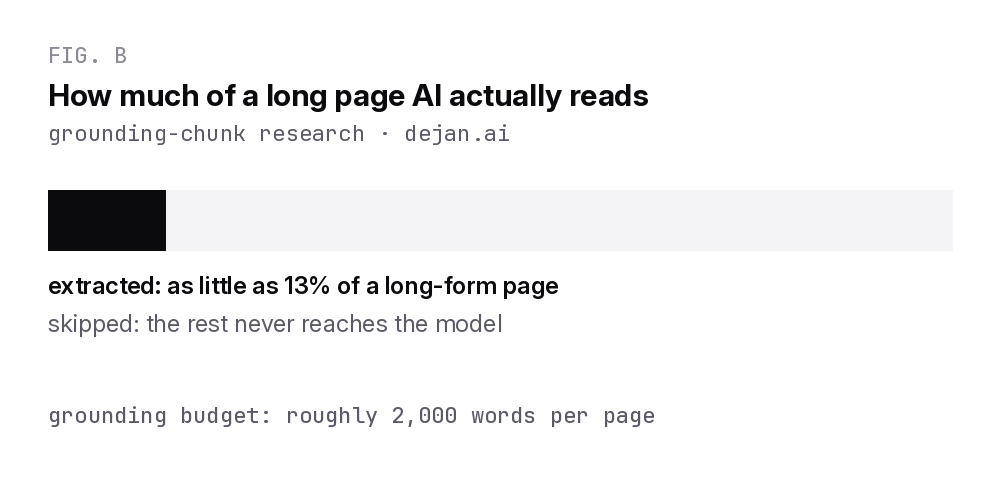
The biggest change to pillar design in the last 2 years is invisible to readers: machines stopped reading whole pages. Google's AI systems work to a grounding budget of roughly 2,000 words, extracting as little as 13% of a long page, per Dan Petrovic's research at Dejan. Your pillar will be sampled, not read, so every section has to survive being lifted alone.
Front-load every answer
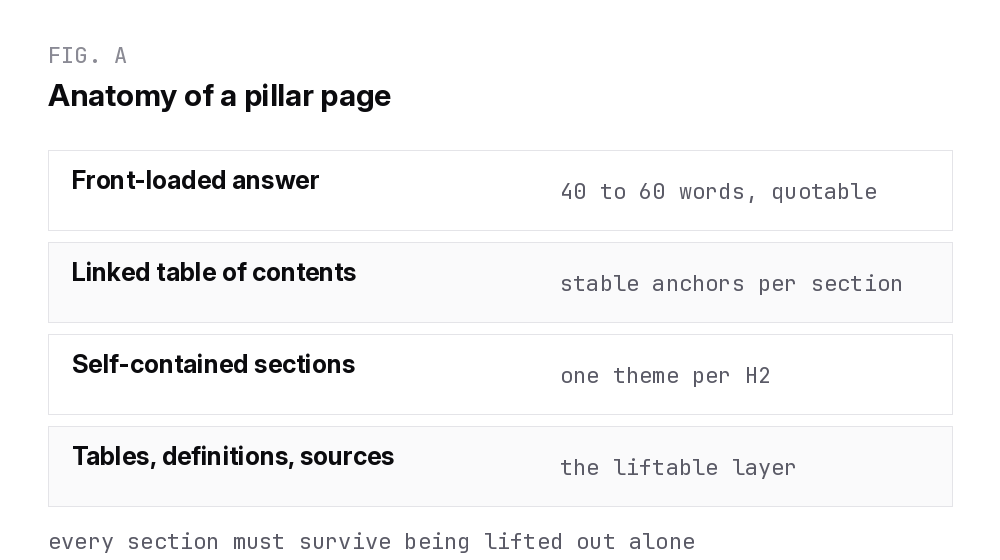
Open the page with a 40 to 60 word definition-first answer to the head query, then open every section with a sentence that could stand as the answer to that section's question. A reader skimming gets the shape of the topic in 30 seconds. A model sampling your page gets a complete, quotable passage wherever it lands.
Chunk the structure
Use one H2 per major theme, H3s for the distinct points inside it, a linked table of contents with stable anchors, and short paragraphs. Never let one section depend on another to make sense. This is the same discipline our semantic SEO guide describes at the passage level: machines evaluate chunks, so write in chunks.
Phrase the headings as the questions people actually search. "How long should a pillar page be" beats "Length considerations" because it matches the query a model is trying to ground, and it matches the way a reader scans. Keep the answer in the first sentence under each heading and the section becomes a self-contained unit that works wherever it's quoted.
Give machines something liftable
Every pillar should carry at least one comparison table, one formal definition, and named data with linked sources. Those elements get extracted into AI answers far more reliably than flowing prose, and they're also what earns the citation. Our guide to content formats for AI search covers which structures get lifted most.
How to build one, step by step
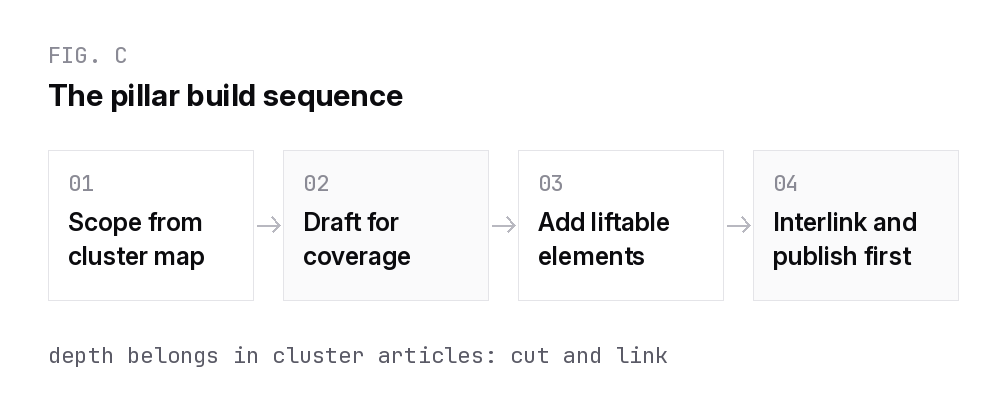
A pillar is scoped from the cluster map, drafted section by section, and finished with links. The order matters, because a pillar written before the map exists always overlaps with the cluster articles that follow it.
Scope from the cluster map
List the subtopics your cluster will cover, then give the pillar one section per subtopic: enough to frame it and hand off to the dedicated article. What the pillar owns outright is the material no cluster article covers, the definitions, the category context, the how-it-fits-together layer. If a section starts going deep, that depth belongs in a cluster article, so cut and link.
Draft for coverage, not length
Target the shorter of two limits: full coverage of the map, or about 3,500 words. Length past coverage is dilution, and it spends your grounding budget on repetition. Study the top 3 ranking pages for the head term, list every subtopic they cover, cover them better, and add the angle they miss. That last part is where experience shows, and it's what separates a pillar from a summary of other pillars.
Finish with the links
The pillar links down to every cluster article with descriptive anchors, and every cluster article links back. Add the money-page link where it's natural, and external links to every named source. Then publish the pillar first, before the cluster articles if you're sequencing, so the hub exists the day each spoke arrives.
Ship the supporting layer with it
Before publishing, finish the parts that don't feel like writing. A meta title under 60 characters with the head term near the front, a meta description that earns the click, and Article schema with a real author. Add alt text on every diagram and compress the images hard, since a slow pillar undermines the exact page you most need crawled and cited often.
Then request indexing in Search Console the day it ships. Pillars are the pages you least want sitting undiscovered for a fortnight, because the entire cluster's internal linking depends on the hub being in the index first.
What good looks like for B2B SaaS
The pattern behind strong SaaS pillars is consistent across categories: a definition-first opening, a visible structure a buyer can navigate, tables that do the comparing, and honest routing to deeper pages. Here's how that plays out in practice.
The category education pillar
The commonest SaaS pillar frames an emerging category, the way our own topical authority guide frames this cluster's category. These pillars win when the category is young and the head term's SERP is still settling. They compound because every new cluster article adds another spoke to an established hub.
The process pillar
Process pillars own a workflow, a complete guide to SaaS onboarding or B2B keyword research, with each stage handed off to a detailed article. They earn citations because assistants love numbered stages with clear openings. The trap is letting stage summaries balloon until the cluster articles have nothing left to say.
The comparison pillar
Comparison pillars frame an evaluation: how to choose a category of software, what to weigh, and how the main options differ at a structural level. They're the most commercially valuable type because they sit closest to a buying decision, and their tables are exactly what assistants lift into recommendation answers. Keep the vendor-by-vendor detail in cluster pages so the pillar stays evergreen while products change.
Mistakes and maintenance
Most pillar failures are decided before drafting starts or a year after publishing ends. The middle part, the writing, is rarely what kills them.
The mistakes that decide it early
Targeting a head term nobody searches, usually internal jargon for a category real buyers name differently. Burying the answer under a long warm-up intro. Writing the pillar with no cluster planned, which produces a long post with nothing to anchor. And duplicating a cluster article's depth inside the pillar, so the two pages cannibalise each other on the exact SERP you planned them for.
One more that surprises teams: skipping the SERP check. If the head term's results are product pages and directories, searchers want vendors, not education, and no pillar will beat that intent. We dropped a planned node from our own hub for exactly this reason. The SERP told us the keyword belonged to a different page type, so we swapped the node rather than argue with the data.
Measure the pillar's real job
Judge a pillar by cluster outcomes, not just its own ranking. Watch the head term's position, the pillar's assisted conversions, how many cluster pages it feeds traffic to, and whether the topic's AI answers start citing any page in the hub. A pillar that ranks fifth while lifting six cluster pages is succeeding. One that ranks second for a term nobody converts from is decoration.
Maintenance is the moat
Pillars age at the speed of their category. Stats go stale, screenshots drift, and the SERP evolves with AI Overviews now on roughly 16% to 25% of US queries per Semrush. We revisit every pillar quarterly: refresh the numbers, check every link still resolves, and add sections when the category grows new questions. A maintained pillar defends its seat, and the seats are worth defending, since category owners hold first place in 90.4% of month-over-month checks in ChatGPT.
The wider shift matters here too. Mike King's argument for reframing the whole discipline applies to no page type more than pillars, because they're where relevance gets engineered or lost.
If your topic needs a pillar and you'd rather not build it alone, our SaaS SEO agency plans and writes cluster hubs for B2B SaaS brands, with the content approach detailed in our B2B SaaS content marketing guide. Or run our free AI SEO audit first to see whether your existing pages already cover the map.
Frequently Asked Questions
How long should a pillar page be?
Most pillar pages land between 2,500 and 3,500 words. The real target is complete coverage of the topic's subtopics, not a word count. If coverage takes 2,600 words, stop there, because padding past coverage dilutes the page for both readers and the AI systems that sample it in small chunks.
What's the difference between a pillar page and a blog post?
A blog post answers one question or covers one angle. A pillar page covers a whole topic at a strategic level and links down to the focused posts that go deep on each subtopic. The pillar also carries the topic's head keyword, while posts carry the long-tail terms.
Do pillar pages still work with AI search and ChatGPT?
Yes, when they're structured for extraction. Assistants sample pages in chunks of a limited grounding budget, so pillars with front-loaded answers, self-contained sections, tables and formal definitions get lifted into answers. Long unstructured pillars mostly get skipped.
Should a pillar page target a high-volume keyword?
It should target the topic's genuine head term, which is usually the highest-volume phrase real buyers use for the category. Check the term's SERP first: if it's dominated by product pages rather than guides, the buying intent is transactional and a guide-style pillar will struggle there.
How many cluster articles does a pillar page need?
Enough to cover every major subtopic in depth, typically 5 to 15. A pillar with fewer than 3 supporting articles is underpowered because there's little structure to anchor. Publish the pillar first, then add cluster articles in priority order, linking each one to the pillar on the day it goes live.
How often should you update a pillar page?
Review quarterly and refresh at least twice a year. Update stats and examples, check that every internal and external link resolves, and add sections when the category develops new questions. Freshness matters more for pillars than for most pages because they compete on the topic's most visible SERP.
.png)
Latest articles
What we've published in the past 30 days — across SEO, GEO, content, and digital PR.