.webp)





.webp)
SEO
Calculating...
Oct 2026
Programmatic SEO Examples: 6 B2B SaaS Teardowns
The best programmatic SEO examples, from Zapier to Wise and Canva, plus what a B2B SaaS team can copy and which pages are decaying in 2026.
The best programmatic SEO examples share one trait: every page is backed by data or a tool a searcher cannot get from a summary. Zapier, Wise, and Canva each built millions of monthly visits this way, and the pages decaying in 2026 are the thin ones without that moat.
This teardown sits under our pillar on programmatic SEO for B2B SaaS. We are not here to admire logos. Each example below breaks down the pattern, the data behind it, and what a lean SaaS team can actually copy.
One caveat before we start. The traffic figures come from public case studies and third-party tools, not from company dashboards, so treat them as directional. The lessons hold regardless of the exact numbers.
What makes an example worth copying
A programmatic example is worth copying when its pages serve a real, repeated search with data the site actually owns. The logo does not matter. The pattern and the moat behind it do.
Look for the data moat, not the page count
Every strong example in this article rests on a data set that is hard to copy, live rates, a review corpus, a template library, an integration catalogue. That is the moat. When you study an example, find the moat first, because the page count is just the output of it.
This is also the fastest way to tell a good example from a cautionary one. Plenty of sites shipped huge programmatic sets on thin, spun data and lost most of it in the 2026 core updates. The survivors all had a moat. So when someone shows you a screenshot of a million indexed pages, the useful question is not how many pages, it is what data sits behind them.
Here is the field at a glance before we go one by one. Notice how the moat and the AI Overview exposure move together.
Zapier: integration pages at scale
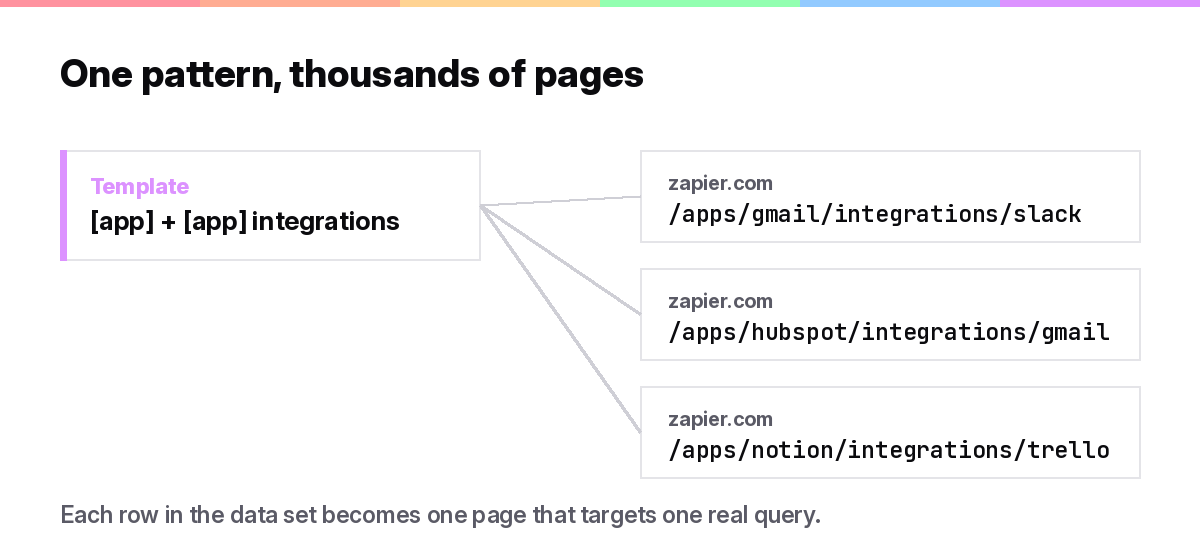
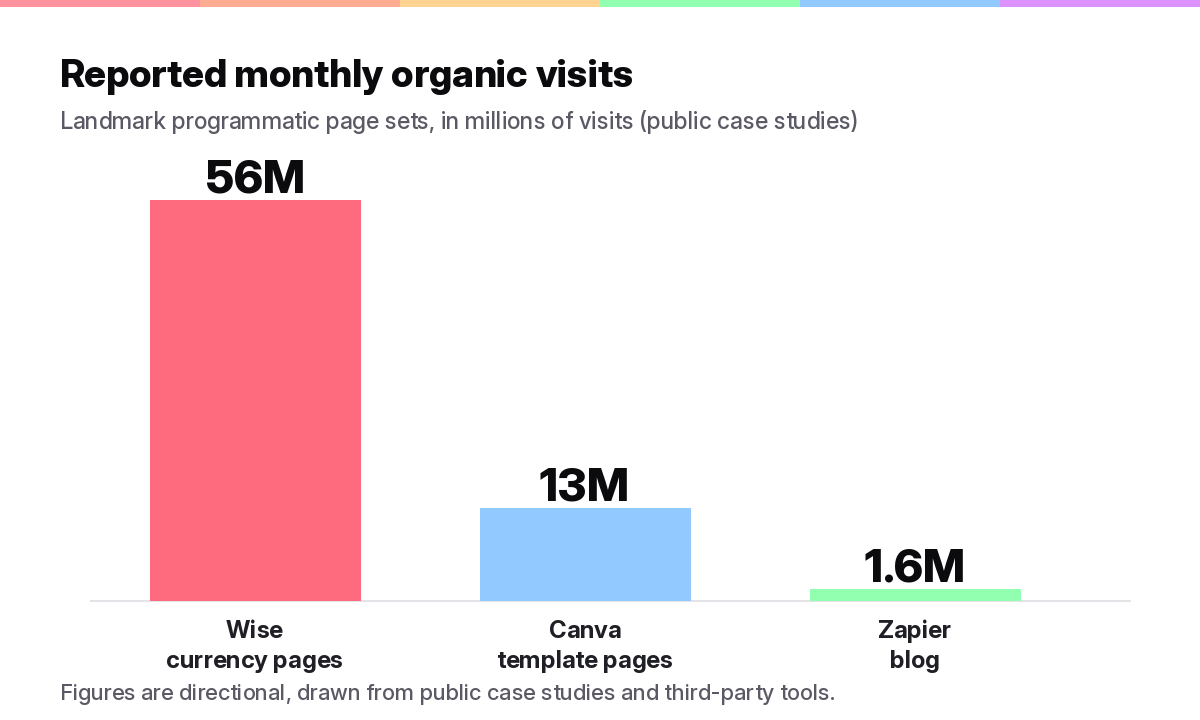
Zapier is the canonical programmatic SEO example: it turned its integration catalogue into tens of thousands of landing pages that capture other brands' demand. Its blog alone pulls 1.6 million organic visits a month, about 67.5 percent of its organic traffic, and the programmatic integration pages add roughly another 16 percent.
The pattern: capture other brands' demand
Zapier does not rank for "automation platform", which barely gets searched. It ranks for "google sheets integrations" and thousands of pairs like it, demand created by other people's products. Each page targets one real query with the specific triggers and actions for that pair.
Why it works, and where it stops
The first page in an integration chain earns real traffic, while the deepest three-way combinations earn none. That is the shape of every large programmatic set: a handful of pages carry it, and a long tail sits quiet. Zapier accepts that trade because the winners more than pay for the rest.
The pages also feed the rest of the site. Each integration page links to product pages and to related content, so the demand Zapier captures from other brands flows toward its own signups. The programmatic set is not a dead end, it is the top of a funnel, and the internal links are what turn traffic into pipeline. Our guide to keyword research for programmatic SEO covers how to find patterns like this one.
Wise: live data as the moat
Wise built currency pages on live exchange rates, and that live data is exactly what an AI summary cannot copy. Case studies put its currency-converter pages at tens of millions of monthly visits, a large share of the company's organic traffic.
The moat: data that changes every second
A "convert USD to EUR" page is useful only if the rate is current. Wise pairs the rate with a calculator, historical charts, and a clear path to actually send money. A static definition would be answered in the results, but a live tool needs the click, which is why these pages hold up as AI Overviews spread.
What SaaS teams can borrow
You do not need foreign exchange data to copy the idea. Any product sitting on data that updates, usage benchmarks, pricing, availability, live status, can build the same kind of page. The lesson is to anchor the set on something dynamic, so the page stays worth visiting.
Wise also shows the value of going wide across languages. It builds the same currency pattern in many countries and languages, which multiplies one template into a global set. For a SaaS brand with international demand, that is a reminder that the pattern travels, as long as the underlying data is localised rather than machine-translated boilerplate.
Canva and G2: templates and review data
Canva and G2 show two more moats: a template library and a review corpus. Both turn assets the company already owns into pages that answer a specific, repeated search.
Canva: a template library that prints traffic
Canva's roughly 21,000 template pages reportedly draw over 13 million organic visits a month, with millions more coming from its create and features pages. Each template page gives the searcher the actual template, not a description of one. The value is the asset itself, so the click is unavoidable.
The structure is worth copying even at a smaller scale. Canva groups templates into tight clusters, links them to one another, and connects them back to the product, the same hub-and-spoke shape we recommend in our guide to topic clusters. A template or asset library is one of the cleanest programmatic patterns a SaaS product with any kind of resource can run.
G2: reviews as the data layer
G2's "[product] alternatives" and comparison pages are powered by verified user reviews, a data set almost no competitor can rebuild. Kevin Indig, who led SEO at G2 and Shopify, has shown how far this kind of user-generated data can scale. For a SaaS brand, the takeaway is that structured customer input can become a programmatic moat.
Most SaaS products already collect a version of this without realising it. Support tickets, onboarding answers, in-app survey responses, and usage patterns are all structured data that, aggregated carefully and stripped of anything private, can seed genuinely useful pages. The trick is to treat that internal data as a content asset, not just an operational one.
Smaller wins, and what is decaying in 2026
You do not need Zapier's scale to win with programmatic SEO, and you do need to know which pages are losing ground. Smaller SaaS teams post real results, while thin informational pages are quietly decaying.
Smaller SaaS results
The tactic scales down. Published case studies report a SaaS brand growing from 67 to over 2,100 monthly signups in ten months, and others citing a 3x lift in organic traffic with a lower cost of acquisition. The common thread is a narrow pattern with genuine data, not a huge page count.
Smaller sets have an advantage the giants do not: they are easy to keep clean. A team running 300 pages can review every one, keep the data current, and prune ruthlessly, which is harder across a million pages. If you are starting out, that control is worth more than raw scale, and it pairs naturally with a strong SaaS SEO foundation.
What is decaying in 2026
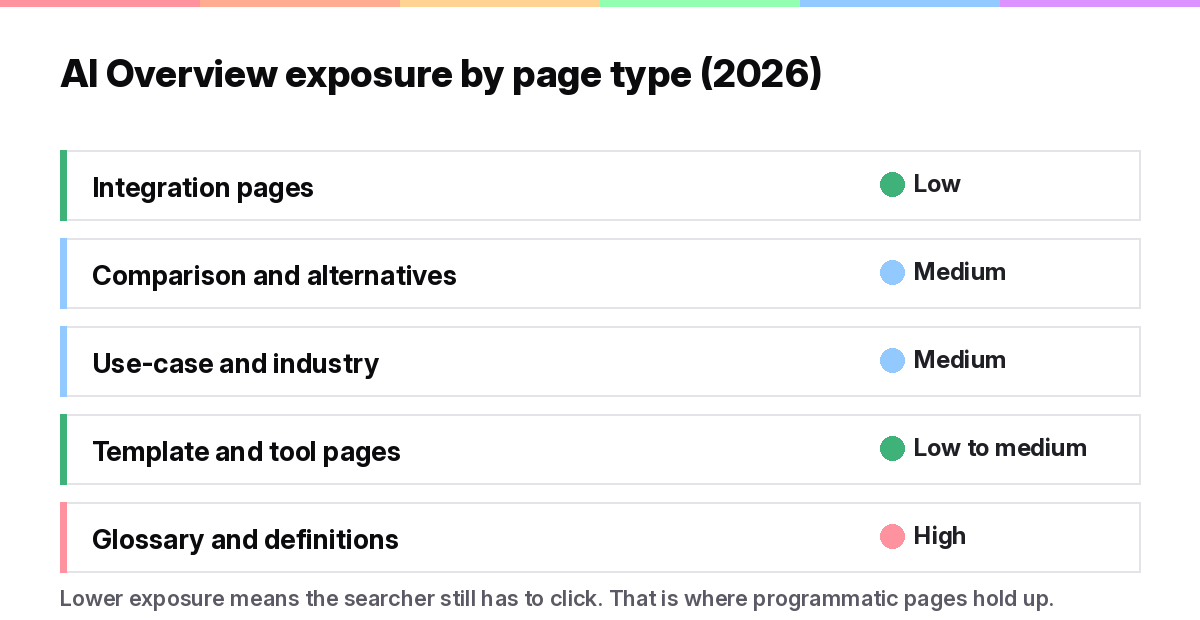
The pages losing traffic are the thin, definition-style ones. AI Overviews now cut the top result's clicks by 58 percent when they appear, and glossary or "what is [x]" pages are the most exposed because a summary answers them outright. Integration, comparison, and tool pages hold up because they still need the click.
That is why the examples in this article age well. Zapier's integration setups, Wise's live calculators, and Canva's downloadable templates all deliver something a text summary cannot. If your programmatic idea can be fully answered in three sentences, it is exposed. If it hands the reader a tool, an asset, or live data, it is far safer as AI search keeps growing.
The verdict
Copy the moat, not the page count. Every example here works because a real data set or tool sits behind the template, and that is the part worth stealing rather than the size of the set. Pick the example whose moat looks most like your own product, then borrow the pattern, not the scale.
If you want the full method, start with our step-by-step build, or let our free AI SEO audit show you where your own data could become a page set. For the ranking-versus-cited side, see programmatic SEO in the AI search era.
Frequently asked questions
What is the best example of programmatic SEO?
Zapier is the most cited example. It turned its integration catalogue into tens of thousands of "[app] integrations" pages that capture demand from other brands, and those pages drive a large share of its organic traffic. Wise and Canva are close behind.
What do the best programmatic SEO examples have in common?
Each one is built on a data set the company owns and competitors cannot easily copy, such as live exchange rates, verified reviews, or a template library. The moat is the reason the pages rank and keep their traffic, not the number of pages.
Can a small SaaS company copy these examples?
Yes. Published case studies show smaller SaaS teams growing signups and organic traffic several times over with narrow programmatic sets. You do not need millions of pages, you need one real pattern backed by data you can stand behind.
Which programmatic pages are losing traffic in 2026?
Thin, definition-style pages are decaying because AI Overviews answer those queries directly and take the click. Integration, comparison, calculator, and template pages hold up better, since the searcher still has to click through to get the value.
How much traffic can programmatic SEO realistically drive?
It ranges widely. Landmark sets like Wise and Canva report tens of millions of monthly visits, while a focused SaaS set might drive a few thousand high-intent sessions a month. The ceiling depends on how much real demand your pattern has.
Want this done for your brand? Get a free AI visibility audit.
Get my free AI visibility audit.png)
Latest articles
What we've published in the past 30 days — across SEO, GEO, content, and digital PR.