.webp)





.webp)
GEO
Calculating...
Aug 2026
Programmatic SEO in the AI Search Era: Does It Still Work?
Is programmatic SEO dead in 2026? No, but the thin version is. How AI Overviews and Google's crackdown reshaped it, and how to get pages cited.

Programmatic SEO is not dead in 2026, but the low-value version is. Google's March 2026 enforcement of its scaled content abuse policy and the spread of AI Overviews punished thin templated pages, while pages with real data or utility kept ranking and started earning AI citations.
This is the node in our programmatic SEO pillar where the tactic meets AI search head on. If you have read the scary headlines, this is the practitioner read on what actually changed and what to do about it.
Both things are true at once: a lot of programmatic pages lost traffic this year, and programmatic SEO still works when it is done well. The rest of this piece separates the two.
What the March 2026 update actually changed
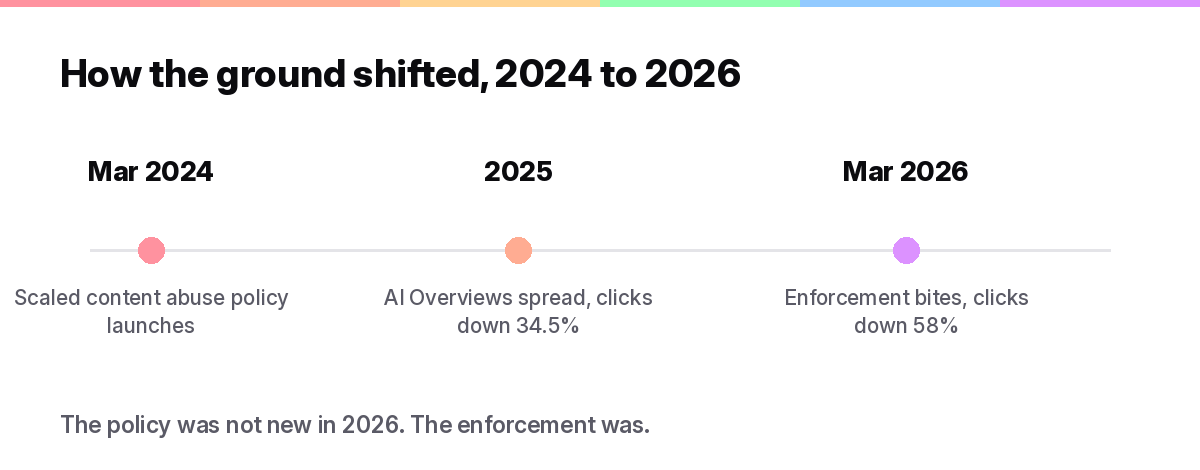
The March 2026 core update made Google's scaled content abuse policy a primary enforcement target, and thin templated sites paid for it. The policy itself is not new, but the enforcement was sharper than anything before it.
Scaled content abuse, enforced
Google's scaled content abuse policy has applied since March 2024, and it does not care whether pages were made by AI, a template, or by hand. What it targets is many pages made mainly to game rankings with little value. In March 2026, sites built that way saw traffic fall off a cliff, with many losing 50 to 80 percent of their organic clicks in two weeks.
Who got hit, and who did not
The sites that fell were the ones running near-duplicate pages on spun or scraped data. The sites that held were the ones where each page carried something real, live data, a working tool, verified comparisons. That split is the whole story, and it is the same line we draw in our pillar: real data or real utility, or nothing.
What made 2026 feel brutal was the speed. Sites that had spent two years quietly accumulating rankings lost them in a fortnight, with no warning in Search Console beyond the traffic graph itself. If you run a programmatic set, the lesson is to audit for thinness before an update forces the issue, not after.
How AI Overviews eat the long tail
AI Overviews answer many queries directly in the results, and they take the click with them. That hits programmatic SEO hardest, because the long-tail queries pSEO targets are exactly the ones AI answers.
The click data
Ahrefs analysed 300,000 keywords and found an AI Overview cut the top result's clickthrough rate by 34.5 percent in 2025, a figure its 2026 re-run pushed to 58 percent. Pew Research found people click a traditional result in only 8 percent of visits where an AI summary shows. The long tail is where those summaries appear most.
Which archetypes are exposed
Exposure is not even across page types. Definition and simple-fact pages are answered outright, while pages that require a click hold up. Here is how the common programmatic archetypes sit, and what to do about each.
The pattern in that table is the same one from our examples teardown: exposure tracks how much of the answer a summary can give away. The more a page hands over a tool, live data, or a decision the reader still has to make, the safer it is. Use the table to triage an existing set, not just to plan a new one.
Is programmatic SEO dead? Both sides
The honest answer is no, but the question deserves both sides. There is a real case that programmatic SEO is finished, and a stronger case that it just changed shape.
The case that it is dead
If your model was to publish thousands of thin pages and harvest long-tail clicks, that model is broken. AI Overviews take those clicks, and Google penalises the pages. For low-effort programmatic SEO, the obituary is fair.
The case that it just changed
Google frames AI Overviews as good for publishers, and the data disputes that for thin pages. But pages with genuine utility still rank, still get clicked, and now also get cited inside AI answers. The surface expanded, it did not close, and there is more to play for, not less.
Our verdict
Programmatic SEO is not dead, it is polarised. Thin sets are dying faster than ever, and strong sets are compounding, because they now win in classic search and in AI answers at the same time. The gap between the two has never been wider, which is exactly why the quality bar in our build guide matters more than it used to.
Notice that both quotes can be right. Google is correct that citations inside AI answers have value, and the click data is correct that thin pages lose. The reconciliation is that value now flows to pages good enough to be quoted, and away from pages that only ever existed to catch a stray long-tail click. That is not the death of the tactic, it is a sorting.
Building programmatic pages that get cited
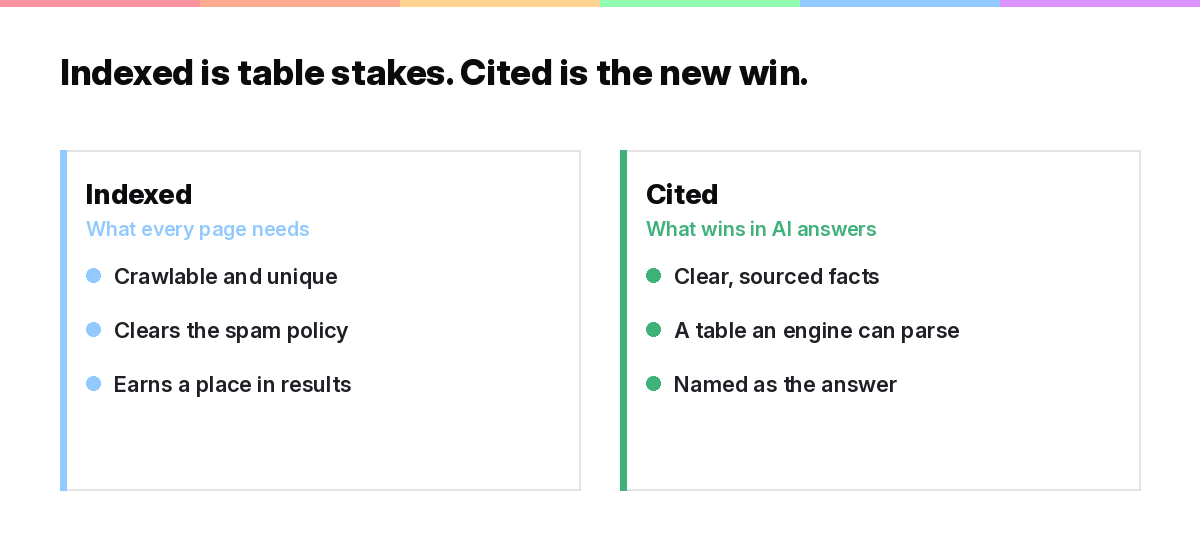
The new prize is the citation, a mention or link inside an AI answer, not just a blue-link click. Programmatic pages can earn citations when they hold structured, sourced data an engine finds worth quoting.
Data pages make the best citation sources
AI engines quote pages that state clear, sourced facts. A comparison page with a real feature table, a page with original data, or a definition backed by numbers is far more citable than prose. Ahrefs found 76 percent of AI Overview citations come from the current top 10, so ranking and being cited are now the same job, a point we develop in our examples teardown.
Mentions and citations, not just clicks
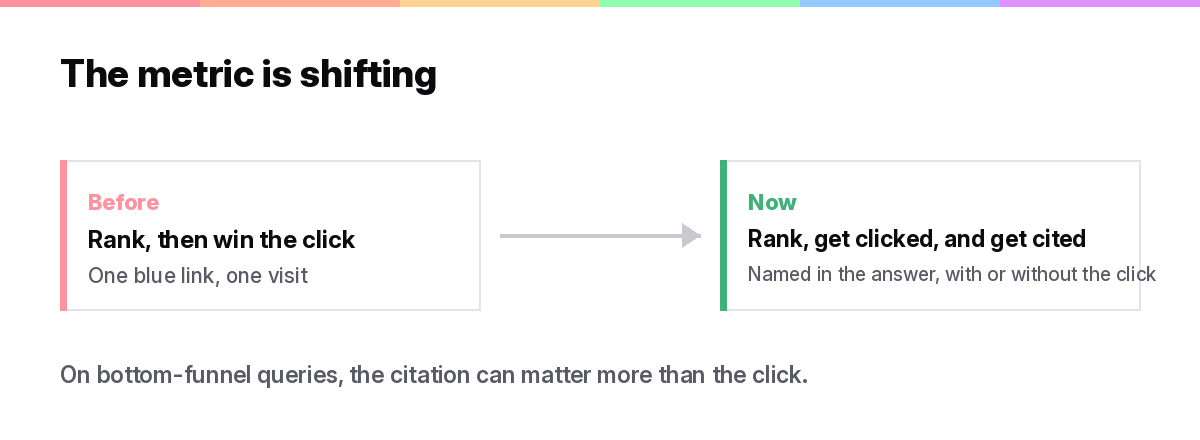
On bottom-funnel queries, being the brand an AI recommends can matter more than the click. A comparison page that gets your product named as the answer to "best [category] for [use case]" does its job even when the buyer never lands on it. Build programmatic pages that are easy to quote and clear about who they are for, and weight the set toward those buyer-stage queries.
Structure helps a page get quoted. Lead each page with a direct, self-contained answer, put the key facts in a table an engine can parse, and keep the claims specific and sourced. The same formatting that makes a page skimmable for a person makes it liftable for a model, so you are not choosing between the two audiences, you are serving both with one layout.
Measure this differently, too. Classic rank tracking misses whether an AI names your brand, so add a check of how your target prompts are answered across the main AI tools. If your product is missing from the answer to a query you should own, that is a gap worth fixing even when the page still ranks in the blue links.
What to do now
Audit the set you have, cut what AI answers for free, and rebuild the rest around data and utility. This is a pruning and upgrading job, not a reason to abandon programmatic SEO.
The three-step response
First, find the pages that lost traffic and check whether an AI Overview now answers their query. Second, cut or merge the ones that are pure definition with no added value. Third, upgrade the survivors with data, tools, and clear buyer-stage positioning so they earn both clicks and citations.
Sequence it so you see results fast. Start with the pages that had real traffic and lost it, because those have proven demand and the quickest payback once upgraded. Leave the long tail of pages that never earned anything for the cut list, since reviving them rarely justifies the effort. The point is to concentrate your work where the demand already exists.
Then set a standing rule for anything new. No page joins the set unless it would survive being read by a person and quoted by a model, which in practice means real data, a clear answer up top, and a reason to click beyond the summary. Hold that line and the next update becomes something you watch with interest rather than dread.
The verdict
AI search did not kill programmatic SEO, it raised the floor and the ceiling at once. Build pages a person and an AI both find worth quoting, and the tactic keeps compounding. If you want a read on where your set stands, our free AI SEO audit checks it against both classic search and AI answers, or our B2B SaaS SEO team can run the rebuild with you.
Frequently asked questions
Is programmatic SEO dead in 2026?
No, but the low-value version is. Thin, near-duplicate pages lost heavily to Google's scaled content enforcement and to AI Overviews, while pages with real data or utility kept ranking and started earning AI citations. The method works, the shortcuts do not.
Does programmatic SEO work with AI Overviews?
It works for patterns where the searcher still has to click, like integrations, comparisons, and calculators. Purely informational patterns are exposed, because AI Overviews answer those queries directly and cut the top result's clicks by more than half.
Will Google penalise templated pages?
Google penalises thin, low-value pages at scale, not templated pages as such. If each generated page genuinely helps a searcher with real data or utility, it is fine. The scaled content abuse policy targets pages made mainly to manipulate rankings.
How do programmatic pages get cited by AI like ChatGPT?
They earn citations by stating clear, sourced facts an engine can quote, such as a real comparison table, original data, or a numbers-backed definition. Ranking in the top 10 helps too, since most AI Overview citations come from pages that already rank well.
Should I stop doing programmatic SEO because of AI search?
No. You should audit what you have, cut pages AI answers for free, and rebuild the rest around data and utility. Strong programmatic sets now win in both classic search and AI answers, so the tactic is more valuable when done well, not less.
Want this done for your brand? Get a free AI visibility audit.
Get my free AI visibility audit.png)
Latest articles
What we've published in the past 30 days — across SEO, GEO, content, and digital PR.