.webp)





.webp)
SEO
Calculating...
Oct 2026
Keyword Research for Programmatic SEO: Finding the Dataset
Keyword research for programmatic SEO means finding a head-term and modifier pattern, then sizing real demand. Here is how to map the dataset behind the pages.

Keyword research for programmatic SEO is not a list of keywords, it is finding a head term with a repeatable modifier, like "[x] for [y]", then sizing how many real variations have search demand. The output is a data-backed map of pages, not a spreadsheet of one-off keywords.
This guide sits under our pillar on programmatic SEO for B2B SaaS and pairs with the step-by-step build. Get this stage right and the rest of the project is straightforward. Get it wrong and you generate thousands of pages nobody searches for.
It also differs from normal keyword research, which we cover in our SaaS keyword research guide. There you research topics one at a time. Here you research a pattern once, then let a data set fill it.
What programmatic keyword research really means
Programmatic keyword research means finding one search pattern that repeats across many variations, then confirming those variations have demand. You are not hunting for keywords one by one, you are validating a template and the data set that fills it.
A pattern, not a list
The difference matters. Normal research asks "what should this page target". Programmatic research asks "what shape of page could I build a thousand of, and is there demand for each one". The answer is a pattern like "[app] integrations" plus a list of apps, not a hand-picked keyword list.
Why the pattern has to come first
If you start from a keyword list, you end up with pages that do not share a template, which defeats the point. Starting from the pattern keeps every page consistent and lets a data set do the work. Zapier is the clearest case: it ignored "automation platform", which gets only about 200 US searches a month, and built on the "[app] integrations" pattern instead.
The mindset shift trips up teams new to this. They open a keyword tool expecting a list of winners and instead need to spot a repeatable shape. The signal you are looking for is a query where only one word changes and the rest stays the same, because that fixed part is your template and the changing part is your data set.
Finding the head-term and modifier pattern
Find the pattern by looking at where your product already sits on structured data, then testing which query shape matches how buyers search. The strongest modifiers come from data you own, not from a keyword tool.
The shapes that work
A few patterns carry most programmatic sets. Match the shape to your data and to real buyer intent, not to whatever has the biggest headline volume.
Where the modifiers come from
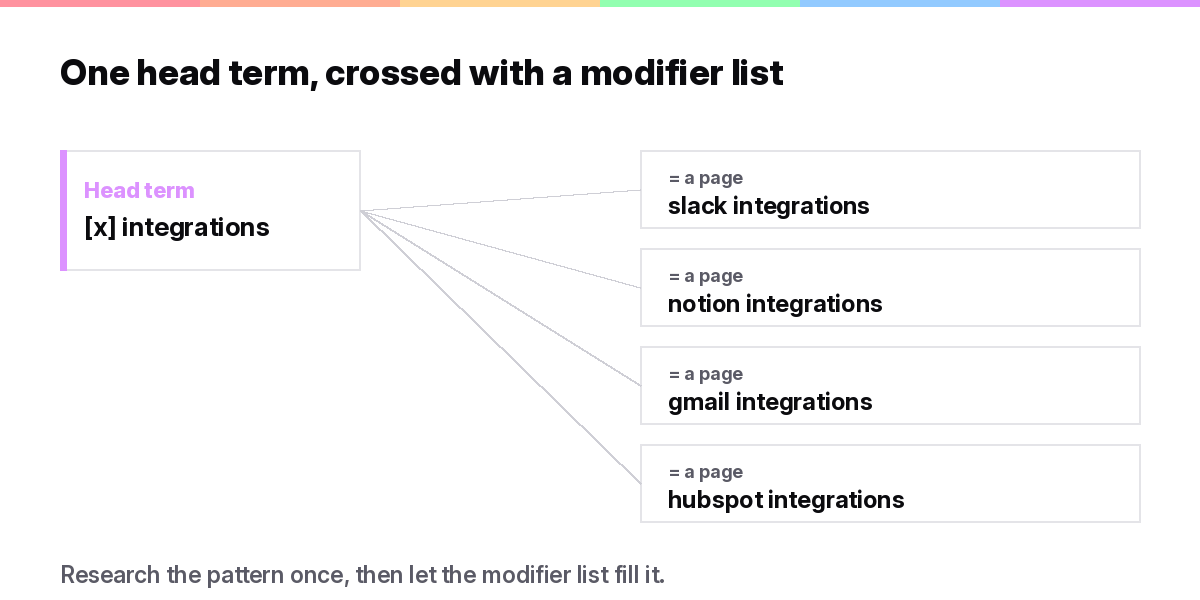
Good modifiers already exist inside your business. Integrations, competitors, industries, job roles, locations, and use cases are all lists you can pull from a product database or a CRM. Ahrefs Keywords Explorer matching-terms and search-suggestions reports then confirm which of those variations people actually search, which turns an internal list into a demand-backed map.
Cross the head term with the modifier list and you can see the whole set at once. A single "[x] integrations" head term crossed with 2,000 apps is 2,000 candidate pages before you have written a word. That is the power of the pattern, and it is why the research is done once, not two thousand times.
Sizing the opportunity honestly
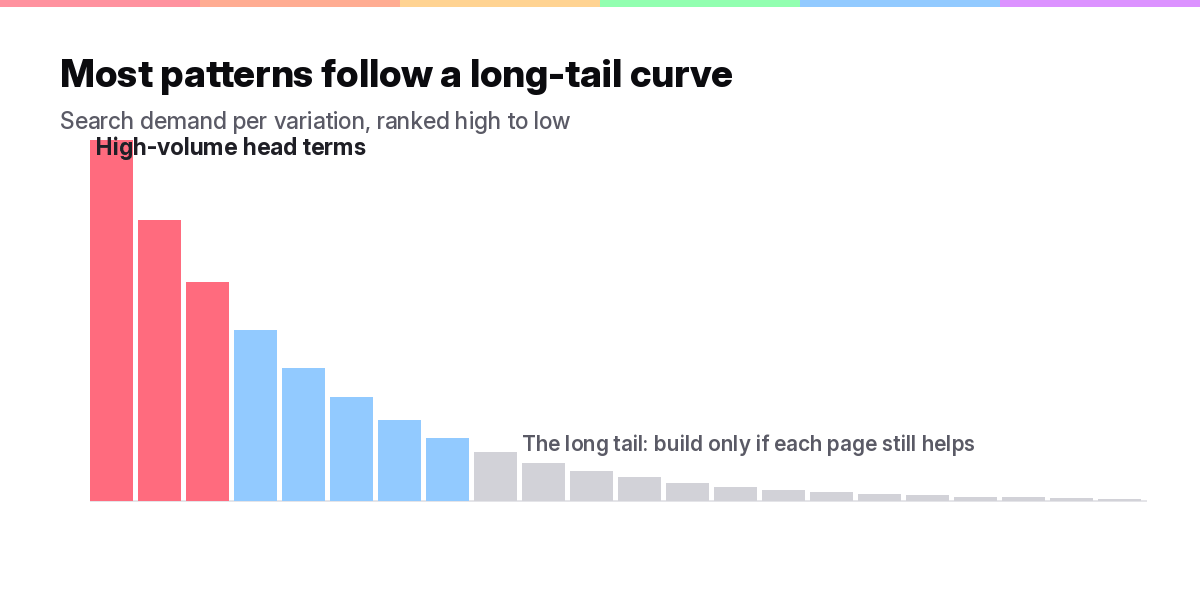
Before you build, size how many variations have real demand, because the answer decides whether the project is worth it. Most patterns follow a steep curve: strong demand for the top terms, a long tail of low-volume variations, and a point where the volume runs out.
The volume math
Pull a sample of the variations into Ahrefs Keywords Explorer or Google Keyword Planner and look at the distribution. If the top 50 terms carry most of the demand and the rest are near zero, build 50 to a few hundred pages, not 5,000. The long tail is worth having, but only when each page still clears a minimum bar of usefulness.
Do the arithmetic before you commit. Multiply a realistic clickthrough rate by the summed volume of the variations you would actually build, and compare that to the cost of building and maintaining them. A pattern that pencils out at a few hundred visits a month may still be worth it if the intent is commercial, and a huge but purely informational pattern may not be.
When the pattern is too thin
Sometimes the honest answer is that the pattern does not have enough demand to justify a programmatic set. That is a good thing to learn at this stage, for free, rather than after generating pages. A thin pattern is better served by a handful of strong editorial pages than by a thousand empty templated ones.
Filtering out queries AI already answers
Remove variations that an AI Overview resolves outright, because those pages will index and earn nothing. The safest programmatic queries are the ones where a searcher still has to click to compare, configure, or calculate.
Which queries are exposed
Definitional and simple-fact variations are the most exposed. A "what is [x]" page is answered in the results now, while a "[x] vs [y]" or "[x] integrations" page still needs the click. Ahrefs found AI Overviews cut the top result's clicks by 58 percent when they appear, so weight the set toward the shapes that survive, a theme we go deep on in programmatic SEO in the AI search era.
A quick way to check is to search ten of your candidate variations and note how many trigger an AI Overview. If most do, the pattern is exposed and you should either add real utility to each page or pick a more commercial shape. If few do, the pattern is safer and worth building.
The new noise in AI search
AI search also changes how people phrase queries, which makes traditional keyword volume a rougher guide than it used to be. Kevin Indig, who has led SEO at Shopify and G2, makes the point directly.
The practical response is not to abandon keyword volume, it is to lean on patterns with clear commercial intent, where the demand is stable and the click still matters. Those patterns hold up whether the searcher types a short keyword into Google or a longer, messier prompt into an AI tool.
From keyword map to page spec
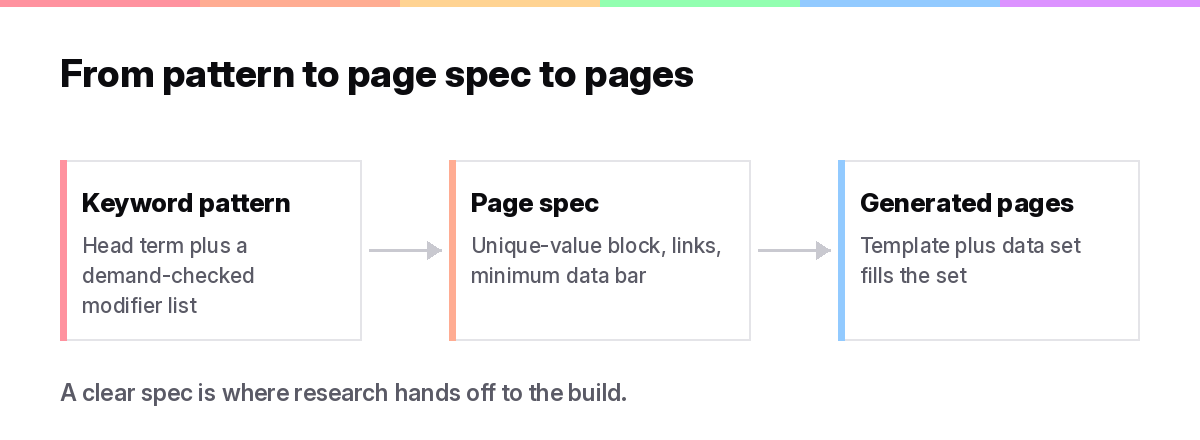
Turn the validated pattern into a page spec that tells the template exactly what each page needs. This is the bridge from research to build, and it is where keyword research hands off to the data set.
What the spec contains
A page spec lists the head term, the modifier list, the unique-value block each page must carry, the internal links it should include, and the minimum data bar for publishing. With that in hand, the build becomes mechanical, which is exactly what our tools guide is designed to run.
Write the spec so a stranger could build the set without asking you questions. If the unique-value block is vague, the pages will be too, so spell out exactly what data fills it and what a good page looks like. The clearer the spec, the less the template drifts once you scale.
Keep the keyword map alive after launch. New modifiers appear as your product adds integrations, competitors, and use cases, so revisit the pattern each quarter and add the rows that now have demand. A programmatic set is a living map, not a one-time research task, and the teams that treat it that way keep compounding while the rest stall.
The verdict
Research the pattern, size it honestly, cut what AI answers, and hand the build a clear spec. Do that and programmatic keyword research stops being a guessing game and becomes the most reliable, and most valuable, part of the whole project. If you want it done with you, our B2B SaaS SEO team runs this stage on every programmatic engagement, or start with a free AI SEO audit to see which patterns your site could own.
Frequently asked questions
How is keyword research for programmatic SEO different?
Normal keyword research targets pages one at a time. Programmatic keyword research finds a single repeatable pattern, a head term plus a modifier, then validates that many variations have demand. You research the pattern once, then a data set fills it.
How do I find programmatic keyword patterns?
Look at structured data you already own, such as integrations, competitors, industries, and use cases, then test which query shape matches how buyers search. Tools like Ahrefs matching-terms confirm which variations have real demand before you build.
What is the minimum search volume per programmatic page?
There is no fixed number, but each page should either have its own demand or clear a genuine usefulness bar. A long tail of low-volume pages is fine when each one still helps a searcher, and a problem when the pages are thin and unread.
Should I build pages for zero-volume keywords?
Only if the page has real utility beyond search, such as an integration a customer needs to set up. Building thousands of zero-volume, low-value pages is exactly what Google's scaled content policy targets, so keep those out of the set.
What tools do I need for programmatic keyword research?
A keyword tool such as Ahrefs Keywords Explorer for volume and matching terms, plus a spreadsheet to hold the modifier list and the sizing. Google Keyword Planner works for a lighter setup. The tool matters less than the pattern you validate.
Want this done for your brand? Get a free AI visibility audit.
Get my free AI visibility audit.png)
Latest articles
What we've published in the past 30 days — across SEO, GEO, content, and digital PR.