.webp)





.webp)
SEO
Calculating...
Aug 2026
How to Do Programmatic SEO: A Step-by-Step Guide for SaaS
Programmatic SEO for SaaS in seven steps. Find the pattern, build the data, design the template, then generate, QA and publish in waves without the penalty.


To do programmatic SEO, you find a repeatable search pattern, build a data set that fills it, design one strong page template, then generate, quality-check, and publish the pages in waves. The work that separates a win from a penalty is the data and the quality control, not the automation.
This guide is the hands-on companion to our pillar on programmatic SEO for B2B SaaS. It walks the exact seven-step workflow we run at MADX, with the checkpoints that keep a set on the right side of Google in 2026.
None of it needs an engineering team. A marketer who can use a spreadsheet and a CMS can ship a real programmatic set. What it does need is discipline at two points, the data and the QA, and we will spend most of our time there.
The seven steps, in short
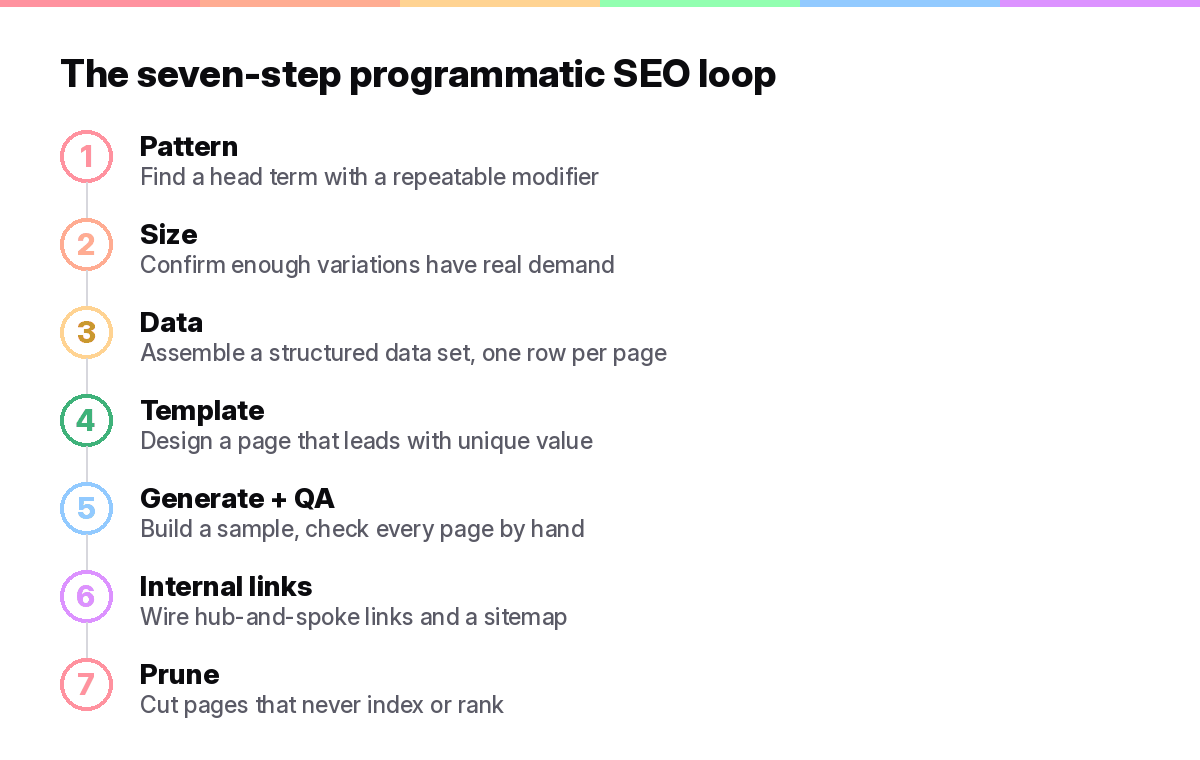
Programmatic SEO is a seven-step loop: pattern, data, template, generation, QA, internal links, and pruning. Miss any one and the set underperforms, but the two that decide the outcome are data and QA.
Here is the whole workflow before we go deep on each part. Keep it next to you as a checklist.
The steps are simple to list and easy to rush. Teams that skip step three or step five are the ones who end up deleting pages six months later, so treat those two as non-negotiable.
One more framing before the detail. Programmatic SEO is a system you maintain, not a project you finish. The first build is the hardest, and once the pattern, data, and template are proven, adding pages becomes cheap. That is what makes it worth the upfront care, because the payoff compounds every time you add a clean row to a set that already ranks.
Steps one and two: find and size the pattern
Start by finding a head term with a modifier that repeats across many real variations. If you cannot express the pattern as a fill-in-the-blank phrase with genuine demand behind each blank, you do not have a programmatic project yet.
Find the modifier pattern
The workhorse shapes are "[x] for [y]", "[x] vs [y]", and "[x] alternatives". Zapier built its traffic on "[app] integrations", and comparison sites live on "[tool] vs [tool]". Look at where your product already sits on structured data, then test which shape matches how buyers search for it.
Size the demand honestly
Pull the full list of variations and check real search volume for a sample. Some patterns have demand for the top 50 terms and nothing after, and some run thousands deep. That distribution tells you how big the set should be, and we go deeper on this in our guide to keyword research for programmatic SEO.
Validate the pattern against a live SERP before you build. Search a handful of the variations and look at what ranks. If the first page is full of programmatic pages like the one you plan to make, the intent is confirmed. If it is dominated by editorial guides or forum threads, a templated page will struggle there and you should pick a different shape.
Cut the queries AI already answers
Before you commit, remove variations that an AI Overview resolves outright. A definition or a simple fact is now answered in the results, so those pages will index and earn nothing. Keep the variations where a searcher still has to click to compare, configure, or calculate.
Step three: build a data set worth publishing
The data set is what makes a programmatic page worth reading, so it is where most of the real effort goes. Rich, accurate, and ideally first-party data is the difference between a page Google trusts and one it treats as filler.
First-party data beats scraped data
The strongest sets are built on data only you have, your product usage patterns, your integration catalogue, your pricing, your original research. Scraped or spun data is easy to copy and easy for Google to spot. If a competitor could rebuild your data set in an afternoon, it is not a moat.
Enrichment closes the gap when your own data runs thin. You can combine a first-party core with a licensed data source, structured public data, or short expert notes written once per category, so each page carries something specific. The point is not volume of words, it is a genuine reason for the page to exist.
The no-code stack that runs it
You do not need custom software. A common stack is Airtable for the data, a CMS such as Webflow for the template, and a sync tool like Whalesync to push rows into pages. That setup runs a full programmatic engine for a few hundred dollars a month, which is why the tactic is within reach for a lean SaaS team. Our roundup of programmatic SEO tools breaks down each layer, and if you want it run for you, our B2B SaaS SEO team builds these end to end.
Keep one row per page and one column per template variable. When the data is clean and structured this way, generation becomes the easy part, and you can add a page simply by adding a row.
Step four: design a template that earns the click
Hand-write three to five example pages before you template anything. If you cannot make a single page genuinely useful by hand, no template will save the other 3,000.
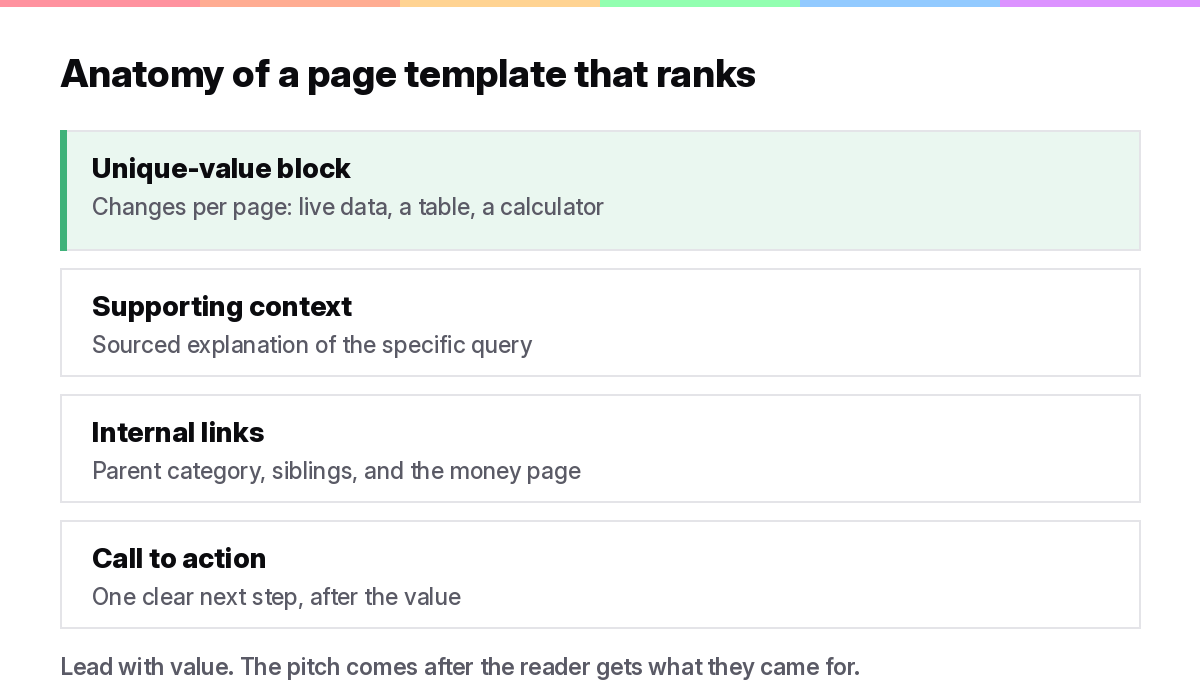
Lead with a unique-value block
The unique-value block is the part of the page that changes meaningfully per row and gives the reader something they cannot get from a summary. On an integration page it is the specific triggers and actions. On a comparison page it is a live feature and pricing table. Put it high, above the boilerplate.
Stay on the right side of doorway pages
The test is simple. If every page in the set leads to the same generic pitch with only the headline changed, Google reads it as a doorway. If each page answers its own query first and pitches second, it reads as helpful. Google's own spam policies spell this line out.
Steps five to seven: generate, QA, and publish
Generate a small batch, check every page, then scale, link, and prune. The order protects you: a 50-page sample surfaces the template's weaknesses cheaply, long before you have 5,000 live pages to fix.
QA the sample before you scale
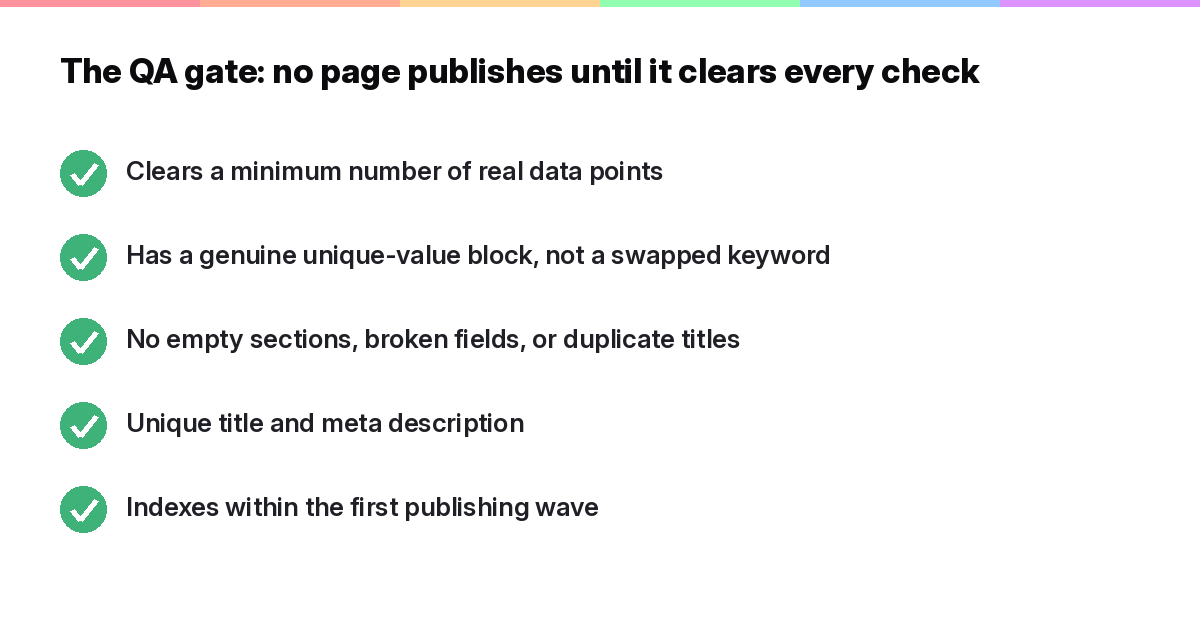
Real data is messy. Missing fields, odd values, and empty rows break templates in ways you only see once you generate. Review the first 50 to 100 pages by hand, fix the template logic, and set a rule that no page publishes unless it clears a minimum bar of data points. That single rule prevents most scaled content problems.
Watch for the common template bugs while you review. Empty sections that render as blank space, a variable that shows a raw code label instead of a value, duplicate titles across near-identical rows, and thin pages where the data simply ran out. Each one is easy to catch at 50 pages and painful to catch at 5,000, so build the checks into your review rather than trusting the output.
Wire internal links and a sitemap
Link each page to its parent category, a few relevant siblings, and the money page it supports, then ship a segmented XML sitemap and ping IndexNow so Google finds the set fast. Internal linking is the step teams skip, and it is why so many programmatic pages sit unindexed. Build the linking rules into the template so it happens automatically.
Publish in waves, then prune
Release the first wave, watch indexation and early rankings for two to four weeks, then release the rest if the signals are good. After a few months, cut pages that never earned an impression. Pruning concentrates crawl budget on the pages that work, the same logic behind Google's helpful content guidance.
Once the set is live and indexing, the loop repeats. Add rows, generate, QA, publish. Done well, programmatic SEO becomes a compounding asset, and our teardown of B2B SaaS examples shows what that looks like at scale.
Frequently asked questions
How do you do programmatic SEO step by step?
Find a repeatable keyword pattern, size the demand, build a structured data set, design one strong template, generate and quality-check a sample, wire internal links and a sitemap, then publish in waves and prune pages that never index. The data and QA steps matter most.
Do you need to code to do programmatic SEO?
No. A no-code stack of a spreadsheet tool like Airtable, a CMS like Webflow, and a sync tool can run a full programmatic set. Coding gives you more control, but a marketer can ship a real set without it.
How many pages should you launch first?
Start with 50 to 100 pages, not the whole set. A small first wave shows whether the template holds up against messy real data and whether Google indexes the pages, so you can fix problems cheaply before you scale.
How do you keep programmatic pages from being flagged as spam?
Give every page real, differentiated data or utility, set a minimum-quality rule before a page can publish, and make sure each page serves its own query rather than funnelling everyone to one pitch. Thin, near-duplicate pages are what Google flags.
How long until programmatic SEO pages rank?
Expect three to six months for a well-built set to index and start ranking, with early signals visible within a few weeks of the first wave. Competitive patterns take longer, which is why publishing in waves is worth the patience.
Want this done for your brand? Get a free AI visibility audit.
Get my free AI visibility audit.png)
Latest articles
What we've published in the past 30 days — across SEO, GEO, content, and digital PR.