


Content
Calculating...
Oct 2026
Content Audit for B2B SaaS: The Process We Use for Google and AI Search
A content audit for B2B SaaS that covers Google and AI search: inventory, scoring, keep/refresh/merge/prune decisions, and a quarterly cadence that sticks.

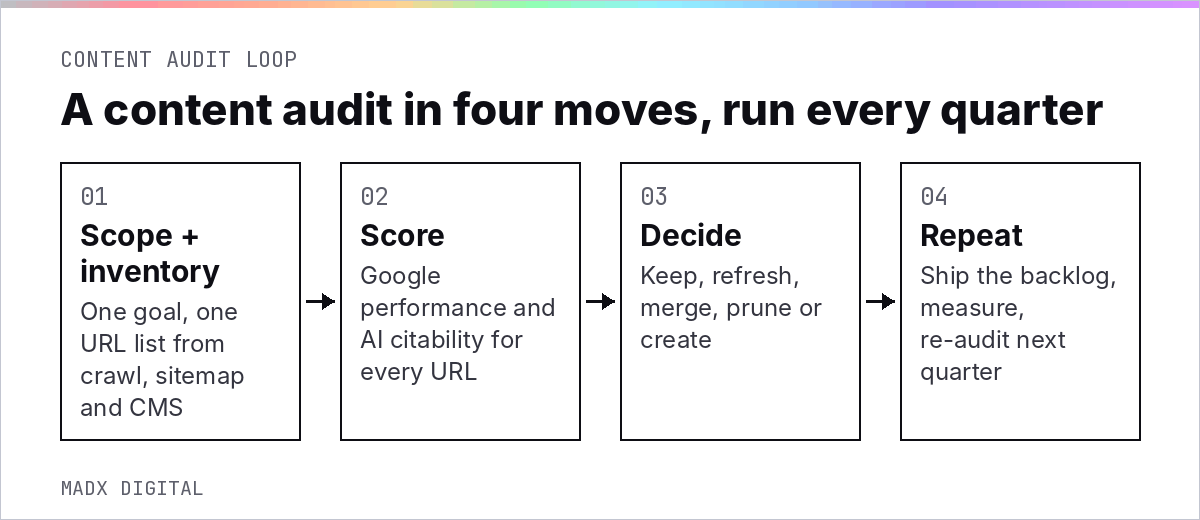
A content audit is a structured review of every page you've already published, scored against a clear goal, that ends with one action per URL: keep, refresh, merge, prune or create. For B2B SaaS teams in 2026, that score has to cover two things at once: how the page performs in Google, and whether AI engines cite it.
Most SaaS blogs we audit have between 100 and 400 posts. A handful drive the pipeline. A long tail does nothing at all, and a worrying middle slowly goes out of date while still ranking for terms your buyers care about.
This guide is the process we run at MADX before we touch a single page. It's written for B2B SaaS marketing leads who own a content library and want it working in Google and in AI search, not just growing.
What is a content audit, and what isn't it?
A content audit is a qualitative and quantitative review of the content you already have, page by page, with a decision attached to each one. It isn't a technical SEO audit, a content strategy, or a list of new topics to write. Those all matter, but they answer different questions.
A technical audit asks whether Google can crawl and index your site. Our SaaS SEO audit guide covers that side. A content audit asks a blunter question: is each page you've published still earning its place?
Content inventory vs content audit
The two get used interchangeably, and they shouldn't be. The inventory is the list. The audit is the judgement.
You can't audit well without a clean inventory. But teams that stop at the inventory end up with a beautiful spreadsheet and no decisions. We've inherited plenty of those.
Why B2B SaaS content goes stale faster than most
SaaS content rots for reasons a recipe blog never deals with. Your product ships new features every quarter, pricing changes, integrations come and go, and competitors launch or get acquired. A comparison page that was accurate in January can be wrong by June.
There's also the long tail problem. Ahrefs' search traffic study found that 96.55% of all pages in its index get zero traffic from Google. Your library won't be that bad, but a big share of it probably isn't pulling its weight either.
What changes when AI search is in scope
Buyers don't only search Google any more. In G2's April 2026 buyer research, 51% of B2B software buyers said they now start research with an AI chatbot more often than with Google, and 71% rely on AI chatbots at some point in their research.
The click has also got harder to earn. Pew Research Center found users who saw an AI summary clicked a traditional result in 8% of visits, against 15% for those who didn't. And Ahrefs' February 2026 update found the presence of an AI Overview now correlates with a 58% lower average clickthrough rate for the top-ranking page.
So an audit that only looks at Google clicks will undervalue pages that AI engines cite, and overvalue pages that rank but never get used as a source. That's the gap this process closes.
Steps 1 to 3: set the scope, build the inventory, pull the data
The first three steps are mechanical, and that's the point. Get them right and the decisions later become obvious. Rush them and you'll argue about every URL.
Step 1: pick one goal for this audit
Every audit needs a single goal that decides what "good" means. For most SaaS teams it's one of three: grow organic pipeline, win more AI citations on buyer queries, or cut a bloated library down to what supports the product.
Pick one. If you try to optimise for traffic, leads, AI visibility and brand all at once, every page looks half useful and nothing gets cut or fixed. We usually set the goal with the CMO in a 30 minute call before anyone opens a spreadsheet.
Here's how the goal changes the work. A pipeline audit weights conversions heavily and spends most of its effort on bottom-funnel pages. An AI visibility audit weights citations and mentions on buyer prompts, so comparison, alternatives and category pages get the most attention. A cleanup audit is mostly about overlap and dead weight.
Step 2: build the inventory
Pull your URL list from three places and merge them: a crawl of the live site, your XML sitemap, and a CMS export. Each catches pages the others miss. Crawls find orphaned pages, sitemaps find pages your crawler can't reach, and the CMS shows drafts, archived posts and authors.
Scope it sensibly. On a first audit we include the blog, resource hub, comparison and alternatives pages, and integration pages. Product and legal pages stay in the inventory but rarely get anything other than a keep. If you're choosing software for this step, our guide to content audit tools maps each tool to the job it does best.
Step 3: pull the data for every URL
For each page, you want enough data to make a call without opening it. Here's the minimum set we pull:
- Search performance: clicks, impressions, average position and top query from Google Search Console, compared over 3 and 12 months.
- Business value: conversions, assisted conversions or demo requests from GA4 or your CRM.
- Authority: referring domains and internal links pointing at the page.
- AI visibility: whether the URL is cited, and whether your brand is mentioned, across ChatGPT, Perplexity, Gemini and AI Overviews for the prompts you track.
- Freshness: the date of the last meaningful update, not the publish date.
That last column is the one most teams don't have. Add it anyway, even if you fill it by hand for the top 100 pages.
Step 4: score every URL for Google and AI search
Score each page on two separate axes: how well it performs in Google, and how citable it is in AI search. Plot them together and the right action for most pages falls out on its own.
The two-axis scoring model
We use a simple one to five score for each axis. Google performance blends clicks, rankings for the target query, and conversions. AI citability blends observed citations and mentions with the on-page traits that make a page easy to lift.
Weight the blend to match the goal you set in step 1. On a pipeline audit, conversions might carry half the Google score. On an AI visibility audit, observed citations on buyer prompts carry most of the AI score, because a page that's already cited is worth far more than one that merely looks citable. Keep the weights in the sheet so the next audit uses the same yardstick.
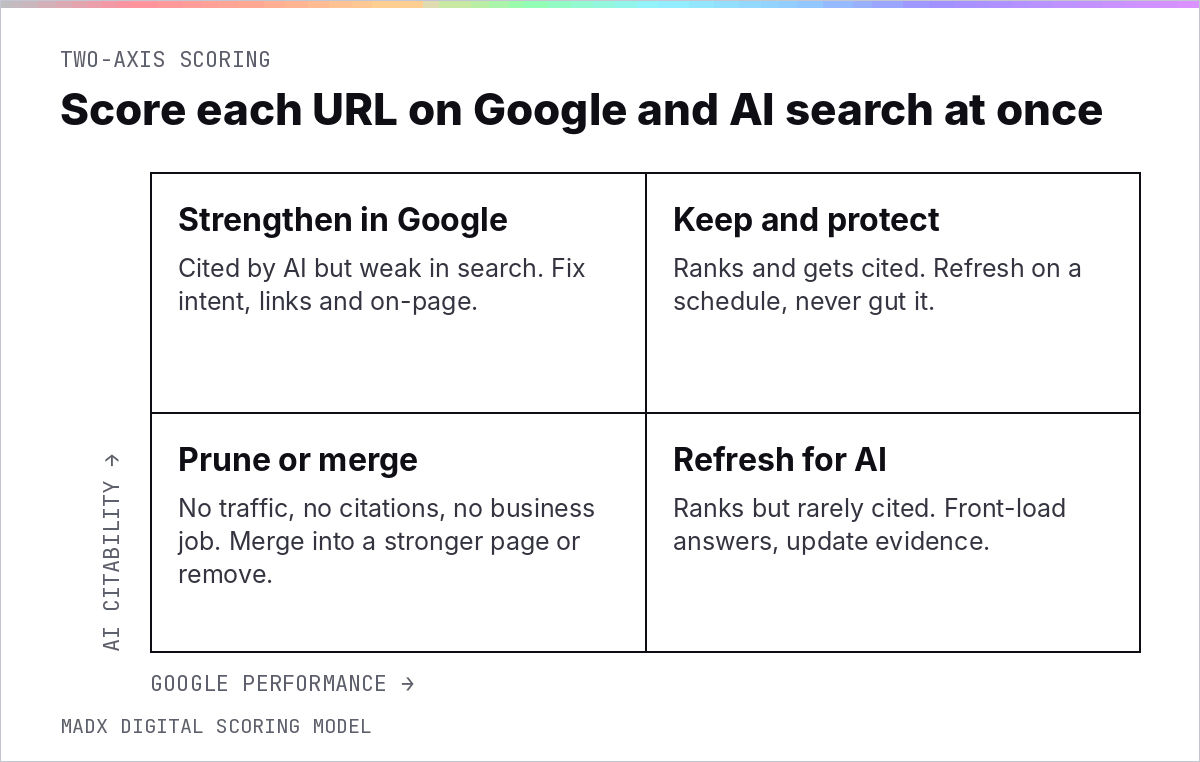
Pages in the top right are your best assets and need protecting. Pages that rank but rarely get cited usually need their answers front-loaded and their evidence updated. Pages that get cited but don't rank often need a search intent fix. The bottom left is where merge and prune decisions live.
What makes a page citable in AI search
AI engines retrieve passages, not whole pages, so a page earns citations when its sections stand on their own. In practice that means a direct answer under each heading, specific claims with named and dated sources, and clean structure that a model can lift without context.
When we score this axis, we check observed citations first. If a page isn't cited, we look at why: is the answer buried, is the data stale, or is a competitor's page simply more specific? Those reasons decide whether it's a refresh or a rewrite.
Freshness: count the last real update, not the publish date
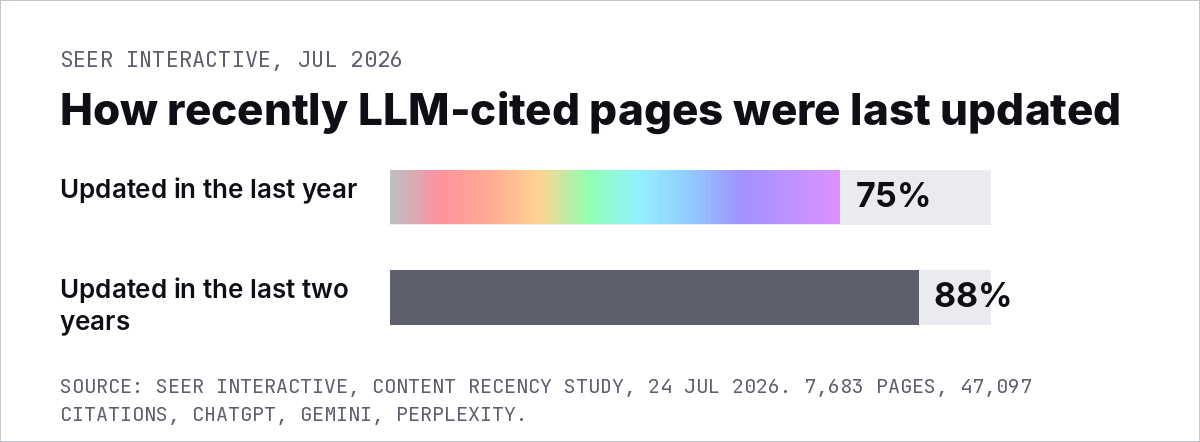
This is the signal that's changed most in the last year. Seer Interactive's July 2026 study of 7,683 pages carrying 47,097 citations across ChatGPT, Gemini and Perplexity found 75% of the pages LLMs cite were updated in the last year, and 88% in the last two. More than a quarter of those "fresh" pages were first published over two years ago.
That lines up with Ahrefs' analysis of 17 million citations, which found URLs cited by AI assistants are on average 25.7% fresher than URLs in organic search results. We cover what that means in practice in our guide to content freshness in SEO and AI search.
Citations also move quickly. SISTRIX's May 2026 analysis of 82,619 prompts over 17 weeks found Google replaces 56% of sources in AI-generated responses every week, while ChatGPT replaces as much as 74%. A page that was cited last quarter isn't guaranteed a place this quarter.
Step 5: decide to keep, refresh, merge, prune or create
Every URL gets exactly one of five actions: keep, refresh, merge, prune or create. One action per page keeps the backlog honest and makes ownership clear.
The decision rules we use on SaaS sites
A few rules save hours of debate. Any page with referring domains never gets deleted outright; it gets merged or redirected. Pages that support sales, like integrations and security, stay even with low traffic. And any page that lost more than a fifth of its traffic year over year goes straight to the refresh queue for diagnosis.
For that last group, our guide to content decay explains how to tell a real decline from seasonality or a tracking change before you spend time on it.
Should you delete old content?
This is where audits get heated, so here's both sides. The case for pruning is real: thin, duplicate and off-topic pages dilute topical focus, confuse internal linking, and on very large sites can waste crawl attention. Plenty of teams have seen traffic improve after cutting dead weight.
The case against is just as real. Google doesn't reward a site for looking new, and it says so directly in its guidance on helpful content.
Our verdict: prune for users, focus and duplicate intent, never to look fresh. Merge first, redirect second, and delete only when a page has no traffic, no links and no job. The full process, including what Google says about large sites, is in our guide to content pruning.
Turn decisions into a backlog
The output of an audit isn't the spreadsheet. It's a prioritised backlog with one row per action, an owner and a date. We rank it by business value first, then by effort, so the first sprint is high-value refreshes that need a day's work each.
Refreshes are usually the biggest share of the backlog. Our content refresh guide covers exactly what to change on each page, and what to leave alone.
Three mistakes sink more audits than anything else. The first is scoring on traffic alone, which buries the low-volume comparison pages that close deals. The second is deciding everything and shipping nothing, because nobody owns the backlog. The third is treating the audit as a cleanup project and never asking which buyer questions you still don't answer, which is where the create action earns its place.
Step 6: run the audit on a cadence, not once
Run a light audit every quarter and a full one once a year. A single big audit goes out of date as fast as the content it reviewed, especially now that AI citations shift week to week.
Quarterly or annual?
There's a fair argument for annual audits: they're cheaper, and some evergreen libraries really don't change much. Semrush's content audit guide cites its 2023 State of Content Marketing report, where one-third of marketers said they run content audits twice a year.
For B2B SaaS, we land on quarterly. Products, pricing and competitors move too fast, and the AI citation data above says a once-a-year refresh leaves you stale for most of the year. The quarterly pass doesn't redo the inventory. It re-scores the top 50 to 100 URLs and adds anything that's started to slide.
What to measure after each sprint
Measure each refreshed or merged page against its own baseline, six to eight weeks after the change. Look at clicks and rankings for the target query, conversions, and whether AI engines started citing or mentioning it on the prompts you track.
That last part needs its own tracking setup. Our guide to AI search monitoring walks through it, and a GEO audit is the natural companion when you want to check the site-level factors that affect AI visibility.
Give the audit one owner. In most SaaS teams that's the head of content or the SEO lead, with product marketing signing off on anything that touches positioning or pricing. The owner doesn't do every refresh, but they keep the backlog moving and report the results each quarter, which is what turns a one-off project into a habit.
Report wins in the language your leadership uses. Pages refreshed, pages merged and pages removed show activity. Pipeline from refreshed pages, and new citations on buyer prompts, show impact. We always lead with the second set.
If you'd like a second pair of eyes on your library first, our AI SEO audit scores your top pages on both axes, and our SaaS SEO agency team can run the quarterly cycle with you.
Frequently Asked Questions
What is a content audit in SEO?
A content audit in SEO is a page-by-page review of the content you've already published, using search and business data to decide whether each URL should be kept, refreshed, merged, pruned or replaced. In 2026 it should also check whether AI engines like ChatGPT, Perplexity and Google's AI Overviews cite each page.
How often should a B2B SaaS company audit its content?
We recommend a light audit every quarter and a full audit once a year. The quarterly pass re-scores your top 50 to 100 pages and anything that's started to decline. The annual pass rebuilds the full inventory and revisits every URL.
How long does a content audit take?
For a SaaS blog with 100 to 400 posts, the inventory and data pull usually takes a few days, and scoring takes another week. The work that takes longest is acting on the decisions, which is why we turn the audit into a prioritised backlog rather than a one-off report.
What's the difference between a content audit and an SEO audit?
An SEO audit checks whether search engines can crawl, render and index your site, and covers technical issues like speed, redirects and canonical tags. A content audit judges the pages themselves: whether each one still answers its query, converts, and earns citations. Most sites need both.
Should I delete old blog posts after a content audit?
Only when a post has no traffic, no backlinks, no AI citations and no business purpose. Google's guidance says removing older content to make a site seem fresh won't help rankings. Merge overlapping posts into the stronger URL and redirect the rest before you delete anything.
How do I check if AI search engines cite my content?
Track a fixed set of buyer prompts across ChatGPT, Perplexity, Gemini and AI Overviews, and record which of your URLs appear as sources and where your brand is mentioned. AI visibility tools automate this, and the results become the AI citability column in your audit.
Want this done for your brand? Get a free AI visibility audit.
Get my free AI visibility audit
Latest articles
What we've published in the past 30 days — across SEO, GEO, content, and digital PR.