What is total addressable market?
Total addressable market (TAM) is the total annual revenue a business could earn if it captured 100% of its market. It is the top-line size of the opportunity for a product or service, before accounting for competition, reach, or execution. TAM answers a simple question: how big could this get, at most?
TAM is used in business plans, investor decks, and strategy to judge whether a market is large enough to justify the investment. On its own it is a ceiling, not a forecast, which is why it is almost always paired with two narrower measures, SAM and SOM.
TAM vs SAM vs SOM
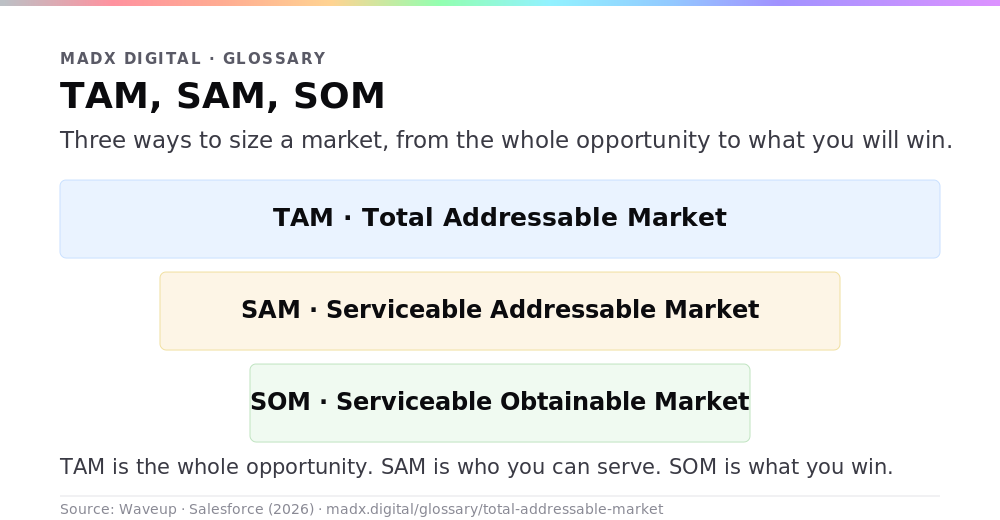
The three numbers narrow from the whole market to what you can actually win.
- TAM (total addressable market). Everyone who could buy this type of product, worldwide. The full opportunity at 100% share.
- SAM (serviceable addressable market). The slice of TAM you can serve with your current product, pricing, and go-to-market strategy, for example one region or one segment.
- SOM (serviceable obtainable market). The share of SAM you can realistically capture in the near term, given your resources and competition.
How to calculate total addressable market
There are two accepted methods, and strong plans show both (Waveup, 2026).
Top-down. Start with a large published market size and narrow it with filters. For example, take the global software market, limit it to SaaS, then B2B, then your specific category. It is fast and good for context, but generic reports and loose assumptions can inflate the number.
Bottom-up. Build the number from real units. Multiply the number of companies that fit your ideal customer profile by the average annual revenue per customer. If 20,000 companies match your profile and each pays $12,000 a year, TAM is 20,000 × $12,000 = $240 million. Bottom-up is harder but far more reliable for planning, because every input reflects real buying behaviour.
Because they are built differently, the two methods rarely match exactly. Presenting both lets you triangulate a defensible range, and founders who show both in fundraising close about 40% faster (Carta 2025, via Waveup).
Why total addressable market matters
TAM shapes big decisions. It tells you whether a market is worth entering, how much you can justify spending to acquire customers, and how ambitious your growth story can credibly be. Investors use it to gauge upside, so a realistic, well-sourced TAM builds more trust than an inflated one. It also frames where to focus expansion, from new segments reached through content and organic search to account-based plays against your highest-value targets. Paired with unit economics like customer lifetime value, TAM turns a market opportunity into a fundable plan.
Common TAM mistakes to avoid
- The "1% of a huge market" claim. Assuming you will capture a small slice of a giant TAM is not a strategy. Ground the number in real reach.
- Top-down only. A market report minus arbitrary filters is easy to inflate. Validate with a bottom-up build.
- Confusing TAM with SAM or SOM. TAM is the ceiling; plan against SAM and SOM.
- Never updating it. Markets, pricing, and your product change, so revisit TAM as they do.
Total addressable market FAQs
What is total addressable market in simple terms?
It is how much revenue you could make if every possible customer bought from you, at 100% market share. TAM is the top-line size of the opportunity, a ceiling rather than a forecast, and is used to judge whether a market is big enough to be worth pursuing.
What is the difference between TAM, SAM, and SOM?
TAM is the whole market at 100% share. SAM (serviceable addressable market) is the part you can serve with your current product and go-to-market. SOM (serviceable obtainable market) is the share of SAM you can realistically capture near-term given competition and resources. They narrow from the whole opportunity to what you will actually win.
How do you calculate TAM?
Two ways. Top-down starts with a large published market and narrows it with filters. Bottom-up multiplies the number of ideal-fit customers by average annual revenue per customer, for example 20,000 companies × $12,000 = $240 million. Bottom-up is more reliable for planning; showing both is best.
What is the difference between top-down and bottom-up TAM?
Top-down begins with a broad market-research number and filters down to your segment, which is fast but easy to inflate. Bottom-up builds from real units (customers × price), which takes more work but reflects actual buying behaviour. Investors trust bottom-up more and like to see it triangulated against a top-down figure.
Why does TAM matter to investors?
TAM signals how big the business could become, which caps the potential return. A large but credible, well-sourced TAM supports an ambitious growth story, while an inflated one erodes trust. Founders who present both top-down and bottom-up figures tend to close funding faster.
What is a good TAM?
There is no fixed threshold; "good" depends on your stage and ambition. What matters more than the headline number is that it is realistic and defensible. A smaller, well-evidenced TAM you can clearly serve beats a giant, hand-wavy one built on arbitrary filters.