SEO
Calculating...
Aug 2026
FinTech SEO: The Ultimate Guide in 2026
Fintech SEO in 2026 means ranking in Google and getting cited in AI search. Learn the trust signals, GEO tactics and metrics that win finance buyers.


FinTech SEO is the practice of optimising a financial-technology website so it ranks in Google and gets cited in AI search tools like ChatGPT, Perplexity and Google AI Overviews. It pairs keyword-led content, technical SEO and authoritative links with the trust signals that high-scrutiny finance topics demand.
Fintech is one of the most competitive and most heavily scrutinised niches in search. You are up against deep-pocketed incumbents, strict regulation, and a topic Google treats with extra caution, all while AI answer engines rewrite how buyers discover products. This guide is the complete playbook: what makes fintech SEO different, what actually ranks, the technical and content work that moves the needle, how to win AI citations, and realistic timelines and budgets. As a fintech SEO agency, we have used this exact approach to grow brands like MoonPay, an enterprise fintech that added more than 120,000 monthly organic visits. Here is how to do it.
Why FinTech SEO Matters, and What Makes It Different
Fintech runs on credibility, and most of that credibility is built in search. Buyers research a wallet, a lending platform or a payment API before they trust it with money, and that research now starts in a search box or an AI assistant. SEO gives fintech companies compounding, high-intent visibility without paying for every click. A payment provider that ranks for “secure online payment gateway”, or gets cited when someone asks an AI assistant “what is the safest way to accept payments online?”, reaches buyers at the exact moment of decision. Three outcomes drive the case:
- Compounding organic traffic. Unlike paid ads, rankings and AI citations keep sending qualified traffic long after the work is done, lowering blended customer acquisition cost.
- Trust at the point of research. Finance is a high-scrutiny category. Content published under named experts, with clear disclosures and sources, is what turns a first-time visitor into a lead.
- A structural edge over incumbents. Targeting niche and long-tail queries the big platforms cover thinly is how smaller fintechs win visibility they could never buy.
The mechanics of fintech SEO match any other niche, but three forces make it harder and raise the stakes: regulation, competition, and complexity. Get them right and they become a moat.

Regulation and Compliance Are Ranking Factors
Financial content is held to a higher standard by regulators and by search engines at the same time. In the US, marketing claims fall under the SEC and FINRA, and consumer-finance content under the CFPB. In the UK, the FCA requires that financial promotions be “clear, fair and not misleading”. In the EU, MiCA governs crypto-asset communications, and GDPR governs data. This matters for SEO in three ways. First, every claim, rate and statistic needs a source and, often, a disclosure, which is exactly what E-E-A-T rewards. Second, compliance review adds time, so build legal sign-off into your content calendar rather than treating it as a blocker. Third, jurisdiction-specific content (rules that differ by country or state) is a genuine ranking opportunity, because generic global content cannot serve it well.
Keyword Competition Is Brutal
Head terms in finance are among the most contested on the internet, dominated by incumbents with enormous authority. Trying to rank a young domain for a two-word money term is a multi-year project. The winning move is to go around the competition: target long-tail, lower-difficulty queries with clear intent (“best business bank account for freelancers” rather than “business bank account”), build topical authority in a narrow niche first, and expand outward as your authority grows.
Complex Products Need Translation
Terms like “smart contracts”, “open banking APIs” or “interchange fees” intimidate a lay audience and confuse search engines. The brands that win turn complexity into clarity: plain-language explainers, definition-first sentences, worked examples, and structured data that tells engines exactly what a page is about. This is also what makes content easy for AI engines to extract and quote.
The FinTech Search Landscape in 2026
Fintech spans digital banking, payments, lending, wealth, crypto and embedded finance, and the search landscape underneath it is shifting fast. Four trends shape strategy this year.
- Search now has two front doors. Buyers research inside Google and inside AI assistants. Google AI Overviews presence grew 58% year over year to mid-2026, according to BrightEdge research reported by Search Engine Land, so optimising for classic search alone leaves demand on the table.
- Mobile-first is the default. The majority of web traffic is now mobile, and Google ranks with mobile-first indexing, so fast, responsive experiences are a prerequisite for both users and rankings.
- Regulation keeps tightening. Clear, compliant content is increasingly a competitive advantage, because it is exactly what Google and AI models reward in finance.
- Embedded finance keeps expanding. As financial services get built into non-financial products, new high-intent queries appear around lending, payments and accounts, and fintechs that publish for them early capture the demand.
Building Your FinTech SEO Strategy
A winning fintech SEO strategy starts with matching the right page to the right search, then optimising it to be read by both people and machines.
Keyword Research and Search Intent
Keyword research maps what your buyers search and how much competition each term carries. Group targets by intent (informational, commercial, transactional) and prioritise long-tail queries, which are lower competition and convert well. In finance, a handful of repeatable query patterns are especially valuable because they signal buying intent:
- “Best [product] for [audience]”, such as “best payment gateway for marketplaces”, which pairs high intent with lower difficulty than the head term.
- Comparison and alternative queries, such as “stripe vs adyen” or “plaid alternatives”, where the searcher is close to a decision.
- Calculator, rate and “fees” queries, such as “international wire transfer fees”, which combine informational and transactional intent.
- “What is” and “how does X work” explainers, which build topical authority and feed AI Overviews.
See our keyword research guide for the full MADX process. The goal is not a giant list of keywords, it is a map of the topics and page types that match how your buyers actually search.
What Actually Ranks: Page Types and the Funnel
The biggest mistake in fintech SEO is publishing only blog posts. Different page types win different searches, and the strongest programmes deliberately build a page for each stage of the buyer journey. The table below maps the page types that rank in finance to the intent they serve.
| Page type | Buyer stage | Example target query |
|---|---|---|
| Deep educational guide | Awareness (TOFU) | how ACH payments work |
| Glossary / “what is” explainer | Awareness (TOFU) | what is open banking |
| Calculator or interactive tool | Consideration (MOFU) | loan repayment calculator |
| “Best [product] for [audience]” | Consideration (MOFU) | best payment gateway for marketplaces |
| Use-case / solution page | Consideration (MOFU) | embedded payments for SaaS |
| Comparison ([Brand] vs [Brand]) | Decision (BOFU) | stripe vs adyen |
| Alternatives ([Brand] alternatives) | Decision (BOFU) | plaid alternatives |
| Pricing / fees page | Decision (BOFU) | international transfer fees |
Two of these deserve special attention. Calculators and interactive tools are among the best passive link earners in finance: they solve a problem instantly, get referenced by other sites, and convert. Support and API documentation is an underrated channel; well-structured docs rank for how-to and troubleshooting queries and earn links from developers, which is why payment platforms with deep documentation dominate their long tail.
On-Page SEO Essentials
On-page SEO aligns each page with a target query and makes it easy to read for people and machines. Use one clear H1, logical H2s and H3s phrased as the questions buyers ask, unique titles (around 50 to 60 characters) and meta descriptions (around 130 to 160), a clean descriptive URL, and descriptive alt text on every image. Lead each section with a direct, definition-first sentence that an engine can lift, and keep passages self-contained so they make sense out of context. Our on-page SEO guide has the full checklist.
Technical SEO for FinTech
Technical SEO makes sure engines and AI crawlers can reach, render and understand your site. Prioritise fast load times and Core Web Vitals (including Interaction to Next Paint), mobile responsiveness, HTTPS and clean architecture, and check that your robots.txt does not accidentally block AI crawlers such as GPTBot, ClaudeBot and PerplexityBot. Two areas matter more in finance than almost anywhere else: structured data and scale.
Use Finance-Specific Schema
Schema markup tells engines exactly what a page is, which is critical for products regulators and buyers scrutinise. Beyond Article, FAQPage and Organization, finance sites should use the schema types built for their products:
| Schema type | Use it on |
|---|---|
| FinancialProduct | Any account, card, loan or investment product |
| LoanOrCredit | Lending, credit and BNPL pages |
| BankAccount / DepositAccount | Account product pages |
| PaymentCard | Debit and credit card pages |
| InvestmentOrDeposit | Savings and investment products |
| CurrencyConversionService | FX, remittance and transfer pages |
| MonetaryAmount / UnitPriceSpecification | Fees, rates and pricing detail |
| Organization + BreadcrumbList | Brand entity and site hierarchy |
Reference the definitions on Schema.org and validate with Google’s Rich Results Test. Note that Google discontinued FAQ rich results, so a visible FAQ section is what matters now, not FAQPage markup alone.
Scale With Programmatic and Support Content
Many fintech queries follow repeatable patterns: “[service] in [city]”, “[currency] to [currency] transfer”, or “[product] for [industry]”. Programmatic SEO builds a template once and generates hundreds of genuinely useful, data-backed pages to capture that long tail, as long as each page is substantive rather than thin. Pair it with a well-structured support and documentation section, which ranks for how-to queries and earns developer links. Use our technical SEO guide alongside Google’s crawling and indexing documentation.
Content, Authority and Trust
In a YMYL niche, content and links are only half the job. Trust is what decides whether Google and AI engines will cite you.
Content, Digital PR and Link Building
Strong content and authoritative links turn a technically sound site into a trusted one, and in finance links are unusually valuable because they are hard to earn. Publish educational guides, original data and clear explainers, then earn links through digital PR and our link building work. A few fintech-specific tactics outperform:
- Turn funding news into links. Funding rounds, IPOs and major partnerships attract press. Publish original data, reports and expert commentary around those moments to convert attention into durable backlinks.
- Publish original data. Proprietary reports and benchmarks (transaction trends, fee comparisons, adoption data) are the most reliable link magnets in finance.
- Avoid the traps. Steer clear of low-quality guest-post farms and generic personal-finance blogger link schemes; in a YMYL niche, a spammy link profile hurts more than it helps.
In finance, links from respected sources double as trust signals for both Google and AI models, which is why digital PR and SEO are now the same conversation.
The Trust Bar: E-E-A-T and YMYL
Finance is a “Your Money or Your Life” (YMYL) category, so both Google and AI engines apply extra scrutiny before citing you. Google is explicit in its AI Overviews documentation:
“For ‘Your Money or Your Life’ (YMYL) queries, where information quality is critically important, we have an even higher bar for showing supporting information from reliable and trustworthy sources.”
That higher bar rewards demonstrable expertise and consistency. In practice, fintech brands win citations by getting several things right: credentialed, named authors rather than a generic byline; a visible editorial and expert-review process with “last reviewed” dates and reviewer bios; clear risk disclosures and compliance detail; up-to-date, dated statistics with real sources; valid Article and Organization schema; and a consistent entity story across the site, author profiles and third-party mentions. AI models weigh how consistently your brand is corroborated across independent sources, which is why sustained digital PR and link building is now a core AI-visibility tactic, not a nice-to-have.
Winning AI Search (GEO)
AI search is the biggest shift fintech SEO has seen in years. Generative Engine Optimisation (GEO) is the practice of structuring content so AI answer engines can extract and cite it. The fundamentals that rank you in Google also help you get quoted, but finance behaves differently from other sectors, and the data is specific.
In finance, only about 11.3% of AI Overview citations also rank in Google’s organic top 10, the lowest overlap of any tracked industry, and roughly 66% of finance AIO citations come from pages that do not rank anywhere in the top 100 organic results. Across YMYL topics, only around 17% of AIO citations come from organic top-10 results at all. The practical takeaway: ranking on page one no longer guarantees you appear in the AI answer, so AI visibility is a separate objective that needs its own attention.
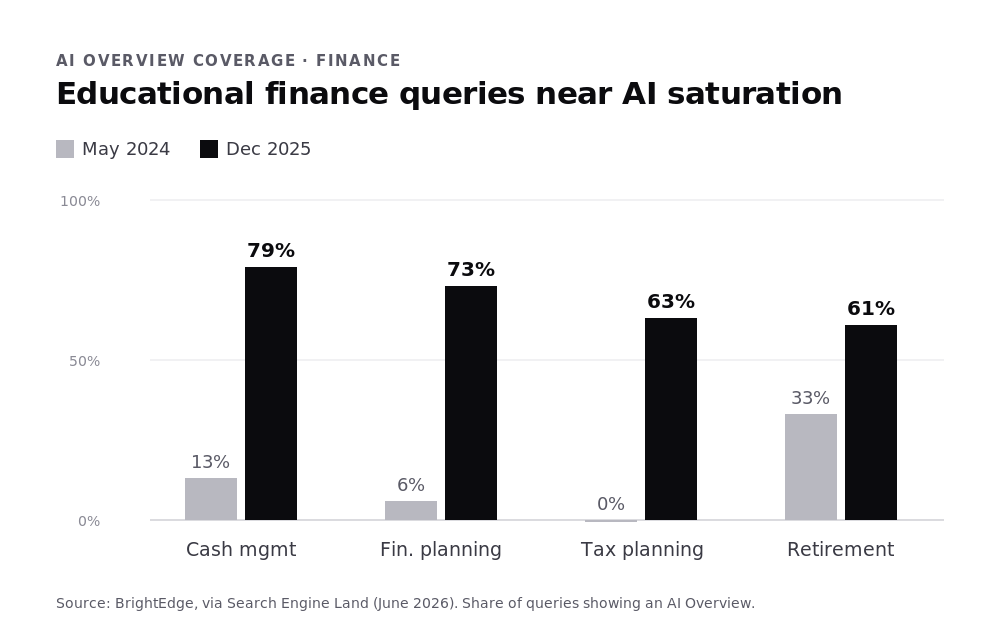
Coverage also depends heavily on query type. BrightEdge’s finance data shows educational queries approaching saturation while real-time price queries stay in classic search: cash-management coverage jumped from 13% to 79% between May 2024 and December 2025, financial planning from 6% to 73%, and “what is an IRA” style explainers reach around 91%, while stock-ticker queries sit near 8%. If your content is educational or explanatory, you are competing in AI answers today; if it is real-time market data, traditional SEO remains the primary channel.
To earn AI citations in finance, lead each section with a direct, definition-first answer, break content into self-contained passages, use clear question-style headings and comparison tables, and cite current statistics with the source named inline. Google’s own guidance on AI features confirms they are rooted in core Search quality systems, so strong SEO and strong GEO reinforce each other. For a deeper walkthrough, see our guide on how to rank in AI search results.
Planning, Measuring and Scaling
Fintech SEO rewards patience and discipline. Set realistic expectations, measure what matters, and steer around the common traps.
Realistic Timelines, Budget and Expectations
Fintech SEO compounds, but it compounds slowly, and setting the right expectations is half the battle. Most sites see meaningful movement in six to twelve months; competitive two-word head terms often take twelve to twenty-four, and the return typically peaks in year two or three as authority and trust accumulate. Match your plan to your growth stage:
- Early-stage. Win a narrow niche. Target long-tail, low-difficulty queries with clear intent, build topical authority in one area, and get the technical foundation right.
- Scaling up. Expand into adjacent topics and higher-intent commercial pages (comparisons, alternatives, best-for), add programmatic pages for repeatable patterns, and start a consistent digital-PR engine.
- Established. Defend head terms, invest in original data and thought leadership, and treat AI-search visibility as a first-class KPI alongside rankings.
On budget, specialist fintech retainers typically range from around $3,000 per month for early-stage programmes to $10,000 or more for competitive, multi-market strategies with digital PR. The right number depends on how contested your terms are and how much of the work (content, technical, links) you need.
Measuring FinTech SEO Success
Track the metrics that connect SEO to revenue, and add AI visibility to the list: organic traffic and rankings for your target keywords, tied to the SEO KPIs that matter; conversions such as sign-ups and funded accounts; engagement signals like bounce rate and time on page; your backlink profile; and how often your brand is cited in ChatGPT, Perplexity and AI Overviews. Build a content-refresh habit into your workflow: use Search Console and analytics to find pages slipping at positions four to twenty, and update the ones with the greatest conversion potential first, since recovering existing pages is faster than earning new rankings.
Common FinTech SEO Mistakes to Avoid
- Chasing head terms too early. Competing for “business bank account” on a young domain burns budget. Win the long tail first.
- Treating compliance as an afterthought. Unsourced claims and missing disclosures get pages buried in a YMYL niche.
- Publishing only blog posts. Without comparison, alternatives, use-case and calculator pages, you miss the highest-intent traffic.
- Thin programmatic pages. Templated pages with no real value are a liability, not an asset.
- Buying spammy links. Low-quality link schemes and personal-finance blogger farms damage trust more than they help.
- Ignoring AI search. With most finance AIO citations coming from outside the organic top 100, a page-one-only strategy leaves visibility on the table.
In-House or a Specialist FinTech SEO Agency?
Build in-house when SEO is central to your model and you can hire experienced specialists who understand both search and financial compliance. Partner with a specialist agency when you need senior expertise across content, technical SEO, digital PR and AI search faster than you can hire it, or when you are competing in a regulated market and cannot afford a long ramp-up. The right partner should show fintech results, not just generic SEO wins: our work with Postalytics grew AI share of voice by 80%, and MoonPay added over 120,000 monthly organic visits.
Ready to Grow Your FinTech Business with SEO?
SEO is no longer optional for fintech companies. It is how you build visibility and trust across both Google and AI search, and how you reach high-intent buyers without paying for every click. With tailored fintech SEO services, you can rank for the terms that convert, become the source AI engines cite, and grow sustainably. Book a call with MADX to map your fintech search opportunity.
Frequently Asked Questions
What is fintech SEO?
Fintech SEO is the practice of optimising a financial-technology website so it ranks in Google and gets cited in AI search tools. It combines keyword research, on-page and technical SEO, content and authoritative links, with extra weight on trust signals because finance is a high-scrutiny, Your-Money-or-Your-Life topic.
How is fintech SEO different from regular SEO?
The mechanics are the same, but the trust bar is far higher and the competition is fiercer. Google and AI models apply stricter quality standards to financial content, so E-E-A-T signals (named authors, disclosures, compliance detail, consistent entity data) carry more weight than in most niches, and compliance and clarity become ranking factors, not afterthoughts.
How long does fintech SEO take to work?
Most fintech sites see meaningful movement in six to twelve months, with competitive head terms often taking twelve to twenty-four. Technical fixes and long-tail content can lift rankings quickly, while authority, trust and AI citations compound over a longer horizon. Treat fintech SEO as an asset that appreciates, not a campaign with an end date.
How much does fintech SEO cost?
Specialist fintech SEO retainers typically run from around $3,000 per month for early-stage programmes to $10,000 or more for competitive, multi-market strategies with digital PR. The right budget depends on your growth stage, how competitive your head terms are, and whether you need content, technical work and link building or just one of them.
Does AI search matter for fintech companies?
Yes. Google AI Overview presence grew 58% year over year to mid-2026, and educational finance queries are nearing AI saturation. Because roughly 66% of finance AI Overview citations come from pages outside the organic top 100, ranking on page one alone no longer guarantees AI visibility, so AI search is now a core channel rather than an experiment.
What content ranks best for fintech?
Deep educational guides and glossary explainers win informational queries, while comparison pages, alternatives pages, use-case pages, pricing pages and calculators win high-intent commercial searches. Support and API documentation also rank and earn links. The winning approach maps a page type to each stage of the buyer journey.
Can a small fintech rank against big banks and incumbents?
Yes, by focusing. Target niche and long-tail queries the incumbents cover thinly, publish genuinely expert content under named authors, use programmatic pages for repeatable query patterns, and earn trusted links through digital PR. Smaller fintechs regularly win visibility on specific topics long before they can compete for the biggest head terms.
Should I hire a fintech SEO agency or build in-house?
Build in-house if SEO is central to your model and you can hire experienced specialists who understand finance and compliance. Partner with a specialist agency when you need senior expertise across content, technical SEO, digital PR and AI search faster than you can hire it, or when you need results in a regulated, competitive market without a long ramp-up.

Latest articles
What we've published in the past 30 days — across SEO, GEO, content, and digital PR.
.png)