.webp)





.webp)
GEO
Calculating...
Aug 2026
Google AI Mode SEO: How B2B SaaS Brands Get Cited
Google AI Mode SEO for B2B SaaS: how query fan-out picks which pages get cited, how to rank in AI Mode answers, and how to track your visibility.

Key takeaways
- Google AI Mode is the Gemini-powered, conversational version of Search. It passed 1 billion monthly users at Google I/O 2026, and query volume is more than doubling every quarter.
- AI Mode runs on query fan-out. It splits one question into many sub-queries, then builds an answer from the pages that best match each sub-query, or facet.
- Ranking for one keyword is no longer the game. You get cited by covering every facet of a buyer topic with clear, self-contained answers.
- Clicks are getting scarce. Roughly 68% of US Google searches now end without a click, so being the named, cited source is the real win.
- Track AI Mode visibility with share of voice and citation rate (Ahrefs Brand Radar, Semrush AI Toolkit, Profound), not blue-link rank tracking alone.
Google AI Mode SEO is the practice of getting your pages chosen as sources inside Google AI Mode, the conversational, Gemini-powered version of Search. Because AI Mode answers the question on the page, visibility now depends on being cited in that answer, not just ranking a blue link below it. For B2B SaaS, that means covering the full set of questions a buyer asks around your category.
Here's the uncomfortable part. Most SaaS marketing teams are still measuring position one for a head keyword while their buyers have quietly moved into a chat box that never shows that keyword's ranking at all.
AI Mode is not a beta curiosity anymore. Google confirmed at Google I/O 2026 that it had crossed 1 billion monthly users inside a year, with query volume more than doubling each quarter. That is the fastest adoption of any Search feature Google has shipped. If your category is being researched in AI Mode and your brand isn't in the answer, you're not losing rank. You're absent from the conversation.
This guide is the playbook we use across B2B SaaS campaigns at MADX. We'll cover what AI Mode actually is, how query fan-out decides which pages get cited, why so many SaaS brands are invisible, a five-part framework to fix it, and how to measure whether any of it worked.
What we'll cover
- 1. What is Google AI Mode?
- 2. AI Mode vs AI Overviews vs traditional search
- 3. How query fan-out decides which pages get cited
- 4. Why B2B SaaS brands go invisible in AI Mode
- 5. How to optimize for Google AI Mode: a five-part framework
- 6. How to measure your visibility in AI Mode
- 7. What AI Mode means for your SEO strategy
- Frequently asked questions
What is Google AI Mode?
Google AI Mode is a full conversational search experience built on a custom version of Gemini. Instead of returning ten blue links, it reads your question, does the research across the web in the background, and writes a synthesised answer with follow-up suggestions and a set of cited source links off to the side.
How AI Mode works under the hood
It sits one step beyond AI Overviews. An AI Overview is a summary box that appears above the normal results. AI Mode replaces the results page entirely with a chat-style interface where people ask a question, read the answer, then ask the next one. Google describes it as more capable at reasoning, comparison, and multi-step tasks, which is exactly the kind of research a B2B software buyer does before a demo.
Under the surface, AI Mode doesn't just read your page and paraphrase it. It runs a small research project. It interprets the question, breaks it into parts, retrieves candidate pages for each part, then ranks and synthesises them into one answer with citations. That extra reasoning step is why the same page can win a classic ranking yet never appear in the AI Mode answer. Different job, different selection.
Why AI Mode matters more for B2B SaaS
The scale is the story. AI Mode reached a billion monthly users in roughly a year, and Google says it now spans close to 200 countries and around 100 languages. Its sibling, AI Overviews, reaches about 2.5 billion users a month. People also behave differently here. AI Mode queries run around three times longer than a classic Google search, because users type full, specific questions instead of two-word fragments.
For a SaaS brand, those longer questions are gold. They're the comparison, integration, and use-case queries that sit closest to a buying decision, and they rarely showed up cleanly in old keyword tools. A buyer no longer types "CPQ software." They type "CPQ that handles usage-based pricing and syncs with HubSpot for a 40-person sales team." That is a demo request in disguise, and AI Mode is now the room where it gets answered.
AI Mode vs AI Overviews vs traditional search
People use the terms interchangeably, and that's a problem, because they reward slightly different things. Traditional search ranks pages. AI Overviews summarise a few sources for a single query. AI Mode runs a whole research session across many sub-queries and cites the sources that survive that process. Here's how the three compare.
DimensionTraditional SearchAI OverviewsAI ModeWhat the user seesRanked list of linksSummary box above linksFull conversational answerQueries per searchOneA fewMany (query fan-out)How you winRank in the top 10Get summarised and linkedGet cited across sub-queriesUnit of optimizationThe keywordThe queryThe topic and its facetsPrimary metricPosition & clicksCitation & CTRShare of voice & citationsAI Mode vs AI Overviews vs traditional search, the shift in what gets rewarded.
The pattern is clear once you see it. Optimizing for AI Mode is less about winning a single query and more about owning a topic completely. If you already do AI Overview optimization well, you're part way there, but AI Mode raises the bar on coverage.
How query fan-out decides which pages get cited
Query fan-out is the mechanism that makes AI Mode different, so it's worth understanding properly.
Definition
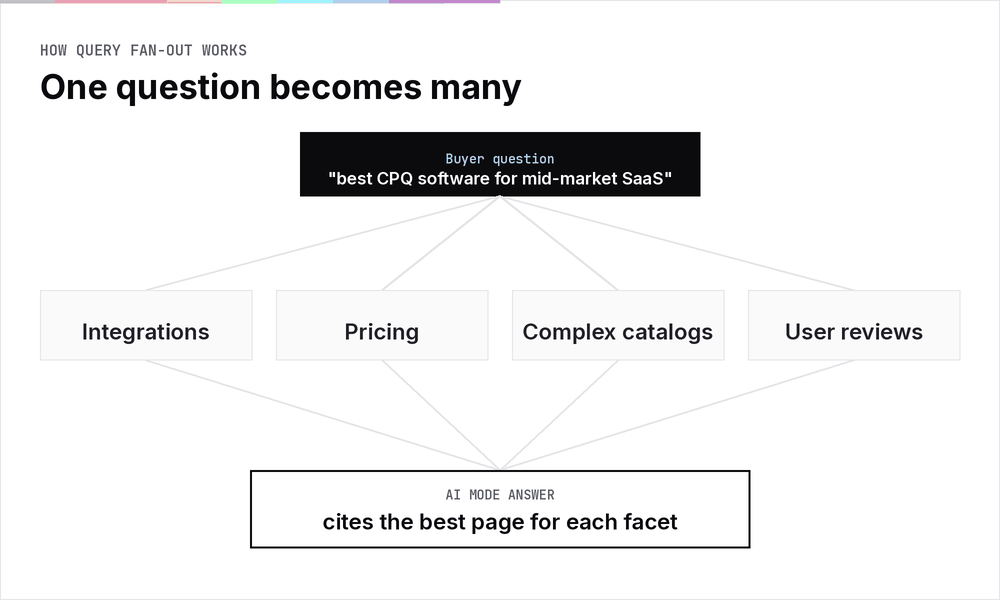
Query fan-out is the technique AI Mode uses to break one question into many sub-queries, run them at the same time, and pull the best sources for each before writing a single answer. Google describes it as "breaking down your question into subtopics and issuing a multitude of queries simultaneously on your behalf."
A query fan-out example: one search, twelve sub-queries
Say a RevOps leader types "best CPQ software for a mid-market SaaS with a complex product catalog." A traditional search matches that string. AI Mode does something else. It fans the question out into a dozen quieter sub-queries running in parallel: CPQ tools for mid-market, CPQ for complex catalogs, CPQ with Salesforce integration, CPQ pricing, user reviews of the top options, implementation time, and so on.
Each sub-query pulls its own set of pages. The answer is then assembled from whichever pages best satisfy each facet. So you're not competing for one ranking. You're competing to be the best answer to a handful of the sub-questions Google invented on the user's behalf. Aleyda Solís put the implication plainly in her original breakdown of the technique.
"You'll need to embrace an 'answer a facet' mentality in your content. For any broad topic you target, you'll need to brainstorm the sub-questions or angles a user might explore, and provide in-depth, focused answers for each subtopic."
Aleyda Solís, founder of Orainti, in her analysis of Google's query fan-out technique.
This is why single-keyword thinking breaks down. Ranking has become probabilistic, not deterministic. Your page is a candidate for many sub-queries at once, and it wins the ones it answers most completely.
What fan-out changes for your content
The practical shift is this. You used to write one page and hope it ranked for one query. Now you want a set of pages that each own a facet, so the model has a reason to pull you in for several of the sub-queries at once. The more facets you answer well, the more often your brand shows up in the final answer, and the more the model treats you as a reliable source for the whole topic. Breadth of coverage and depth per answer both count, and they reinforce each other.
Why B2B SaaS brands go invisible in AI Mode
Across many B2B SaaS campaigns, we see the same four reasons a brand fails to show up, and none of them are about "not ranking."
First, thin topical coverage. A product page and three feature pages can rank fine in classic search, but they answer maybe two of the twelve facets AI Mode fans out. The brand simply isn't a candidate for the other ten.
Second, buried answers. The information is on the page, but it's wrapped in narrative, sat behind a "book a demo" wall, or split across a slide deck. If a passage can't be lifted and understood on its own, it won't be cited.
Third, weak third-party presence. AI Mode leans heavily on what the wider web says about you. If your competitors appear in every "best tools for X" roundup and you don't, the model has more evidence to recommend them.
From the field
One pattern we see repeatedly: a SaaS brand ranks page one for its category keyword, yet never appears in the AI Mode answer for the same topic. When we map the fan-out, the gap is always coverage. The competitors being cited have a cluster of focused pages answering each sub-question. The invisible brand has one strong page trying to do everything.
Fourth, entity confusion. If Google can't cleanly connect your brand name, product, and category, it hedges. Inconsistent naming across your site, your generative engine optimization footprint, and third-party sources makes you a riskier thing to cite. We dug into the mechanics of this in our piece on why your brand isn't showing up in Google AI Overviews, and the same logic carries into AI Mode.
How to optimize for Google AI Mode: a five-part framework
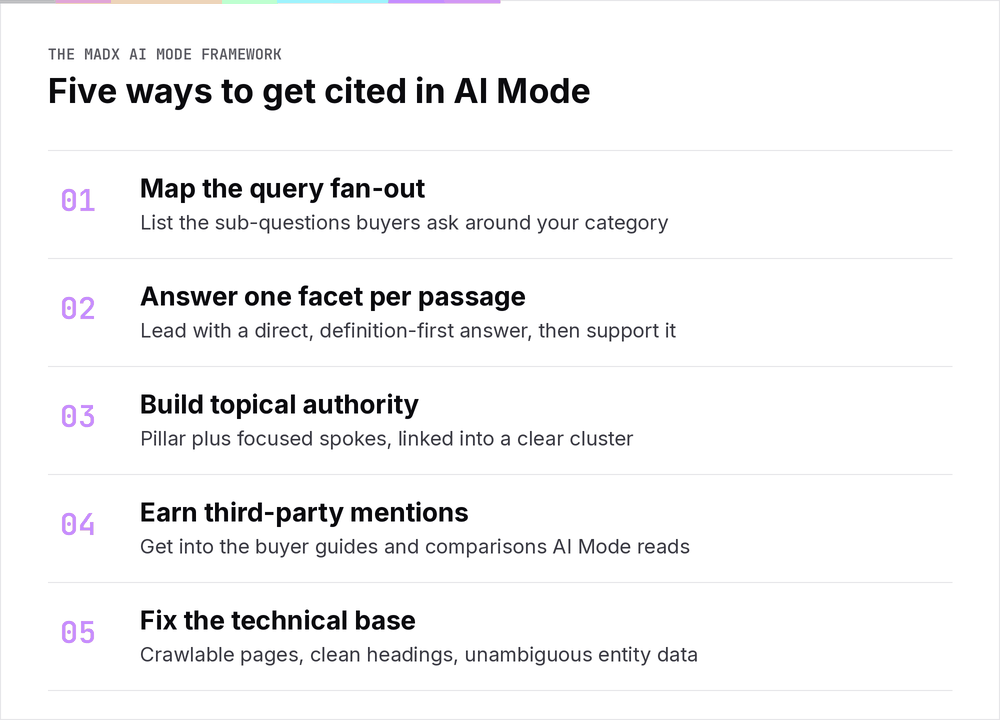
Here's the framework we run. It's built around one idea: give AI Mode more high-quality facets to cite than anyone else in your category.
Mike King of iPullRank calls the new discipline relevance engineering, where visibility is a vector and content is judged not just on what it says, but on how closely it aligns with what Google infers the user meant.
Mike King, founder of iPullRank, on how AI Mode works.
1. Map the query fan-out around your category
Start by reconstructing the sub-questions a buyer explores. Pull "People Also Ask" data, autocomplete, review-site questions, and real sales-call objections. The goal is a facet map: for a category like "customer onboarding software," that's integrations, pricing, security, time-to-value, use cases by team, and comparisons against named competitors. This map becomes your content brief. Our guide to the buyer queries worth tracking is a good starting list.
2. Answer one facet per passage, definition-first
Write so any single passage can stand alone. Lead each section with a direct, definition-first sentence that answers the sub-question in one or two lines, then support it. Short paragraphs. Clear headings phrased as the questions people ask. This is the "answer a facet" mentality in practice, and it's the single highest-impact change most SaaS blogs can make.
3. Build topical authority with clusters
One page can't cover a topic exhaustively, so stop trying to make it. Build a hub-and-spoke cluster: a pillar page for the category, plus focused spokes for each facet, linked semantically. Coverage is what makes you a candidate across the whole fan-out, and it compounds. This is the same muscle that helps you rank across AI search results generally, not just AI Mode.
4. Earn third-party mentions and citations
AI Mode weighs what the rest of the web says about you. Getting into the buyer guides, comparison pages, and "best of" lists that models read is the highest-return work in AI search, and it's the core of what we call Link Building 2.0. When you're the brand named in the independent roundup, you're the brand the model repeats. Google's own guidance backs the direction: in its official advice on succeeding in AI search, the team stresses unique, non-commodity content and consistent brand signals over algorithm-chasing.
5. Fix the technical base
None of this matters if the machine can't read you. Make sure your key pages are crawlable and not JavaScript-gated, use clean heading structure, add Organization and Product structured data so your entity is unambiguous, and keep answers out of gated PDFs. Boring, and non-negotiable. If you want a hand auditing this, our AI search optimization team does exactly this for SaaS teams.
How to measure your visibility in AI Mode
You can't manage what you can't see, and AI Mode is genuinely hard to see. There's no "AI Mode ranking" in Search Console, and refreshing the answer yourself tells you nothing, because it changes per user and per session.
The two metrics that matter: citation rate and share of voice
Citation rate is how often your brand or page appears when your buyer prompts are run. Share of voice is how often you appear compared with named competitors for the same prompts. Rankings tell you where a page sits. These two tell you whether you're in the answer at all, and whether you're winning the topic or watching a rival win it. A growing set of tools tracks both by running your prompts through AI surfaces on a schedule and logging who gets mentioned.
ToolBest forStarting priceAhrefs Brand RadarSEO teams already in Ahrefs wanting AI visibility tied to search data$199/mo per indexSemrush AI ToolkitSentiment, prompts, and competitor tracking across AI platforms$99/mo per domainProfoundEnterprise teams wanting deep, multi-engine coverage~$499/moSE Ranking AI TrackerAgencies wanting AI plus classic rank tracking in one place$65/moOtterlyBudget-conscious teams needing basic mention monitoring$29/moAI visibility tools and indicative entry pricing, as of mid-2026. Check vendors for current plans.
How to run a monthly AI Mode visibility audit
You don't need the priciest option to start. Pick a set of 20 to 30 buyer prompts that map to your facets, from category comparisons to integration and pricing questions. Run them monthly, and track two numbers: how often you appear, and who appears instead of you.
Then read the gaps like a to-do list. If a competitor keeps getting named for "best tool for X" and you don't, that's a facet you haven't covered well enough, or a third-party guide you're missing from. Feed those gaps straight back into your content and mentions plan, then re-run next month to see if the fix landed. That loop, prompt set to gap to content to re-check, is the whole discipline. For a wider view of the category, we keep a running list in our AI search statistics resource.
What AI Mode means for your SEO strategy
The honest headline: fewer people will click your link, and that's fine if you plan for it. Roughly 68% of US Google searches already ended without a click in early 2026, according to SparkToro's clickstream study. When an AI answer is present, the drop is steep. Pew Research found users click a result only 8% of the time when an AI summary appears, versus 15% without one, and click a cited source just 1% of the time.
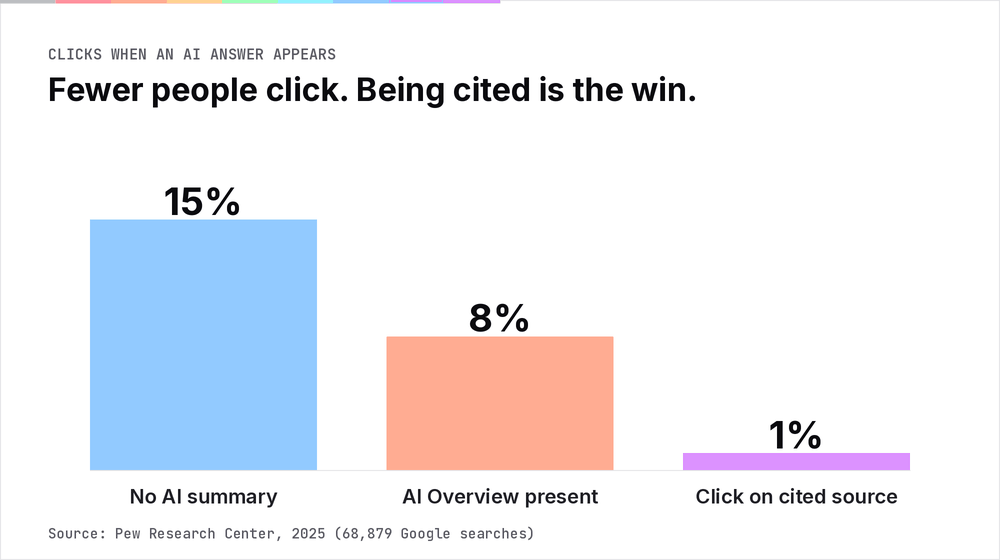
So the goal shifts from "win the click" to "be the recommendation." If AI Mode names your product and describes it accurately, that's brand influence at the exact moment of research, whether or not the user visits your site. Rand Fishkin has been making this case with the data behind it.
Rand Fishkin's read on the 2026 data: SEO alone won't win back lost traffic. Invest in brand awareness and influence on the platforms where your audience already spends time, whether or not that drives a direct visit.
Paraphrased from SparkToro's 2026 zero-click study.
Practically, that means three moves for a B2B SaaS team. Treat topical coverage as the unit of SEO, not the keyword. Invest in being mentioned across the independent web, because that's what AI Mode repeats. And measure brand presence in AI answers alongside rankings and pipeline, not instead of them. None of your classic SEO work is wasted here. Crawlability, strong content, and authority still matter. AI Mode just changes what winning looks like, and rewards the brands that cover a topic like they actually run the category. If you want that mapped for your product, you can book a call with our team.
Frequently asked questions
What is Google AI Mode and how does it work?
Google AI Mode is a conversational, Gemini-powered version of Search that replaces the list of links with a written answer plus cited sources. It works by taking your question, fanning it out into many sub-queries, researching each one across the web at the same time, then synthesising a single answer from the pages that best match each part.
Is Google AI Mode the same as AI Overviews?
No. AI Overviews are summary boxes that appear above normal search results for a single query. AI Mode is a separate, full conversational experience where you ask a question, get a synthesised answer, and keep asking follow-ups. AI Mode uses query fan-out far more aggressively, so it rewards broad topical coverage rather than a single strong page.
How do I rank in Google AI Mode?
You don't rank in the classic sense, you get cited. The reliable way is to map the sub-questions buyers ask around your category, answer each one in a clear, self-contained passage, build a linked cluster of pages for topical authority, and earn mentions in the third-party guides AI Mode reads. Strong technical foundations and consistent brand signals tie it together.
Can Google rank AI-generated content in AI Mode?
Yes, Google judges content on quality and usefulness, not on whether a human or a model wrote it. What gets cited in AI Mode is unique, non-commodity content that answers a specific question well. Mass-produced content that repeats what everyone else says gives the model no reason to pick you over an original source.
How do I measure my brand's visibility in Google AI Mode?
Track citation rate (how often you appear in answers) and share of voice (how often you appear versus competitors) across a fixed set of buyer prompts. Tools like Ahrefs Brand Radar, Semrush AI Toolkit, and Profound run these prompts on a schedule and log the mentions. Start with 20 to 30 prompts run monthly and watch which competitors show up in your place.
Does traditional SEO still matter for AI Mode?
Yes. Crawlability, clear structure, quality content, and domain authority are the same signals AI Mode relies on to choose sources. AI Mode doesn't replace SEO, it raises the bar on topical coverage and brand presence. Teams with a strong SEO base have a head start, they just need to broaden coverage and measure citations, not only rankings.
.png)
Latest articles
What we've published in the past 30 days — across SEO, GEO, content, and digital PR.