.webp)





.webp)
GEO
Calculating...
Oct 2026
Google Preferred Sources in AI Overviews and AI Mode: What Changed (and What Didn't)
Google brought Preferred Sources to AI Overviews and AI Mode in May 2026. Here is what changed, why it is still user-scoped, and what it means for SaaS.

Google's Preferred Sources feature lets a person choose the websites they want to see more of in Search. On 27 May 2026, Google extended it from Top Stories into AI Overviews and AI Mode, so a user's chosen sites can now stand out inside AI answers. The important catch: the effect is user-scoped. It helps you with the people who added you, not with everyone.
What Preferred Sources actually is
Preferred Sources is a personalisation setting. In Search personalization settings, a user opens source preferences, searches for the sites they trust and adds them. From then on, Google shows more from those sites and labels them so they stand out. There is no cap on how many a person can add.
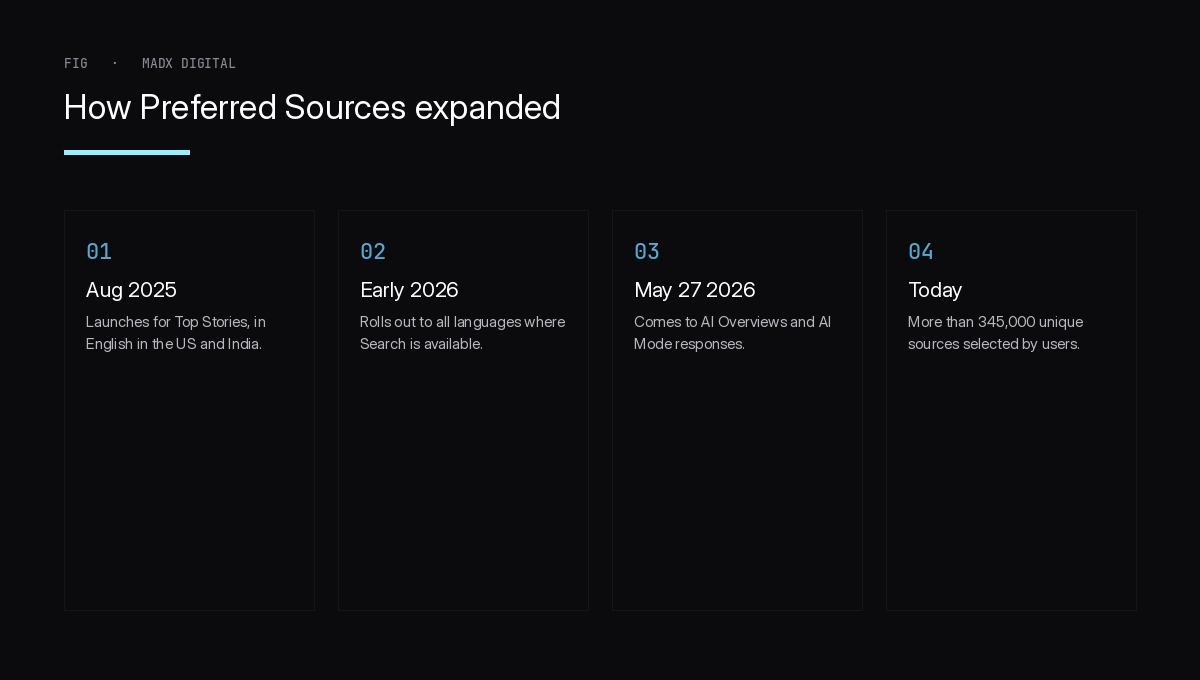
It launched in August 2025 for Top Stories, in English in the US and India, and later expanded to all languages where Search is available. For most of its life it was a news-feed personalisation tool, which is probably how you first came across it.
Who is eligible
Only domain-level and subdomain-level sites are eligible, so example.com and code.example.com qualify but example.com/blog does not. Google also says any website that publishes fresh content can be added. To appear inside the AI features specifically, your site has to be included in Search's generative AI features in Search Console.
What the reader sees
For the user who added you, your links carry a “Preferred” label so they stand out, and in Top Stories a separate “From your sources” block pulls together more of what they picked. The experience is built around recognition: the reader spots the names they already trust faster, wherever those names appear.
What changed in May 2026
The update that matters for AI search landed on 27 May 2026. Google announced it was bringing Preferred Sources into its AI experiences, so chosen sites now stand out inside AI-generated answers, not only in the Top Stories box.
The headline numbers
Google says people have selected more than 345,000 unique sources, and that they are twice as likely to click through to a Preferred Source than to other links. Google did not share how that click figure was measured or whether it controls for intent, so treat the 2x as directional rather than a precise lift.
New carousels, too
The same May update added a prominent link carousel for some searches about developing topics, and Google says it will also highlight your Preferred Sources there, helping timely articles show up on a wider range of queries. A second carousel for firsthand perspectives from forums and social posts is on the way. The adoption curve is steep as well: that 345,000 figure is roughly four times what Google reported at the end of 2025, as the feature went global and publishers began promoting it.
It is Search, not the Gemini app
One precision point worth making to your team. This lives inside Google Search's AI Overviews and AI Mode. AI Mode runs on Gemini models, but Preferred Sources is a Search personalisation setting, and there is no evidence it is a control in the standalone Gemini app. Scope your expectations to Search.
Why it is still user-scoped
Here is the part that your initial read got right, and that has not changed with the AI expansion. Preferred Sources is a personalised signal, not a universal one. Google's own publisher documentation is explicit about where the effect applies.
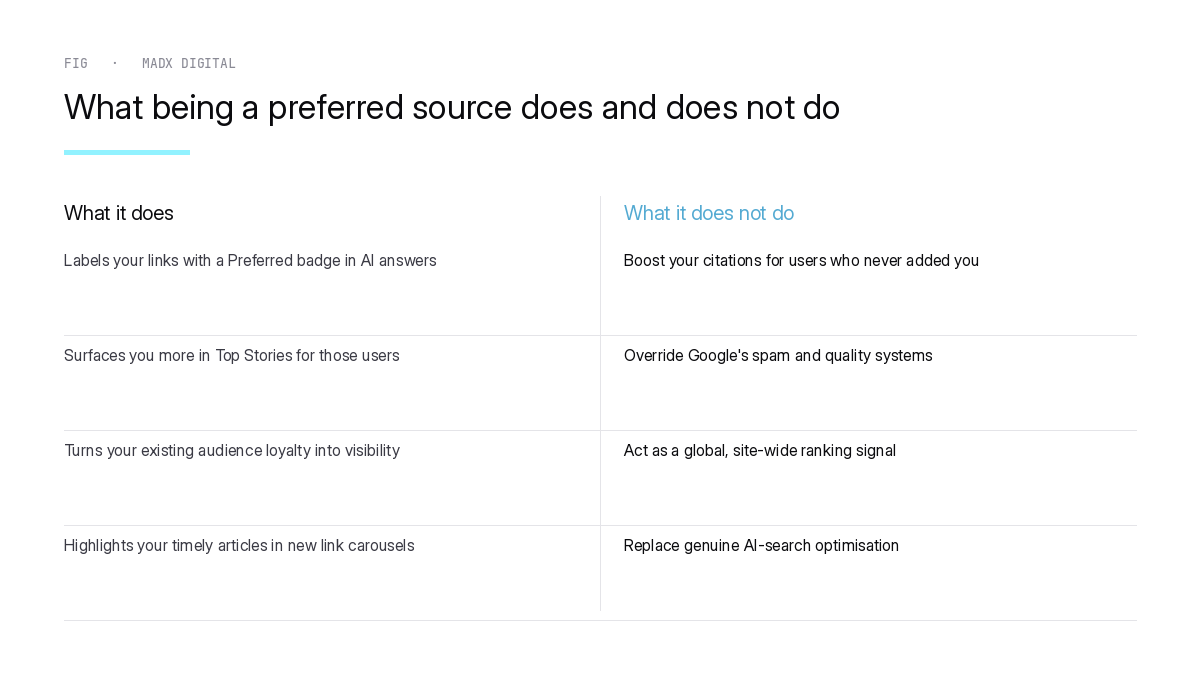
Read that carefully: the highlighting is for users who have selected your site. If someone has never added you, being a thousand other people's preferred source does nothing for their AI answer. It amplifies reach with the audience you already have, and is invisible to everyone else.
It does not override quality
It is also not a way around Google's ranking systems. Google's John Mueller clarified that Preferred Sources works alongside ranking rather than overriding it, so a site that trips Google's spam or quality filters cannot use the preference to force its way in. The signal sits on top of quality, it does not replace it.
Why Google built it this way
This design is deliberate. Google is giving users a way to shape their own results without handing publishers a new lever to rank for everyone. For a reader it is control; for a publisher it is a reward for loyalty, not a ranking hack. Understanding that distinction is what stops teams from over-investing in it or misreporting what it did.
What it means for your B2B SaaS
For a B2B SaaS brand, this is a real but bounded opportunity. It is best understood as an audience-loyalty lever, not an AI-visibility strategy on its own.
Where to ask, and what to say
The play is simple. Put the ask in the places your audience already pays attention, and frame it as a way for them to see more of you. Use the official button where you can embed it, and the deeplink everywhere else.
Use case: new visitors and customers
When a first-time reader or a fresh customer adds you, you stop being a one-off visit. You resurface as a labelled, trusted reference in their future searches on your topic, including the AI answers they see, long after they have left your site. It is a low-friction way to turn a single visit into recurring visibility with that person.
Use case: existing customers
For customers you already have, it is a retention and mindshare play. Every time they research something in your category, your name shows up with a Preferred label, which keeps you top of mind and quietly reinforces that they chose well. In a crowded category, being the familiar, flagged option in your customer's own results is worth more than another nurture email.
The effort is genuinely small. The official button is two lines of HTML, the deeplink is a single URL with your domain, and both drop neatly into a newsletter footer, a thank-you page, or your docs. For a brand that already sends email or runs a community, this is an afternoon of work, not a project.
Do not do this
Do not treat it as a substitute for being genuinely recommendable to AI. Getting cited for buyers who have never heard of you is a different job, and it still runs through clear content, structured facts and third-party evidence. That is the work we cover in agentic SEO and in our guide to getting recommended by AI.
Measure the right thing
Preferred Sources will not show up as a blanket ranking gain, so do not expect it to. Track it where it acts: referral and engagement from your own audience, and your presence on the buyer prompts that matter, which we cover in ranking in AI search and measuring AI search visibility. If you want a baseline of where you stand with AI today, a free AI search audit is the fastest way to see it.
The honest verdict
Preferred Sources moving into AI Overviews and AI Mode is a genuine shift, and it is worth a few hours to set up if you have an audience to activate. But your original instinct holds. It is user-scoped personalisation, not a global citation cheat code, and it rewards brands that already earn attention rather than replacing the work of earning it.
Frequently asked questions
Does being a Google Preferred Source make AI cite me more?
Only for users who added you. Google's documentation says your content can be highlighted with a “preferred” badge in AI Overviews and AI Mode for users who have selected your site. It does nothing for people who have not added you, so it is not a global citation boost.
Is Preferred Sources a ranking factor?
Not a universal one. It is a personalised signal that amplifies reach with your existing audience. Google's John Mueller clarified it works alongside ranking systems rather than overriding them, so it cannot push past Google's spam or quality filters.
Does Preferred Sources work in the Gemini app?
There is no evidence it does. The feature lives in Google Search's AI Overviews and AI Mode. AI Mode runs on Gemini models, but Preferred Sources is a Search personalisation setting, not a control in the standalone Gemini app.
How do I let readers add my site as a preferred source?
If your site appears in Google's source preferences tool, add the official JavaScript button (two lines of HTML) or a deeplink to your pages, newsletter and social posts. Only domain and subdomain level sites are eligible, and to appear in the AI features your site must be included in Search's generative AI features.
Is this worth doing for a B2B SaaS brand?
Yes, if you have an audience to ask. It turns existing loyalty into a visible edge in the AI answers your readers and customers see. It is not a replacement for genuine AI-search optimisation, which is what gets you in front of buyers who have never heard of you.
.png)
Latest articles
What we've published in the past 30 days — across SEO, GEO, content, and digital PR.